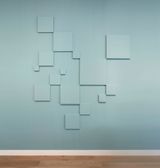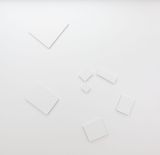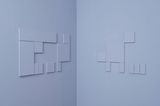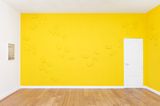
Perrotin is pleased to present an exhibition at 2bis Avenue Matignon dedicated toclaude rutault, who passed away in 2022. Theexhibition features six definitions/methods (dm) actualisedaccording to the artist’s instructions, including the first and lastwork from his book de-finitions/methods 1973–2016.
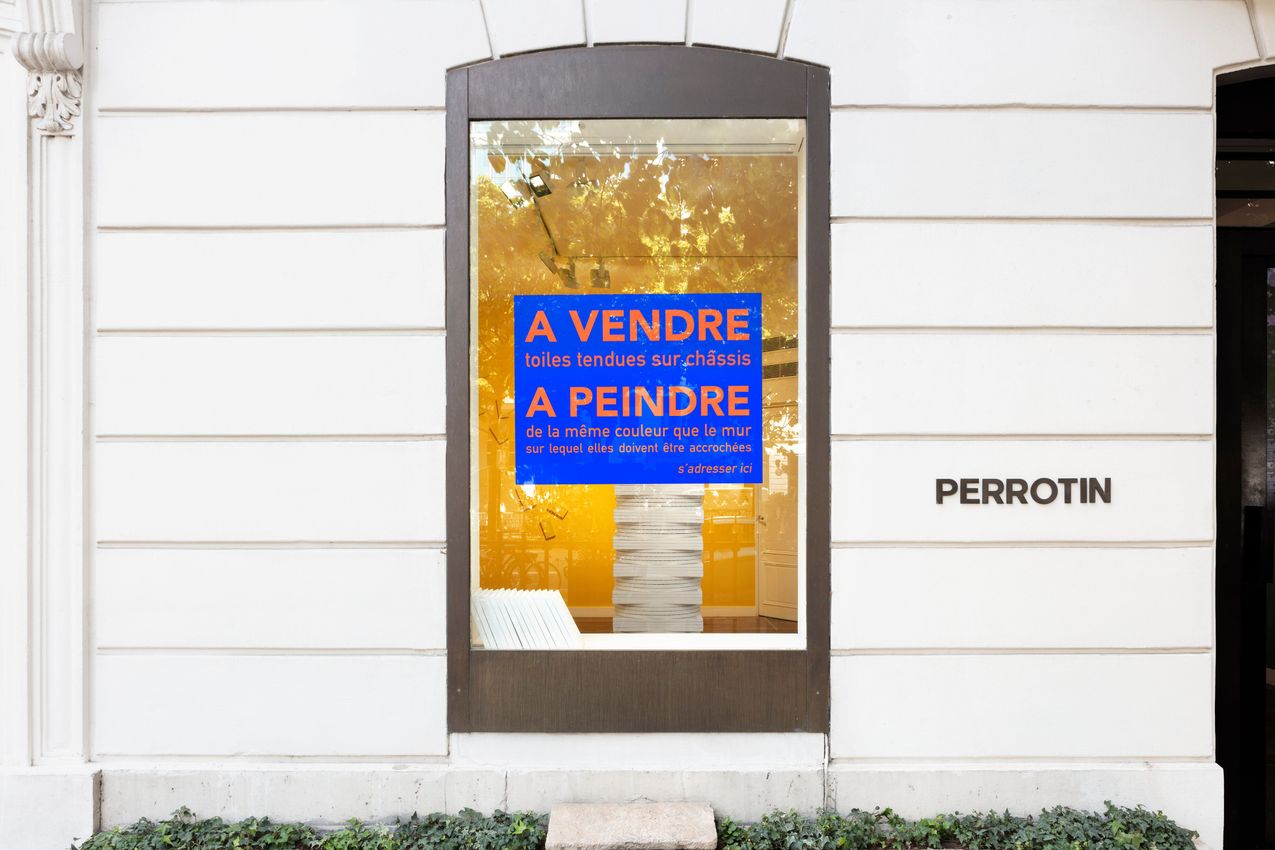
The window at the gallery entrance features à vendre toiles apeindre, a humorous and caustic reflection on the commercialcodes of the art world, and an allusion to the exhibition titlewhich derives from a joke in the artist’s family: ici mieux qu’enface (‘better here than over there’). To claude rutault, thisexpression seemed the perfect argument for selling all kinds ofobjects.
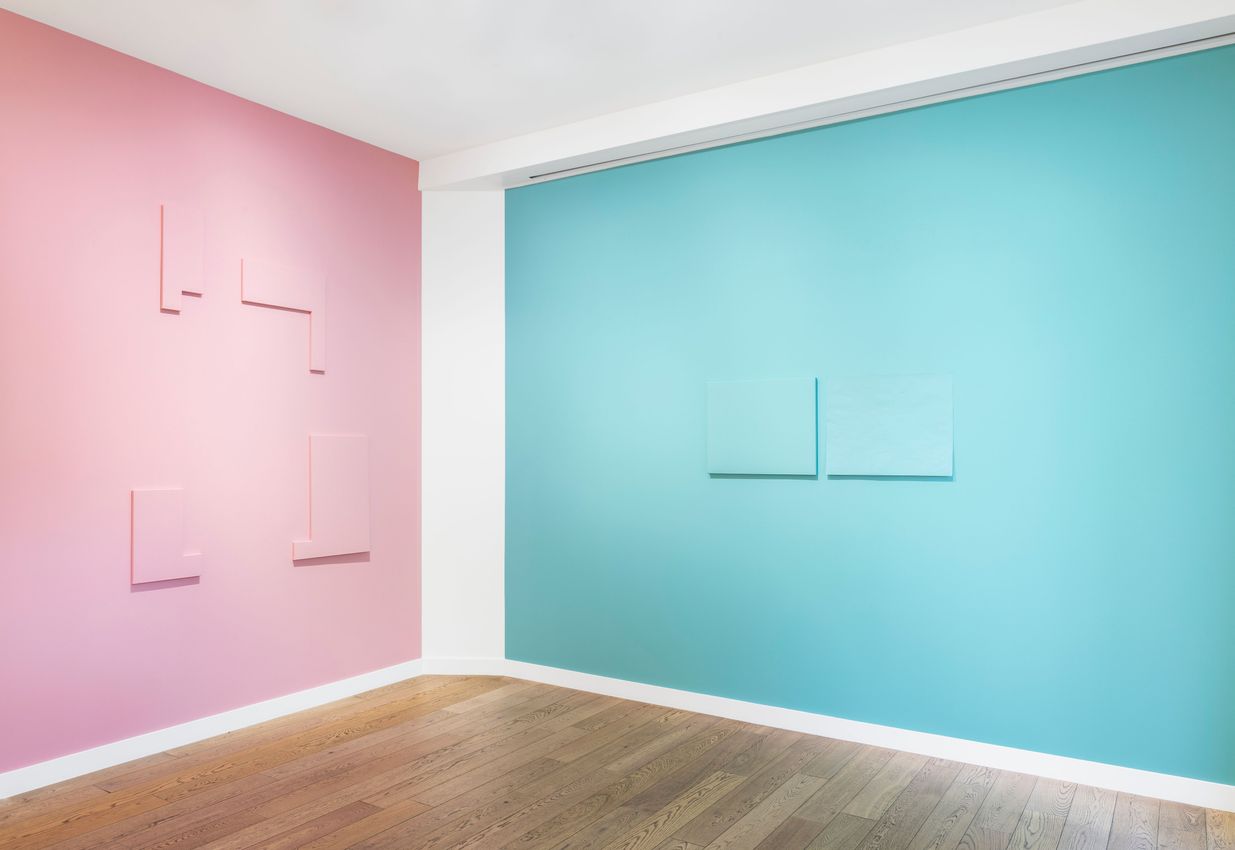
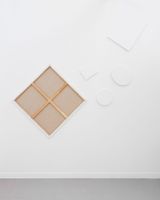
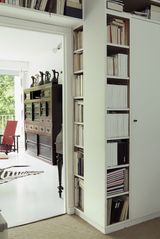
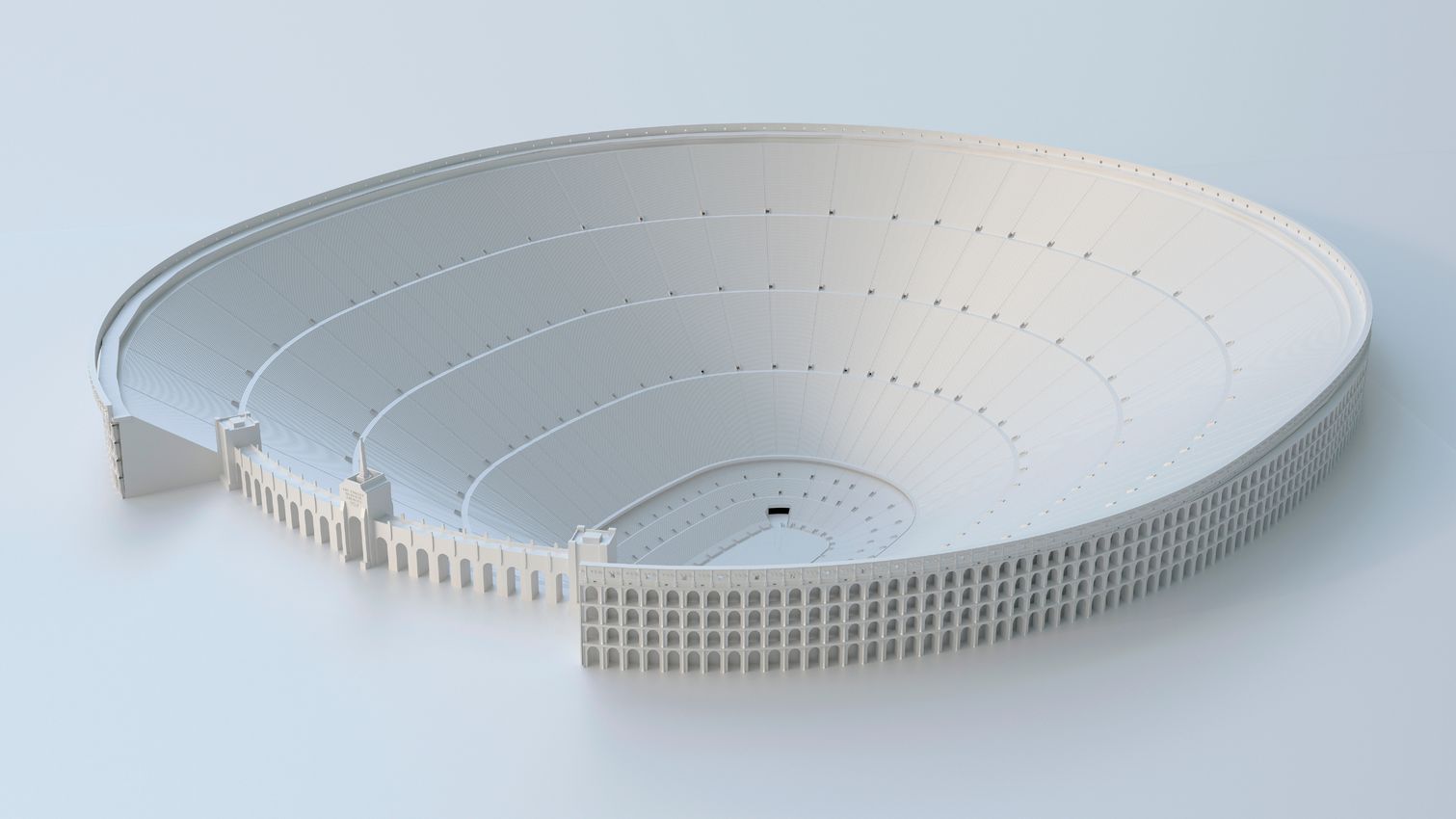
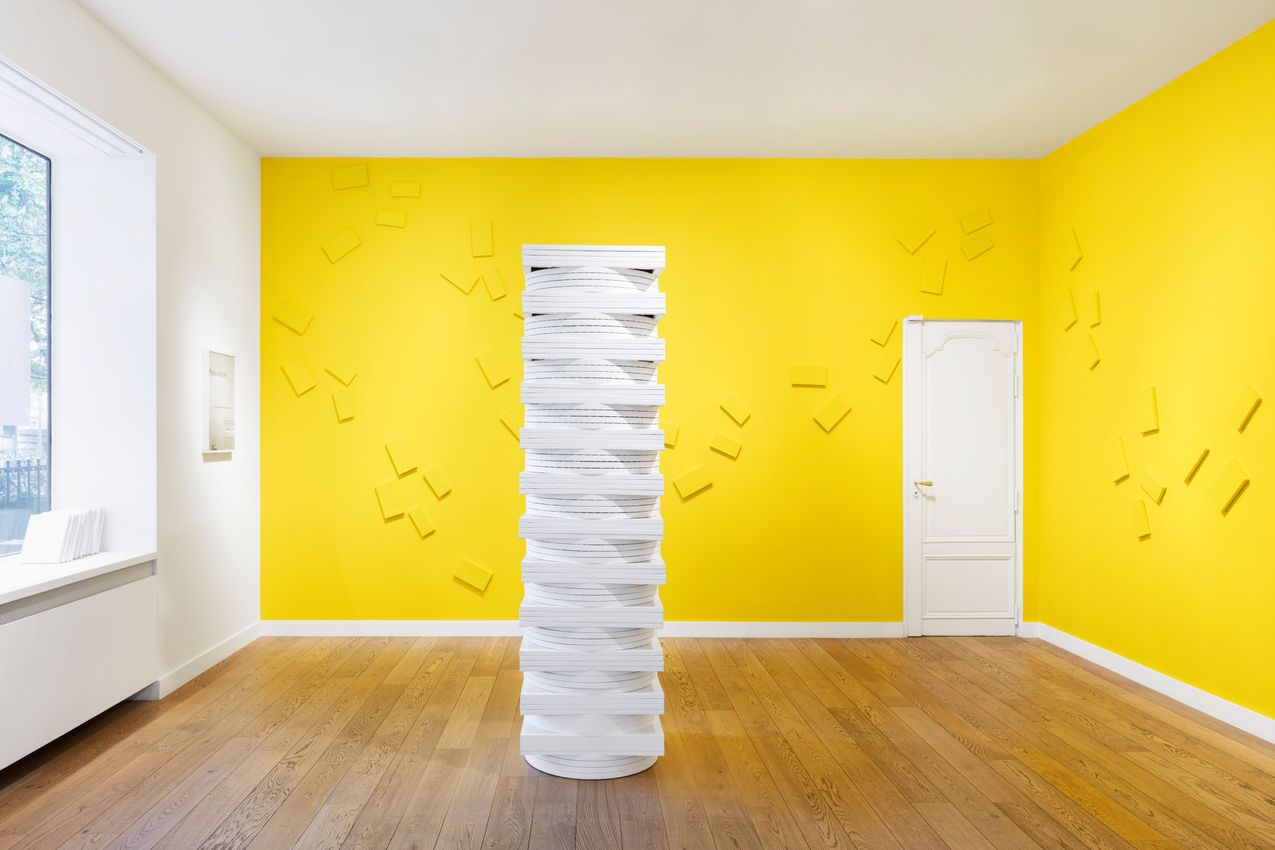
Inside the gallery, a diptych painted the colour of the wall (dm 1peinture à l’unité , 2013) spells out the artist’s vocabulary, furtherdeveloped in the horizontal and vertical alignments of thecanvases dépendance et indépendance limite 3 (1974). A columnmade of piles of canvases_nicolas ledoux memoire_ (2012) and ahumorous evocation of a paso-doble dance duet (1995) complete the gallery space.
Finally, the triangular painting format limite 4 (1974), to be actualised by 3 people, brings the social implications of Rutault’swork to the fore; they are pushed to the extreme with AMZ (2016), a mobile world-work with more than 100 participants,evolving according to the time and location of the paintings,represented here by a rectangular painting outlining an absence.
Four prestigious museums are currently paying the artist anexceptional homage. The Musée d’Orsay is showing la porte dela peinture, a work inspired by Auguste Rodin’s La Porte de l’En-fer, while the Musée du Louvre is exhibiting a work by Rutaultbased on a Fayum painting. The National Museum of ModernArt, Centre Pompidou, is displaying ready to be made, actualisedwith Marcel Duchamp’s Bottle Rack. The Musée d’Art Modernede Paris, finally, is taking part in this homage by adding a workfrom their collection to the permanent exhibition.
‘If there is a biography, it is not mine. It is that of the charge-takers,since the writing of the painting allows me to withdraw from the scene.’ claude rutault, la peinture fait des vagues, Musée des Beaux-Arts, Brest, 2007
In 1973 in Paris, claude rutault painted his kitchen.He placed two mounted canvases on the floor, one of which he paintedwith a roller, before hanging it on the wall. The canvas and the wall nowhad the same colour: a breakthrough. From this act, whose simplicity isalmost tautological, claude rutault would create a significant body ofwork that despite being written as much as painted (by him and others)would revolutionise the history and practice of painting.
This gesture gave rise to a set of written instructions which he called–with the efficiency and radical economy of a founding act–definitions/ methods (or d/m), specifying the method for creating and positioninga work: painted, repainted and de-painted canvases, piles of canvases,dialogues with other works (most often from the history of art), spatialarrangements, a work’s appearance, disappearance, etc. The first d/m(subtitled toile à l’unité) begins thus: ‘a canvas stretched on a frame andpainted the same color as the wall on which it hangs’. Until his death inMay 2022, he would continually expand, develop, and elaborate this initial statement–not without humour–ultimately creating 657 more.
The exhibition presents an exhaustive overview of this body of work–from the first d/m (toile à l’unité) to the last (AMZ) – allowing us to graspit in all its dimensions.
Considering that his raw material was the writing of instructions, clauderutault must be seen not only as a painter but as a writer. He wrote several books that sometimes resemble fiction and was close to the writersassociated with the Nouveau roman and the generation of authors whodeconstructed poetic form in the 1970s, 80s, and 90s using narrativecontinuum and continuous pagination across several works, unusualpunctuation and capitalisation, serial writing, and playful page layouts.Although claude rutault frequently claimed ‘I am a painter’–mainly toescape the label of conceptual artist and inscribe his work in a certainpainterly tradition–, he is in fact more of a formalist author, his variousbooks interrogating the possibilities and meaning of painting, sculpture,and colour. He also sought to engage in a dialogue with other artists,irrespective of period and technique, from the Fayum mummy portraitists to Poussin, Dürer, Picasso, Rodin, and Eugène Leroy.
By exhibiting what seems like nothing more than a set of painted orunpainted canvases, coloured sheets of paper, piles of canvases ofvarying heights placed opposite one another, and works from the his-tory of art, claude rutault belongs to a long tradition of painting thatquestions the very status of representation–it would, in fact, be illuminating to read his work from a phenomenological perspective.
The radicality of the instructions and issues presented by claude rutaultmight seem austere. Yet on closer look, his work is also joyful and funny.But its defining characteristic, resulting from its unique method andendless adaptability, from its writing to its creation, is freedom.
Once written down, the de-finitions / methods can be actualised at anytime, sometimes several times and within a variable timeframe, allowingseveral people (claude rutault himself or so-called ‘charge-takers’ likecollectors, museum staff, and other artists) to use or even develop theinstructions. Thus, some works remain on the wall or the floor wherethey first appeared for a long time, only to disappear and reappear in thesame place or elsewhere; unless their development is suspended dueto external circumstances, such as the death of the collector or theartist, or as a result of the latter’s clever calculation.
Most of the de-finitions/methods play with time: the instructions includeschedules of varying specificity. But as they are updated or re-actualised by charge-takers they also form part of a continuum. clauderutault’s work brings about a conceptual and artistic revolution becauseit is in constant motion: it can be painted, repainted, repositioned, andreconditioned. Always active, always alive, always concurrent with themoment of its actualisation, it occurs in the present tense–the presentprogressive. Unlike a painting or sculpture in a museum or the home ofan art lover, Rutault’s art evolves: making it, remaking it, and repaintingit is the very condition of its integrity. It does not belong to the categoryof finished objects: once a de-finition/method is realised, it rarely staysthe same and the agent of change is not necessarily the same at eachstage of its development. In the end, the main question is: who, following the artist’s death, is at work in claude rutault’s oeuvre?
As Rutault writes, it is ‘a painting to live’ which through its endlesslyrenewable gesture of generosity gives those who seize it great responsibility, triggering inexhaustible discussions on the status and thepresence of the work: what is the role of the charge-taker, the painter,the one who paints the canvas and the wall? In short, Rutault blurs thelines of social interaction: artist, patron, collector, the work requires thateach one, in turn, occupies the place of the other. The traditional usevalue of the work of art is made redundant.
Presenting the first and the last de-finitions/methods, the exhibitionshows how Rutault constantly increased the scope of the artistic act aswell as the responsibility of those who take charge of the work. Since1973, d/m 1 has been reworked twice more by its author, from Toile àl’unité to Tableau à l’unité to peinture à l’unité, showing that nothing isfixed, that the work continues to evolve. It is therefore no surprise thatAMZ, the last d/m to be published, offers the most freedom and themost responsibility. claude rutault writes: ‘For a long time now, the textshave contained the right to make proposals, as well as a right to correction and the possibility to repent.’_AMZ _must now be seen as a key definition/method as it opens up an unlimited field of possibilities, wideningthe field of action, always in motion. Thus, apart from the personal anecdote that gives the exhibition its title, the formula ‘Better here than overthere’ is also a way to understand claude rutault’s work: a round trip thatforces you to come back to the point of departure, but having seen whatwas in front of you, providing a point of view of the place where youstarted. A pendular movement in space and time. Life as a continualre-actualisation, always evolving, never fixed.
’ so as not to come to an end,
my painting does not stop with me,
quite the opposite, it begins the moment I leave, my goal is to provide away of painting that continues beyond myself as well as beyond my proposals, some will have to be revisited when the conditions change,unless they no longer mean anything, the paintings have to evolve,continue to be corrected without delay, adapt to remain alive, to be dis-covered, covered, begun again, pursued, continued. a painting full ofrisks (dé-finitions/méthodes 1973 – 2016, Mamco éditions, p. 2231.) ’
Press release courtesy Perrotin. Text: Alexandre Mare.
Claude Rutault describes himself as a painter; and indeed, viewing any one of his pieces is uncontroversially an encounter with paint on canvas. Rutault, however, does not paint his pieces himself; and neither is he in the business of overseeing their production on the model of a producer, designer, or director running a factory, studio, or workshop. Instead, the mainspring of Rutault’s practice is the writing and issuing of a set of rules, caveats, instructions and procedures called ‘de-finition/methods,’ according to which a gallery, collector, or institution—known as the ‘charge-taker’—agrees to ‘actualise’ a given work.


Emmanuel Perrotin founded his first gallery in 1989 at the age of 21. He has opened since then over 17 different spaces, with the aim of continuing to offer increasingly vibrant and creative environments to experience artists work. He has worked closely with his roster of artists, some since more than 25 years, to help fulfil their ambitious dreams and projects.

A respected voice in contemporary art discourse.
Focusing on ambitious storytelling and insightful art-world commentary. Ocula Magazine publishes in-depth interviews, critical essays and timely analysis on the artists, exhibitions and ideas driving the global art world.
Learn more about Ocula Magazine
Showcasing the best of the art world.
Ocula partners with galleries from around the world to highlight their artists, artworks and exhibitions. Gallery membership is by application and invitation, with each member vetted by an independent panel.
Learn more about Ocula Membership

Specialises in the sale of major artworks.
Led by a team with deep ties to the world’s leading auction houses, galleries and collectors. Ocula’s advisory team offers bespoke services to high-net-worth clients from around the world who are looking to acquire the best of contemporary and modern art.
Learn more about our team and services