Press Release

Born in 1896 in Sainte-Croix, Switzerland, Gérard Schneider grew up in Neuchâtel, where he was surrounded by art from an early age–his father was a cabinetmaker and antique dealer. He quicklydeveloped a keen interest in mastering classical techniques aswell as a great appetite for discovery. His artistic training began atthe age of twenty when he went to Paris to study at the NationalSchool of Decorative Arts, before moving to the National School ofFine Arts in 1918 to work under Fernand Cormon who had taughtmany masters of modern art such as Vincent van Gogh and Henride Toulouse-Lautrec. Schneider settled permanently in Paris in1922, devoting the following years to the study of art techniquesand art history.

In 1926, he exhibited for the first time at the Salon d’Automne, where his submission, L’Allée hippique, was well received. In addition to hisactivities as a painter and restorer of artworks, he frequented the Parisian music scene. At the Salon des Surindépendants of 1936, he exhibited five paintings –including Figures dans un Jardin–praised by acritic of La Revue Moderne for their ‘style and figures of such agility thatthe expression of movement seems to be contained in the rapidbrushstroke’.In the 1930s, Schneider began to embrace the abstract revolutions initiated by Cézanne and Kandinsky while never renouncing the influenceof the great masters such as Goya, Delacroix, Fragonard, and others. Atthe same time, the avant-garde introduced him to new possibilities. Nolonger painting from nature, he started writing poetry and mingling withSurrealists like Luis Fernandez, Oscar Dominguez, Paul Éluard, VictorBrauner, and Georges Hugnet. From 1938 onwards, the titles of hisworks stopped referring to the real world: the three works he submittedto the Salon des Surindépendants that year were entitled Composition.By 1944, his work had completely abandoned any reference to reality.

In the immediate post-war period, Schneider played a central role in the birth of Lyrical Abstraction. This new, radical movement triggered amajor aesthetic upheaval in post-war Europe, profoundly marking thehistory of 20th-century art.

‘It is necessary to reach transcendence, to go beyond oneself, to go beyond nature, to go beyond the object in order to create a work that is original and autonomous, whose subject comes from interiority and not from representation, without figurative allusion.’ Gérard Schneider, ca. 1948

The so-called ‘Second School of Paris’ included artists such as Jean-Michel Atlan, André Lanskoy, Georges Mathieu, Serge Poliakoff, and aboveall Hans Hartung and Pierre Soulages–with whom Schneider maintainedclose friendships. From the mid-1940s onwards, the Lyrical Abstractionists were exhibited in the Paris galleries of Lydia Conti, Denise René, andColette Allendy, before reaching a wider audience abroad (in Europe andthen throughout the world) at the end of the decade. Two notable examples were the exhibitions Wanderausstellung Französischer AbstrakterMalerei in Germany, from 1948 to 1949, and Advancing French Art,shown in several museums in the United States between 1951 and1952.

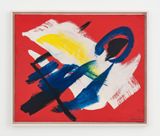
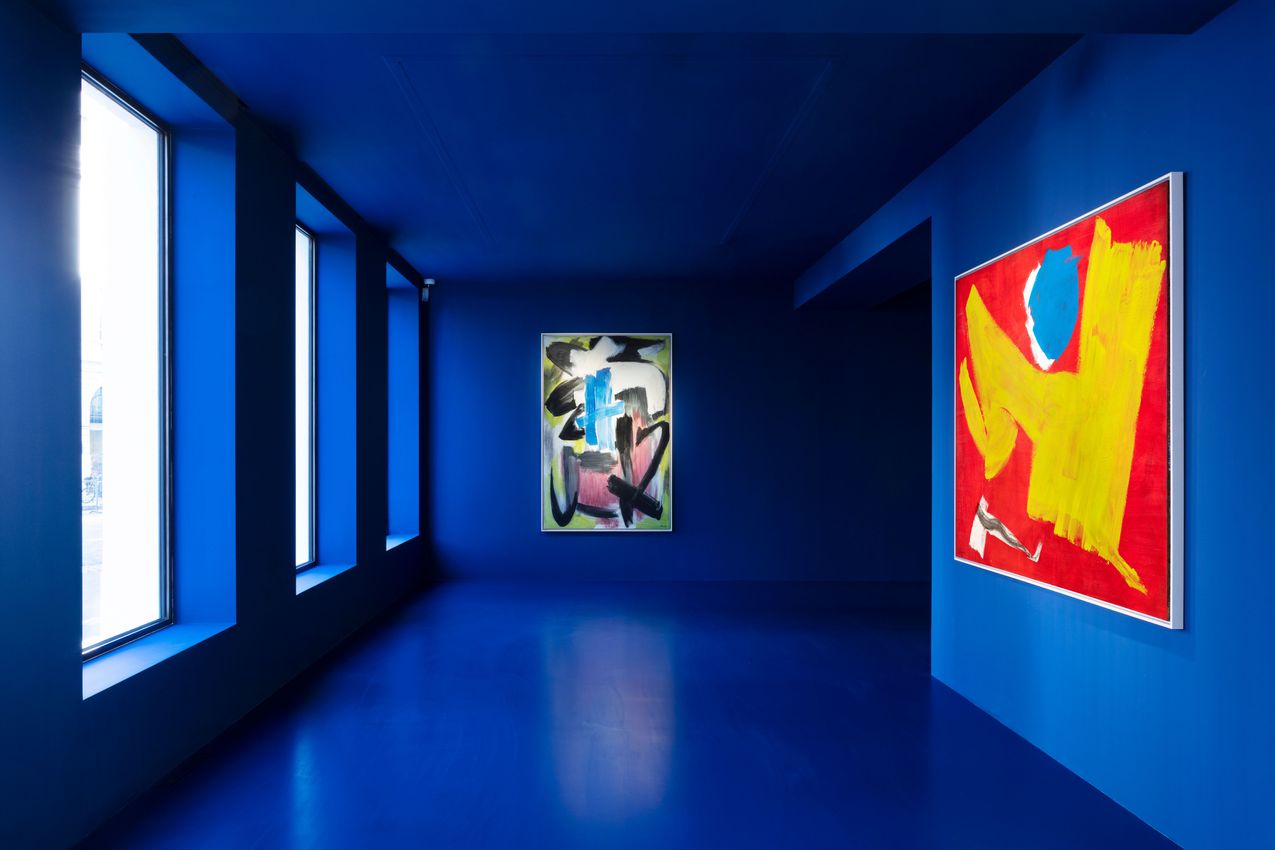
For Schneider, it marked the beginning of a new period, during which he abandoned form to express interiority, ardor, and passion, striving for theabsolute and the universal. For him, the best way to achieve this wasthrough gesture, derived from the automatic writing of the Surrealists, onthe one hand, and Far Eastern calligraphy, on the other. This was one ofthe reasons why his work was so warmly received in Japan. Schneiderliked to recall ‘these wonderful words’ from a Tibetan wisdom book: ‘Andabove Thought, there is the God of Gesture, for gesture unites body andmind.’

From 1955 to 1961, Schneider was represented in the United States by the Samuel Kootz Gallery in New York, which also represented Pierre Sou-lages and Georges Mathieu, and exhibited his works on several occasions.

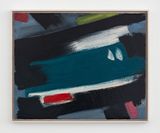
“As for colour... it appears in Schneider’s recent works with ever greater freedom, as the quintessential factor of life, even when this colour is black, whichSchneider uses with the mastery of someone who knows how emotionallycharged every shades of night and darkness is. The answer that thesepaintings find in the viewer’s heart and mind–clearly delighted–achievethe communion that had previously been established between artist andartwork, form and space, structure and motion.’ Marcel Brion, member ofthe Académie Française, Foreword, Exhibition Catalog, Kootz Gallery, NewYork, 1958

The first two retrospectives of his work took place in Brussels (1953) and in Düsseldorf (1962) respectively. He also participated in the first two edi-tions of Documenta in Kassel, in 1955 and 1959. One should also mention he exhibited three times at the Venice Biennale –in 1948, 1954, and1966. In 1966, an entire room of the French Pavilion was dedicated to hiswork. Confirming his role as a major artist on the international scene, Schneider also participated several times in the São Paulo Biennale: in 1951,1953, and 1961. At the initiative of Jean Cassou, then the chief curator ofthe Musée national d’art moderne de Paris, Schneider exhibited tenlarge-format works, including four canvases measuring two by threemeters, at the 1961 edition.

During the 1960s, Schneider’s close ties with Milanese art dealer Bruno Lorenzelli brought him greater recognition in Italy, culminating in a majorretrospective at the Galleria Civica d’Arte Moderna in Turin in 1970, fea-turing 100 paintings.

From the mid-1960s, Schneider’s painting acquired an additional dimension: colour as an autonomous element. Previously, Schneider’sabstraction had previously embraced form and gesture as vectors ofinner expression. As colour and gesture had now definitively become calligraphic, his works gained a new freedom and accessibility. GérardSchneider’s oeuvre challenged itself and echoed both the aestheticaspirations of his time and a complex inner process, established as earlyas the 1930s.

‘A painting is an organized whole, a set of relations between forms, lines, and colored surfaces on which the meanings that one attributesto it are made or unmade’. Gérard Schneider, Entretiens sur l’Art abs-trait, Pierre Cailler, 1964

At the beginning of the 1980s, large-format paper offered him the ideal medium to formalise and materialise this synthesis of form, colour, andspace. Ardor and passion, speed of execution, a completely liberatedand spacious gesture... This led to the creation of large, luminouslycolourful compositions, fiery and resolutely lyrical.

Gérard Schneider died on July 8, 1986, at the age of 90.

‘The work of Gérard Schneider epitomised Lyrical Abstraction, in the same way that Picasso epitomised cubism.’ Michel Ragon, Schneider,Expressions contemporaines, 1998

Press release courtesy Perrotin. Text: Christian Demare.

Read More

Installation Views

About the Artist

Swiss born, Gérard Schneider (1896-1986) enrolled in the École nationale des arts décoratifs and the École nationale des beaux-arts de Paris before settling permanently in France. Throughout the mid-1930s, Gérard Schneider incorporated into his work Kandinsky’s revolutionary abstraction while writing poems and exploring the new horizons opened by Surrealism. In the excitement of the immediate post-war period, Gérard Schneider’s painting plays a key role in the rise of a new and radical form of art: Lyrical Abstraction. His gesture is raw and vibrant, physical and unrestrained. Deeply inspired by music, his brushstrokes reflect his intention to translate pure emotion into painting. Gérard Schneider befriended George Mathieu, Hans Hartung and Pierre Soulages, whose work also took an international dimension. Starting from the mid-1940s, major exhibitions featuring the main figures of lyrical abstraction take place in Paris, in Germany and then in the United States, especially on the occasion of the major travelling exhibition ‘Advancing French Art’ which travelled all over the country—notably to the San Francisco Museum of Modern Art, the Philipps Collection in Washington, the Art Institute of Chicago, after which Samuel Kootz Gallery represented him in New York. During the 1950s-1960s, Gérard Schneider exhibited across several continents where he would be invited for major institutional retrospectives and Biennials. Gérard Schneider kept painting until his death in 1986, at the age of 90.

View Artist Profile

Also Exhibiting at Perrotin

About the Gallery

Emmanuel Perrotin founded his first gallery in 1989 at the age of 21. He has opened since then over 17 different spaces, with the aim of continuing to offer increasingly vibrant and creative environments to experience artists work. He has worked closely with his roster of artists, some since more than 25 years, to help fulfil their ambitious dreams and projects.

View Gallery Profile
Address
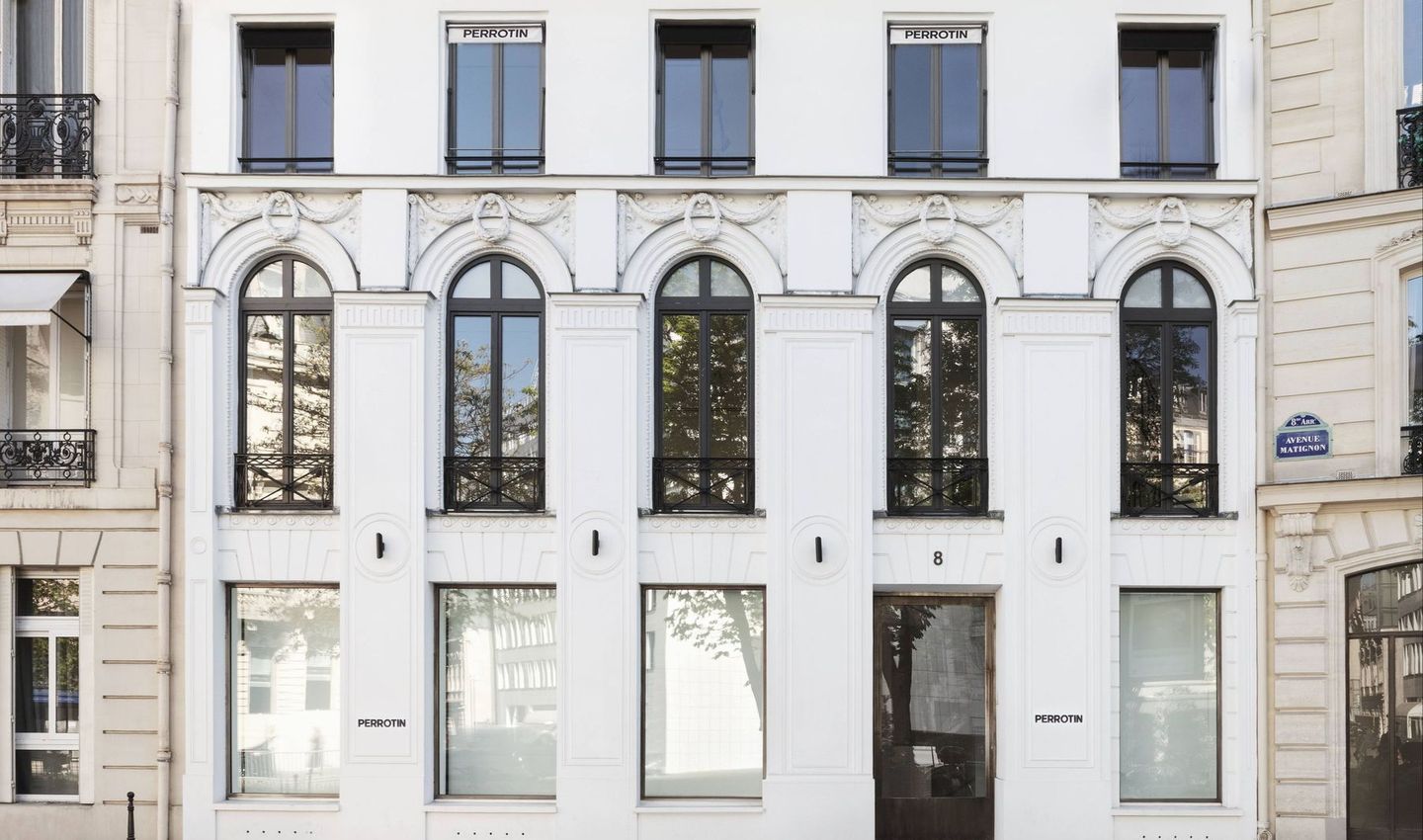
8 Avenue Matignon

8 Avenue Matignon
75008
Paris

(1)
Paris 76 rue de Turenne
Perrotin
76 rue de Turenne, Paris, France
+33 1 42 16 79 79
http://www.perrotin.com

Opening hours
Tuesday – Saturday
10am – 6pm
The art world in focus