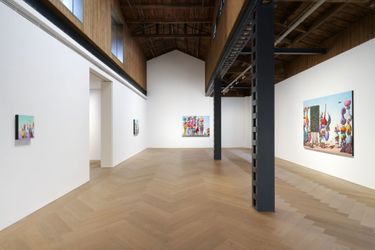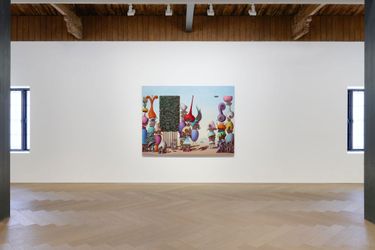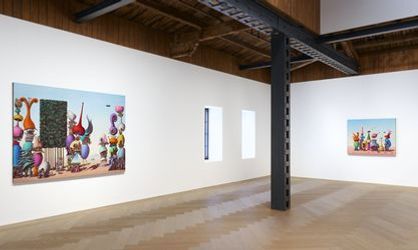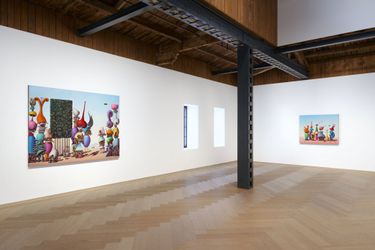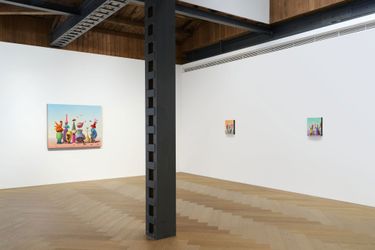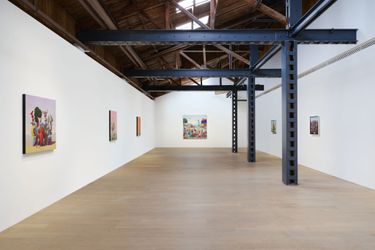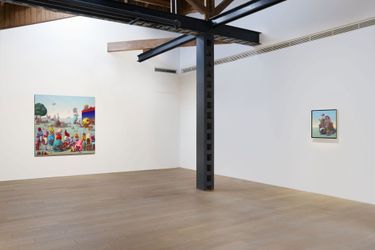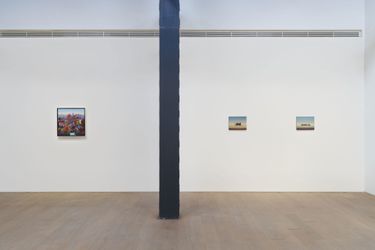




Perrotin Shanghai is pleased to present New World, a solo exhibition by Chinese artist Wang Fanseng, marking his first collaboration with the gallery.
The exhibition surveys Wang’s painting practice from 2008 to the present. From early reconfigurations of Chinese landscape painting through lush reimagining and subtle pastiche, to later works that turn toward invented forms and historical references, he methodically forges connections between the profane and the sacred. His canvases stage a convergence of nature, the human condition, and metaphysical space, articulating an artistic doctrine defined by composure and capaciousness.
Beyond serving as an invaluable archive of imagination, Wang’s work reads as a philosophical treatise on the structure of the world. Beginning with the landscape series “Records of Qixie Mountains,” the artist seeks to revive a landscape lineage that predates literati codification. In the “Zhiguai” series, abundant forms, fantastical allegories, and eccentric symbolism produce a disquieting richness. In early Chinese historiography, the anomalous is not opposed to truth, and zhiguai, or the accounts of the strange, are granted historical legitimacy. Such a cosmology—one that imagines the world as an indivisible totality—finds precedent in the pre-Qin Classic of Mountains and Seas, where deities, creatures, and terrains coalesce into a unified supernatural continuum. The mystical and the topographical together structure the world: geography is grasped through zhiguai, and it in turn provides the matrix through which the world is conceived.
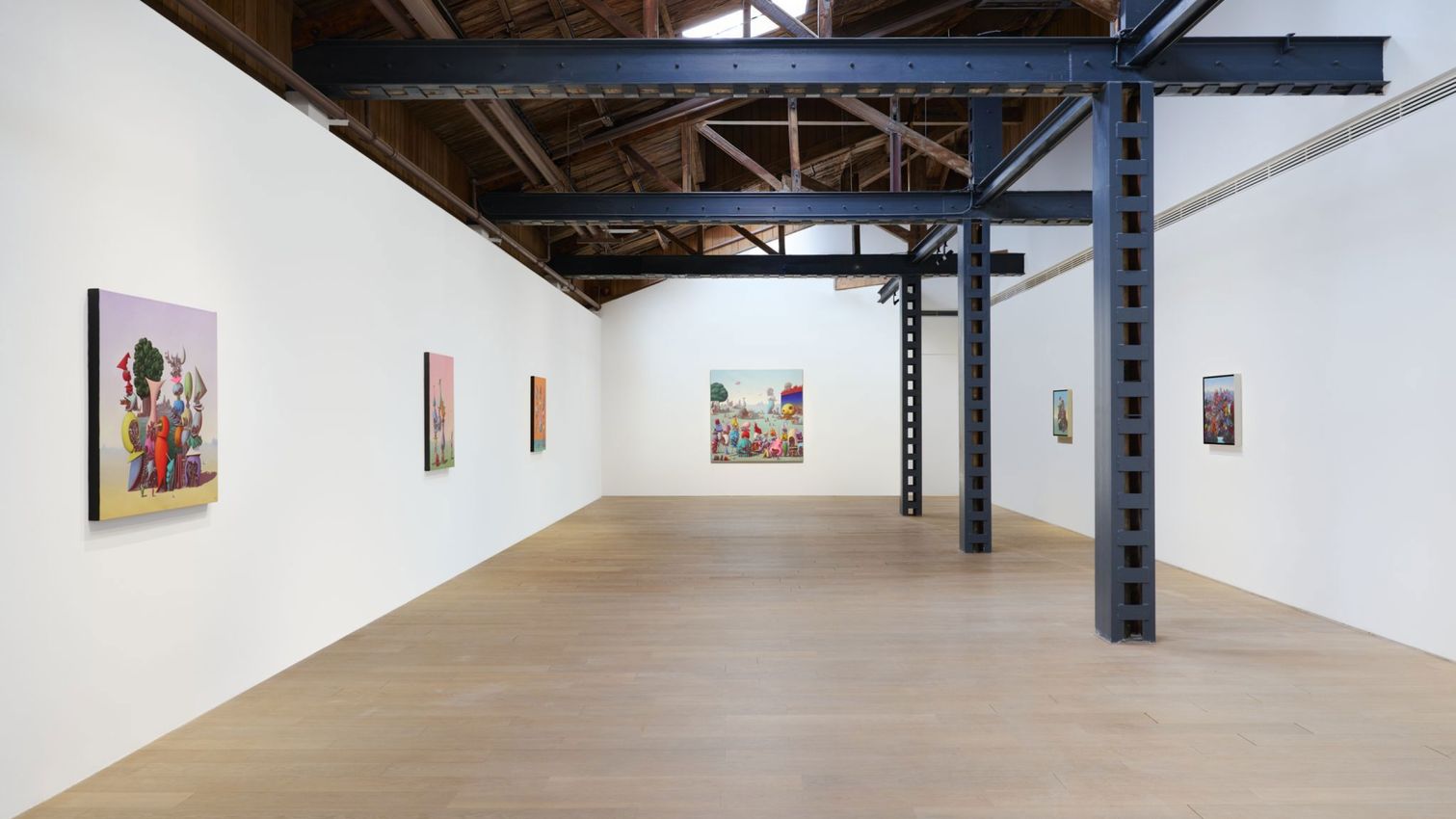
Since 2020, Wang’s ongoing series “New World” consolidates landscape, geography, human presence, and mythic beings into a cohesive whole, rendered in luminous, unadulterated color and suffused with sensual delight. Everything thrives; creatures, however strange, revel in their existence and the joy of life. “New World” evokes a primordial condition, intrinsic and prior to all division.
Read below the essay text commissioned from Wang Min’an for the series “New World”.
I deconstruct and fragment stale, conventional figurations in hopes that ‘form’ itself may attain Nirvana and rebirth.
— Wang Fanseng
Wang Fanseng’s chromatically radiant canvases teem with uncanny forms. Each eludes definition. Some resemble artifacts, yet betray no discernible function; others suggest animals, yet remain without motion; some evoke the human body, yet bear no human face; others recall deities stripped of divine power, or specters devoid of menace. They occupy a liminal space between objecthood, animality, humanity, and divinity. Just so, they hover at the threshold of life and death, at once animate beings and inert matter. Wang further compounds this ambiguity by stacking them in dense profusion, allowing these motifs to multiply and overlap, thereby heightening their illegibility. The forms strain against settling into any determinate image. And what emerges is a mode of quasi-figuration. They qualify as images because they are not mere exercises in abstract form; rather, they seem driven toward figural resolution. Yet the form they arrive at is one we have never encountered, untethered to the real and marked by the strange. Wang might be said to create, on canvases, an iconography of the strange uniquely his own.
Wang’s paintings are distinguished by their rich and saturated palette. Varied chromatic intensities cling to distinct motifs and flare across the surface, establishing a dynamic tension between color and form. The motifs themselves remain neutral, their pathways undone by incessant mutation. Color, however, grants them voice. It does not merely fill in form; its brilliance can dominate the surface, even subduing the shapes beneath its intensity. The pictorial field radiates with an exuberant vibrancy: baby blue, pale gold, soft lavender, and muted green flash and reverberate against one another. Each image relies on its glow to step forward from the visual thicket. Still, another shimmer answers it, challenging and tempering its radiance. The painting therefore becomes a site of chromatic contention. Color builds toward incandescence, flickering with instability, until the image becomes as labyrinthine in hue as in space and time.
What, then, is at stake in such a labyrinth of metamorphosis and illusion? In its geometric articulation, the work nods to Cézanne. Concrete forms are abstracted into cylindrical, conical, and elliptical units, an analytic deconstruction of figuration. Pictorially, a Surrealist shadow lingers. It reveals the implausible lodged within reality, the genesis of dream and delirium, the surfacing of a latent unconscious. The imagery at times conveys spectral unease, a ferocious deformation, and even a teeming vitality—impulses resonant with Expressionism. In this sense, the modernist legacy continues to inform Wang’s practice.
Do Wang’s images give rise to rapturous delight, or to repose that follows release? For Wang himself, it is likely the latter; for others, it may well be the former.
Courtesy Perrotin.


A respected voice in contemporary art discourse.
Focusing on ambitious storytelling and insightful art-world commentary. Ocula Magazine publishes in-depth interviews, critical essays and timely analysis on the artists, exhibitions and ideas driving the global art world.
Learn more about Ocula Magazine
Showcasing the best of the art world.
Ocula partners with galleries from around the world to highlight their artists, artworks and exhibitions. Gallery membership is by application and invitation, with each member vetted by an independent panel.
Learn more about Ocula Membership

Specialises in the sale of major artworks.
Led by a team with deep ties to the world’s leading auction houses, galleries and collectors. Ocula’s advisory team offers bespoke services to high-net-worth clients from around the world who are looking to acquire the best of contemporary and modern art.
Learn more about our team and services