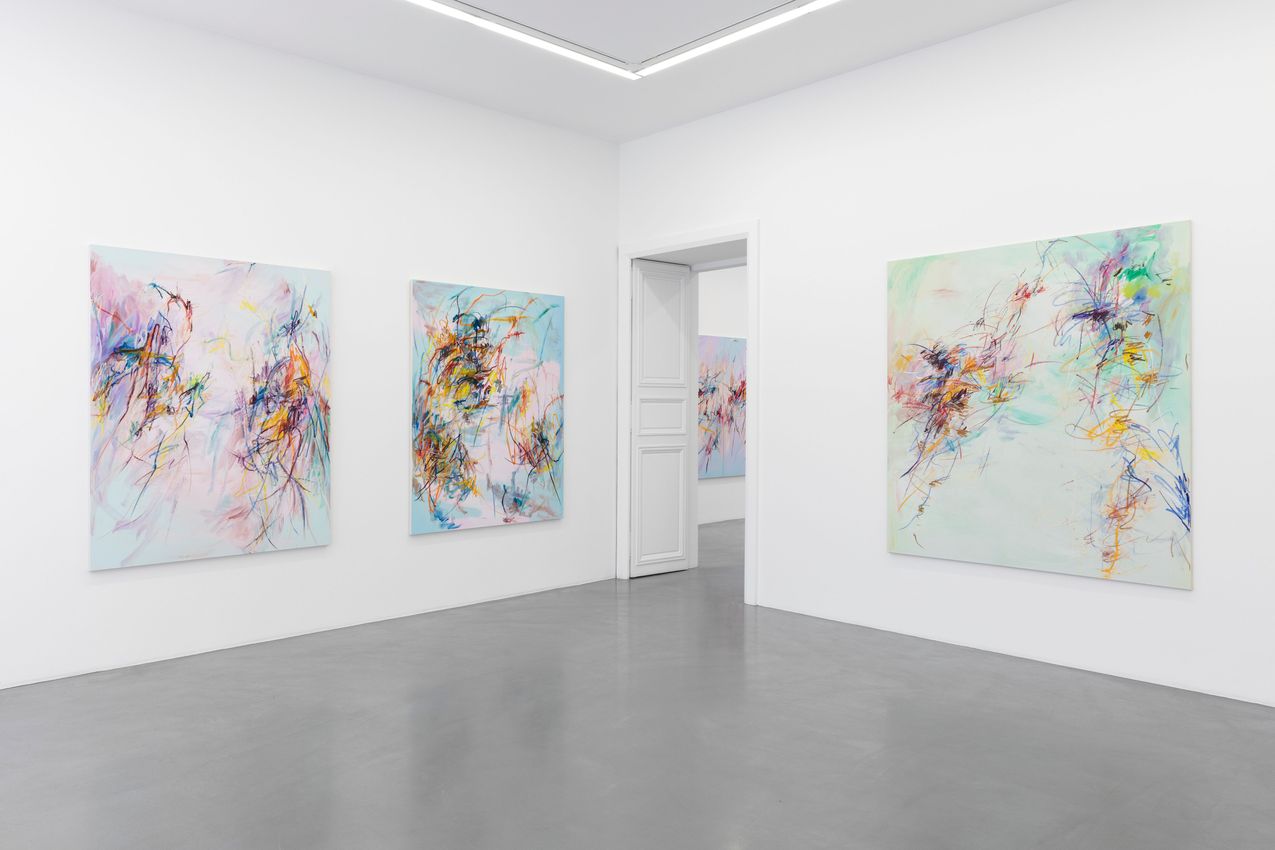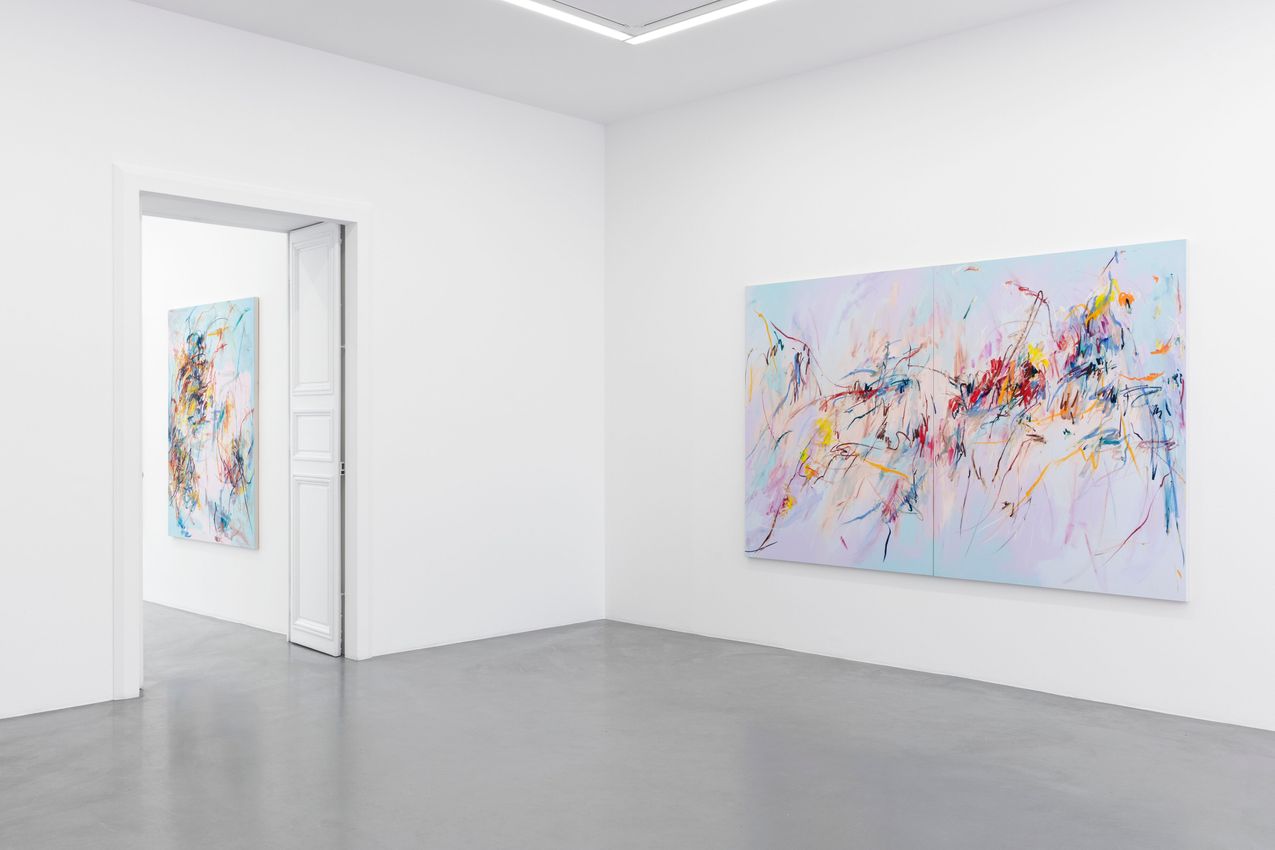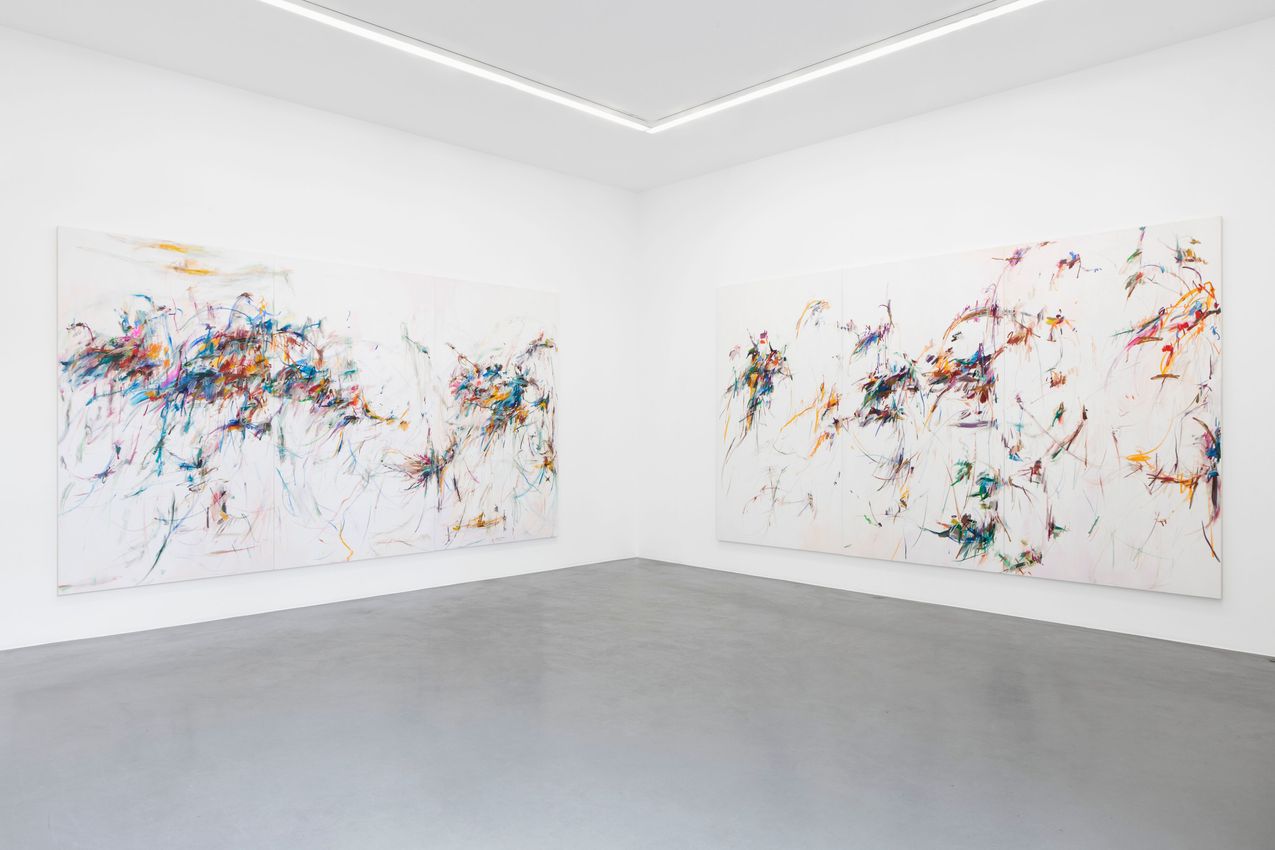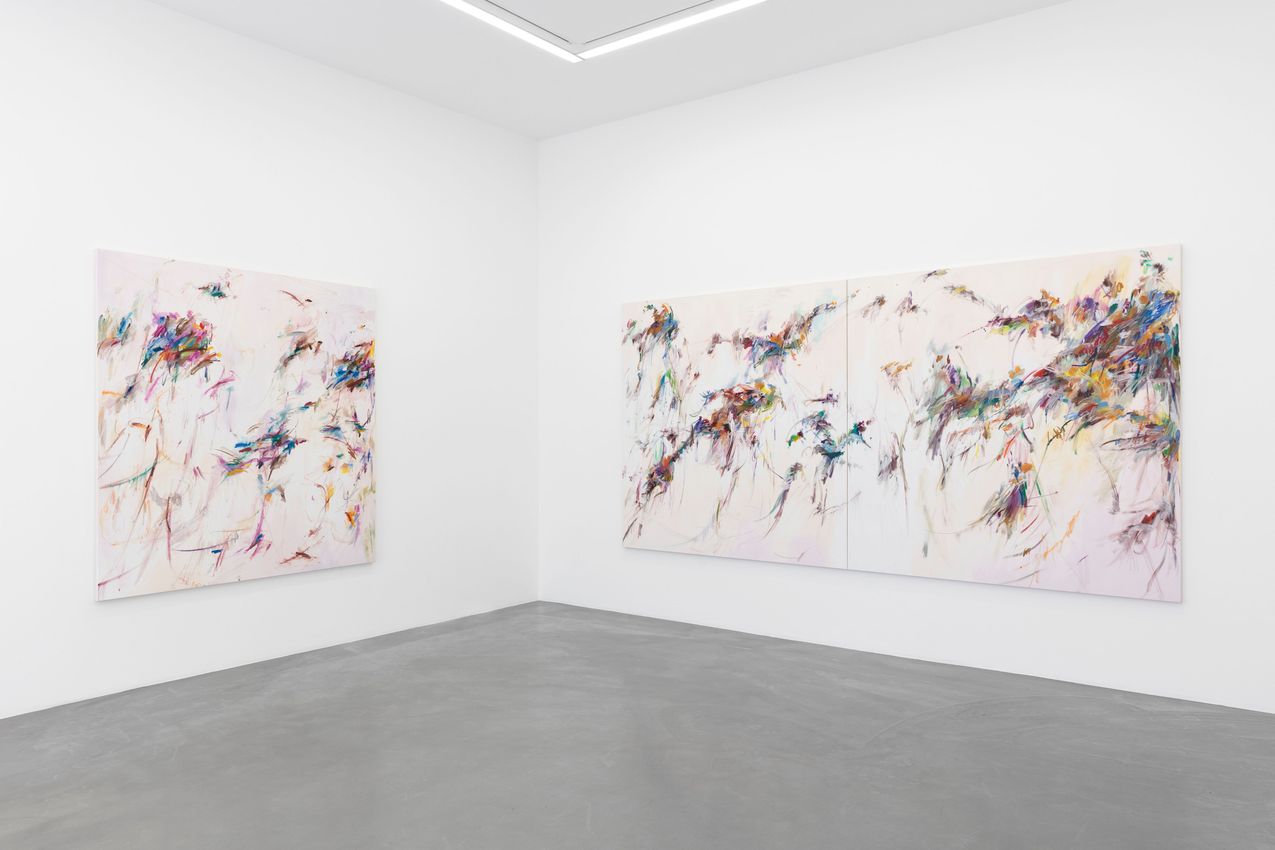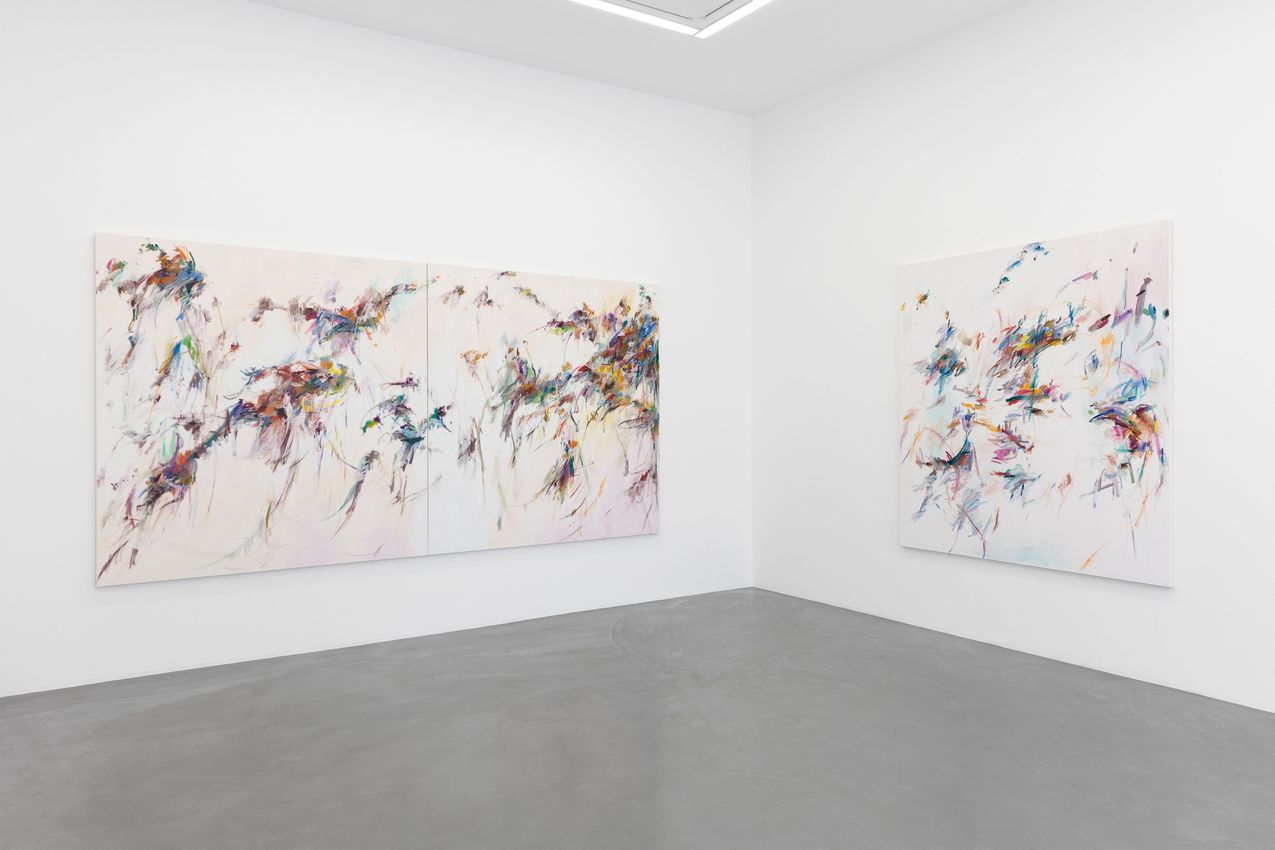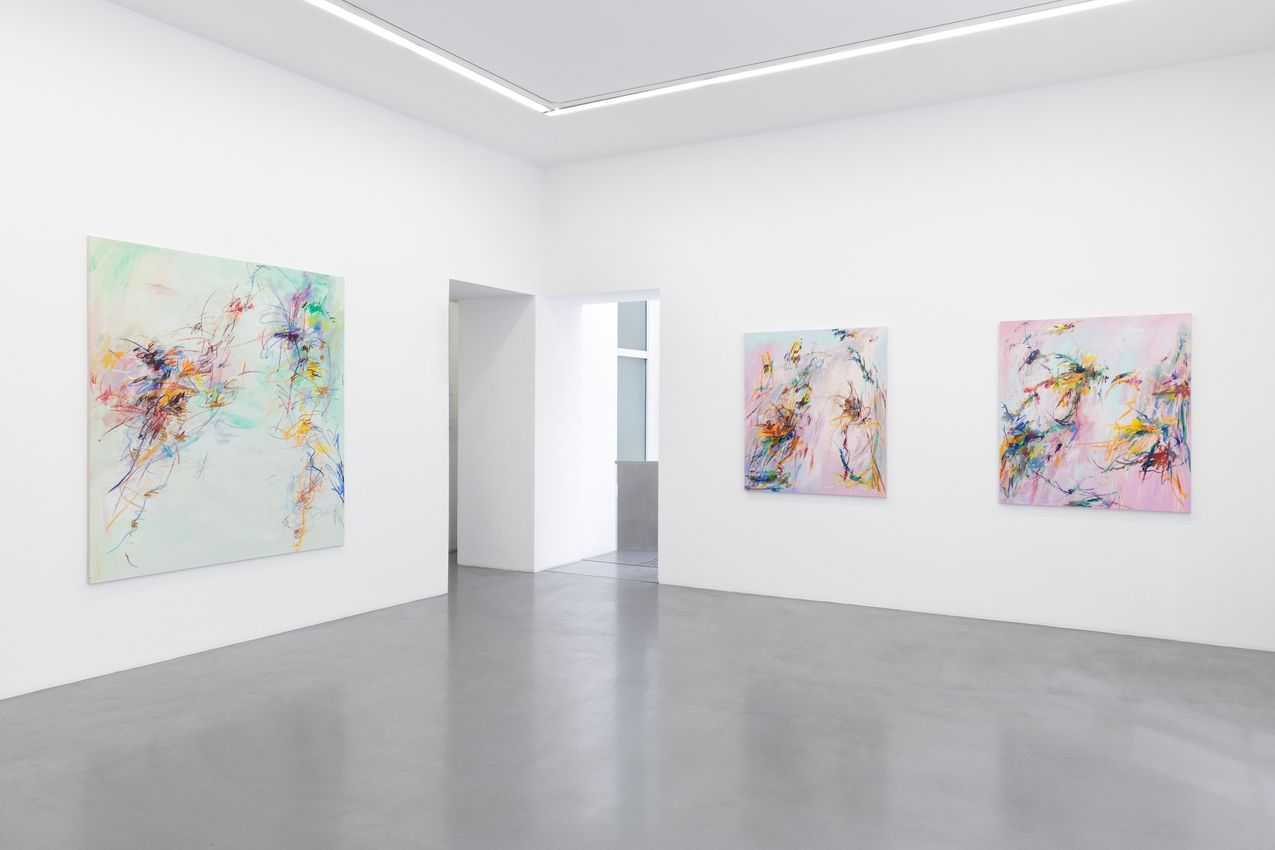
Perrotin Paris is pleased to present Xiyao Wang’s first exhibition at the gallery. The young, Berlin-based Chinese artist creates large-scale, immersive paintings in which gestural lines evoke echoes oflandscapes, bodies, movements, thoughts. In the process, shedevelops a kind of hybrid abstract painting that combines variousinfluences and inspirations: Taoism and post-structuralism, ancientChinese pictorial traditions, bodywork, dance, martial arts, and thecanon of Western art history. In her work, mythologies and the lyrical,hermetic painting of Cy Twombly merge with global mass culture,electronic music, with the networked, media-influenced thinking ofmillennials and Gen Z. Xiyao’s paintings explore inner visions, bodilyperceptions, sensations, feelings, interrogating her East-Westbiography.
Xiyao, who studied with Werner Büttner and Anselm Reyle, is interested besides Twombly in German painters such as Günther Förg and AlbertOehlen. In the practice of all these painters the line plays a crucial role,through the ‘eccentric,’ in some cases calligraphic ductus, the tensionbetween reduced clarity and affect-laden chaos. But Xiyao Wang is not concerned with picking up where lyrical abstraction and Abstract Expressionism left off, nor with a female remake of the German,male-dominated painting of the 1980s and 1990s. Rather, she deals withthe question of how to create abstract and bold pictorial spaces todaywith similarly reduced means. The Crystalline Moon Palace, the title of herexhibition, borrowed from a series of paintings in the show, refers to anancient Chinese myth around the moon goddess Chang’e. The latter wasimmortalised in her present form in a fourth-century poem.
Many of the depictions from different periods, such as the Buddhist frescoes from the cave temples near Dunhuang dating back to the fourthcentury, which the artist studied in detail, show flying female deities risinggracefully into the sky, surrounded by floating fabric and ribbons. Themotif of the female figure flying weightlessly through the air, defying thelaws of gravity and all physical limitations, entered global mass culturethrough kung fu and martial arts films such as Ang Lee’s Crouching Tiger,Hidden Dragon (2000). The myth of the moon princess Chang’e inspirednot only the world-famous manga series Sailor Moon, but also the namesof various Chinese moon probes.
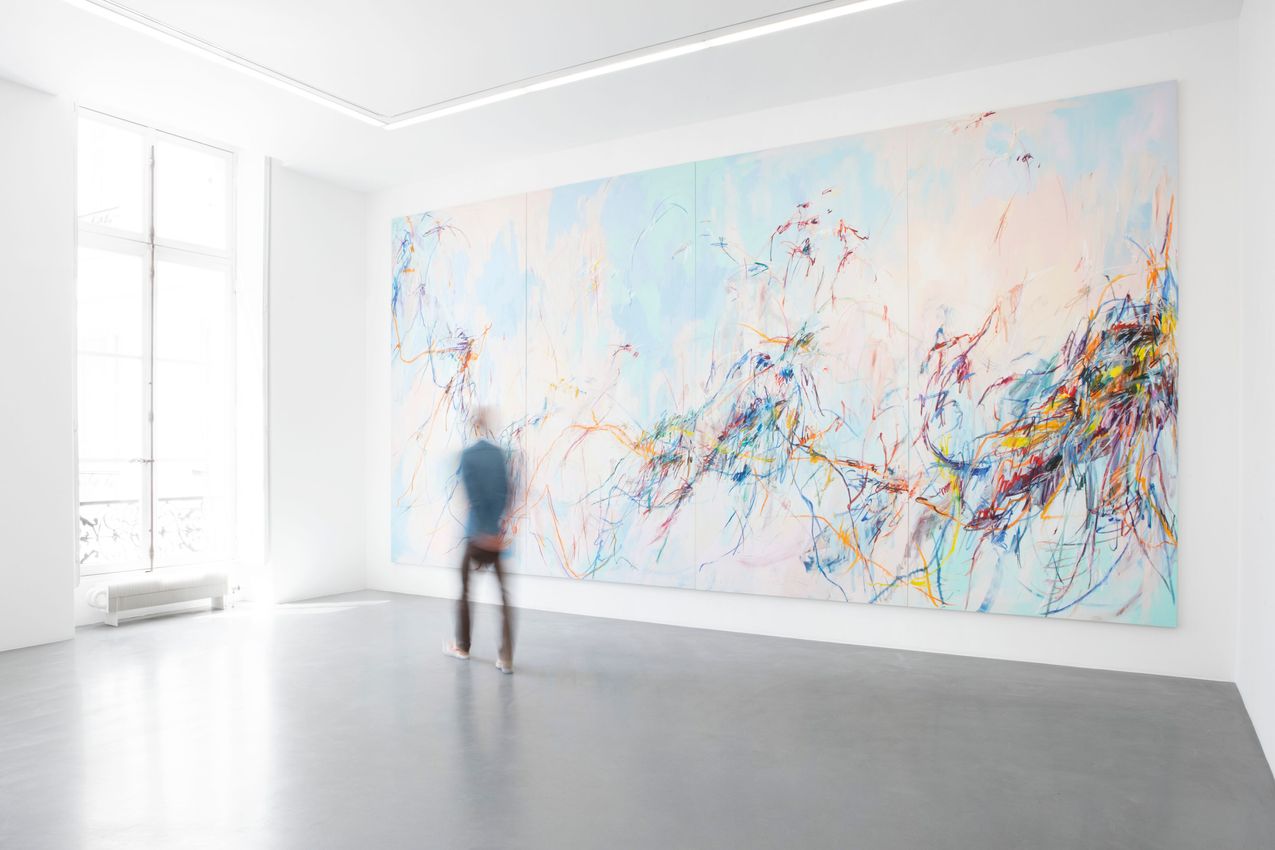
The vision of flying, of intense physical and emotional states, of weightlessness, liberation, and dissolution of boundaries is the essentialstarting point for the construction of Xiyao Wang’s expressive pictorialspaces, reduced to colour, gesture, and lines. Although nonrepresentational,they conjure up abstract landscapes, neural pathways, fragmentedafterimages of flowering or dying plants, animal or human bodies, traces ofdance, struggle, search and thought processes. The experience theyconvey is paradoxical: disembodied and transcendent, yet at the same timeexhilaratingly sensual, material, almost tangible. Again and again, Xiyao, whopractices kickboxing, ballet, tango, and all manner of sports, has emphasisedthe physical aspect of her painting. In her gigantic, over 6,8 meter widepolyptych River, River, Could You Tell Me The Story Of My Hometown(2022), one can see how the artist relates physically, with her entire body, to the canvas. The techniques she chooses, the priming of the background with quick-drying acrylic paints, the use of oil pencils that react almost likedrawings or calligraphy to painting executed with a brush, require speedand spontaneity, intuitive, even risky painterly decisions. Of course,connections can be seen in Xiyao’s painting to Abstract Expressionism, andthere are references to Action Painting, Informel, and Tachism.
Xiyao’s paintings are influenced by her profound knowledge of Eastern and Western painting history, as well as by the digital, hybrid imageculture of the twenty-first century. There is no landscape they want toreproduce. On the contrary, they speak of placelessness and timelessness,boundless openness and bottomlessness. There are no certainties, no ‘grand narratives,’ no political or religious systems left to cling to.Especially in view of the current geopolitical crises, this loss triggersexistential fears and longings, the desire for a sort of return to an earlier,orderly state in which conditions were still ‘normal.’ But Xiyao findsfreedom in her painting in the exact opposite—in an acceptance of thislonging for myths, for authenticity, yet with the simultaneous certainty thatthere is no way back. Her paintings are akin to echo chambers in whichvoices and times overlap: They reflect reflections on painting, conveyperceptions of perceptions.
It is not necessarily a conscious act that Xiyao’s pictorial backgrounds are reminiscent of baroque paintings in terms of their colourfulness, that theartist, like Tiepolo, applies large areas of color with the brush, and only subsequently adds definition. When Xiyao echoes the lyrical abstraction of Cy Twombly, his painterly examination of the mythologies of antiquity,that includes classicism and baroque, as well as her own experiencesresonate.
Culture and art have literally inscribed themselves in Xiyao’s body, like trauma or the internalised movements of a high-performance athlete. Thefleeting, affect-laden gestural traces that might suggest body fragments,movements, or limbs in her paintings often emerge from such physicalmemory. In China, before applying to the art academy, one must paintnude models for at least half a year, but often for several years, makinghead, chest, and full-body portraits over and over again. A specialdiscipline is the creation of a sketch, capturing muscles, calves, andwrinkles as quickly as possible. Xiyao still uses this internalised technique,but performatively, without depicting, without an aim or a meaning, similarto automatic writing that allows for completely new associations.
Press release courtesy Perrotin. Text: Oliver Koerner von Gustorf.
Chinese artist Wang Xiyao paints expressive works on canvas, translating life experiences, embodied tensions, and movement into collections of gestural marks.
Emmanuel Perrotin founded his first gallery in 1989 at the age of 21. He has opened since then over 17 different spaces, with the aim of continuing to offer increasingly vibrant and creative environments to experience artists work. He has worked closely with his roster of artists, some since more than 25 years, to help fulfil their ambitious dreams and projects.

A respected voice in contemporary art discourse.
Focusing on ambitious storytelling and insightful art-world commentary. Ocula Magazine publishes in-depth interviews, critical essays and timely analysis on the artists, exhibitions and ideas driving the global art world.
Learn more about Ocula Magazine
Showcasing the best of the art world.
Ocula partners with galleries from around the world to highlight their artists, artworks and exhibitions. Gallery membership is by application and invitation, with each member vetted by an independent panel.
Learn more about Ocula Membership

Specialises in the sale of major artworks.
Led by a team with deep ties to the world’s leading auction houses, galleries and collectors. Ocula’s advisory team offers bespoke services to high-net-worth clients from around the world who are looking to acquire the best of contemporary and modern art.
Learn more about our team and services