




ROY LICHTENSTEIN
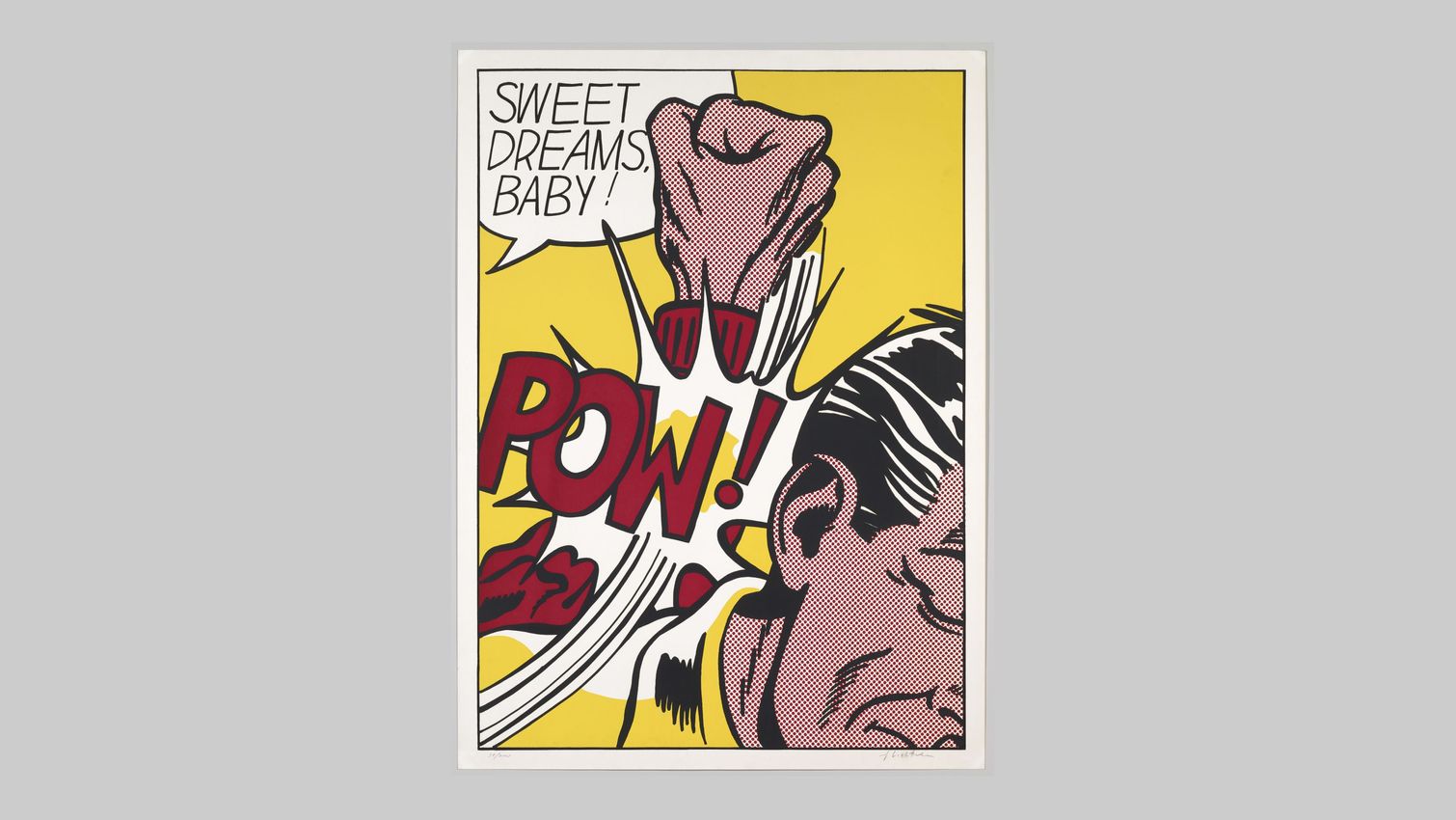
1923-1997, United StatesAlongside artists such as Andy Warhol, Jasper Johns, and James Rosenquist, Roy Lichtenstein was a leading figure of the American Pop Art movement, amassing an important legacy through his painted parodies of comic strips and advertising techniques using the Ben-Day dot printing technique.
Roy Lichtenstein’s artistic Influences
Coming from an upbringing in New York that was immersed in the arts, Roy Lichtenstein‘s earlier influences in the 1940s were artists like Rembrandt, Daumier, and Picasso, as well as Hoyt L. Sherman who taught Lichtenstein at Ohio State University and encouraged his critical perspective of accepted art canons.
Early life and work
Lichtenstein’s fascination with vernacular commercial imagery developed throughout the 1940s and 50s. It was the outcome of experiments during his time teaching at Ohio State University and later the State University of New York at Oswego, and his academic hiatus in between spent working in various commercial and industrial professions in Cleveland. These ideas were fermented when teaching at Rutgers University’s Douglass College in the late 1950s, where Lichtenstein’s colleagues included Geoffrey Hendricks, Allan Kaprow, and George Segal.
Roy Lichtenstein: Key works
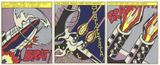
The hallmarks of Roy Lichtenstein’s Pop Art style emerged in the 1960s. Seminal large-scale works such as Drowning Girl (1963), and the iconic diptych Wham! (1963), borrowed and altered imagery found in romantic and action comic strips, advertisements, and chewing gum wrappers. Highlighting the lowly mass-produced origins of his subjects, Lichtenstein used homemade stencils and oil paint to recreate the Ben-Day dots used in commercial printing.
Art historical references
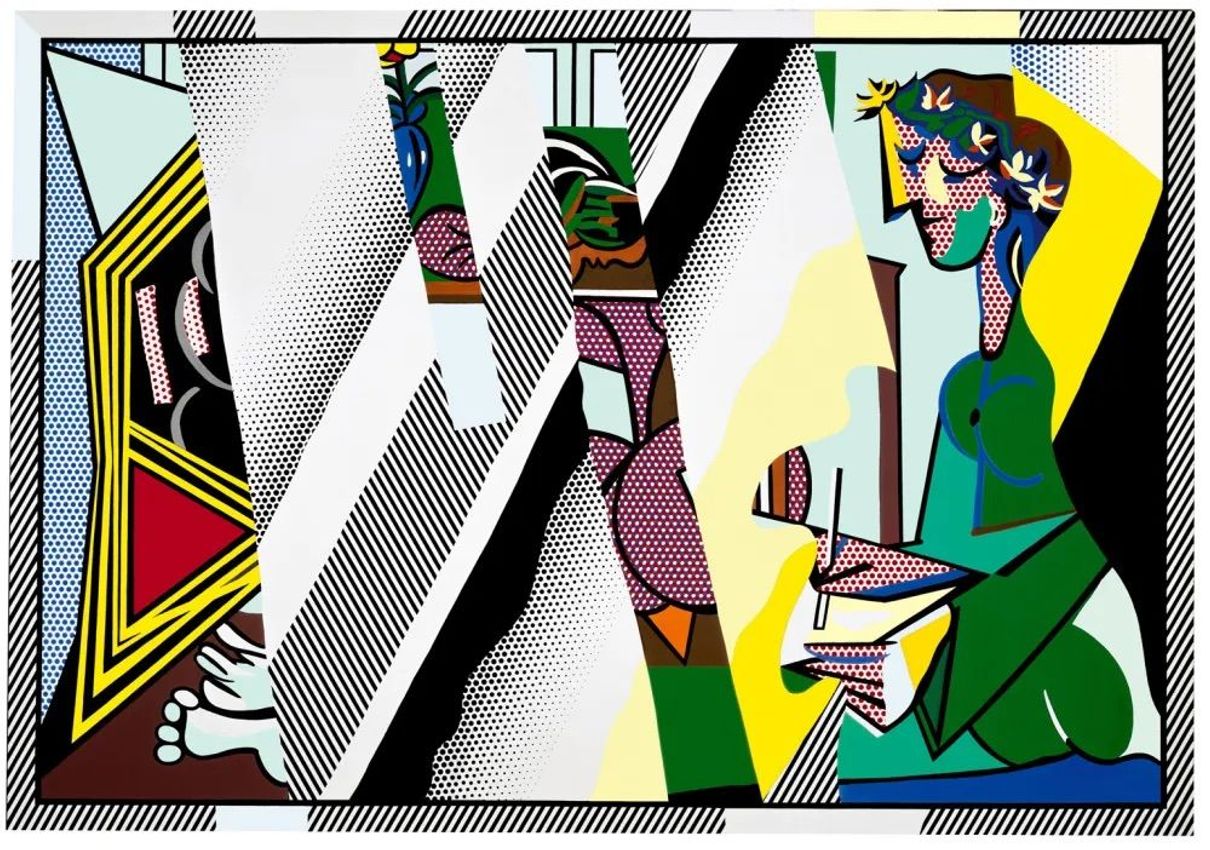
Roy Lichtenstein’s art in the late 1960s continued to interrogate artistic processes, in particular landscape paintings and still lifes by artists like Cezanne, Mondrian, and Picasso, which he reimagined through his semi-abstract ‘Brushstrokes’ paintings (1965–1966). In the 1980s, he began parodying the gestural brushwork and abstract compositions of Abstract Expressionism with commercial techniques antithetical to that movement.
Sculpture and Public art
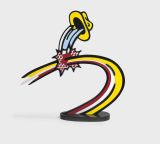
Alongside his paintings, Lichtenstein became heavily involved in printmaking and sculpture. His coloured bronze and steel sculptures are seemingly drawn on the three-dimensional space like his two-dimensional drawings and prints.
Lichtenstein was also a major contributor of public art. Throughout his career, he painted murals in North America, Europe, and the Middle East. He has also produced various forms of monumental sculpture since the late 1980s, which can be found in public spaces across the globe.
Legacy
When Lichtenstein passed away in 1997, he left behind a legacy of light-hearted but intellectually rigorous works which, themselves, have ironically been appropriated and parodied for non-art purposes across the globe.
His works can be found in major institutions worldwide, including the Solomon R. Guggenheim Museum and Museum of Modern Art (MoMA) in New York, the Tate Modern in London, Centre Pompidou in Paris, Museum Ludwig in Cologne, National Gallery of Australia in Canberra, and Hara Museum of Contemporary Art in Tokyo.
Roy Lichtenstein solo exhibitions include:
- Roy Lichtenstein: Painting with Scattered Brushstrokes, Gagosian, 541 West 24th Street, New York (19 March–25 April 2026)
- Roy Lichtenstein: in the Studio, Dallas Museum of Art, Dallas, Texas (January–July 5, 2026)
- The Loaded Brush, Galerie Thaddaeus Ropac, Salzburg, Austria (2019)
- Lichtenstein: A Retrospective, the Art Institute of Chicago, the National Gallery of Art, Washington DC, Tate Modern, London (2012–2013)
- Three Landscapes: A Film Installation by Roy Lichtenstein, Whitney Museum of American Art, New York (2012)
- Roy Lichtenstein: All About Art, Louisiana Museum for Moderne Kunst, Humlebaek, Denmark (2003)
- Roy Lichtenstein: A Retrospective, Museum of Contemporary Art, Los Angeles (1994)
Roy Lichtenstein group exhibitions include:
- Pop Forever, Tom Wesselmann &..., Paris (17 October 2024–24 February 2025)
- Found, Made, Cast, Castelli Gallery, New York (2017)
- From Kandinsky to Pollock: the Art of the Guggenheim Collections, Palazzo Strozzi, Florence, Italy (2016)
- Les années Pop, 1956–1968, Centre Pompidou, Paris (2001) * Art in the Mirror, MoMA, New York (1966)
- 66th Annual American Exhibition: Directions in Contemporary Painting and Sculpture, Art Institute of Chicago (1963)
Roy Lichtenstein FAQs
Who was Roy Lichtenstein?
Roy Lichtenstein was an American pop artist best known for large-scale, comic strip–style paintings that used bold outlines, primary colours, and Ben-Day dots to mimic commercial printing.
What was Roy Lichtenstein famous for?
Roy Lichtenstein was famous for transforming imagery from comic books, advertising, and popular culture into monumental paintings that helped define the Pop Art movement in the 1960s. He became known for his Ben-Day dot technique, flat fields of colour, and ironic, melodramatic scenes of romance and war that questioned the boundary between high art and mass media.
What is Roy Lichtenstein’s most famous painting?
Roy Lichtenstein’s most widely cited most famous painting is Whaam! (1963), a large diptych showing a fighter jet firing a rocket that explodes with the onomatopoeic word “WHAAM!”. Whaam! and Drowning Girl are often named together as his best-known works and key icons of Pop Art.
Where is Roy Lichtenstein from?
Roy Lichtenstein was from New York City; he was born in New York, New York, in the United States. He later lived and worked in several places, including Ohio, New Jersey, and Manhattan, but New York remained a central base.
When was Roy Lichtenstein born?
Roy Lichtenstein was born on 27 October 1923. He grew up in an upper-middle-class family on the Upper West Side of Manhattan.
How did Roy Lichtenstein die?
Roy Lichtenstein died from complications of pneumonia. He became ill in August 1997 and died unexpectedly a short time later.
When did Roy Lichtenstein die?
Roy Lichtenstein died on 29 September 1997, at the age of 73. His death marked the end of a career that helped shape late 20th-century American art.
How did Roy Lichtenstein make his art?
Roy Lichtenstein typically began with source images from comics, adverts, or art history, which he redrew and simplified through preparatory sketches. He then projected, traced, and painted these compositions onto canvas using flat colour areas, hand-rendered Ben-Day dots via stencils, and crisp black outlines to emulate mechanical printing.
What inspired Roy Lichtenstein?
Roy Lichtenstein was inspired by American popular culture—especially comic books, printed advertisements, and consumer imagery—as well as modern artists like Picasso, Mondrian, and Cézanne. He was also influenced by mass media’s visual language and wanted to explore how banal, industrial images could become fine art.
What materials did Roy Lichtenstein use?
Roy Lichtenstein used oil and acrylic paints (notably Magna, a solvent-based acrylic), typically on canvas, to achieve smooth, industrial-looking surfaces. He also employed stencils, screens, and metal templates for Ben-Day dots, and later expanded into prints and sculptures using materials like metal, enamel, and various print supports.
Is Roy Lichtenstein still alive?
Roy Lichtenstein is not still alive; he died in 1997. His work, however, remains highly visible in major museum collections and public commissions worldwide.
What type of art did Roy Lichtenstein make?
Roy Lichtenstein made Pop Art, focusing on paintings, prints, and sculptures that appropriate and transform commercial imagery. His work is characterised by stylised comic-strip narratives, bold graphic design, and a cool, detached emotional tone.
When did Roy Lichtenstein start making art?
Roy Lichtenstein began making art seriously as a young man; he studied at the Art Students League in New York and then at Ohio State University in the early 1940s. He had his first solo exhibition in New York in 1951, marking his early professional career.
How much is a Roy Lichtenstein painting worth?
Roy Lichtenstein’s major paintings can sell for well over $100 million; for example, his painting Masterpiece reportedly sold privately for about $165 million in 2017. Prints and lesser works range widely in price, from a few thousand to hundreds of thousands of dollars, depending on rarity, condition, and subject.
Why did Roy Lichtenstein do Pop Art?
Roy Lichtenstein turned to Pop Art in the early 1960s to engage directly with mass culture and to challenge Abstract Expressionism’s emphasis on personal gesture. He used comic and commercial images to question originality, authorship, and the status of everyday visual material in a media-saturated society.
What art movement was Roy Lichtenstein part of?
Roy Lichtenstein was a leading figure in the Pop Art movement. Pop Art emerged in the late 1950s and early 1960s, drawing on popular culture and commercial imagery as legitimate subjects for fine art.
Where did Roy Lichtenstein work?
Roy Lichtenstein worked in several studios across the United States, notably in Cleveland, New Jersey, and later in Manhattan, New York. By the mid-1960s he was based in New York City full-time, working in a studio practice that supported an international career.
Why is Roy Lichtenstein important?
Roy Lichtenstein is important for redefining painting through the lens of mass media and for helping to establish Pop Art as a major international movement. His highly recognisable style, conceptual approach to appropriation, and influence on later artists secure his status as a key 20th-century figure.
How many paintings did Roy Lichtenstein make?
Roy Lichtenstein produced thousands of works across paintings, drawings, prints, and sculpture; his catalogue raisonné lists over 5,000 artworks in all media. The exact number of paintings alone is smaller but still runs into the many hundreds.
Why did Roy Lichtenstein use Ben-Day dots?
Roy Lichtenstein used Ben-Day dots to imitate commercial printing processes and to give his paintings a mechanical, mass-produced appearance. The dots also allowed him to modulate colour and tone while maintaining a flat, graphic look that reinforced his interest in industrial imagery.
What is Roy Lichtenstein’s style of art?
Roy Lichtenstein’s style is a highly stylised, graphic form of Pop Art marked by comic-book linework, primary colours, speech bubbles, and Ben-Day dots. The style combines cool detachment with dramatic, often ironic scenes, creating a tension between emotion and mechanical reproduction.
When did Roy Lichtenstein start pop art?
Roy Lichtenstein began making Pop Art around 1961, when he developed his signature comic-strip style and showed works such as Look Mickey. By 1962–63, with paintings like Whaam! and Drowning Girl, his Pop Art idiom was fully established.
What techniques did Roy Lichtenstein use?
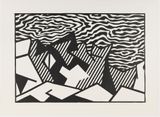
Roy Lichenstein used techniques that mimicked mechanical reproduction: projection and tracing for composition, stencils for Ben-Day dots, and flat, unmodulated painting to remove visible brushwork. Lichtenstein also explored printmaking methods such as lithography, screenprinting, and woodcut, often combining them in innovative ways.
Did Roy Lichtenstein use paint?
Yes, Roy Lichtenstein used paint extensively, especially oil and acrylic paints, including Magna, to achieve his characteristic smooth, glossy surfaces. These paints were applied in carefully controlled, flat layers rather than expressive brushstrokes.
Did Roy Lichtenstein have a wife?
Roy Lichtenstein was married twice: first to Isabel Wilson, and later to Dorothy Herzka. He and Dorothy Herzka married in 1968 and remained together until his death.
How did Roy Lichtenstein become an artist?
Roy Lichtenstein became an artist through formal study and continuous practice, beginning at the Art Students League in New York and continuing at Ohio State University, where he earned BA and MFA degrees in fine arts. Teaching art, exhibiting in galleries, and gradually developing his Pop style in the late 1950s and early 1960s solidified his professional career.
Why did Roy Lichtenstein become an artist?
Roy Lichtenstein’s early art education and enthusiasm for drawing, jazz, and visual culture led him toward an artistic career rather than a conventional profession. His decision to pursue advanced art studies and later to leave teaching in 1964 to focus solely on his work reflects a commitment to being a full-time artist.
Where did Roy Lichtenstein go to school?
Roy Lichtenstein studied briefly at the Art Students League in New York with painter Reginald Marsh. He then attended Ohio State University in Columbus, earning both undergraduate and graduate degrees in fine arts.
Where did Roy Lichtenstein die?
Roy Lichtenstein died in New York City. He passed away in a New York hospital following complications from pneumonia.
Were Roy Lichtenstein and Andy Warhol friends?
Roy Lichtenstein and Andy Warhol were contemporaries and key figures in the New York Pop Art scene, showing with many of the same galleries and museums. They were professionally associated and often discussed together, though not known as intimate personal friends in the way of a close lifelong partnership.
Ocula | 2026






















Roy Lichtenstein in Ocula Magazine









Explore and Follow Artists Shaping Contemporary Art
A respected voice in contemporary art discourse.
Focusing on ambitious storytelling and insightful art-world commentary. Ocula Magazine publishes in-depth interviews, critical essays and timely analysis on the artists, exhibitions and ideas driving the global art world.
Learn more about Ocula Magazine
Showcasing the best of the art world.
Ocula partners with galleries from around the world to highlight their artists, artworks and exhibitions. Gallery membership is by application and invitation, with each member vetted by an independent panel.
Learn more about Ocula Membership
Specialises in the sale of major artworks.
Led by a team with deep ties to the world’s leading auction houses, galleries and collectors. Ocula’s advisory team offers bespoke services to high-net-worth clients from around the world who are looking to acquire the best of contemporary and modern art.
Learn more about our team and services