



Press Release

Found objects such as bass amps and solar panels form Haroon Mirza’s intensely precarious assemblage, connecting light and sound. Electricity, considered by Mirza to be his primary medium, acquires an almost material quality as the artist manipulates its frequency and wavelength. Charactized by clean lines, geometric forms, and a restrained use of colour, the minimalist aesthetics of his kinetic sculptures contrast with the complexity of the sound and pattern-making mechanisms that often underpin his audio-visual compositions.

Titled Ceremonies and Rituals, Mirza’s latest solo exhibition delves deeper into his fascination with electricity, exploring its uncharted realms at the intersection of the mystical and the scientific. The exhibition contemplates sacred geometries and ritualistic elements, emphasising the artist’s ongoing inquiry into sound used in rituals and ceremonies, and how mystical experiences might be elucidated through neurological processes, especially in the context of research into psychedelics.

At the heart of his presentation is Cymatic Ceremony (2024), a multimedia installation featuring a two-channel video, shown for the first time in this exhibition. Synchronised to a set of drums that perform live, the work experiments with Cymatics, a branch of modal vibrational phenomena. In this piece, Mirza features artist Helga Dóróthea Fannon performing a ritualistic act in a forest, where she scatters seeds on a Chladni plate. The plate, resonating at various frequencies including 111 Hz, reveals intricate patterns in response to the singer’s voice (Juliette Fraser). Many natural forms, such as snowflakes and seashells exhibit cymatic-like patterns due to their inherent vibrational frequencies and resonances. This work highlights these forms as studied by Hans Jenny, Swiss physician and advocate of Anthroposophy, as well as the mystical frequency of “Om”, postulate by the artist at 111 Hz.

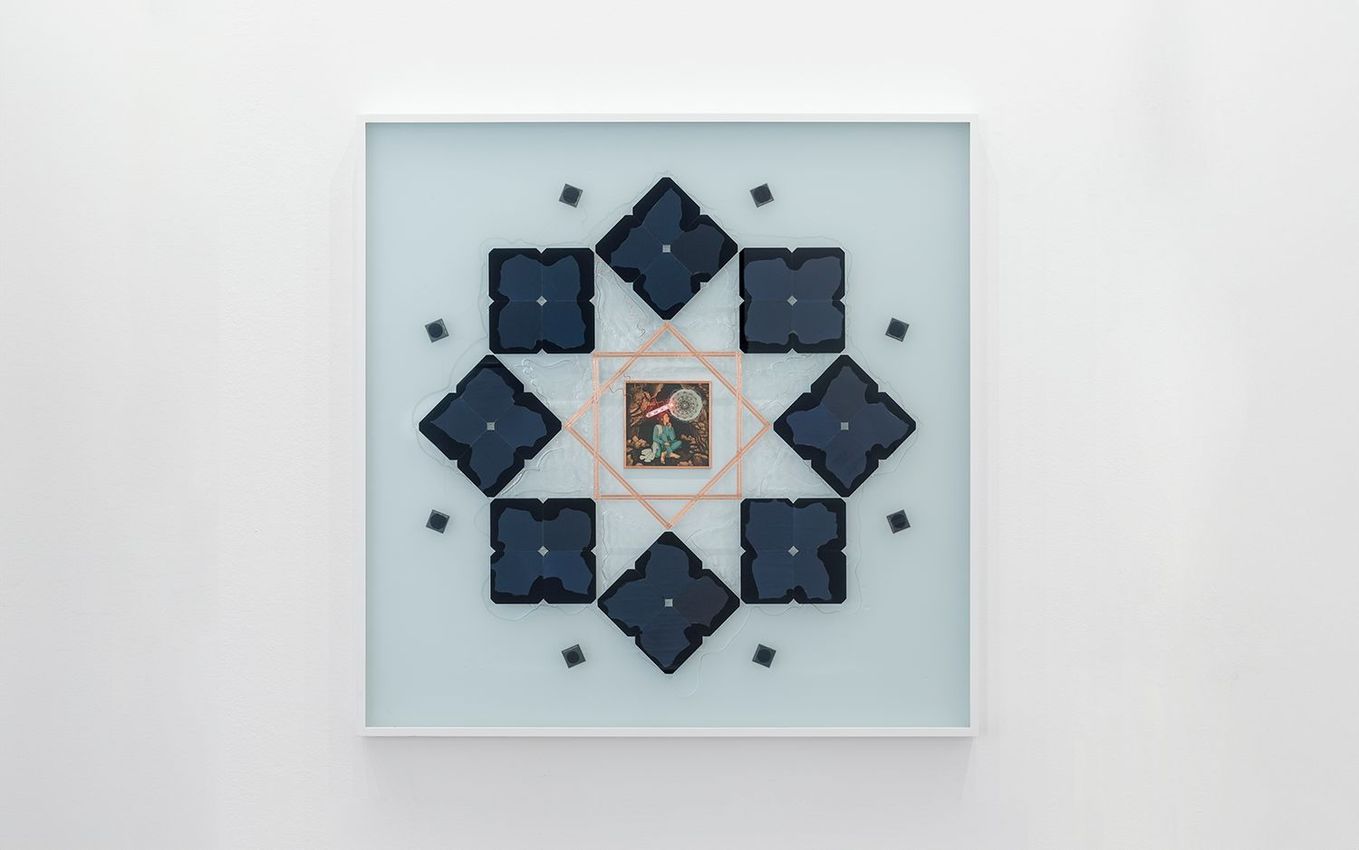
The exhibition also features Mirza’s recent series, “Ogdoad Interstellar Magnet (Solar Cell Circuit Compositions).” These pieces draw inspiration from an 8-pointed star, originally depicting the sun with eight primary rays in the Tartessian civilisation, today common in the Arab world as the Rub al-Hizb. At the centre of each, a meteorite is found wrapped in a copper coil, effectively enveloping it in a magnetic field.

Mirza arranges solar cells to form intricate circuits that generate LED illumination, framing miniature paintings by Pakistani artist Brishna Amin Khan. In European classical painting and Catholic iconography, the luminous aura, such as a halo or beacon, serves as a symbolic signifier of sanctity and divinity. “Yet the individuals in the series of works are pagan lay people, or icons of psychedelia such as the indigenous healer Olivia Arévalo.” The three illuminated Solar Cell Circuit Compositions interact with the daylight in the gallery space, each depicting scene directly connected to the film Cymatic Ceremony, exploring different stages of shamanistic rituals engaging nature and altered stages of consciousness.

Ceremonies and Rituals marks Haroon Mirza’s second solo exhibition with the gallery in ten years, presenting the most recent evolution of his artistic practice. From referencing acid house with socio-political commentaries to the studies of Cymatics and shamanistic rituals, Mirza’s consistent investigation of sound, light and electricity as a medium is nourished by an increasingly collaborative approach. This exhibition weaves together a pulsating tapestry of scientific and mystical inquiry, envisioning electric frequencies and their inherent potential power.

Read More
About the Artist

British artist Haroon Mirza works with video, objects, light and sound to form large-scale installations, kinetic sculptures and performances. His work explores tensions between sound waves, light waves and electrical currents, often blurring the line between noise and music. In what he refers to as ‘self-governing systems’, Mirza combines rewired electronics such as turntables, speakers, radios and household items including lamps and chests of drawers to create three-dimensional collages that are in many ways reminiscent of Dadaist principles. Take for example his mixed-media sound installation, Cross section of a revolution (2011): footage of African drummers at a Muslim wedding ceremony plays on loop on three screens while a student participating in a speech competition in Lahore is seen on another. The work acts as a remixing of two distinct Islamic populations. A light hangs from a constructed metal frame, illuminating a turntable that spins clockwise.

View Artist Profile Haroon Mirza contemporary artist
About the Gallery

SCAI The Bathhouse is a contemporary art gallery located in Yanaka, with a town ambience reminiscent of Old Tokyo. In walking proximity to Ueno, an area dense with museums and art schools, the gallery was converted from a venerable 200-year-old public bathhouse. Take a step inside, and you will find a white cube with soft natural light descending from the high ceiling.

View Gallery Profile
Address
Kashiwayu-Ato
6-1-23 Yanaka
Taito-ku
Tokyo
Japan
Opening Hours
Tuesday – Saturday
12pm – 6pm
(1)
Tokyo Kashiwayu-Ato, 6-1-23 Yanaka
SCAI THE BATHHOUSE
Kashiwayu-Ato, 6-1-23 Yanaka, Taito-ku, Tokyo, Japan

Opening hours
Tuesday – Saturday
12pm – 6pm
The art world in focus
