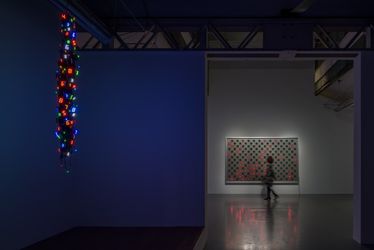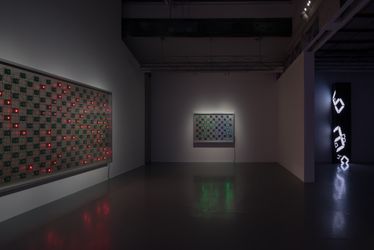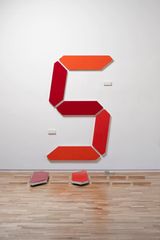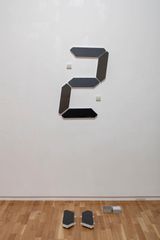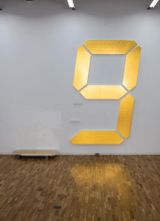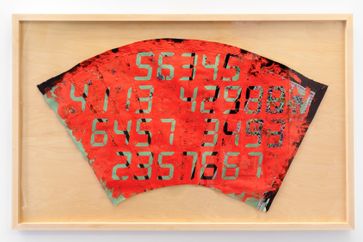
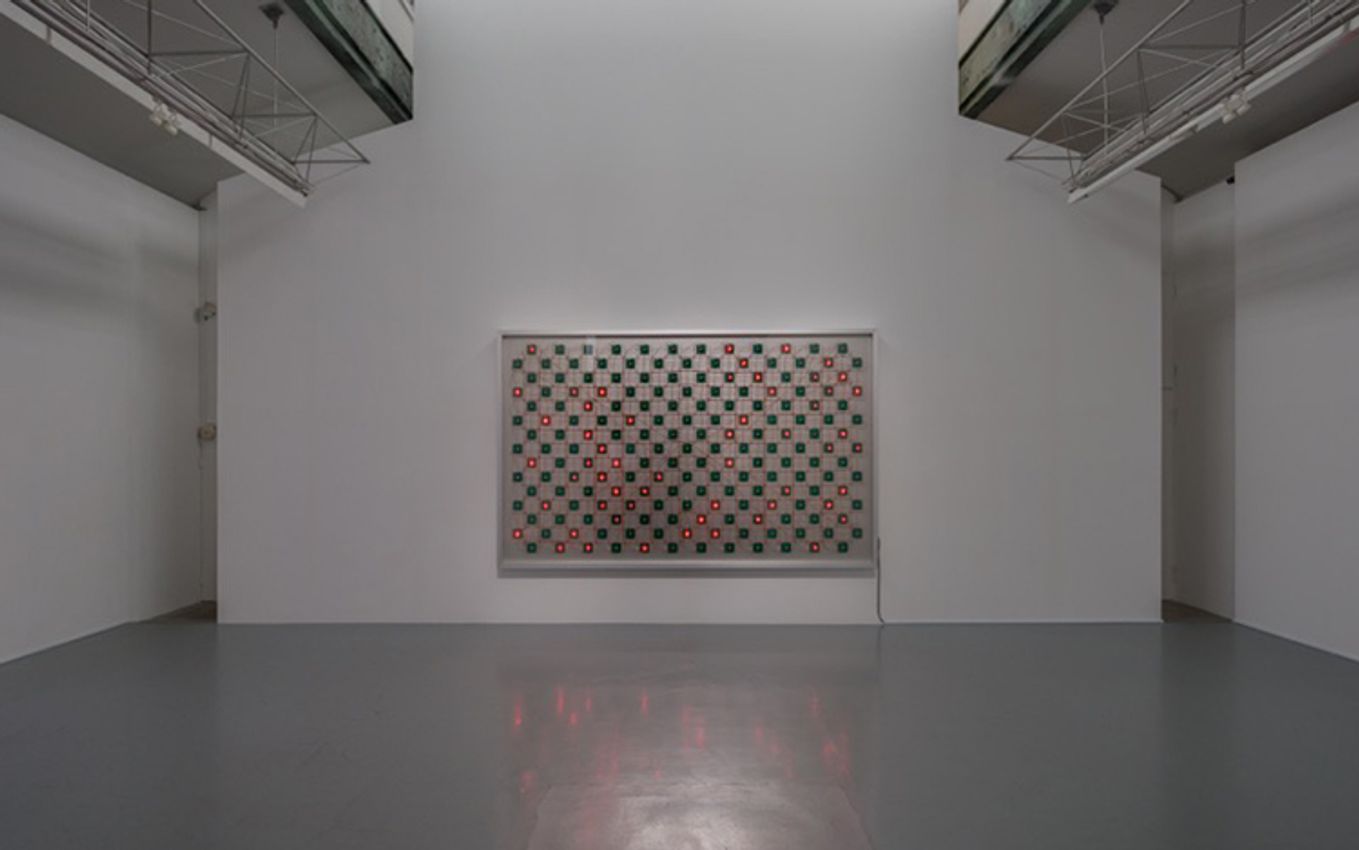
With the gleam of light emitting diodes (LEDs), which continuously count between 1 and 9, Tatsuo Miyajima portrays the eternal luminance of human life using numbers as a universal language. In his work, a flow of number sequences represents the flow of life from birth to death, as well as our integral connectivity to others. In 2012, the artist worked with Professor Takashi Ikegami, researcher of artificial life at Tokyo University, to develop a self-moderating network of lighting signals called IKEGAMI Model, which behave like a living organism using unique programming and electronic circuitry. Advanced by the scientific perspective whereby an individual life form is viewed as an active agent adapting itself to the environment in communication with others and the whole, the IKEGAMI Model produces conditions where one electronic signal initiates a chain of unpredictable reactions, constantly rewriting its own programme.
Miyajima’s new series Life (Complex System) consists of IKEGAMI Model digital counters neatly positioned on an electronic circuit board, and housed in a stainless steel case. These counter agents glow gently and are connected with coloured electronic wires resembling fine blood vessels,, evoking the image of artificial life generating breath in a laboratory incubator. Manifesting individual characters as they ash in the three primary colours of light, the diodes’ luminosity eventually fades into a moment of darkness replacing zero. This darkness suggests death - though only momentarily - and light reemerges to count again following the Buddhist belief in reincarnation. The semi-permanent life of LED technology evokes an eternal time flow, unifying the mystery of life, scientific theories, and religious doctrines.
Last year, Miyajima presented a light installation Time Waterfall (2016), spanning the entire façade of Hong Kong’s iconic 490-meter-high International Commerce Centre (ICC) building. Named after this installation, Time Waterfall (2017) is a projected sequence of the numerical digits on a 3-meter-high LED panel, with digits of various sizes cascading at different speeds. It stresses how time is irreversible, and breeds an ethos of ‘living in the present’.
Buddhism emphasises a system of causal relationships within the universe that constitutes the natural order. Chains of reactions creating a situation that governs a moment; a single electronic signal may unfold into an unexpected light spread. In the age of accelerated information technology and post-truth politics, it may be this light of artificial life that predicts how our aggregate intelligence will react in the future.
It keeps changing / It connects with everything / It goes on forever – Tatsuo Miyajima


SCAI The Bathhouse is a contemporary art gallery located in Yanaka, with a town ambience reminiscent of Old Tokyo. In walking proximity to Ueno, an area dense with museums and art schools, the gallery was converted from a venerable 200-year-old public bathhouse. Take a step inside, and you will find a white cube with soft natural light descending from the high ceiling.

A respected voice in contemporary art discourse.
Focusing on ambitious storytelling and insightful art-world commentary. Ocula Magazine publishes in-depth interviews, critical essays and timely analysis on the artists, exhibitions and ideas driving the global art world.
Learn more about Ocula Magazine
Showcasing the best of the art world.
Ocula partners with galleries from around the world to highlight their artists, artworks and exhibitions. Gallery membership is by application and invitation, with each member vetted by an independent panel.
Learn more about Ocula Membership

Specialises in the sale of major artworks.
Led by a team with deep ties to the world’s leading auction houses, galleries and collectors. Ocula’s advisory team offers bespoke services to high-net-worth clients from around the world who are looking to acquire the best of contemporary and modern art.
Learn more about our team and services