





KARA WALKER
b. 1969, United StatesKara Walker’s artistic practice uses painting, installation, film and printmaking to explore ideas around race, identity and violence. Her provocative but darkly humorous pieces take apart racist archetypes and examine how society depicts the social and psychological consequences of the slave trade.
Early Years
Kara Walker was born in 1969 in Stockton, California. When she was 13, the family moved to Stone Mountain, just outside Atlanta in Georgia, because her father (the artist Larry Walker) had taken a teaching job. Stone Mountain Park is home to the world’s largest Confederate monument: a relief sculpture of Robert E Lee, Stonewall Jackson and Jefferson Davis. Walker has said that the carving encapsulated “this weird insidious way that the Lost Cause looms as a mode of defiance and self-delusion”. Walker gained her BFA from Atlanta College of Art in 1991 and her MFA from Rhode Island School of Design in 1994.
Kara Walker: Artworks
Described as “an uneasy balance of ornament and content”, Kara Walker’s artworks tear down the nostalgia of history, although viewers may not see the true message until the second look. Her early pieces used silhouettes (during the 19th century, this was an art form adopted by females in higher social classes) to create scenes that unfold from romance into violence. Walker also references other historical art forms, including shadow puppetry and magic lantern projections, to create often disturbing sexual and violent artworks.
- A Subtlety (or, to give it its full title, A Subtlety: Or... the Marvellous Sugar Baby an Homage to the unpaid and overworked Artisans who have refined our Sweet tastes from the cane fields to the Kitchens of the New World on the Occasion of the demolition of the Domino Sugar Refining Plant) was Walker’s first large-scale public project, installed in the derelict Domino Sugar refinery in Williamsburg, New York City in 2014 and attracting visitors including Jay Z and Beyoncé. The enormous, curvaceous, sugar-coated sphinx, reflected on sugar’s controversial, slavery-dependent history.
- Kara Walker originally made The Katastwóf Karavan for the Prospect 4 Triennial in New Orleans in 2017, where it stood at Algiers Point on the Mississippi River, a site that had housed slaves before they were sold. The sculptural work—which included a steam calliope, a 19th-century musical instrument, inside a steel-wrapped wagon featuring the artist’s familiar silhouettes—later moved to other venues in the US.
- In 2019, Kara Walker created Fons Americanus, a huge fountain installed in the Turbine Hall of Tate Modern that asked viewers to consider how public monuments ask us to remember history (it was installed not long after demonstrations urging the removal of statues in the UK and the US celebrating colonialist figures). Inspired by the Victoria Memorial at Buckingham Palace, Fons Americanus was highly detailed, including a series of motifs about the global history of violence against Black Africans.
- For 2025’s Monuments exhibition in Los Angeles, Walker reconstructed and recontextualised a statue of Confederate general Stonewall Jackson that had formerly stood in Charlottesville, Virginia. To create the sculpture Unmanned Drone, Walker cut the statue into pieces and reassembled it as a disjointed entity, including a clenched fist on the ground.
Kara Walker: Select Awards
- MacArthur Fellowship (“genius grant”) (1997)
- Membership of the American Academy of Arts and Letters (2012)
- Tepper Chair in Visual Arts, Mason Gross School of the Arts, Rutgers University (2015)
- Contemporary Vision Award, San Francisco Museum of Modern Art (2018)
- Gold Medal for Graphic Art, American Academy of Arts and Letters (2022)
- Charles Wollaston Award, Royal Academy (2023)
Kara Walker: Select Exhibitions
Select Solo Exhibitions
- Kara Elizabeth Walker presents Dispatches from A— and the Museum of Halfremembered Histories, Sprüth Magers, Berlin (2025)
- Kara Walker, Fundación PROA, Buenos Aires (2025)
- Fortuna and the Immortality Garden (Machine) / A Respite for the Weary Time-Traveler. / Featuring a Rite of Ancient Intelligence Carried out by The Gardeners / Toward the Continued Improvement of the Human Specious / by Kara E-Walker, San Francisco (2024)
- Kara Walker: Back of Hand, Poetry Foundation, Chicago (2024)
- The Katastwóf Karavan, Glenstone, Potomac (2023)
- Kara Walker: Back of Hand, Georgetown University Art Galleries, Washington (2023)
- A Black Hole is Everything a Star Longs to Be, Kunstmuseum Basel (and Frankfurt) (2021)
- Drawings, Sikkema Malloy Jenkins, New York (2020)
- Kara Walker: Figa, Deste Foundation, Athens (2017)
- Emancipating the Past: Kara Walker’s Tales of Slavery and Power, University of Wyoming Art Museum (2016)
- Kara Walker: Norma, Victoria Miro Gallery, London (2015)
- Kara Walker, The Metropolitan Arts Centre, Belfast (2014)
- Kara Walker, Rise Up Ye Mighty Race!, The Art Institute of Chicago (2013)
- Fall Frum Grace, Miss Pipi’s Blue Tale, Lehmann Maupin, New York City (2011) * Kara Walker: Harper’s Pictorial History of the Civil War (Annotated), Cincinnati Art (2010)
- The Black Road, CAC Málaga (2008)
- Kara Walker: My Complement, My Enemy, My Oppressor, My Love, Whitney Museum of American Art, New York City (and Paris, Harvard, Minneapolis) (2007)
- Kara Walker at the Met: After the Deluge, The Metropolitan Museum of Art, New York City (2006)
- Song of the South, Redcat, Los Angeles (2005)
- Grub for Sharks: A Concession to the Negro Populace, Tate Liverpool (2004)
- Excavated from the Black Heart of a Negress, Studio Museum in Harlem, New York City (2003)
- Kara Walker, Slavery!, Slavery!, 25th São Paolo Biennial (2002)
- Kara Walker, Taka Ishii Gallery, Tokyo (2001)
- Why I Like White Boys, an Illustrated Novel by Kara E Walker Negress, Geneva Contemporary Art Centre (2000)
- Another Fine Mess, Brent Sikkema, New York City (1999)
- Kara Walker: Prints, The Print Centre, Philadelphia (1998)
- Presenting Negro Scenes Drawn Upon My Passage Through the South and Reconfigured for the, Benefit of Enlightened Audiences Wherever Such May Be Found, By Myself, Missus KEB, Walker, Coloured, The Renaissance Society at the University of Chicago (and The Cincinnati Contemporary Arts Centre and Henry Art Gallery, Seattle (1997)
- From the Bowels to the Bosom, Wooster Gardens/Brent Sikkema, New York City (1996)
Select Group Exhibitions
- 10 Years LA!, Sprüth Magers, Los Angeles (2026)
- Everything is true—Nothing is Permitted, Brutus, Rotterdam (2025)
- Entangled Pasts: 1768–Now, The Royal Academy of Arts, London (2024)
- Longing, Grief, and Spirituality: Art Since 1980, The Menil Collection, Houston (2023)
- Summer Exhibition 2023, The Royal Academy of Arts, London (2023)
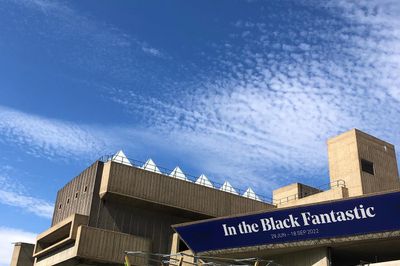
- In the Black Fantastic, Kunsthal Rotterdam (and London) (2022)
- Womanology, Bilbao Fine Arts Museum (2021)
- This World Is White No Longer, Museum der Moderne Salzburg (2021)
- Andy Warhol to Kara Walker: Picturing the Iconic, The Art Museum of Sonoma County, Eugene (2020)
- She Persists, A Century of Women Artists in New York, Gracie Mansion, New York City (2019)
- Outliers and American Vanguard Art, Los Angeles County Museum of Art (and Atlanta and Washington DC) (2018)
- Art in the Open: Fifty Years of Public Art in New York, Museum of the City of New York (2017)
- Southern Accent: Seeking the American South in Contemporary Art, Speed Art Museum, Louisville (2017)
- Beyond Mammy, Jezebel and Sapphire: Reclaiming Images of Black Women, Alexandria Museum of Art, Los Angeles (2016)
- America is Hard to See, Whitney Museum of American Art, New York City (2015)
- Remembering is Not Enough, MAXXI, Rome (2013)
- Slash: Paper Under the Knife, Museum of Arts and Design, New York City (2009)
- 52nd Venice Biennale (2007)
- Drawing from the Modern, 1975–2005, MoMA, New York City (2005)
Further Reading
- Kara Walker’s Instagram
- Kara Walker’s official website
- Profile at Sprüth Magers
Kara Walker FAQs
What happened between Kara Walker and Betye Saar?
During the late 1990s, an argument broke out between Walker and the artist Betye Saar when Saar called Walker’s work “revolting and negative and a form of betrayal to the slaves”. In a pre-social media world, Walker was not “cancelled”, but Saar wrote letters that persuaded some spaces to remove Walker’s work.
Did Kara Walker direct an opera?
Yes, at the 2015 Venice Biennale, Walker was responsible for stage direction, set design and costume design for a six-performance run of Vincenzo Belliini’s Norma, transposing the setting from Roman Gaul to the late 19th century and an unspecified African country under European colonial rule.
What are the main themes in Kara Walker’s work?
Kara Walker’s artwork asks viewers to question the presentation of American history and how it addresses race, gender, sexuality and power, particularly regarding the ongoing trauma caused by the slave trade. Her controversial use of racial caricatures is an act of subversion, highlighting the bigotry of history.
Ocula

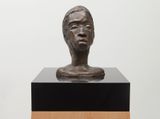



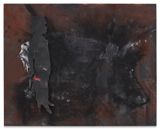
182.9 x 228.6 x 6.3 cm
Sprüth Magers Request Price & Availability

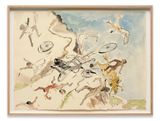

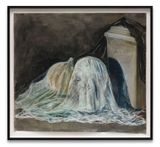

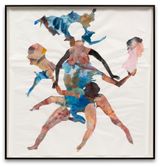

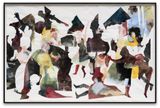

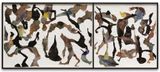

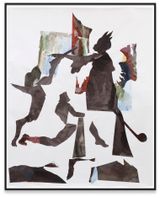

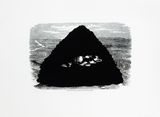
Explore Kara Walker's Exhibitions


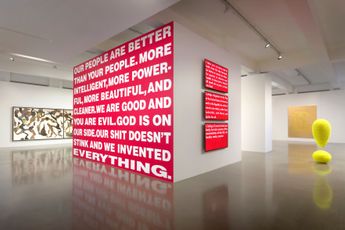

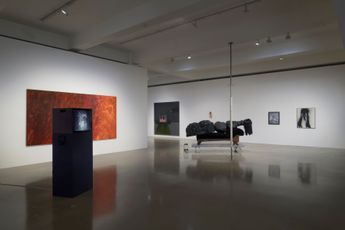


Kara Walker in Ocula Magazine







Explore and Follow Artists Shaping Contemporary Art
A respected voice in contemporary art discourse.
Focusing on ambitious storytelling and insightful art-world commentary. Ocula Magazine publishes in-depth interviews, critical essays and timely analysis on the artists, exhibitions and ideas driving the global art world.
Learn more about Ocula Magazine
Showcasing the best of the art world.
Ocula partners with galleries from around the world to highlight their artists, artworks and exhibitions. Gallery membership is by application and invitation, with each member vetted by an independent panel.
Learn more about Ocula Membership
Specialises in the sale of major artworks.
Led by a team with deep ties to the world’s leading auction houses, galleries and collectors. Ocula’s advisory team offers bespoke services to high-net-worth clients from around the world who are looking to acquire the best of contemporary and modern art.
Learn more about our team and services