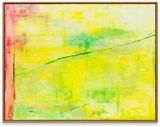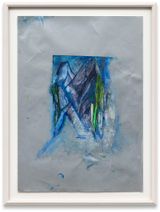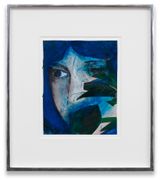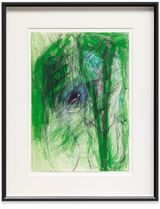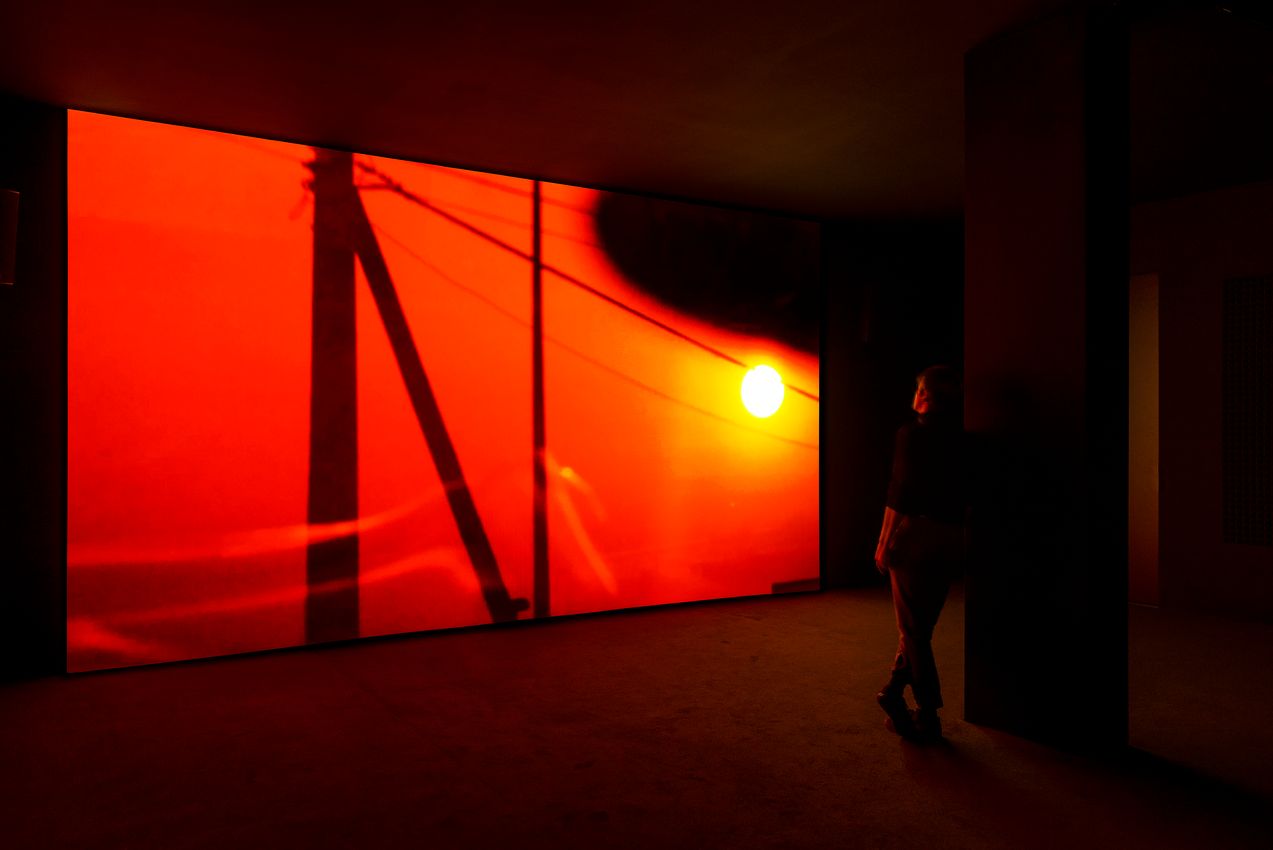
Andro Wekua’s work strides powerfully and forcefully in our direction–while constantly eluding us. As visitors we find ourselves caught between contradictory movements, and the result is a tension that we cannot easily escape. This accounts for some of the intensity and quality of Wekua’s work, but not all. Much of it has to do with the artist’s way of weaving images together and playing them against one another, and the undertow this creates. The draw of this maelstrom is narrative and cinematic in nature, although his films in particular tend toward abstraction.
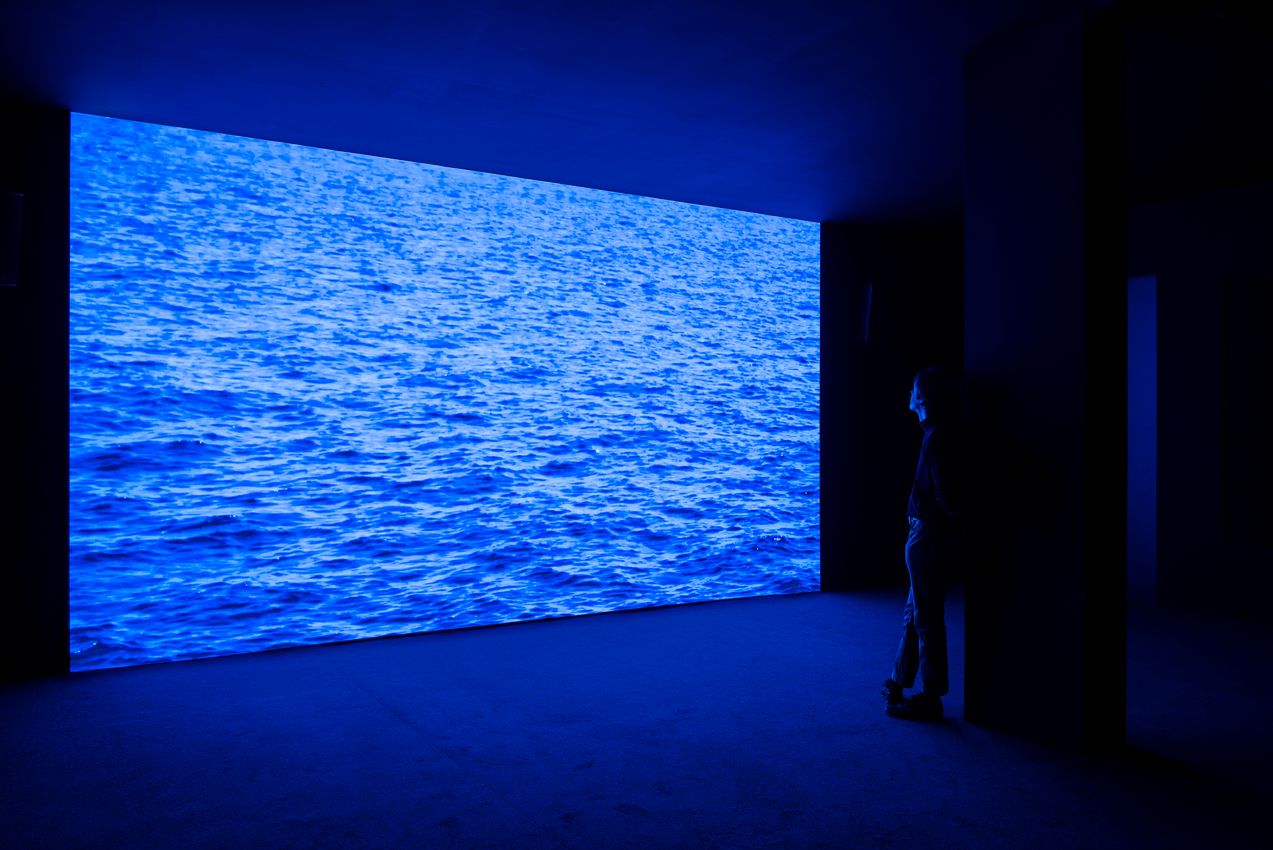
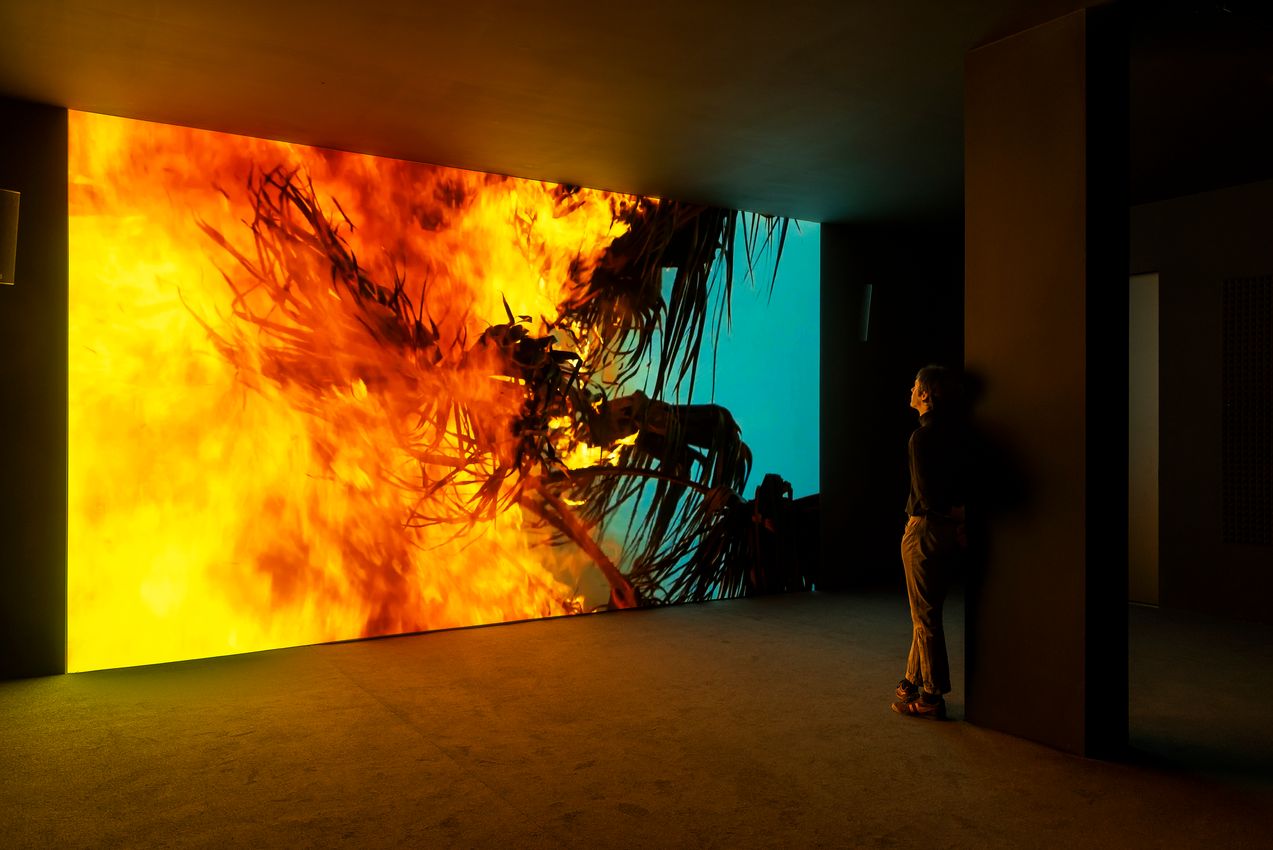
Take Wekua’s latest film All Is Fair in Dreams and War (2018). Running just over five minutes, the film unfolds before our eyes in the form of a central composition (or rather a Rorschach test). It is arranged around a central axis, a burning palm tree, which appears in the middle between 1 minute 54 and 3 minutes 14. It is a single (and the longest) uncut take, around which a series of shorter ‘before’ and ‘after’ sequences appear on the ‘left’ and ‘right,’ respectively. ‘Before’ (or left), we see a moon, sky, seagulls, palm trees, cars, city, dance, nature, water. ‘After’ (or right) shows a city, gambling, movement, water, sky, night, time, city, darkness. This triptych is held together and varied with a metallic soundscape by Berlin musician Jörg Hiller.
All Is Fair in Dreams and War appears dreamy and melancholic at first. But the true meaning of the film lies in its symmetry: how the before and the after group around the now, how the past and future form a space called the present that, like the palm tree, is forever burning. All Is Fair in Dreams and War brings all this to light in just five minutes.
Text by Daniel Baumann, Kunsthalle Zürich. Courtesy Sprüth Magers.
Known for his uncanny evocations of architecture and memory through exhibitions that imply a non-linear narrative, Wekua here creates a psychologically charged interior. A figure, at once robotic and lifelike, is isolated in a clean gallery space, behind a forbidding block wall that restricts the view to the outside world. The device from which the figure hangs suggests a playground swing, yet he or she hangs in a physically impossible position. Wekua poses questions about interior and exterior, private and public space, performance and imprisonment, revelling in an ambiguity that serves to provoke the viewer’s imagination.
Sprüth Magers has expanded from its roots in Cologne (Germany) to become an international gallery dedicated to exhibiting the very best in groundbreaking modern and contemporary art. With galleries located in Berlin Mitte, London’s Mayfair and the Miracle Mile in Los Angeles–as well as an office in Cologne and an outpost in Hong Kong–Sprüth Magers retains close ties with the studios and communities of the German and American artists who form the core of its roster.

A respected voice in contemporary art discourse.
Focusing on ambitious storytelling and insightful art-world commentary. Ocula Magazine publishes in-depth interviews, critical essays and timely analysis on the artists, exhibitions and ideas driving the global art world.
Learn more about Ocula Magazine
Showcasing the best of the art world.
Ocula partners with galleries from around the world to highlight their artists, artworks and exhibitions. Gallery membership is by application and invitation, with each member vetted by an independent panel.
Learn more about Ocula Membership

Specialises in the sale of major artworks.
Led by a team with deep ties to the world’s leading auction houses, galleries and collectors. Ocula’s advisory team offers bespoke services to high-net-worth clients from around the world who are looking to acquire the best of contemporary and modern art.
Learn more about our team and services