



Press Release

Sprüth Magers is pleased to announce Kaari Upson’s first solo exhibition with the gallery and her first in Germany. Upson’s practice is rooted in the question of contamination, unearthing the space between the self and the other, the indeterminable zone of ‘both.’ By investigating the domestic environment, Upson presents the wealth of emotional material that a familiar object or space can contain, exude, and expel; we leak all over our things, and they, in turn, leak their thingness back onto us. The intimate and mundane objects of the American household become bodily, uncanny, and multiple.

In the exhibition MMDP Upson again collapses the dichotomy between inside/outside, offering a Barthesian ‘third term’. By dividing the gallery into two twinned octagonal spaces, Upson offers the viewer two split viewing experiences. Upon entering the body is surrounded by a quartet of videos through the space. Each video is different but together they constitute a singular portrait: examining the inner life and outer experience of an unnamed blonde, who wanders the aisles of Costco, a new type of flâneur. Costco is presented as a formal landscape, a pastoral and emotional scene, cluttered with the ‘bulk’ of the American dream. In another video, the same blonde is seen in an idyllic forest, mid-ritual, sloshing around in a river, pulling a tarp over the ghostly floating bodies of other outcasts, setting fire to plastic towers. This setting is like Costco folded inside out, but the same figure moves through it with the same spectral determination. The psychic waste of our character pollutes both environments; neither is free, but both have hope.

The viewer then chooses between two hallways, and enters a second chamber. A sculpture sits in the negative space between the rooms, like a penumbra cast against the wall’s edge. Fossilized Pepsi cans sit in vertical troughs, buried standing up. Upson makes them using an experimental casting process: a Pepsi can is filled with liquid aluminum that melts into the can’s form, merging the stream of metal and the can into one solid object. The colors of the can burn off, but there is a shadow of the label left. They proliferate through the gallery, swarming. They look like the litter that’s left after the world burns down, remnants of a prehistoric future, the debris of a post- capitalist world. In the second chamber, the viewer can wander to the window, and see a twin sculpture, sprouting from the ground outside. The tomb is doubled, as the work descends into the real (or should we say natural?) world that surrounds the interior of the gallery. Upson’s work thumbs a puncture through the ghostly film that separates space: private, public, inner, outer, sacred, and profane.

In an accompanying publication Upson presents a log-book that follows the process and ephemera of the can’s production, layered and juxtaposed with the manuscript of Upson’s mother’s autobiography, which describes her life in East Germany and her journey to the United States.

Kaari Upson (*1972 in San Bernardino) lives and works in Los Angeles. Upcoming exhibitions include the 2017 Whitney Biennial and the New Museum, New York (2017). Her work has recently been shown in Los Angeles - A Fiction, Astrup Fearnley Museet, Oslo (2016); Adhesive Products, Bergen Kunsthall (2016); The Art of Our Time, Museum of Contemporary Art, Los Angeles (2015); Sleepless: The Bed in History and Contemporary Art, 21er Haus, Vienna (2015); No Man’s Land: Women Artists from the Rubell Family Collection, Rubell Family Collection, Miami (2015) and Test Pattern, Whitney Museum of American Art, New York (2013).

The Berlin gallery is concurrently presenting the solo exhibition REFRACTIONS by Robert Morris.

Kaari Upson

We start double, growing our own bodies inside another, already embedded in a life that is not completely our own. We are born wound up in our — or is it one belly for two? People say you die alone, but no one has ever been born that way. At first, our boundaries are permeable, shifting cells from person to person, with no sense of edges or property. This is not a metaphor: years after a woman gives birth, scientists can locate the unique genetic material of her baby floating around her cellular structures. The child becomes part of her body, and her body becomes part of the child. Love is a form of contamination.

This is where Kaari Upson’s work begins: the site where intimacy meets disgust, and the thin membrane between connection and alienation is punctured. Upson’s swarms of aluminum Pepsi cans, cast from the inside out, pile up like fossils in some post-capitalist future. At first glance, they seem like landfills, or graves, or towers of debris, accumulating endlessly. Their title, My Mother Drinks Pepsi reveals the personal narrative that weaves in and out of each commodity object. Upson fixates on the sound her mother makes when she pops open a Pepsi can, takes a first sip, and sighs aloud. It is a vocalizing of pleasure that Upson finds deeply disturbing. What is it about that sound (tschk, fizz, glurg, ahhhh) that scrapes against the boundaries between parent and child? The cans are the archetypal container, mass-produced voids, only useful when full — almost like mothers. They are copies of a copy, ‘the endless reproduction of a self-same pattern,’ — almost like daughters. Upson builds a monument to her mother: the shape of lack, the weight of the empty vessel. A seemingly innocuous moment (a sip of Pepsi) triggers the repulsion that accompanies the realization that the maternal body is also an erotic one, one that feels pleasure.The reliable satisfaction ofPepsi, always the same, counters the chaotic, intertwined reality of having and sharing a body.

The cans cluster like cells, stacked in the kind of symmetry that evokes genetic structure, or places of divine worship. Upson’s videos are also stacked and symmetrical, echoing the other’s content: twinning, warping, whispering across glass. It’s important to remember that mirrors do not reflect how things are. On the contrary, they hold an image of how we fear they might be, or how we imagine they should be. They are a glittering screen onto which we can project an idealized (or demonized) version of ourselves: whole, discrete, constant, and still. Our reflection is another empty vessel. What does it mean to make the same thing over and over again? To be the same thing, over and over? Mothers can be mirrors, as well as monsters. Just as we repudiate their abject desires, we also turn to them to see ourselves. Upson repeats herself, her mother, her objects, and her pleasures, in an effort to untangle the knot of mass production, memory, and maternal attachment.

Text by Kaari Upson and Audrey Wollen

Read More
About the Artist

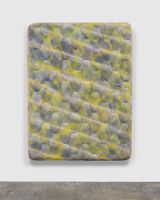
The majority of Kaari Upson’s career has been devoted to a single, multifarious series titled The Larry Project, 2007–onward. ‘Larry’ is the fictitious name Upson assigned to her parents’ neighbour, whose possessions she salvaged when his house burned down. Larry’s large trove of personal mementos—which included photographs, journals, and pornography—became the raw material or reference for Upson’s paintings, installations, performances, and films. She originally hoped to explore his psychological state of mind, but quickly realised, ‘I was using him as a mirror back on myself.’ Though she hasn’t figured out ‘an exit strategy’ for the project, Upson recently began a new monumental series: Sleep with the Key (2013), is comprised of silicon replicas of discarded mattresses Upson finds in L.A.—a reference the artist’s recent experience being bedridden with illness.

View Artist Profile

Also Exhibiting

About the Gallery

Sprüth Magers has expanded from its roots in Cologne (Germany) to become an international gallery dedicated to exhibiting the very best in groundbreaking modern and contemporary art. With galleries located in Berlin Mitte, London’s Mayfair and the Miracle Mile in Los Angeles–as well as an office in Cologne and an outpost in Hong Kong–Sprüth Magers retains close ties with the studios and communities of the German and American artists who form the core of its roster.

View Gallery Profile
Address
Oranienburger Straße 18
Berlin
Germany
Opening Hours
Tuesday - Saturday
11am - 6pm
(1)
Berlin Oranienburger Straße 18
Sprüth Magers
Oranienburger Straße 18, Berlin, Germany
+49 302 888 4030
http://www.spruethmagers.com

Opening hours
Tuesday - Saturday
11am - 6pm
The art world in focus