



Robert Irwin has spent over six decades producing art that examines our experience of seeing and moving through the world, heightening viewers’ awareness of their senses and surroundings. Regularly employing light, reflection and colors as their primary materials, his wall works, sculptures and site-conditional installations involve a careful balance of presence and absence that use simple, understated means to generate sophisticated visual and spatial effects. Monika Sprüth and Philomene Magers are delighted to present an exhibition of new work by the celebrated American artist, his second solo presentation at the Berlin gallery and his third with Sprüth Magers.
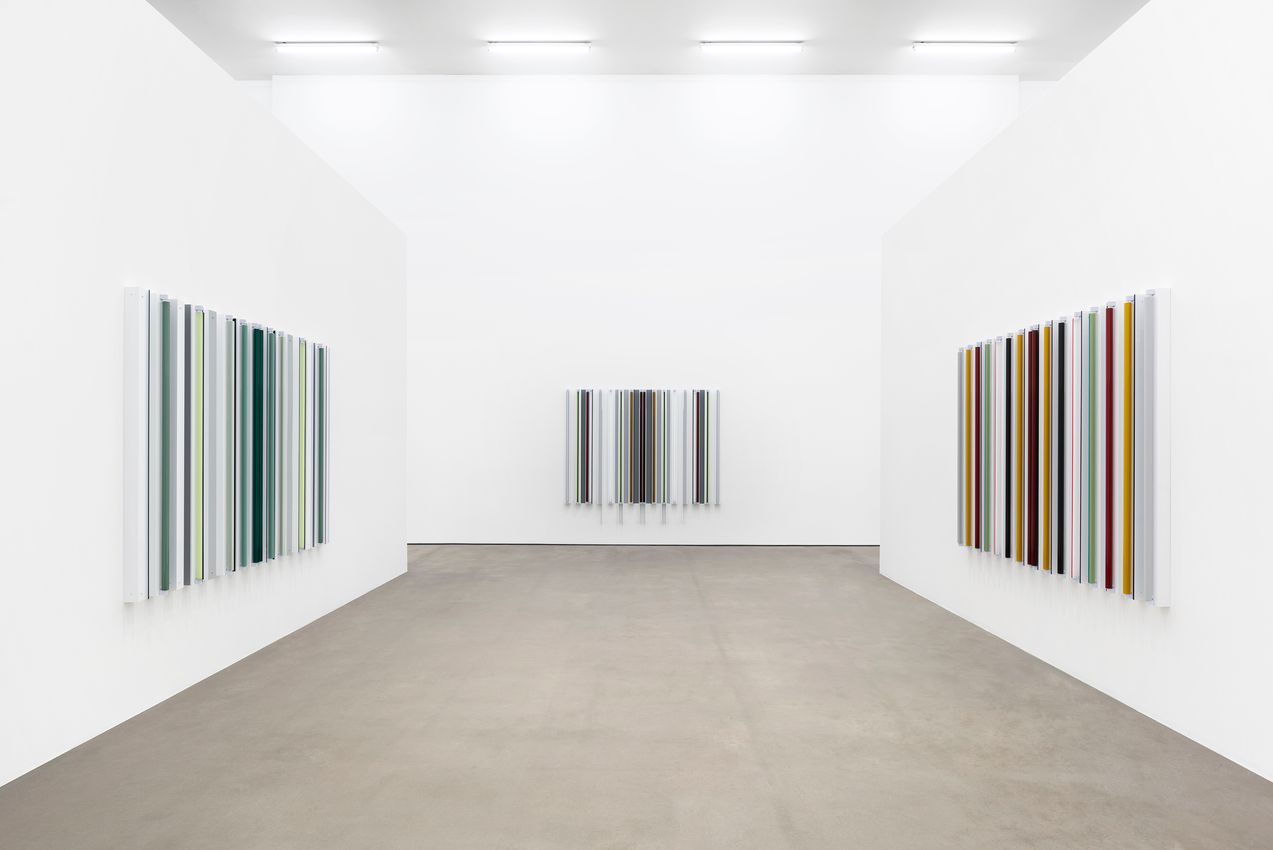
The exhibition features two bodies of work: several new ‘Unlights’ (Irwin’s unlit fluorescent wall works, which emit no light) and a group of acrylic sculptural configurations. The artist began working with fluorescent bulbs for the first time in the early 1990s, incorporating them into his renowned scrim installations; in the last decade, his use of fluorescent lights has evolved into standalone works. Atop these commercially available objects, Irwin wraps a layer, or layers, of coloured and metallic gels, similar to those employed in theatres to give stage lights their different tonalities; like a painter, he ‘blends’ these hues through juxtaposition, anticipating the brilliant visual effects that ensue and how our eyes perceive them. He also adds touches of black and white in the form of strips of tape running vertically along the bulbs, as well as on the sides of the light fixtures. These interventions create a feeling of depth and recession that defy the relatively flat, bas-relief nature of the objects.
Irwin defines his work as ‘conditional art’—attuned to the particular spaces in which they are seen at a particular moment. While some of Irwin’s fluorescent works are electrically powered, his ‘Unlights’ are not. Yet because of the complexity of his tonal manipulations, they often appear to be: as one encounters the works, moving in front of and around them, there is a flickering, pulsing sensation that occurs as one colour transitions to the next. This experience is also predicated on the light and atmospheric conditions in which the works are installed, to which Irwin draws our attention, asking us to take notice.
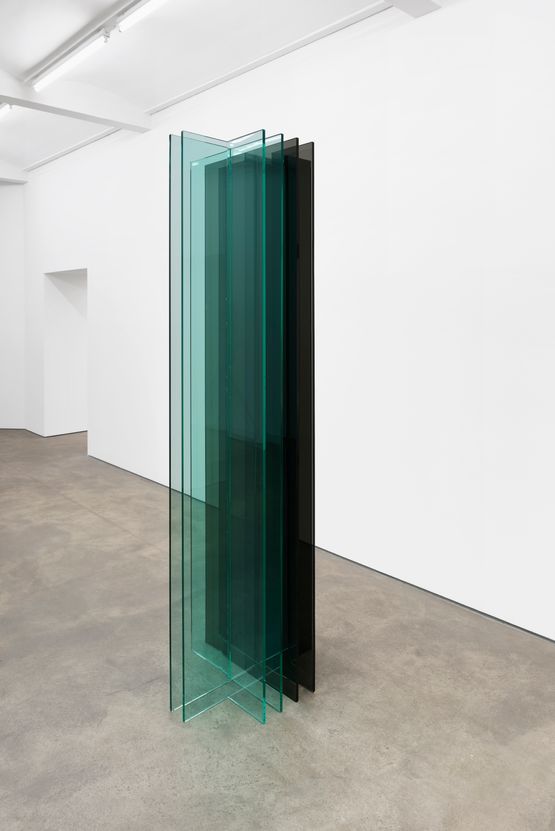
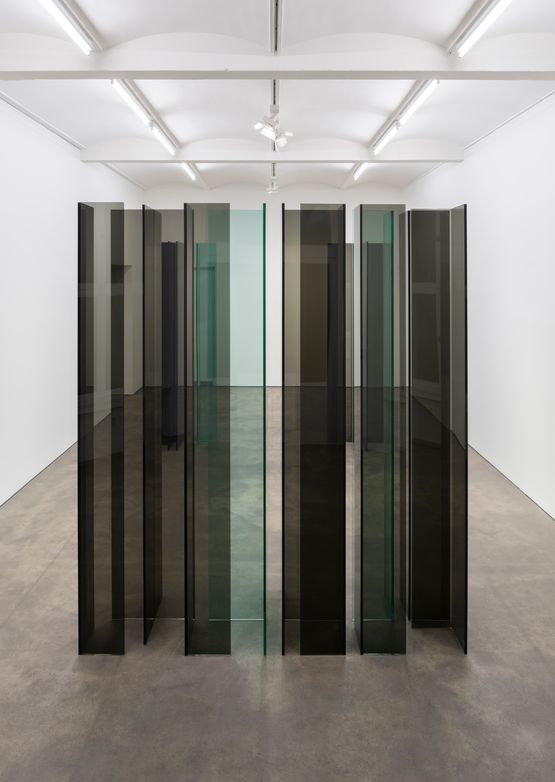
Three of Irwin’s acrylic sculptural configurations from 2018 also illustrate the artist’s urge to create phenomenological experiences through subtle changes in light, colour and surface. Irwin first worked with this material and form in the late 1960s and early 1970s, producing tall, transparent columns that disappeared and reappeared before viewers’ eyes as they changed position. Reminiscent of obelisks and monuments, Irwin’s columns and configurations are dedicated not to any event or cause, but rather to the perceptions of light as it travels across the room and interacts with the viewers’ senses.
These recent configurations are made from coloured acrylic, in shades that transition from smoky grey to glassy pale blue-green. Glimpses of the gallery space come and go within the walls and edges of the acrylic panels, which sometimes appear transparent, while elsewhere they look opaque. As art historian Matthew Simms wrote in 2018: ‘The configurations, when viewed by an ambulatory visitor, give rise to sensations of parallax, as they appear to rotate in space as the viewer moves around them.’ Just as they did at the beginning of his career, Irwin’s objects continue to surprise and move us, even to throw us off balance, with seemingly simple interventions, reminding us to stop and experience the physical world and its many phenomena.
Concurrent with this exhibition, Irwin will also début a major new site-specific work, Light and Space (Kraftwerk Berlin) (2021), organised by the Berlin-based art foundation LAS and on view at Kraftwerk Berlin, December 5, 2021 through January 30, 2022.
Robert Irwin (*1928, Long Beach, CA) lives and works in San Diego, CA. Solo exhibitions include those at Pratt Institute School of Architecture (2019), University Art Museum, California State University, Long Beach (2018), Hirshhorn Museum and Sculpture Garden, Washington, DC (2016), Corcoran Gallery of Art, Washington, DC (2010), Museum of Contemporary Art, San Diego (2007), Dia Center for the Arts, New York (1998), Musée d’art contemporain, Lyon (1998), Reina Sofía, Madrid (1995), Musée d’art moderne de la Ville de Paris (1994), Kölnischer Kunstverein, Cologne (1994), and Museum of Contemporary Art, Los Angeles (1993). Since the early 1970s, Irwin has created site-conditioned installations and major architectural and environmental installations at institutions worldwide, including most recently Chinati Foundation, Marfa, TX (2016), Dia:Beacon (2015), Whitney Museum of American Art, New York (2013), Vienna Secession (2013), Los Angeles County Museum of Art (2010), and Walker Art Center, Minneapolis (2009).
Robert Irwin (b. 1928, Long Beach, California) lives and works in San Diego, California. Major solo exhibitions include All the Rules Will Change at the Hirshhorn Museum and Sculpture Garden, Washington, DC (2016), Primaries and Secondaries at the Museum of Contemporary Art, San Diego (2007), and a large-scale retrospective organised by the Museum of Contemporary Art, Los Angeles, that traveled to the Kölnischer Kunstverein, Cologne, the Musée d’art moderne de la Ville de Paris, and the Reina Sofía, Madrid (1993–1995). Since the early 1970s, Irwin has created site-conditioned installations at institutions such as the Museum of Modern Art, New York; the Whitney Museum of American Art, New York; the Walker Art Center, Minneapolis; the Museum of Contemporary Art, San Diego and La Jolla; and the Chinati Foundation, Marfa, Texas, among many others. The artist has also designed major architectural and environmental installations at the Los Angeles County Museum of Art, Dia:Beacon, and the Getty Center. Irwin has received numerous awards, including the Thomas Jefferson Foundation Medal in Architecture (2009), a John D. and Catherine T. MacArthur Fellowship (1984–1989), and a Guggenheim Fellowship (1976).
Sprüth Magers has expanded from its roots in Cologne (Germany) to become an international gallery dedicated to exhibiting the very best in groundbreaking modern and contemporary art. With galleries located in Berlin Mitte, London’s Mayfair and the Miracle Mile in Los Angeles–as well as an office in Cologne and an outpost in Hong Kong–Sprüth Magers retains close ties with the studios and communities of the German and American artists who form the core of its roster.

A respected voice in contemporary art discourse.
Focusing on ambitious storytelling and insightful art-world commentary. Ocula Magazine publishes in-depth interviews, critical essays and timely analysis on the artists, exhibitions and ideas driving the global art world.
Learn more about Ocula Magazine
Showcasing the best of the art world.
Ocula partners with galleries from around the world to highlight their artists, artworks and exhibitions. Gallery membership is by application and invitation, with each member vetted by an independent panel.
Learn more about Ocula Membership

Specialises in the sale of major artworks.
Led by a team with deep ties to the world’s leading auction houses, galleries and collectors. Ocula’s advisory team offers bespoke services to high-net-worth clients from around the world who are looking to acquire the best of contemporary and modern art.
Learn more about our team and services