Interiors are sites of existential symbolism. They are the place where a child first clashes with the world – a location of real and symbolic protection for the ego. They collect the sediments of cultural history and of our own lives, marking an interspace between us and the world.
Few contemporary artists have so cannily, idiosyncratically explored the existential experience of the interior as Thea Djordjadze, whose expansive sculptural installations combine constructed and found elements into intuitive arrangements. The materials she uses range from the mundane to the elegant, from rigid timber and steel structures to amorphous plaster, textile and foam parts. Some of these objects are reused from one exhibition to another, running through her work like a continuous thread. With their striking psychological depth and unique physical impact, Djordjadze’s installations have an inimitable effect on the viewer.
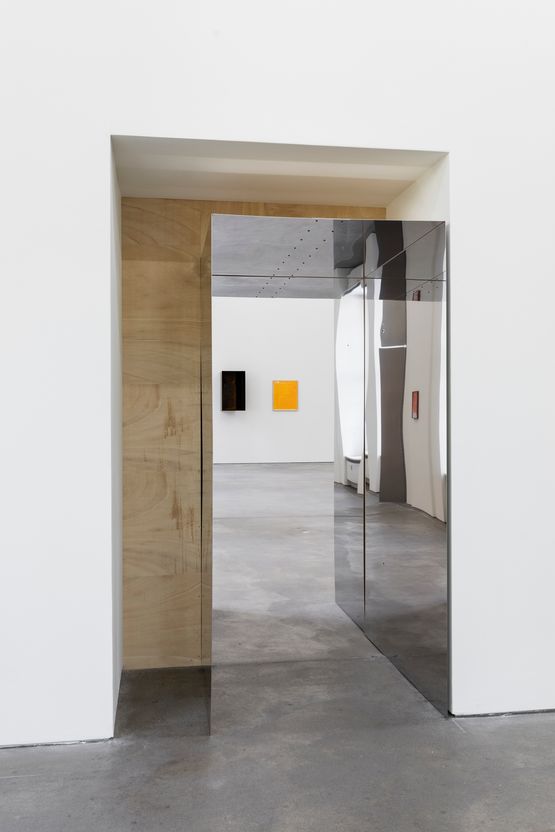
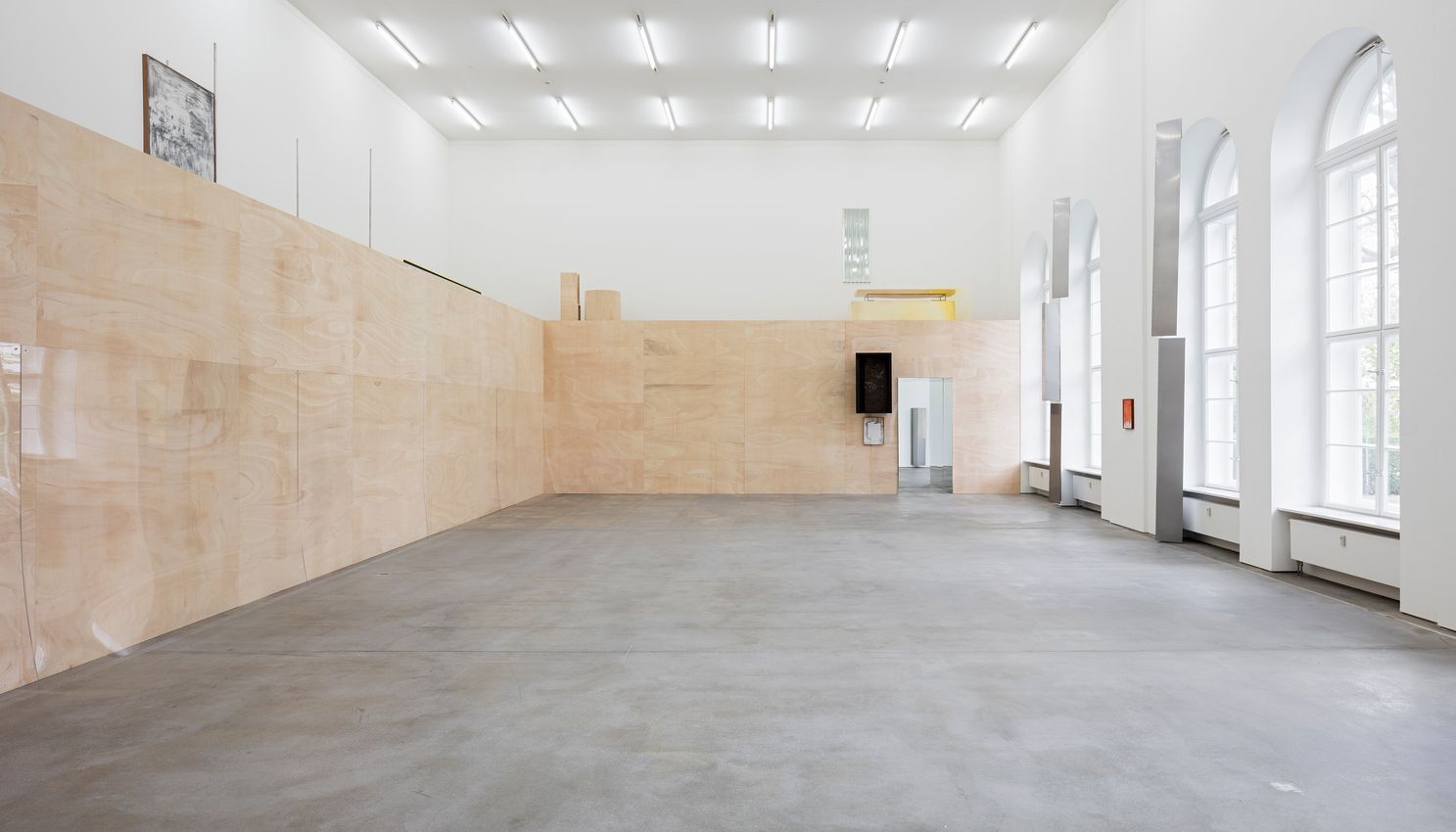
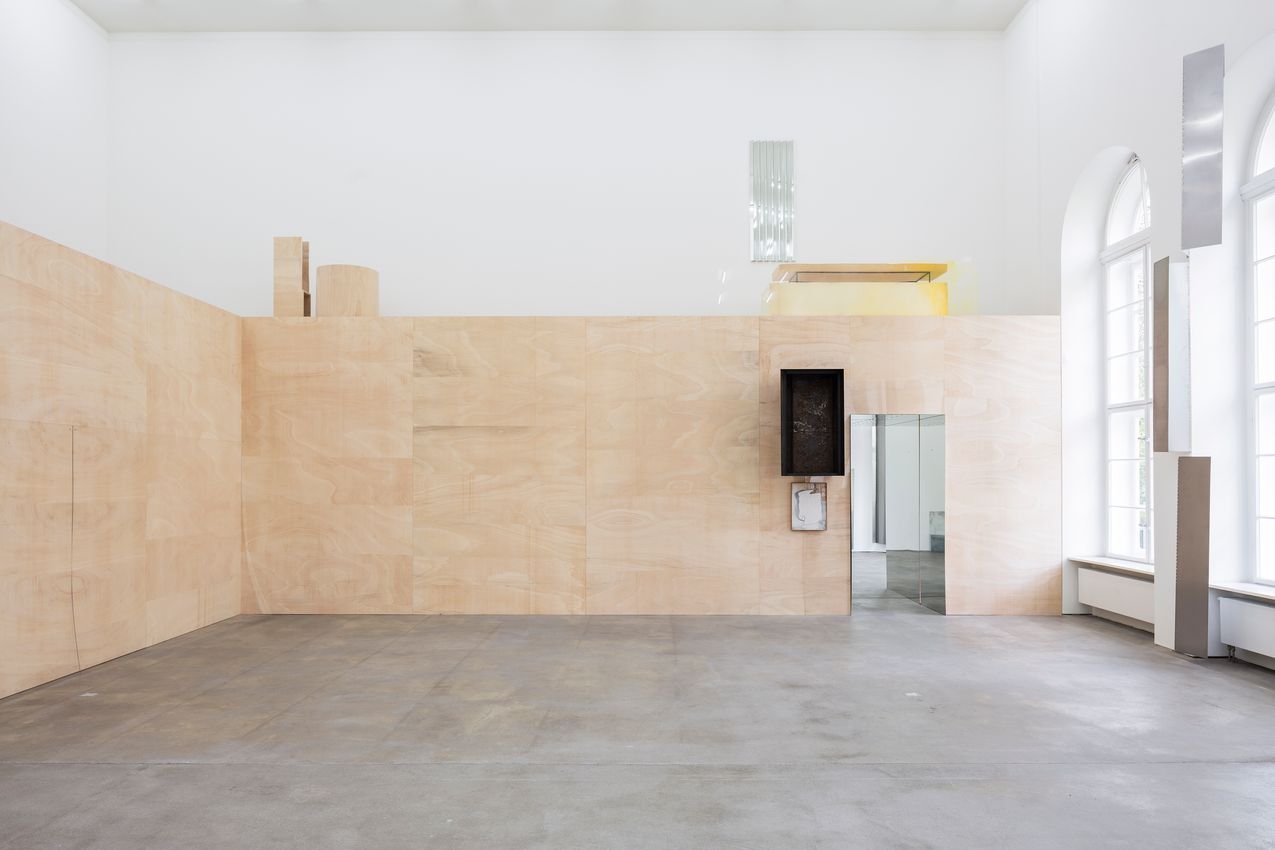
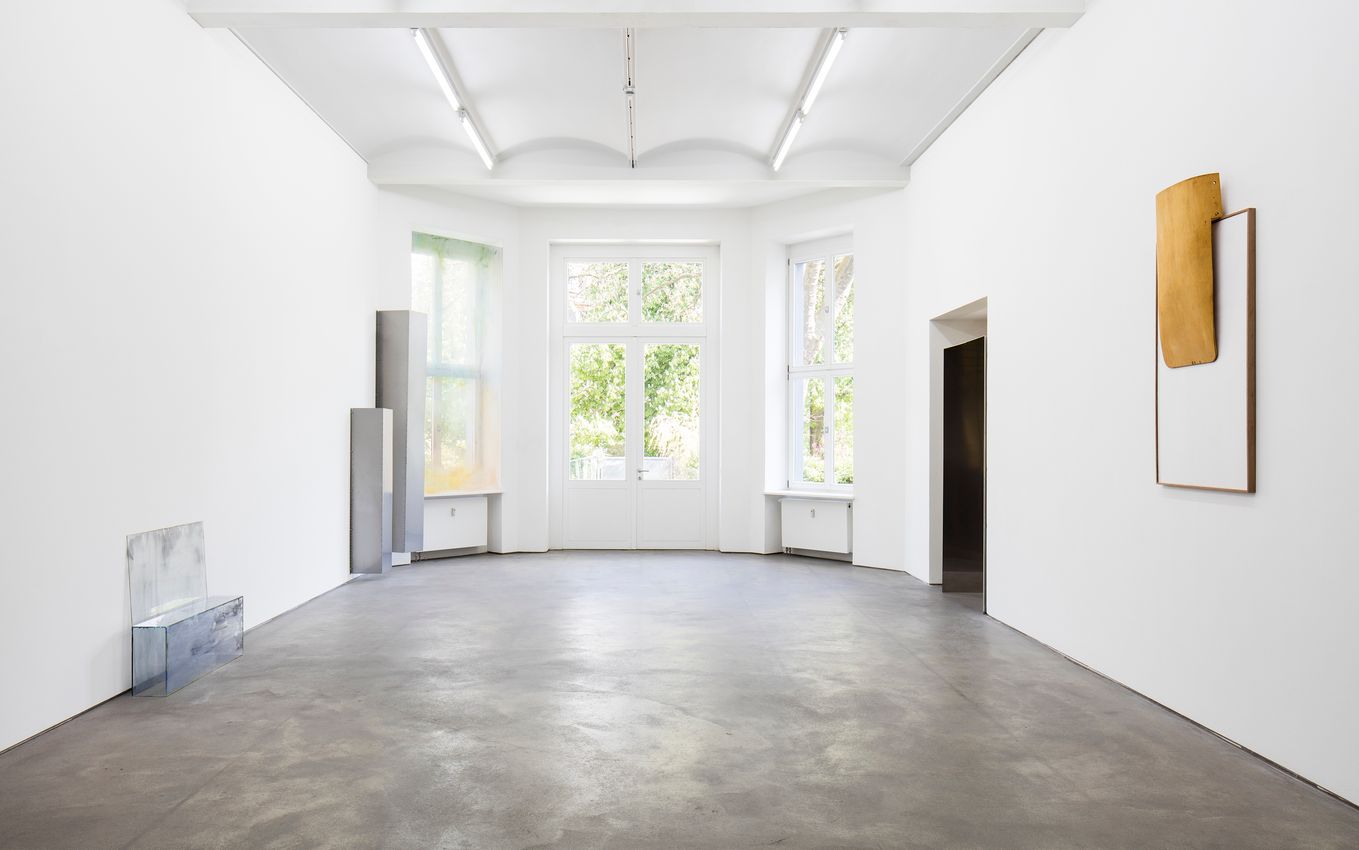
This meticulous narrative handling of the interior is also at the core of Djordjadze’s new exhibition at Sprüth Magers in Berlin. It takes a moment to notice the fine, mesmerizing light filling the first space in the installation – a light filtered through a Plexiglas plate mounted on a window, which Djordjadze has painted with a translucent mixture of gouache and housepaint, to create a thin haze of blue, yellow and green hues, sometimes red. The effect is subtle, not ostentatious, but it has a decisive, sustained impact on how the space is perceived. This fundamental impact on the viewer’s perception is evident in Djordjadze’s other spatial interventions as well. The two exhibition spaces are connected by a tunnel of polished stainless steel plates. Rather than create a seamless transition, their high-gloss, mirrored surfaces cause the viewer to hesitate when passing through, making for a certain sense of disorientation. An elaborate construction of untreated wood core plywood has scaled the otherwise large showroom down to ‘homelike’ dimensions: half-height walls reach deep into the museum-like exhibition space with their organic surfaces flanking it on two sides. Djordjadze mounted plexiglas plates along the timber wall here too, in which light from the window is reflected. Three of the windows feature sculptures made of raw steel plates connected with piano hinge; they transform the light entering the room and, despite their odd dimensions, look something like window shutters from a distance.
The installation has an atmospheric flair, fusing presumably familiar elements from Djordjadze’s work. Painted glass objects recall her 2008 intervention at the Neue Nationalgalerie in Berlin. Two dark wall sculptures with rusted interiors have the look of paintings – closer inspection reveals them to be planters from her installation at the 56th Venice Biennale in 2015. The plaster blocks filling Djordjadze’s mahogany frames – their surfaces covered in slapdash bits of paint residue – appear to be both paintings and sculptures at the same time. We also find examples of her objects that, despite their unsettling proportions, resemble furniture, as well as her dark steel structures that act like axonometric drawings in space.
Everything about these spaces exudes tremendous physical presence, yet remains abstract. It is an interior breached by the organism and the landscape – one that seems to contain the echoes and memories of other places, merging a multitude of time-fields and layers of perception. Djordjadze’s object constellations create an atmosphere that is difficult to describe, but can be felt immediately. There is so much more in the air than can be put into words.
Djordjadze’s dissonant materials and their expansive effect assume the language of bricolage, assemblage and collage articulated at the beginning of the modern age, when everyday objects found their way into art for the first time. But Djordjadze takes bricoleur to the extreme. Her version alters architectural space, challenging the visual clarity and inherent wholeness of the individual objects. The installation’s vocabulary seems to oscillate between architectural history, Minimalism and Conceptual art. The parallels are never explicit, the references never more than a hint. Instead they are more of an unconscious manifestation of memories.
In a way, Djordjadze’s installations have to do with temporary and site-specific concepts of an archeology of the interior – an archeology of atmospheres, of the half-conscious, of space-turned-memory. These interiors are not governed by the same laws as others, which is precisely what makes the viewer aware of how she or he normally moves through space. They dissect the cultural practices of the interior and resonate with our collective dreams. They allow the stability and fragility of objects to lead our intuition astray, challenge mental projections only to let them fail and cause the viewer to measure the room like a cartographer.
Djordjadze’s aesthetic blurs all known boundaries of the interior and fundamentally confuses our obvious and unconscious perceptions of what an object and non-object can be, of mimesis and abstraction, result and process, inside and outside. She feels out a liminal border region in the viewer’s perception, probing past and present, participation and imagination. She explores a psychological space in art that many would not believe existed. Her project is that of transformative poetry.
Thea Djordjadze (1971, Tbilisi, Georgia) lives and works in Berlin. Her work has been shown in numerous solo exhibitions, such as MoMA PS1 (2016); South London Gallery (2015); MIT Cambridge (2014); the Aspen Art Museum (2013); Malmö Konsthall (2012); The Common Guild Glasgow (2011); Kunsthalle Basel (2009) and Kunstverein Nürnberg (2008). Major group exhibitions include the 56th Venice Biennale (2015); dOCUMENTA 13, Kassel (2012) and BB5 – 5th Berlin Biennale (2008). A solo presentation of her work opens September 2016 at Vienna Secession.
For her multipartite sculptural ensembles, Djordjadze uses everyday materials such as foam, steel, fabric, glass and plaster along with found objects which refer to the classical materials of sculpture but also the traditions of arts and crafts. The artist’s sculptures themselves are situated between form and anti-form, a combination of stable structures and fragile, gestural renderings typically exhibited together in a carefully choreographed setting. The installations, incomplete and fragmentary in character, oscillate between open spatial designs and dense performative gestures, emphasizing the contrasts between mental and actual interior spaces, between intimacy and public presence.
Sprüth Magers has expanded from its roots in Cologne (Germany) to become an international gallery dedicated to exhibiting the very best in groundbreaking modern and contemporary art. With galleries located in Berlin Mitte, London’s Mayfair and the Miracle Mile in Los Angeles–as well as an office in Cologne and an outpost in Hong Kong–Sprüth Magers retains close ties with the studios and communities of the German and American artists who form the core of its roster.

A respected voice in contemporary art discourse.
Focusing on ambitious storytelling and insightful art-world commentary. Ocula Magazine publishes in-depth interviews, critical essays and timely analysis on the artists, exhibitions and ideas driving the global art world.
Learn more about Ocula Magazine
Showcasing the best of the art world.
Ocula partners with galleries from around the world to highlight their artists, artworks and exhibitions. Gallery membership is by application and invitation, with each member vetted by an independent panel.
Learn more about Ocula Membership

Specialises in the sale of major artworks.
Led by a team with deep ties to the world’s leading auction houses, galleries and collectors. Ocula’s advisory team offers bespoke services to high-net-worth clients from around the world who are looking to acquire the best of contemporary and modern art.
Learn more about our team and services