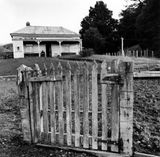
Starkwhite is delighted to present our first exhibition of Marti Friedlander’s work in partnership with the Marti Friedlander Estate.
Marti Friedlander (1928–2016) had an almost sixty year career in New Zealand. She arrived from England in early 1958 and was taking photographs until shortly before her death. From the early 1960s on she became one of the best-known and most celebrated photographers here; her work reproduced in periodicals and books and exhibited ever more widely, especially after the Auckland Art Gallery-organised retrospective in 2001, which toured the country.
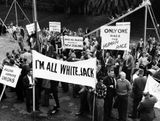
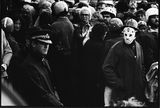
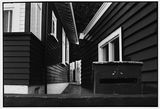
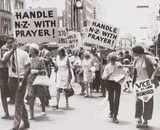
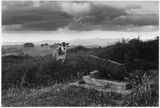
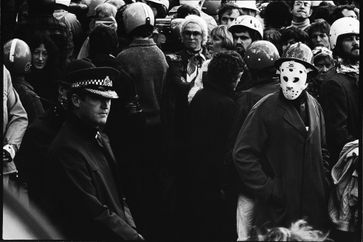
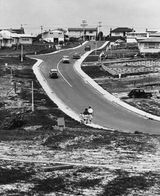
Most of the photographs in this exhibition are original prints from the 1960s and 1970s, with many of them included in her Larks in a Paradise (1974, with texts by James McNeish). Except for two, a New York street scene and the self-portrait made in Paris, they are all New Zealand subjects. And those subjects are diverse— city, suburban, small town, rural and one ‘wilderness’ (Milford Sound), various kinds of protests and demonstrations, work and ceremonies, as well as their equally diverse human inhabitants and participants. Larks in a Paradise was subtitled New Zealand Portraits, and while it did include literal portraits of individuals, it was more portraits of aspects of New Zealand society and manners of living and being here, as perceived by a still relatively recent immigrant from the other side of the world and a very different cultural background from the vast majority of subjects—sharp-eyed, exploratory views of the places and people she found herself in and among by an outsider aiming to come inside. Creative outsiders can often see a society and it’s people in ways insiders cannot or don’t want to. In short they open eyes to what had not been represented before, or what had only been half seen. That was, and is, so with Marti Friedlander’s pictures, not all of which make comfortable viewing. For instance, consider Pub, South Island (1967): a solitary man, locked into himself, his fist clenched, separate from others; an image of an almost explosive, not-so-latent tension, ‘captured’ by a woman photographer, at a time when women rarely entered public bars. Or, how can we see Mt Eden (woman with glasses) from 1969, a bland title for a Diane Arbus-like vision of things, askew from the surfaces of otherwise polite, suburban appearances. There is also wit, warmth and empathy in Friedlander’s imaging of experiences, as in the two Catholic Brothers in their vineyard, the sheep shearers, and the Turangawaewae Marae Jubilee (1971). Marti Friedlander’s photographs work through suggestion, rather than by preaching or declaiming, especially when the subjects touch on the complexities of New Zealand history, as with Ruapekapeka and its foreground cannon and cows, beyond which are open land and a lowering sky – pastoral riches on the site of what Governor George Grey declared a decisive battle, though in fact inconclusive, between Maori led by Kawiti (Ngapuhi) and British troops in January 1846. Nearly 120 years later Marti Friedlander pictured the then Governor-General Sir Bernard Fergusson at Waitangi. In full ceremonial regalia, he might immediately seem, with his extraordinary moustache, monocle and antique quasi-nineteenth century military garb, a self-parody of imperial delusion, though in fact Fergusson was well-known for his sociability with everyone, his deep concerns about Maori-Pakeha relations and his promotion of the need to revitalise te reo Maori and include Maori properly and fairly in public and civic life.
Appearances may be deceptive, and Marti Friedlander’s photographs often probe beyond surfaces and visualise social and psychological conditions, ambivalences and ambiguities, which might be difficult to articulate otherwise. You need to look closely not just what she photographed, but also, and crucially, at how she pictured her subjects. Each photograph in this exhibition could be the starting point of a complicated story—as the best photographs are.
References: his Marti Friedlander (2009) and Marti Friedlander: Portraits of the Artists (2020), both published by Auckland University Press.
Text by Leonard Bell, 6 July 2024. Courtesy Starkwhite, Auckland
Marti Friedlander (1928–2016) was born in London, UK. Friedlander photographed the people of Aotearoa New Zealand from the 1960s up until the present. By bringing an immigrant’s perspective to her adopted country she showed New Zealanders to themselves. An acclaimed photographer, she is especially celebrated for her portraits of artists and her portraits of the last Māori women to have received the chin moko in a customary manner during the 1960–70s. Friedlander’s images of protests, of rural and suburban life, and of everyday people and things captured Aotearoa New Zealand at a moment in time and in ways that have come to define this place.
Starkwhite is a contemporary art gallery in Auckland, New Zealand, specialising in the presentation of interdisciplinary visual art exhibitions with an international focus. Starkwhite is committed to a strong art fair programme engaging with the best of contemporary art practice.
In 2022 Starkwhite partnered with 1301PE (Los Angeles) to open 1301SW in Melbourne, Australia. 1301SW opened its second space in Sydney in October 2024. www.1301SW.com.

A respected voice in contemporary art discourse.
Focusing on ambitious storytelling and insightful art-world commentary. Ocula Magazine publishes in-depth interviews, critical essays and timely analysis on the artists, exhibitions and ideas driving the global art world.
Learn more about Ocula Magazine
Showcasing the best of the art world.
Ocula partners with galleries from around the world to highlight their artists, artworks and exhibitions. Gallery membership is by application and invitation, with each member vetted by an independent panel.
Learn more about Ocula Membership

Specialises in the sale of major artworks.
Led by a team with deep ties to the world’s leading auction houses, galleries and collectors. Ocula’s advisory team offers bespoke services to high-net-worth clients from around the world who are looking to acquire the best of contemporary and modern art.
Learn more about our team and services