




JENNY HOLZER
b. 1950, United StatesJenny Holzer is a trailblazing American artist whose text-based installations have redefined the possibilities of contemporary art, making language both her subject and medium. Holzer became the first woman to represent the United States with a solo presentation at the Venice Biennale in 1990, where she was awarded the Golden Lion for Best National Pavilion. Her work has been referenced in Pop cullture, for example by the musician Lourde, who has worn clothes bearing excerpts from Holzer’s work.
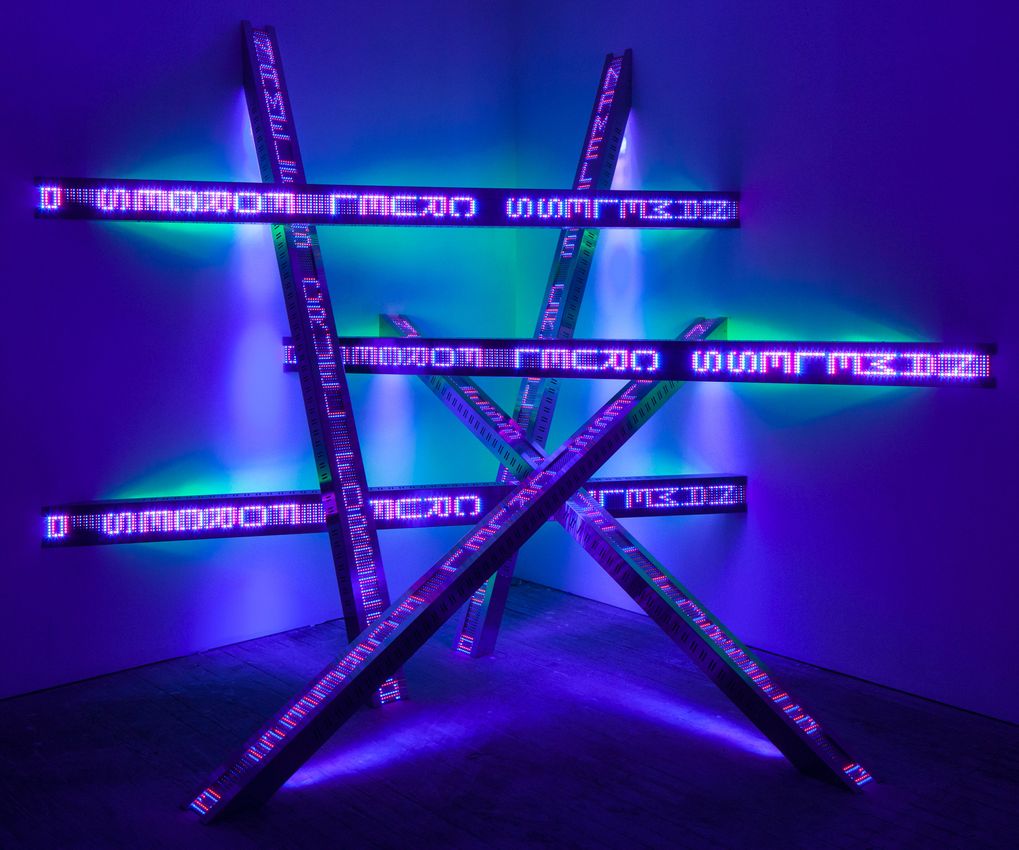
Her art, which appears on LED signs, stone benches, projections, and paintings, has brought urgent questions about power, violence, and social justice into public and institutional spaces worldwide.
Early Years
Jenny Holzer was born in Gallipolis, Ohio, in 1950. She began her studies at Duke University and the University of Chicago before earning her BFA at Ohio University in 1972. Holzer later attended the Rhode Island School of Design, receiving her MFA in 1977, and moved to New York City to join the Whitney Museum of American Art‘s Independent Study Program. Immersed in the city’s conceptual art scene, Holzer shifted from painting to language-based work, influenced by her early experiences as a typesetter and her engagement with feminist and activist circles such as Colab. She is currently based in Hoosick, New York.
Jenny Holzer Artworks
Jenny Holzer’s contemporary art practice centres on the use of language to address themes of power, conflict, and vulnerability. Her works appear in diverse forms—LED displays, stone benches, light projections, paintings, and printed materials—often situated in public spaces to reach the widest possible audience.
‘Truisms’ and Early Series (1977–1985)
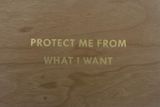
Holzer’s breakthrough came with ‘Truisms’ (1977–79), a series of aphoristic statements distilled from political and philosophical texts, first wheat-pasted anonymously across New York City. These were followed by ‘Inflammatory Essays’ (1979–82), which drew on the rhetoric of radical thinkers, and the ‘Living’ (1981–82) and ‘Survival’ (1983–85) series, which appeared as plaques and signs in urban environments. Holzer’s texts, such as ‘Abuse of power comes as no surprise’ and ‘Protect me from what I want,’ became part of the public consciousness.
LED Installations, Stone, and Public Projections (1982–2000s)
Holzer pioneered the use of LED technology in art, most notably with her 1989 installation spiraling up the rotunda of the Solomon R. Guggenheim Museum in New York, which was subsequently represented by the museum in 2024. She began inscribing texts on stone benches, sarcophagi, and floors in works such as Under a Rock (1986) and Laments (1989), combining the permanence of stone with the ephemerality of language. Her installation at the 44th Venice Biennale in 1990 juxtaposed marble benches and LED signs, earning her the Golden Lion. From the mid-1990s, Holzer expanded her practice to include large-scale light projections on buildings and landscapes in cities such as Paris, Florence, and San Francisco.
Painting and Redacted Texts (2005–present)
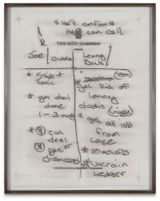
Since 2001, Holzer has incorporated found texts—poetry, literature, and declassified government documents—into her art. Her ‘Redaction Paintings’ (from 2005) silkscreen enlarged, redacted government documents onto canvas, confronting themes of war, surveillance, and secrecy.Holzer continues to innovate with new technologies, including AI-generated text in LED installations, as seen in her 2024 exhibition at Sprüth Magers in New York.
Select Public Commissions
- Permanent LED installation at Seven World Trade Center, New York
- Stone benches at Massachusetts Museum of Contemporary Art (MASS MoCA), North Adams
- Light projections on the Louvre, Paris; Arno River, Florence; and San Francisco’s Transbay Transit Center
- Permanent installation at Guggenheim Museum Bilbao
Select Awards and Accolades
- Golden Lion, Venice Biennale (1990)
- Crystal Award, World Economic Forum (1996)
- Officier des Arts et des Lettres, France (2016)
- International Medal of Arts, U.S. Department of State (2017)
- Time 100 (2024)
- Honorary doctorates from Williams College, Rhode Island School of Design, The New School, and Smith College
Exhibitions
Jenny Holzer has been the subject of both solo exhibitions and group exhibitions at important institutions. Below is a selection of important exhibitions.
Solo Exhibitions
- Light Line, Solomon R. Guggenheim Museum, New York (2024)
- Jenny Holzer, K21, Kunstsammlung Nordrhein-Westfalen, Düsseldorf (2023)
- Thing Indescribable, Guggenheim Bilbao (2019)
- For You: Jenny Holzer, National Museum of Modern and Contemporary Art, Seoul (2019)
- Protect Protect, Museum of Contemporary Art, Chicago, and Whitney Museum of American Art, New York (2008–2009)
Group Exhibitions
- The Art of Food, Long Beach Museum of Art, Long Beach (2025)
- documenta 7, Kassel (1982)
- Times Square Show, New York (1980)
Jenny Holzer FAQs
Where can I see Jenny Holzer’s art?
Jenny Holzer’s artworks are held in major public collections, including the Solomon R. Guggenheim Museum in New York, Guggenheim Bilbao, the Museum of Modern Art in New York, Tate Modern in London, and the National Gallery of Art in Washington, D.C. Permanent installations such as her stone benches can be found at MASS MoCA, and her LED works are installed at Seven World Trade Center, New York, and the Transbay Transit Center in San Francisco.
What are the main themes in Jenny Holzer’s contemporary art?
Jenny Holzer’s art explores power, violence, gender, social justice, and the complexities of public and private language. Her works use text to provoke thought and public dialogue on urgent social and political issues.
How did Jenny Holzer become known as an artist?
Jenny Holzer gained recognition with her ‘Truisms’ series in the late 1970s, which appeared as anonymous posters across New York. Her innovative use of LED signs, stone benches, and public projections, as well as her major exhibitions at the Guggenheim Museum and the Venice Biennale, established her as a leading figure in conceptual art.
Has Jenny Holzer received any major awards?
Jenny Holzer has received numerous awards, including the Golden Lion at the Venice Biennale, the Crystal Award from the World Economic Forum, the International Medal of Arts from the U.S. Department of State, and the Time 100 recognition. She holds honorary doctorates from several leading institutions.
Are there any random and interesting facts about Jenny Holzer?
Jenny Holzer’s texts have appeared on a wide range of surfaces, from LED signs and stone benches to T-shirts, condom wrappers, and even AI-generated installations. She was an active member of the artist collective Colab and participated in the landmark Times Square Show in 1980.
How do you pronounce Jenny Holzer’s name?
Jenny Holzer is pronounced ‘JEN-ee HOHL-zer’.
Ocula | 2025

Explore Jenny Holzer's Exhibitions On Now


View Jenny Holzer's Artworks
















Jenny Holzer in Ocula Magazine








Explore and Follow Artists Shaping Contemporary Art
A respected voice in contemporary art discourse.
Focusing on ambitious storytelling and insightful art-world commentary. Ocula Magazine publishes in-depth interviews, critical essays and timely analysis on the artists, exhibitions and ideas driving the global art world.
Learn more about Ocula Magazine
Showcasing the best of the art world.
Ocula partners with galleries from around the world to highlight their artists, artworks and exhibitions. Gallery membership is by application and invitation, with each member vetted by an independent panel.
Learn more about Ocula Membership
Specialises in the sale of major artworks.
Led by a team with deep ties to the world’s leading auction houses, galleries and collectors. Ocula’s advisory team offers bespoke services to high-net-worth clients from around the world who are looking to acquire the best of contemporary and modern art.
Learn more about our team and services