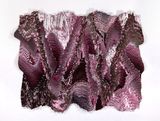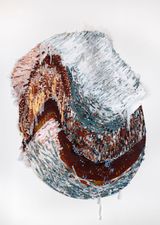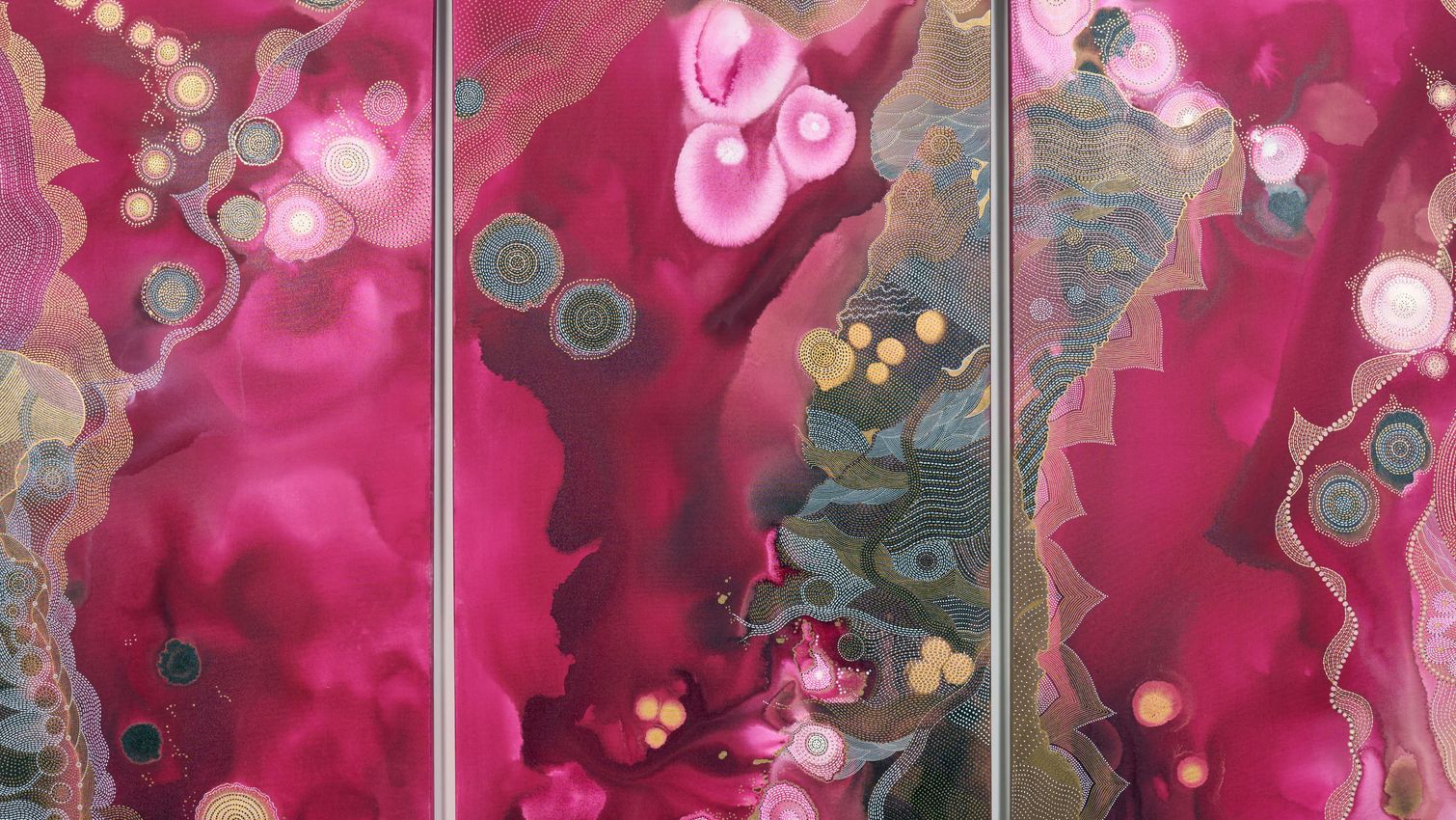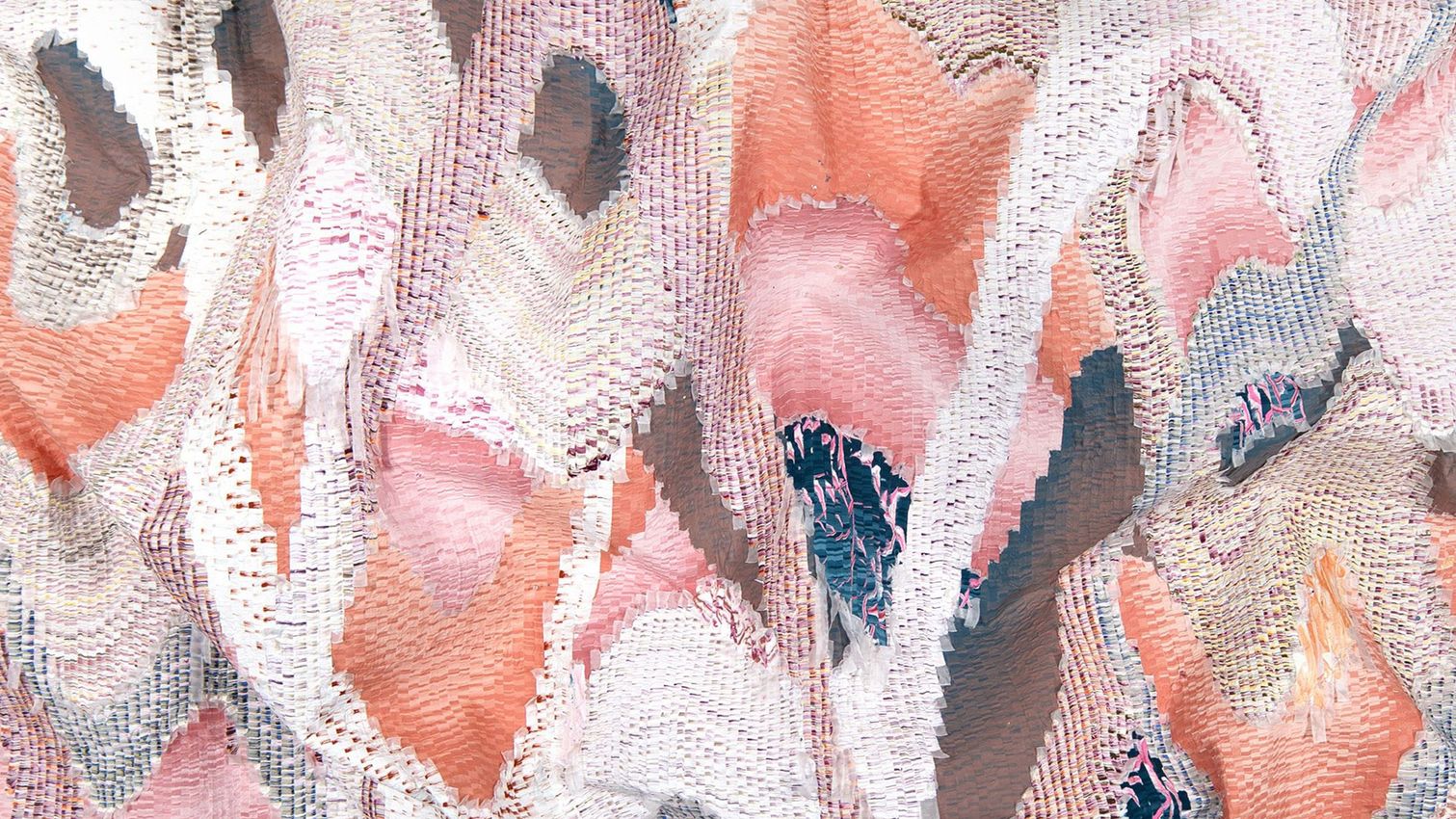
For his first solo exhibition at Sundaram Tagore New York, Kenny Nguyen (b. 1990, Bến Tre Province, Vietnam) presents new sculptural installations composed of strips of silk. Drawing on Vietnamese literature and colour symbolism, the North Carolina-based artist has created vibrant works that explore the emotional and cultural dimensions of colour. Because this exhibition coincides with the 50th anniversary of the Fall of Saigon, Nguyen also debuts select work from a new series titled White Noise, which references his memories of the black-and-white photos and films of the war that were ubiquitous in his childhood.
Raised on a remote coconut farm in southern Vietnam, Nguyen moved to Ho Chi Minh City at 17 to study fashion design. He began working as a designer but decided to leave his career behind to relocate to the United States with his family in 2010. Unfamiliar with the English language, he began creating art, employing painting as a form of communication.
Nguyen was naturally drawn to experimenting with silk, a highly revered fabric in Vietnam, which he had previously used to create garments. ‘Silk may appear delicate, but it’s the strongest natural fibre on earth, so it reflects resilience,’ he says. Over time, he developed a distinctive technique using the fabric to create abstract three-dimensional paintings. He begins by hand cutting silk into strips. He then mixes and pours various colours of acrylic paint onto a palette, creating a multicoloured surface. After soaking strips of silk in this paint mixture, he affixes them to a raw canvas with the wet paint serving as an adhesive. The result is a structured but malleable medium, which he sculpts into undulating forms that are mounted on the wall with pushpins.
His early works were monochromatic, but Nguyen soon infused his work with colours evoking his homeland. When trying to articulate certain hues, he found the English language surprisingly limited. He realised that the Vietnamese color lexicon was far richer in symbolic and poetic references: “We use colors to speak about emotion, history, landscape and the life of our people,” he says. ‘In many ways, it reflects the whole country. The greyish-blue tone called khói lam chiều, translates to ‘evening smoke blue,’ ’ he points out. So named for the muted hues of the sky at dusk and nostalgic scenes of cooking smoke rising from village homes. He also recalls a soft, earthy yellow called màu lúa chin, which translates to ‘ripe rice colour’ and references the vibrant colour of rice fields during the harvest season.
Colours are also often associated with emotions in Vietnamese culture. Nguyen shares the example of a historic poem describing a scene of a soldier leaving for war and disappearing into the emerald-green mulberry fields in the distance. ‘The poem speaks of a woman watching her loved one depart, so that shade of green landscape is symbolic of the feeling of separation,’ he says.
Throughout this exhibition, colour functions as both a poetic and cultural signifier. For instance, some works feature a rich crimson-maroon, a shade often found in Buddhist temples, alluding to his interest in spiritual traditions, while others are streaked with a dramatic reddish-purple, the colour of xôi, a Vietnamese sticky rice dish steeped in magenta-hued plant leaves. ‘It’s very hard to explain these kinds of colours. The only way to do it is to tell a story,’ he says.
Because this exhibition coincides with the 50th anniversary of the end of the Vietnam War, Nguyen is also debuting select works from his new series White Noise, which draws from his memories of vintage war photographs and documentaries, which he says were an ever-present backdrop as he was growing up. These works with subtle black-and-white undertones speak to the collective histories of Vietnamese-Americans.
At its core, Nguyen’s work is at once personal and universally resonant. Each individual piece can be installed in multiple ways : ‘A single work can take on so many different forms depending on the space and how it’s sculpted as it’s mounted on the wall. So it’s in a state of constantly adapting, which is a reflection of my journey,’ he says.
ABOUT KENNY NGUYEN
Kenny Nguyen lives and works in Charlotte, North Carolina. He has participated in exhibitions across the globe, including at the Sejong Museum of Art, Seoul; CICA Museum (Czong Institute for Contemporary Art), Gimpo, Gyeonggi Province, Korea; Kunstwerk Carlshütte, Büdelsdorf, Germany; LaGrange Art Museum, Georgia; Museum of Contemporary Art Jacksonville, Florida; Orange County Center for Contemporary Art, Santa Ana, California; and The Rayburn House Office Building, United States Capitol Complex, Washington, DC.
In 2024, Nguyen’s work was the subject of the solo exhibition Kenny Nguyen: Adaptations at the Mint Museum in Charlotte. His work is currently on view in Hoa Tay (Flower Hands) the at the Ogden Museum of Southern Art in New Orleans, which showcases work by leading Southern artists from the Vietnamese diaspora. The exhibition commemorates the 50th anniversary of the Fall of Saigon.
In 2016, Nguyen received the Excellence Asia Contemporary Young Artist Award from Sejong Museum of Art; in 2023, a nomination for the Joan Mitchell Fellowship; and in 2024, Asian Art in London’s Modern & Contemporary Art Award for a work from his Eruption series. He has been awarded numerous grants, fellowships and residencies.
Kenny Nguyen (b. 1990, Ben Tre Province, Vietnam) creates expansive, dimensional, mixed-media paintings that center on ideas of cultural identity, displacement and integration. Nguyen grew up on a coconut farm in a rural area near the Mekong Delta in southern Vietnam. Despite having an established career in fashion design, he decided to join his family when they moved to the United States in 2010.
Established in 2000 in New York City, Sundaram Tagore Gallery represents established and emerging artists from around the globe, specialising in work that is aesthetically and intellectually rigorous, infused with humanism and art historically significant. The gallery was founded with a mission to show that some of the best and most meaningful art was being created by artists deeply engaged in cross-cultural explorations. Our international roster of artists cross cultural and national boundaries, synthesising Western visual language with forms, techniques and philosophies from Asia, the Subcontinent and the Middle East. More than twenty years later, we continue to champion artists, particularly women and those from underrepresented cultures, whose work exemplifies our interconnectedness.

A respected voice in contemporary art discourse.
Focusing on ambitious storytelling and insightful art-world commentary. Ocula Magazine publishes in-depth interviews, critical essays and timely analysis on the artists, exhibitions and ideas driving the global art world.
Learn more about Ocula Magazine
Showcasing the best of the art world.
Ocula partners with galleries from around the world to highlight their artists, artworks and exhibitions. Gallery membership is by application and invitation, with each member vetted by an independent panel.
Learn more about Ocula Membership

Specialises in the sale of major artworks.
Led by a team with deep ties to the world’s leading auction houses, galleries and collectors. Ocula’s advisory team offers bespoke services to high-net-worth clients from around the world who are looking to acquire the best of contemporary and modern art.
Learn more about our team and services