



Press Release
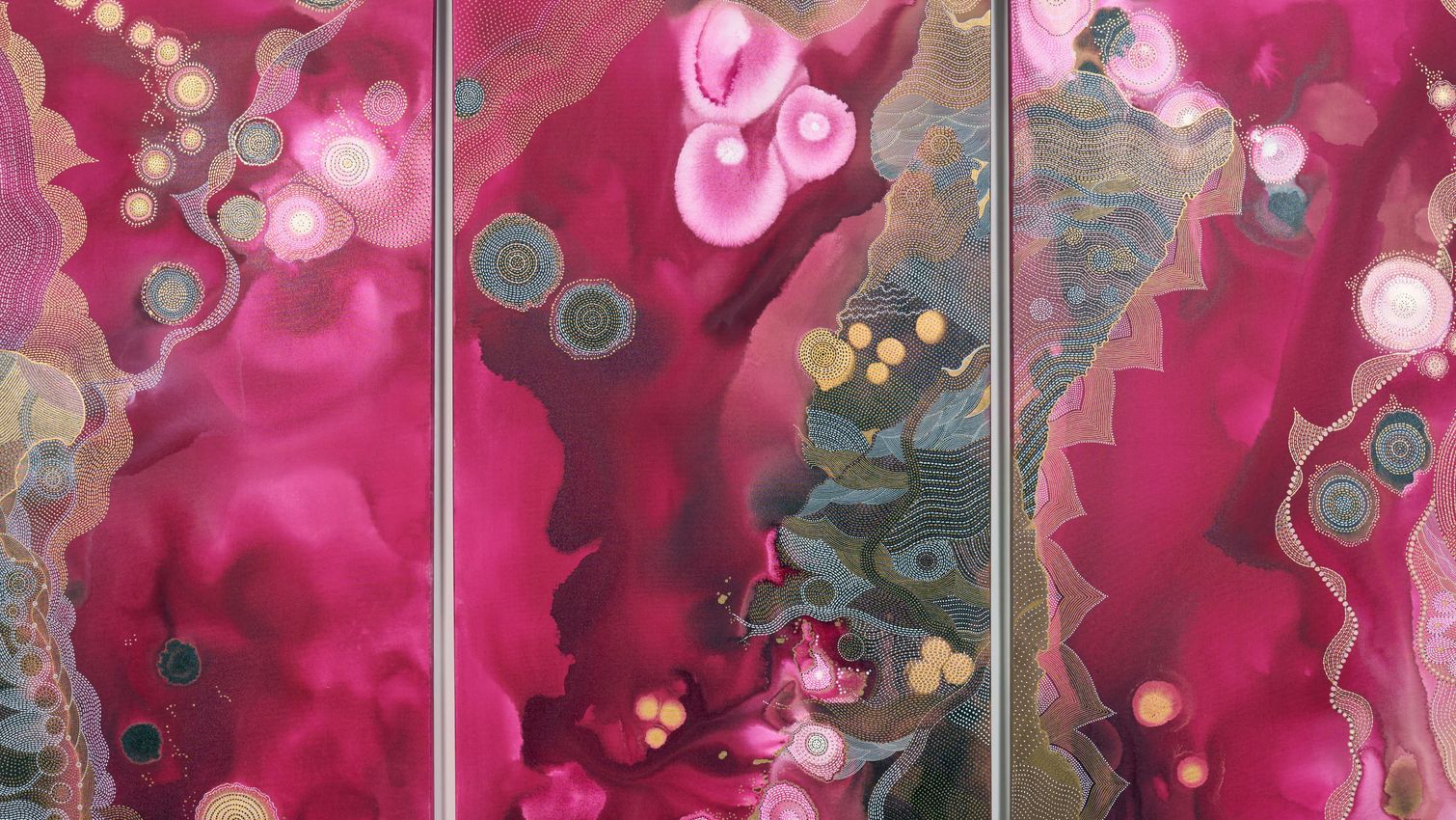
Sundaram Tagore presents the first New York solo exhibition of work by Tayeba Begum Lipi, one of Bangladesh’s foremost contemporary artists. This exhibition, which includes installations, paintings and sculpture, showcases the Dhaka-based artist’s innovative use of materials.

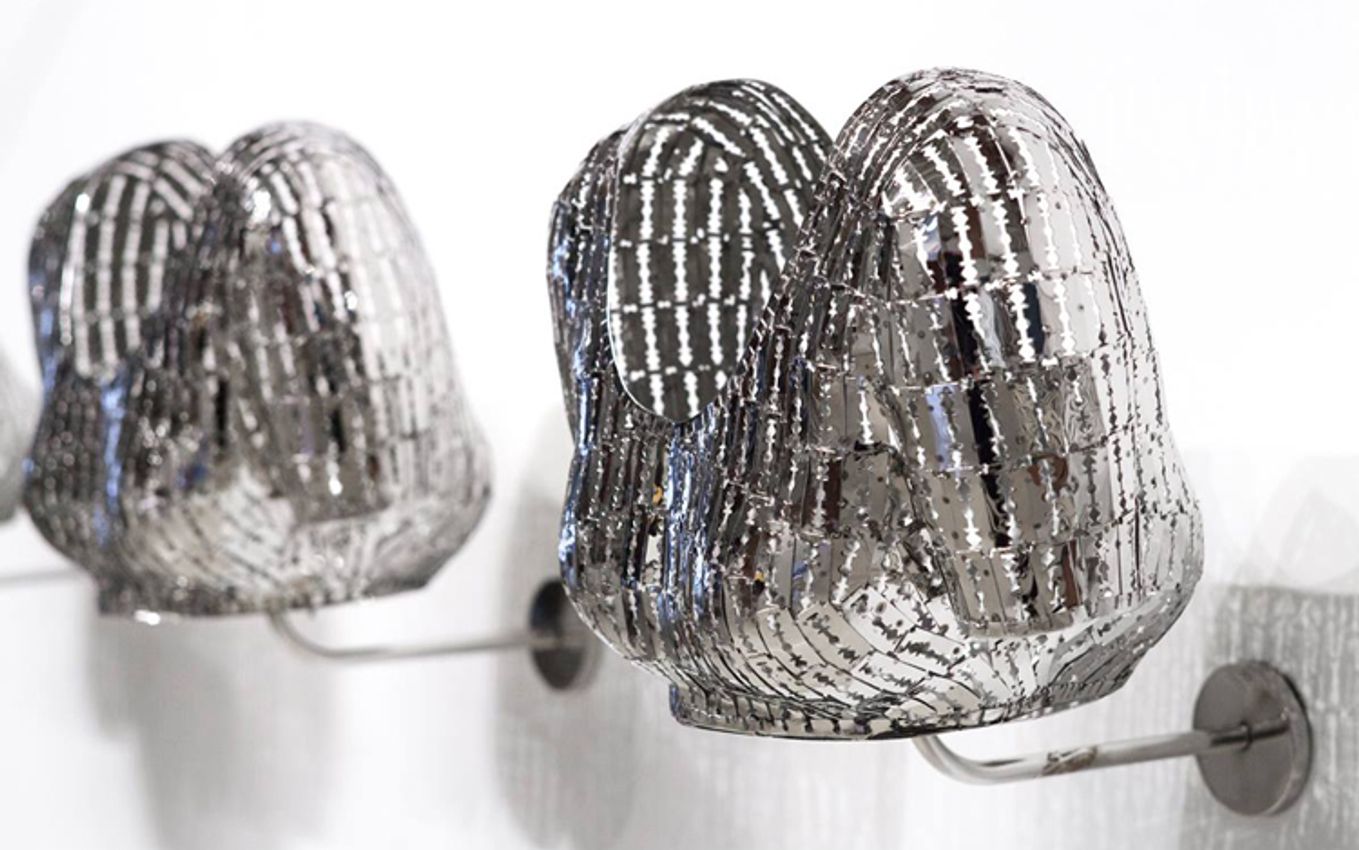
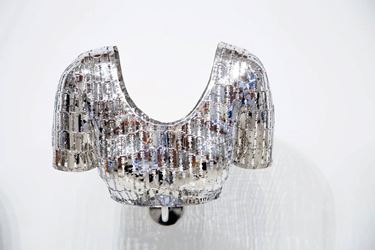
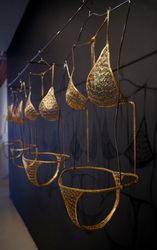
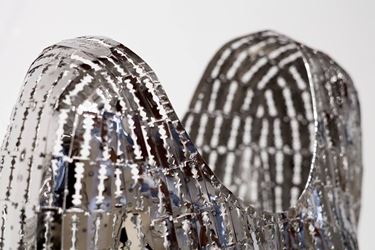
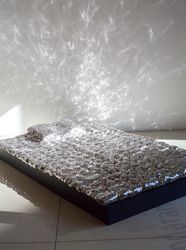
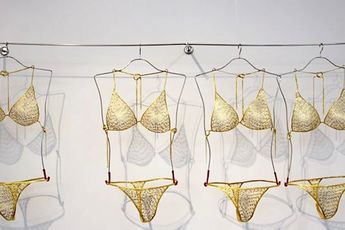
Lipi’s paintings, prints, videos and installations articulate themes of female marginality and focus on the female body. She is best known for her sculptural works, which re-create everyday objects of domesticity, including bathtubs, strollers, wheelchairs, dressing tables and women’s undergarments, made from safety pins and razor blades. The provocative and visually compelling choice of materials speaks to the violence facing women in Bangladesh, as well as references tools used in childbirth in the more underdeveloped parts of the country.

Lipi’s artistic practice is rooted in her experiences growing up in Gaibandha, a small town in Bangladesh. The eleventh of twelve children, she was often present for the home births of nieces and nephews delivered with the help of a local village woman and a razor blade. This visceral memory—the sound of the blade rolling in boiling water and the glint of the sharpened edge—eventually translated into a powerful symbol that plays a recurring role in her work. Although she previously used readymade blades, the artist now has them custom manufactured in gleaming stainless steel, which allows her latitude to create different sized works.

With I Do Not Wear This, a set of three life-size bikinis fabricated from the custom blades, Lipi questions how the perception of women’s bodies plays into the societal structures that dominate their lives. In contrast to the soft, touchable materials usually associated with women’s apparel, the metal structure suggests a protective layer of armor for the wearer, while the intrinsic allure of the garment remains undiminished by the steely composite.

Lipi’s choice of medium is not confined to razor blades, however, nor does she only focus on the subjection of women. We Can’t Be the Same, a wall-mounted installation comprising five wigs made from stands of copper wire, gives voice to the fear and isolation experienced by the transgender community in Dhaka.

Lipi’s work first appeared on the global stage in 2011 when she was the commissioner for the first Bangladeshi pavilion at the 54th Venice Biennale. In 2012, she was invited to participate in the critically acclaimed Guggenheim Museum survey of contemporary Southeast Asian art No Country, where her installation Love Bed was one of the most discussed pieces in the show and is now part of the museum’s permanent collection. Lipi returned to the Venice Biennale in 2015 with two installations in Frontiers Reimagined, a collateral event of the 56th Venice Biennale, organized and curated by Sundaram Tagore (www.frontiersreimagined.org). 

Tayeba Begum Lipi completed a Master of Fine Arts in Drawing and Painting at the Faculty of Fine Arts, University of Dhaka in 1993. In 2000 she was an artist-in-residence at the Irish Museum of Modern Art, Dublin. She was awarded a Grand Prize at the 11th Asian Art Biennale Bangladesh 2003, Dhaka; was the commissioner for the Pavilion of Bangladesh at the 54th International Art Exhibition of la Biennale di Venezia, 2011; and she was one of the curators for the Kathmandu International Art Festival 2012. Lipi has had solo exhibitions in Dhaka, Delhi, Istanbul and London. She also participated in the 14th Jakarta Biennale 2011; the Colombo Art Biennale, 2012, Sri Lanka; and Dhaka Art Summit 2012.

Lipi is an activist as well as an artist. Together with her artist husband, Mahbubur Rahman, she founded the Britto Arts Trust in 2002, an organization dedicated to creating opportunities for other Bangladeshi artists through exhibitions, seminars, residencies and workshops.

On March 5, 2016, Artist as Activist: Tayeba Begum Lipi and Mahbubur Rahman will open at the Eli and Edythe Broad Art Museum at Michigan State University.

Installation Views

Artists Exhibiting

Also Exhibiting at Sundaram Tagore Gallery

About the Gallery

Established in 2000 in New York City, Sundaram Tagore Gallery represents established and emerging artists from around the globe, specialising in work that is aesthetically and intellectually rigorous, infused with humanism and art historically significant. The gallery was founded with a mission to show that some of the best and most meaningful art was being created by artists deeply engaged in cross-cultural explorations. Our international roster of artists cross cultural and national boundaries, synthesising Western visual language with forms, techniques and philosophies from Asia, the Subcontinent and the Middle East. More than twenty years later, we continue to champion artists, particularly women and those from underrepresented cultures, whose work exemplifies our interconnectedness.

View Gallery Profile
Address
542 West 26th Street
New York
United States
Opening Hours
Tuesday – Saturday
10am – 6pm
(1)
New York 542 West 26th Street
Sundaram Tagore Gallery
542 West 26th Street, New York, United States

Opening hours
Tuesday – Saturday
10am – 6pm
The art world in focus
