For his second solo show at Sundaram Tagore New York, Beijing-based artist Zheng Lu presents new sculptures and mixed-media installations revolving around themes of water, a subject matter that holds multiple meanings for the artist, from an element essential to existence, to a medium symbolic of change, self-reflection and the passage of time.
The title of the show, Root Metaphor, refers to a concept developed by American academic Sarah Allan, based on the idea that early Chinese philosophers used physical principals of the natural world to better understand mysteries of the cosmos and the nature of man. Water, a shapeless medium that can be potent or supple, dynamic or latent, can take on abundant meaning and serve as a tangible model embedded with conceptualised ideas. Zheng Lu employs imagery of water and the principals that govern it to reveal a world we cannot see.
‘With little bearing on the phenomenal world, these models belong to an invisible world that is contrary to our mundane and recognisable universe,’ Zheng explains. ‘Various natural phenomena play the role of models in the system of abstract philosophical principles.’
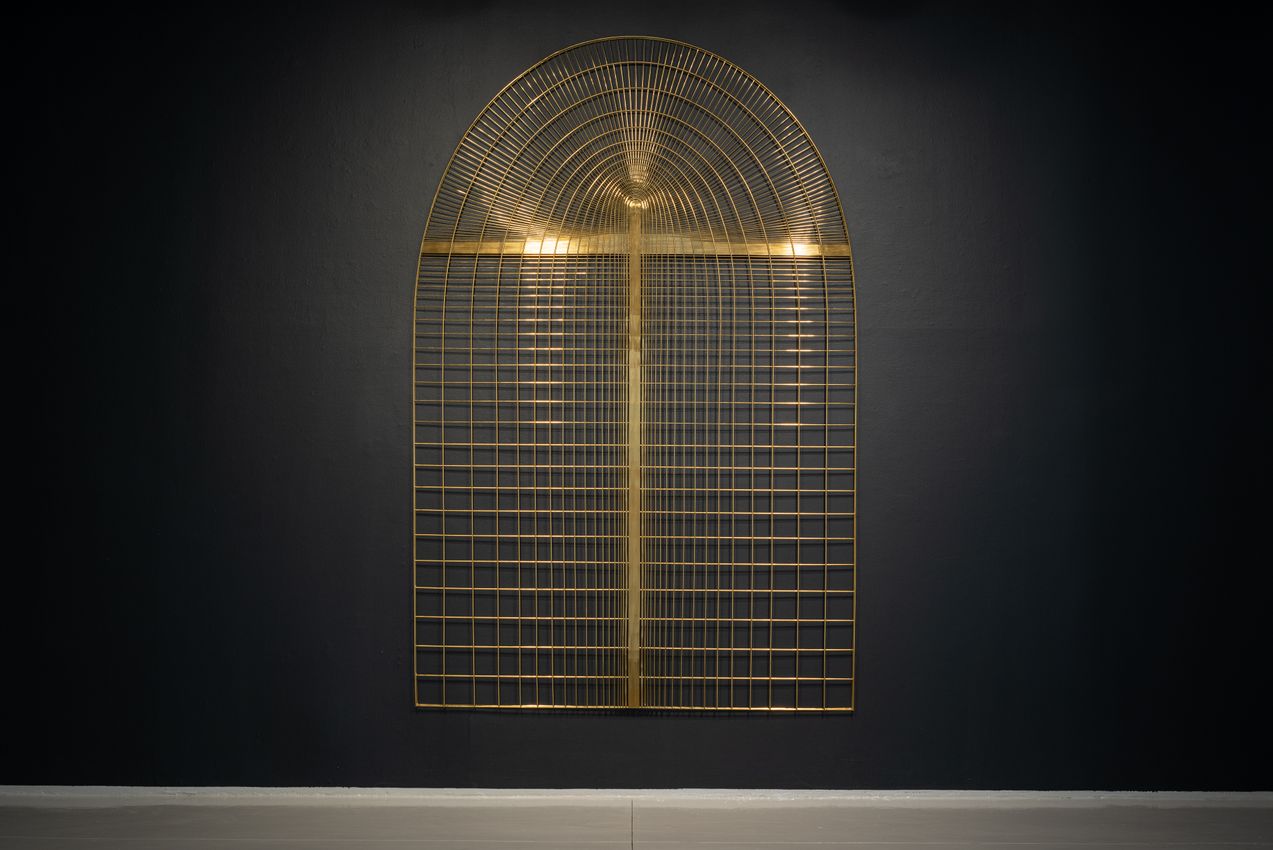
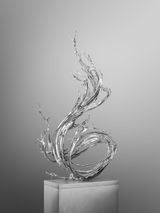
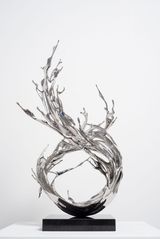
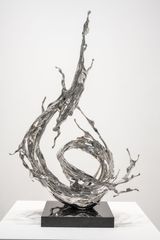
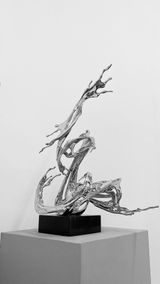
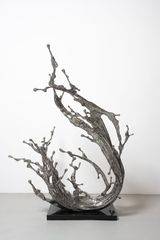
Zheng illustrates this concept with his new series ‘Fluid Mechanics’; abstract metal sculptures that are an aesthetic departure from his acclaimed ‘Water in Dripping’ series, where he poetically expresses water in stainless steel form, evoking dynamic splashes suspended mid-air. Here, Zheng approaches his investigation on a micro-level inspired by principals of applied mathematics, physics and computational software designed to produce quantitative predictions of fluid-flow. The practical application of this branch of science is used to study ocean currents and weather patterns, as well as develop technology for aircrafts, rocket engines and wind turbines.
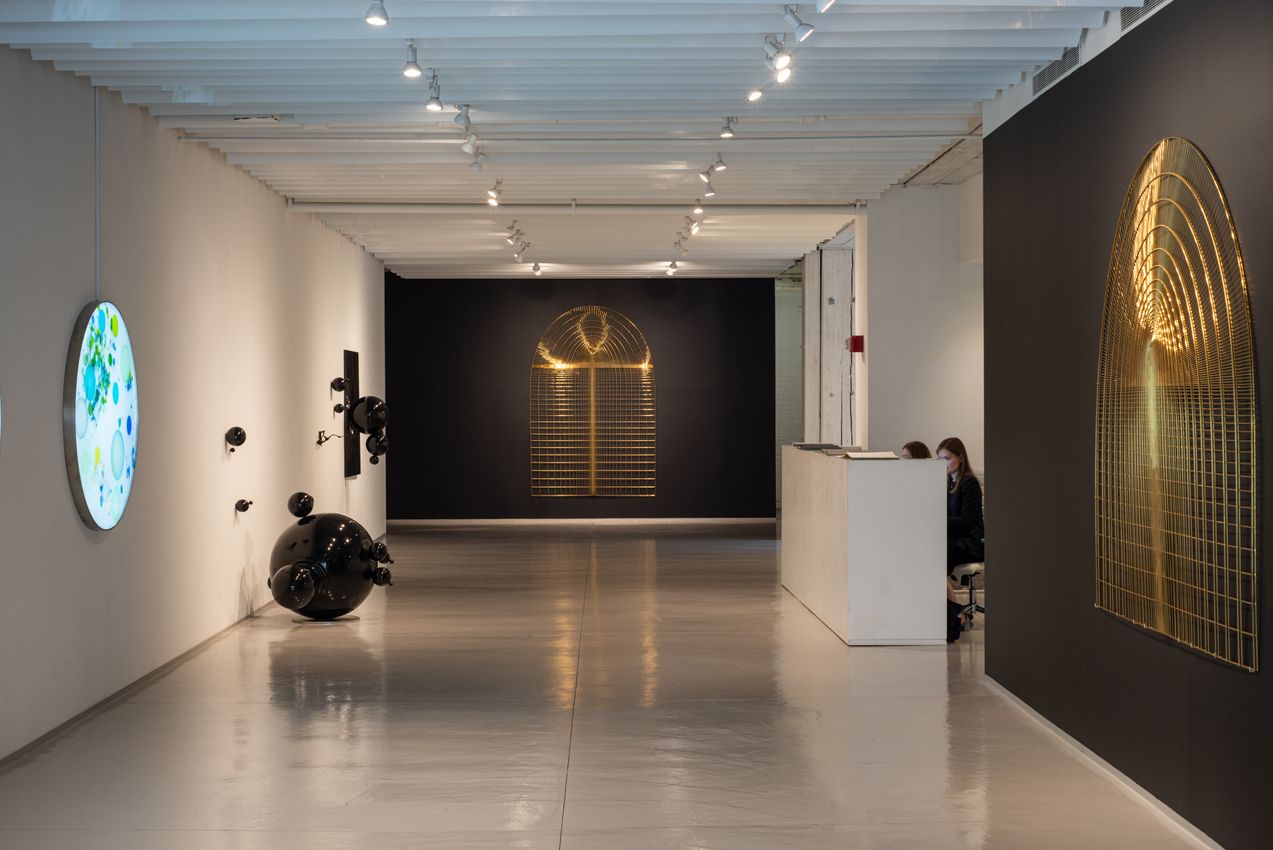
Fluid mechanics often uses computer generated grids to explore principals of water flow, but Zheng’s lattice-like structures forged from titanium and stainless steel take the idea further by also considering the fundamental human desire to make sense of what we don’t know or can’t see, while at the same time, imparting meaning drawn from collective cultural experiences.
‘Geometry is probably a rational outcome of the life form,’ he says. ‘These patterns, seemingly simple but actually unstable, complicated, and orderly, are showered with human-generated metaphors.’ Zheng’s metal structures are rhythmic and delicate, while also conveying the power and momentum that comes from fluid in motion. But some viewers will find symbolic meaning in the incidental geometric shapes that are formed, as with NACA0012 Airfoil, in which a cross appears, a result of when the tail of an airplane cuts through air.
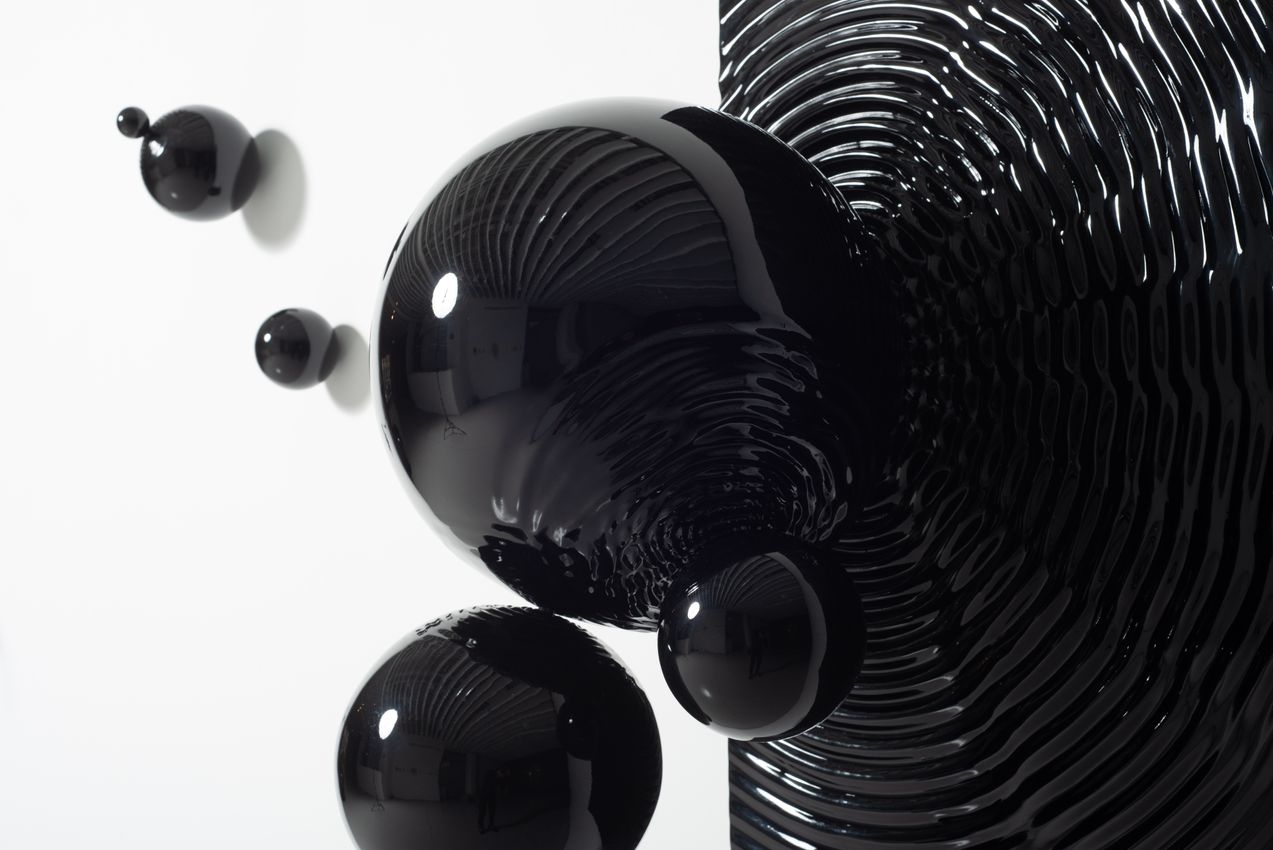
Also on view is Unknown Circles, a spatial installation first shown at the Museum of Contemporary Art Taipei (MOCA) in Zheng’s solo exhibition Shiosai in 2015. Comprising a series of luminous black orbs in various sizes, the work is inspired by the principle of wave interference, a natural phenomenon that occurs when two waves collide while traveling along the same medium. Where the spheres connect to each other and the wall, expanding ripples appear, the energy of the interaction validating one another’s presence.
‘I imagine these spheres being liquid and as such, collisions between the sphere and the space around it causes ripples across the surface,’ Zheng explains. ‘As the ripples stack atop each other, they magnify the vibrations in some areas, while diminishing the vibrations in others. The positions of the waves establish each other’s existence, reveal their existence, or reveal its meaning.’
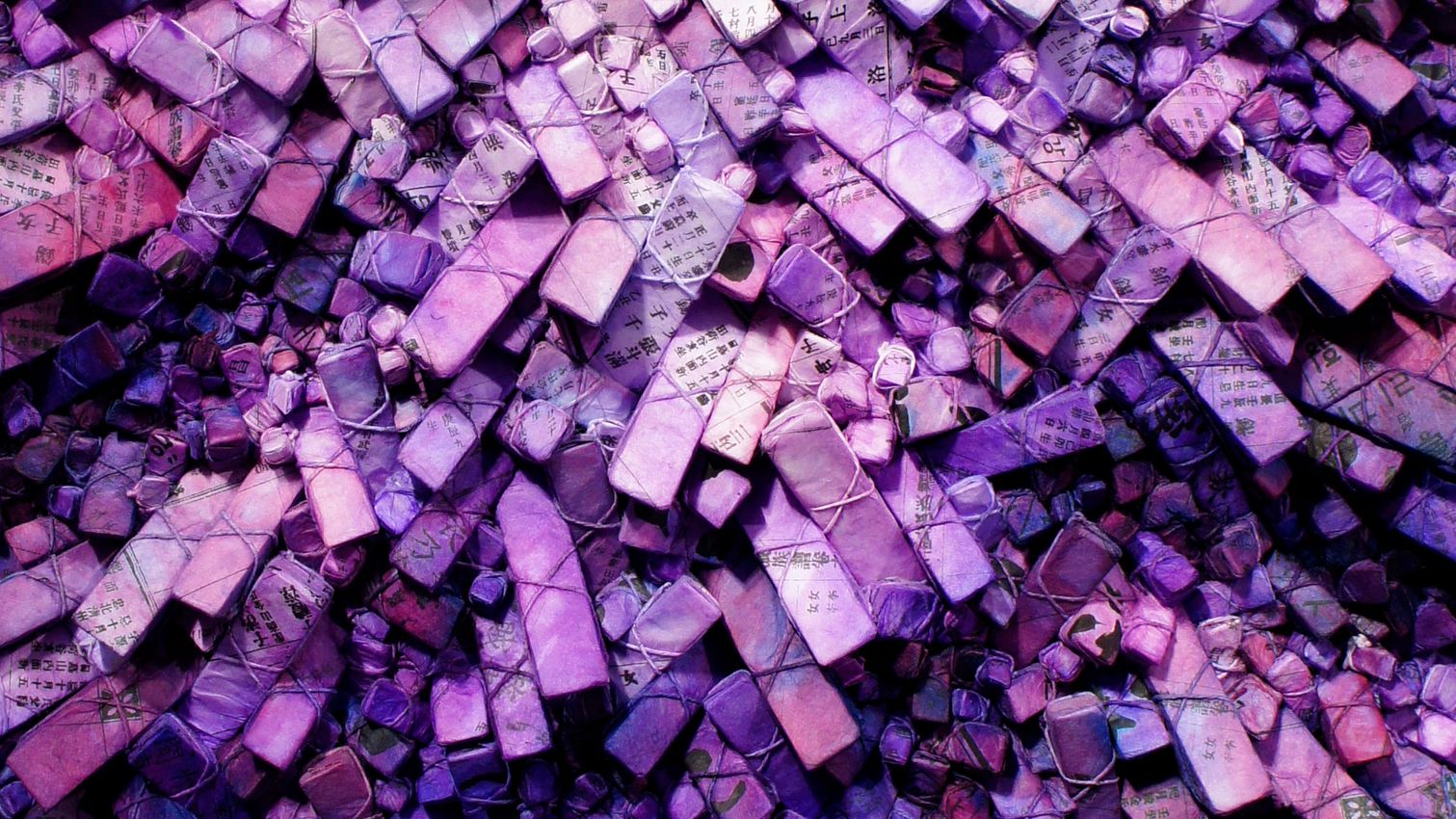
Additionally, the exhibition features new lightboxes that evolved from the artist’s ‘Insubstantiality ‘series, which made its American debut during his solo show Undercurrent (Sundaram Tagore New York, 2017). These bright, colourful works are imbued with Daoist philosophy and play with the notion that reality is not always what you see. A convex lens placed over glass magnifies and deconstructs the imagery beneath, resulting in vibrant abstract compositions similar to what one might see when looking through the lens of a microscope.
These new series are an organic evolution of Zheng’s acclaimed ‘Water in Dripping’ series, of which there will be several recent works on view. ‘Water is a very important motif in my art,’ he says. ‘As a key element in Chinese philosophy, it was observed, visualised and ruminated upon rather than getting examined in terms of logic.’ With these works, Zheng Lu integrates ideas rooted in Chinese philosophy with explorations of physical forms to reveal deeper metaphysical truths, realised in dynamic contemporary sculpture.
Zheng Lu graduated from Lu Xun Fine Art Academy, Shenyang, with a B.F.A. in sculpture in 2003. In 2007, he received his Master of Fine Arts degree in sculpture from the Central Academy of Fine Art, Beijing, while also attending an advanced study program at the École Nationale Supérieure des Beaux-Arts in Paris.
Zheng has participated in numerous exhibitions, including at the Museum on the Seam, Jerusalem; the Ekaterina Cultural Foundation, Moscow; Musée Océanographique, Monaco; Musée Maillol, Paris; the National Museum of China, Beijing; and the Shanghai Duolun Museum of Modern Art, Shanghai. He had solo exhibitions at the Museum of Contemporary Art, Taipei in 2015, one of the leading institutions in the region, the Long Museum, Shanghai, in 2016, and the Song Museum in Beijing in 2017.
The gravity-defying sculptural works of Zheng Lu are deeply influenced by his study of traditional Chinese calligraphy, an art form he practiced growing up in a literary family. Zheng Lu uses language as a pictorial element, inscribing the surface of his stainless-steel sculptures with thousands of Chinese characters derived from texts and poems of historical significance.


Established in 2000 in New York City, Sundaram Tagore Gallery represents established and emerging artists from around the globe, specialising in work that is aesthetically and intellectually rigorous, infused with humanism and art historically significant. The gallery was founded with a mission to show that some of the best and most meaningful art was being created by artists deeply engaged in cross-cultural explorations. Our international roster of artists cross cultural and national boundaries, synthesising Western visual language with forms, techniques and philosophies from Asia, the Subcontinent and the Middle East. More than twenty years later, we continue to champion artists, particularly women and those from underrepresented cultures, whose work exemplifies our interconnectedness.

A respected voice in contemporary art discourse.
Focusing on ambitious storytelling and insightful art-world commentary. Ocula Magazine publishes in-depth interviews, critical essays and timely analysis on the artists, exhibitions and ideas driving the global art world.
Learn more about Ocula Magazine
Showcasing the best of the art world.
Ocula partners with galleries from around the world to highlight their artists, artworks and exhibitions. Gallery membership is by application and invitation, with each member vetted by an independent panel.
Learn more about Ocula Membership

Specialises in the sale of major artworks.
Led by a team with deep ties to the world’s leading auction houses, galleries and collectors. Ocula’s advisory team offers bespoke services to high-net-worth clients from around the world who are looking to acquire the best of contemporary and modern art.
Learn more about our team and services