Press Release

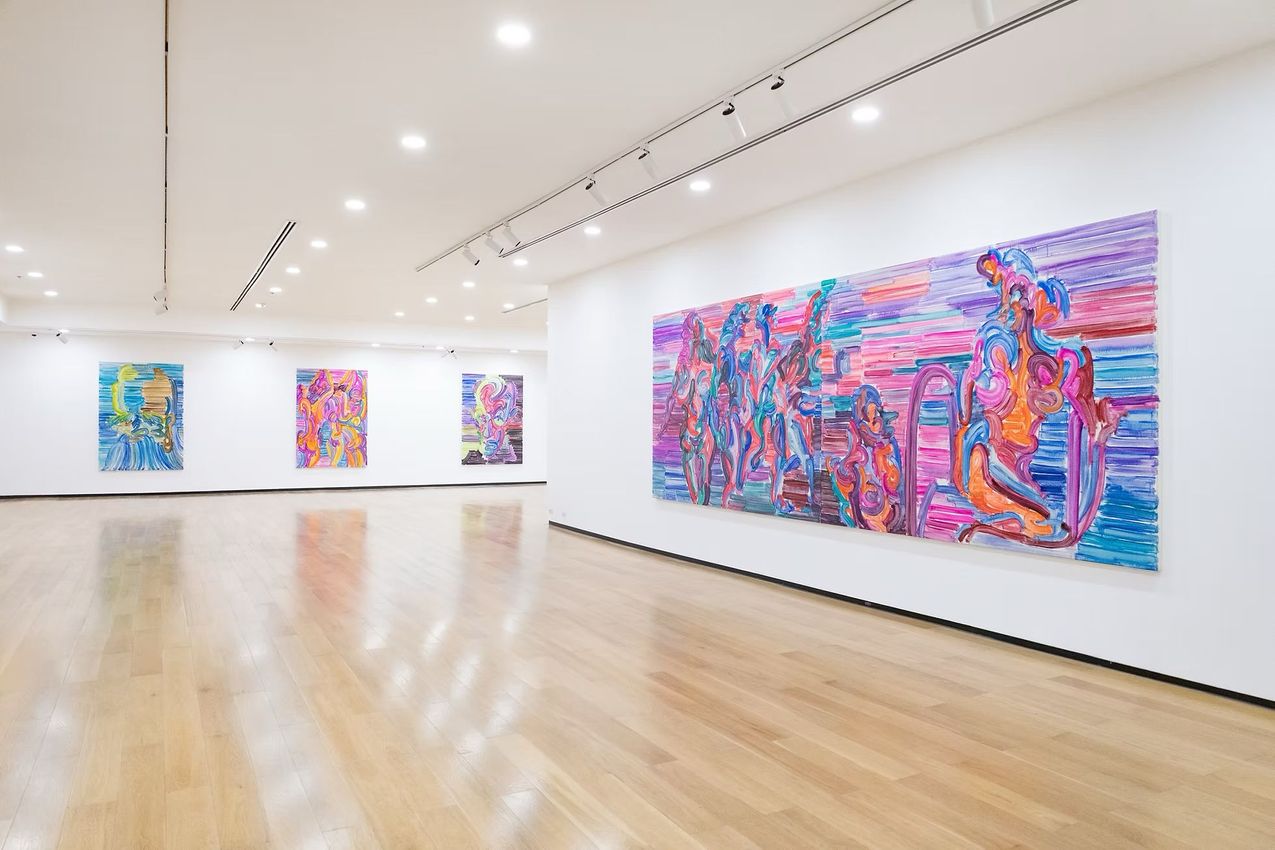
Tang Contemporary Art is pleased to announce the solo exhibition of Etsu Egami, “Time,” at our Bangkok space, which runs from December 21, 2024 to January 26, 2025. This exhibition will showcase more than ten of the artist’s newest works.

Humans Think, Therefore They Paint: Etsu Egami’s Exploration

Today, we are still lingering in the twilight of “modern painting,” a period often referred to as the “post-painting” era. How long this phase will last remains uncertain. However, humans will never lose the desire to paint, and thus painting will continue. Yet if it remains merely a desire, it risks becoming a repetition of the past. What we seek is “painting that transcends painting,” which goes beyond surface-level and material innovations.

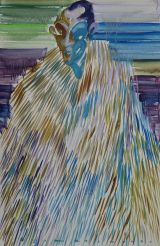
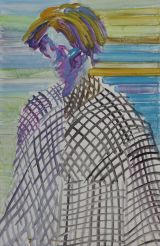
In this context, Etsu Egami consciously takes her own experiences as a starting point, creating works themed around language, human connection, and the interplay of “communication and misunderstanding.” In her earlier series Star Time, she portrayed Japanese literary figures. This time, she delves deeper into the portraits of thinkers, writers, and painters who have shaped human thought. The subjects span across Asia and the West, including Freud, Laozi, Dostoevsky, Kafka, Tagore, Nietzsche, Guiguzi, Confucius, as well as Cézanne and Warhol.

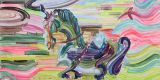
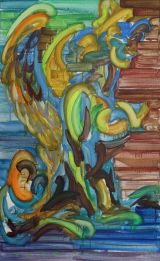
For instance, Etsu Egami reads the books of these thinkers and writers. The inspiration and insights she gains from this reading drive her to capture their visage and essence. If photographs exist, she might refer to them, but their absence does not deter her. Her portraits are shaped by their intellectual essence, rather than external appearances. What matters is not the photographic surface but the depth of their thoughts. To depict this intellectual essence is, in itself, an act of “communication.” Naturally, this also invites “misunderstanding.” The treatment of the background in these works is similar to her Star Time series, comprising horizontal stripes of various colors.

In any case, the painting’s theme serves as an entry point for viewers to engage in dialogue with the work. Interpretation, of course, is up to the audience. For example, I might illustrate this by comparing two works: Freud and Laozi.

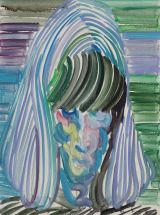
In Freud, the eyes, nose, and chin are relatively discernible, while swirling lines spread across the forehead. The background on the left features blues and greens, while purples dominate the right and lower sections. Whether this resembles Freud’s physical appearance is irrelevant. What matters is that the image evokes something akin to the experience Freud described in The Interpretation of Dreams. Through her strokes and lines, Etsu Egami reflects her reading experience and the questions she pondered.

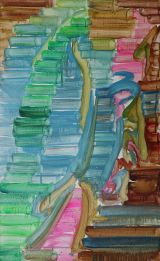
In contrast, Laozi resists facial recognition even upon close examination. The background consists of vivid horizontal stripes. If one were to ask, “What is this?” the answer might be as elusive as the four short blue stripes extending from the upper right to the lower left. Even if they seem like living beings, they remain indefinable. Etsu Egami painted them precisely this way. For me, rather than a portrait or a living entity, the work conveys an abstract gesture or form that symbolizes the essence of this thinker, Laozi.

Modern painting has been deconstructed by minimalism and conceptual art down to its “zero point.” So, what comes next?

When one engages with a thinker’s ideas, it often triggers a boundless, expansive sensation within. This internal space feels as vast as the universe. Etsu Egami seeks to translate this “expansion of thought” into her art, turning it into an “expansion of pictorial space.” This “transmutation” is her unique artistic expression. Her unprecedented attempt is forging a new form of painting in an era where the possibilities of painting seem to be reaching their limits.

Read More
About the Artist

Etsu Egami graduated with a B.F.A. from the Central Academy of Fine Arts (CAFA) specialising in Oil Painting in 2016. She graduated with an M.F.A. at CAFA under the mentor of artist Liu Xiao Dong and studied at HFG in Germany. She is now in New York dispatched as a talented artist by Agency for Cultural Affairs, Japan Government. Etsu Egami currently lives and works between Tokyo and New York.

View Artist Profile

Also Exhibiting

About the Gallery

Tang Contemporary Art was established in 1997 in Bangkok, later establishing galleries in Beijing and Hong Kong. Tang Contemporary Art is fully committed to producing critical projects and exhibitions to promote Contemporary Chinese art regionally and worldwide, and encourage a dynamic exchange between Chinese artists and those abroad.

View Gallery Profile
Address
Room. 201–206, River City Bangkok
23 Soi Charoenkrung 24
Talad noi, Sampantawong
Bangkok
Thailand
Opening Hours
Tuesday – Sunday
11am – 7pm

Closed on Public Holidays.
(1)
Bangkok Room. 201–206, River City Bangkok, 23 Soi Charoenkrung 24
Tang Contemporary Art
Room. 201–206, River City Bangkok, 23 Soi Charoenkrung 24, Talad noi, Sampantawong, Bangkok, Thailand

Opening hours
Tuesday – Sunday
11am – 7pm

Closed on Public Holidays.
The art world in focus