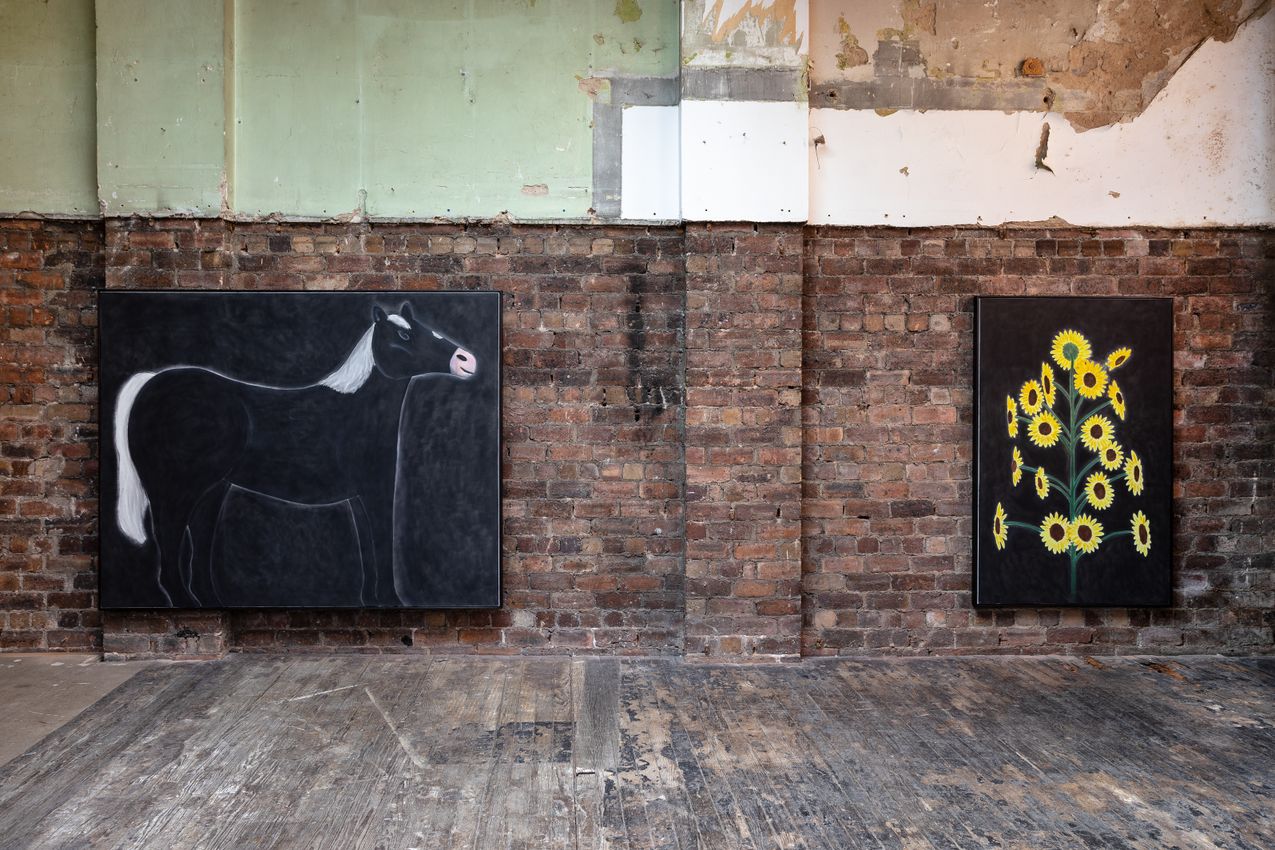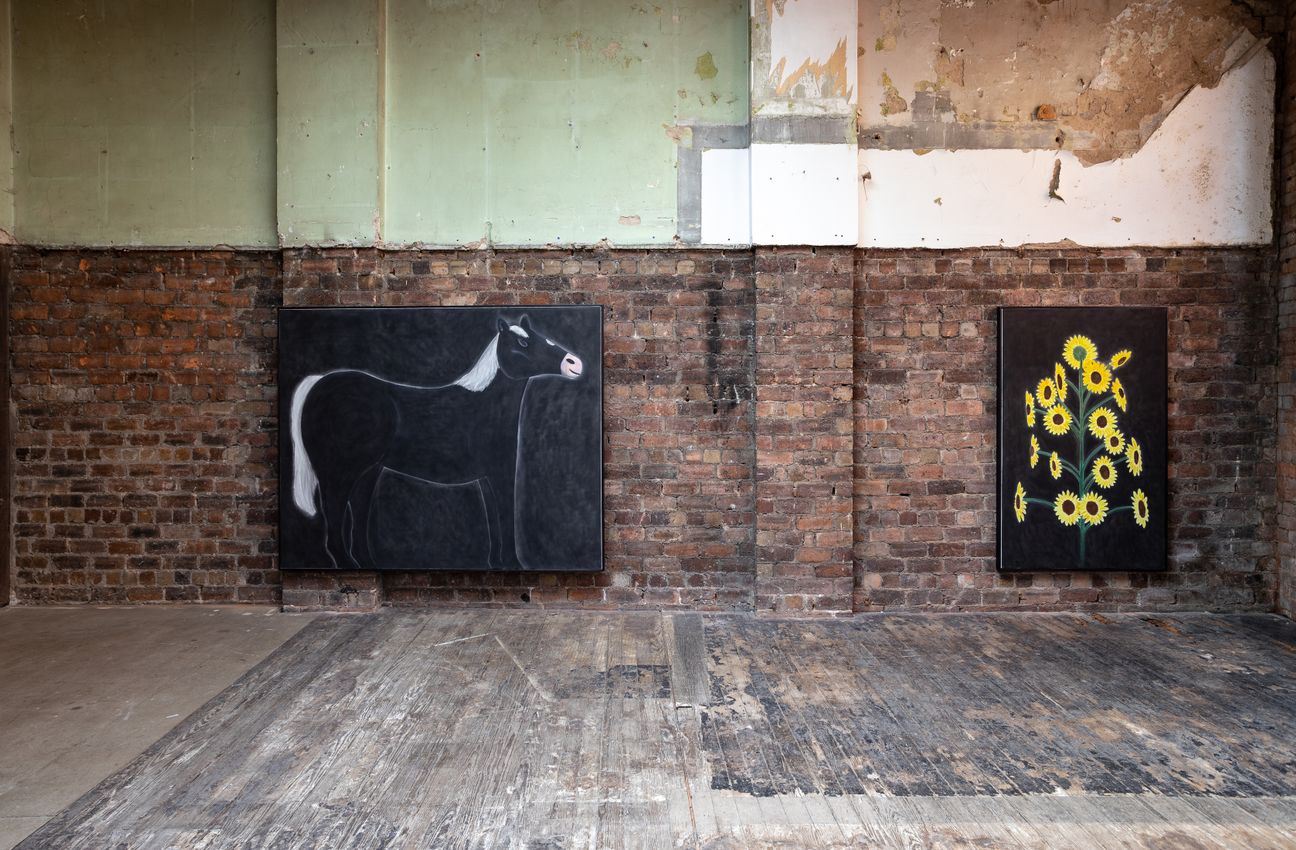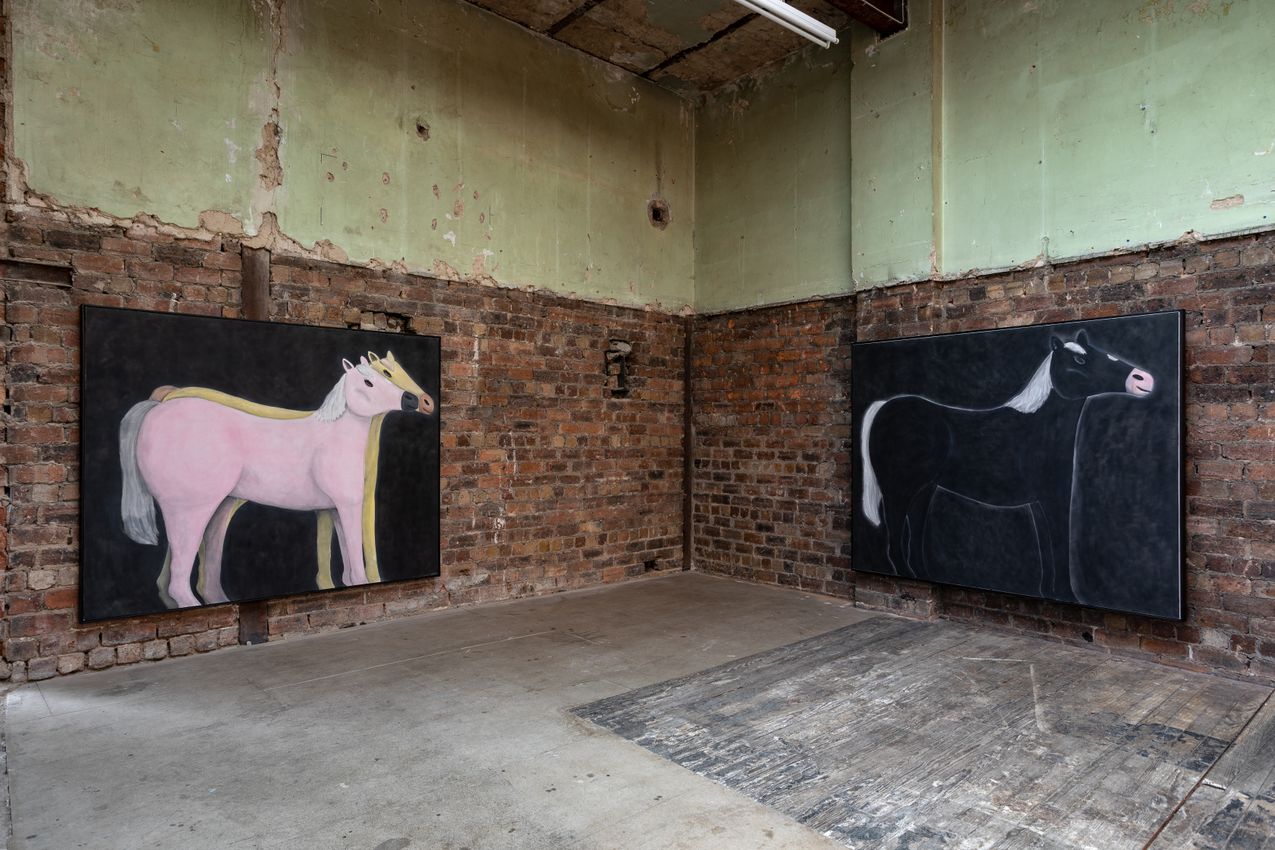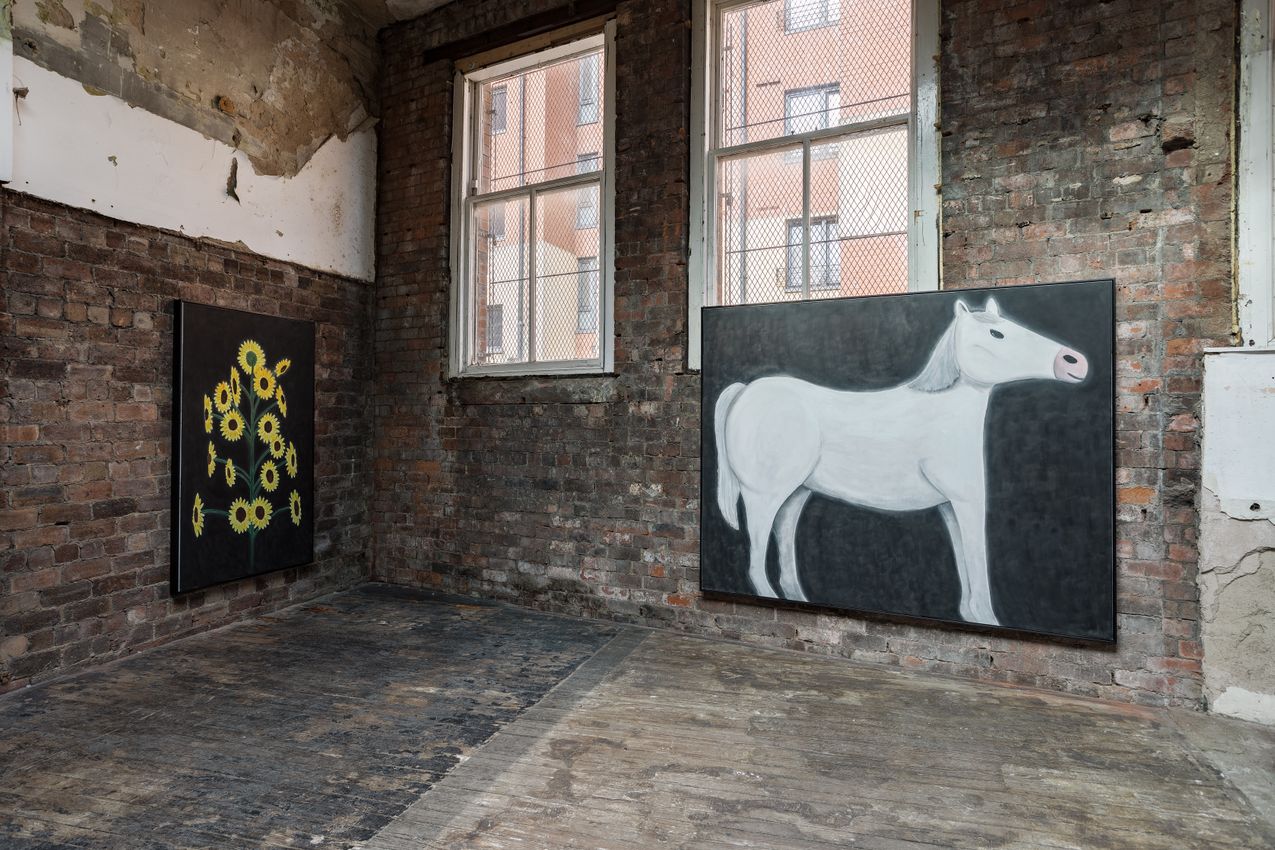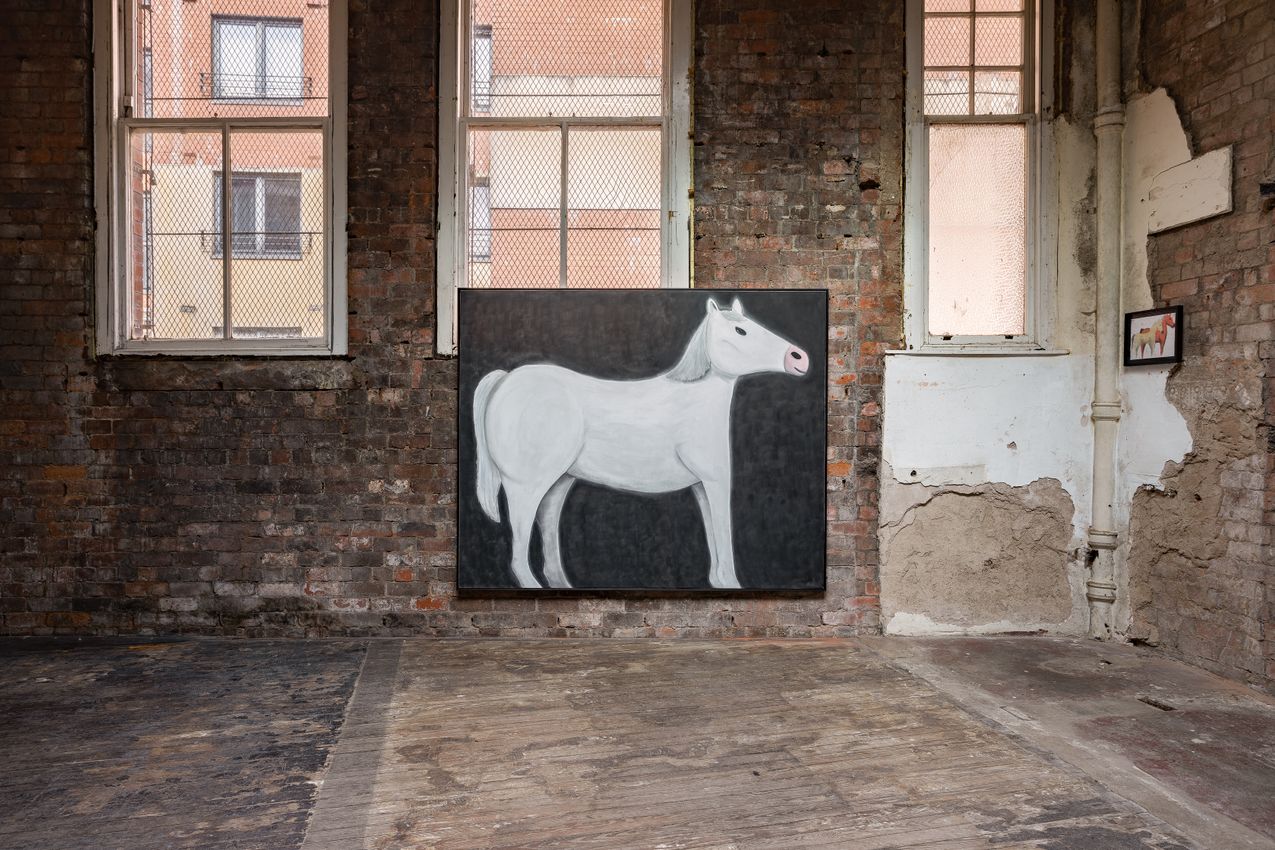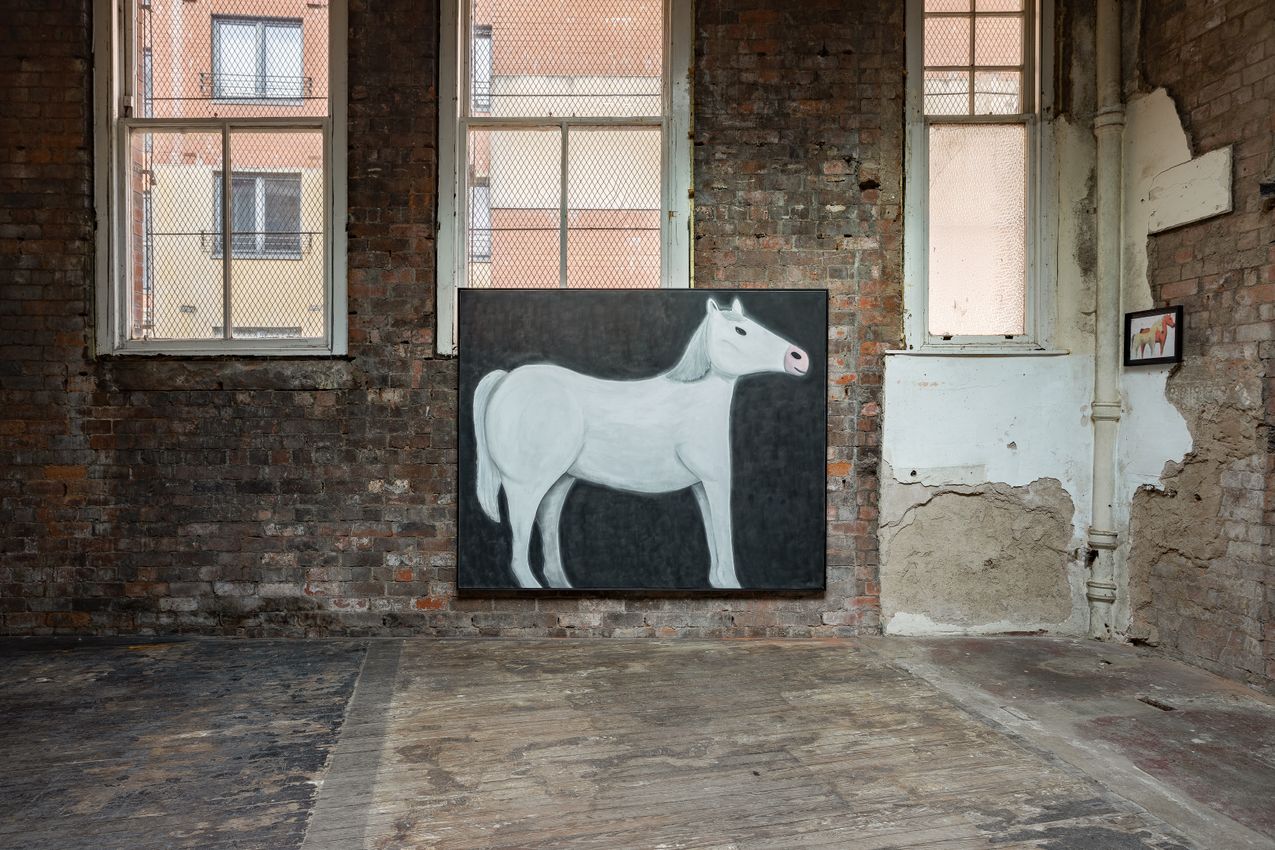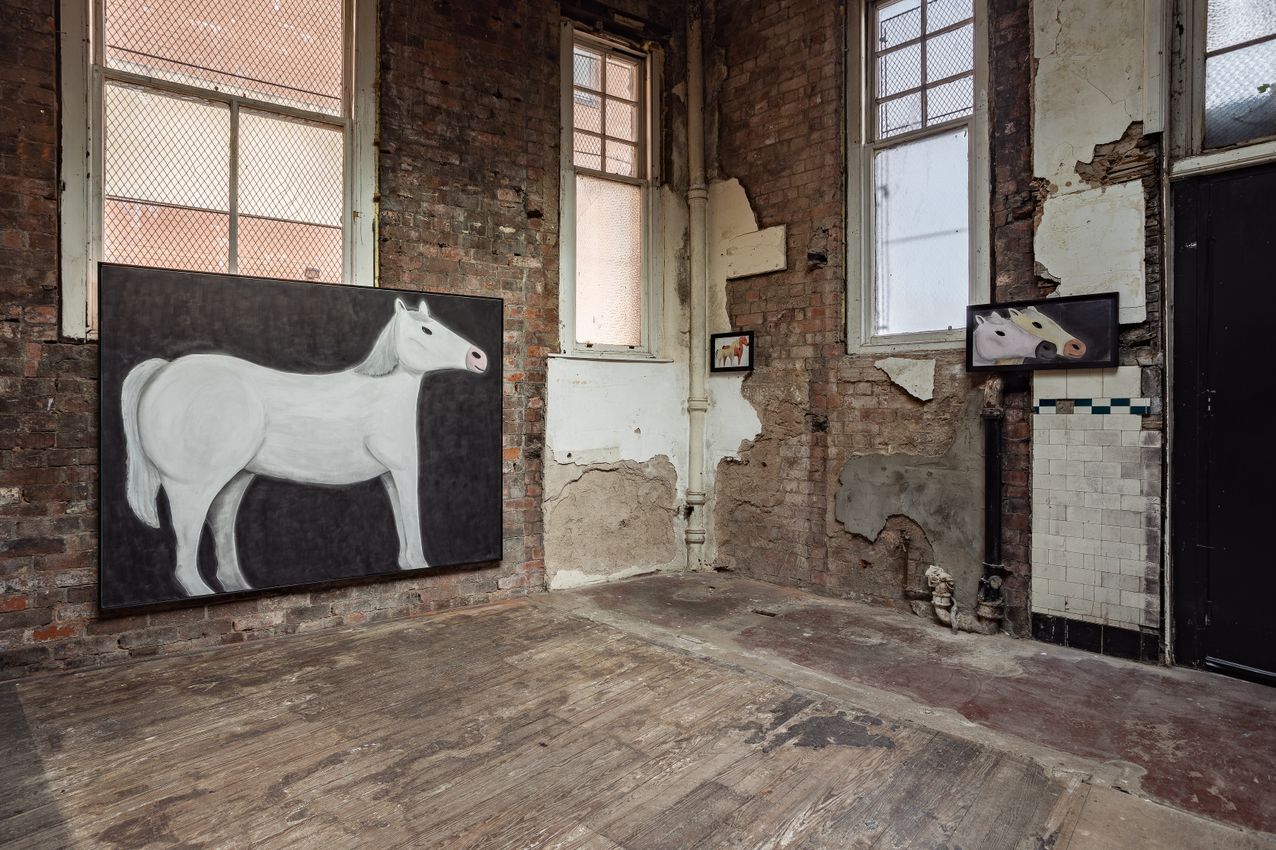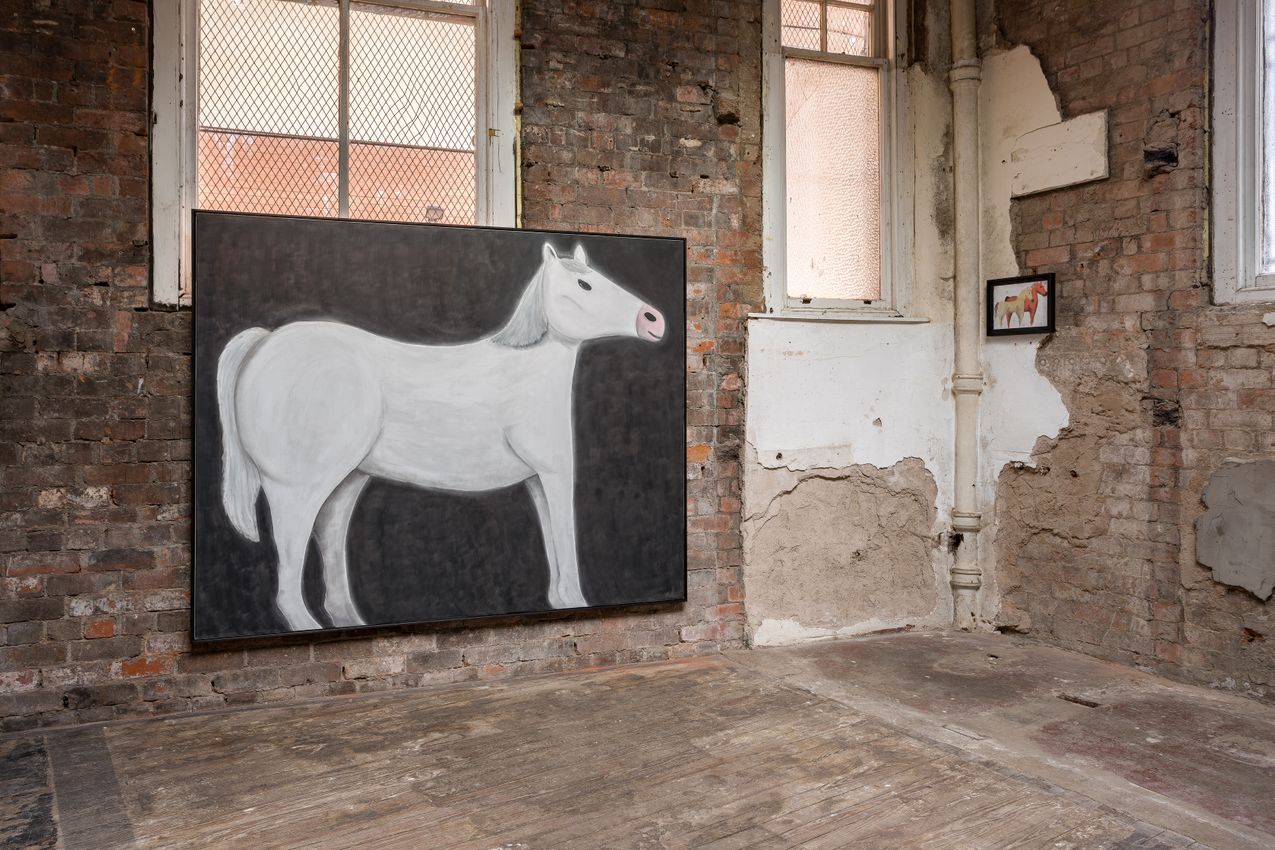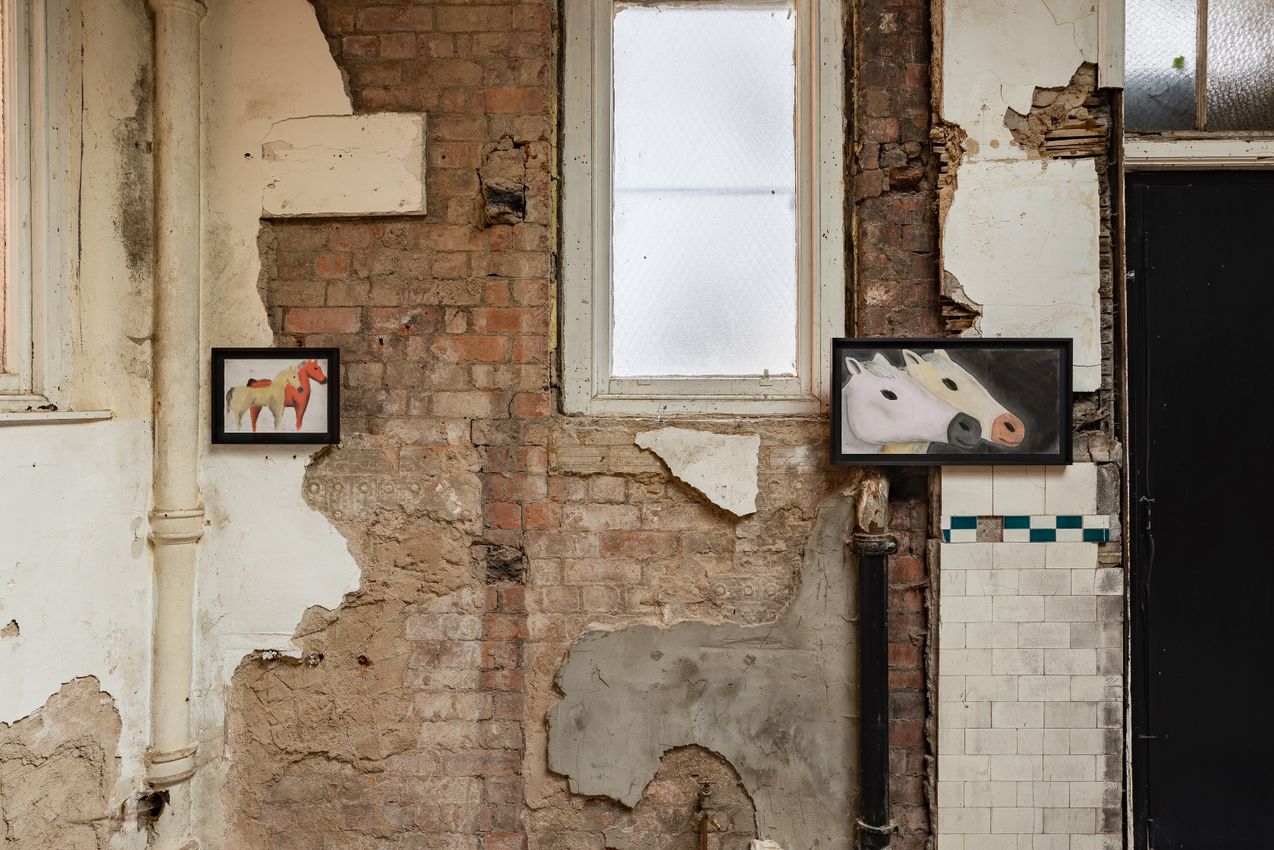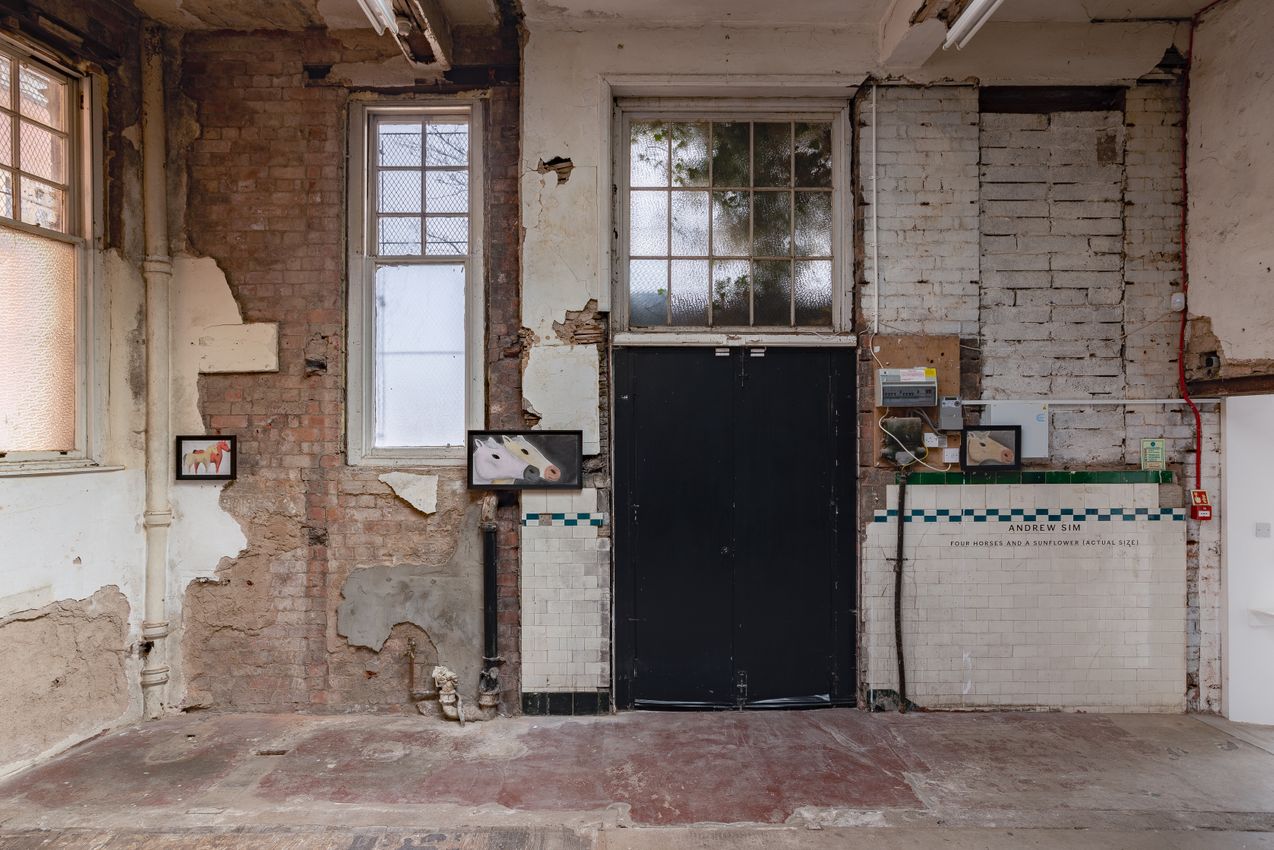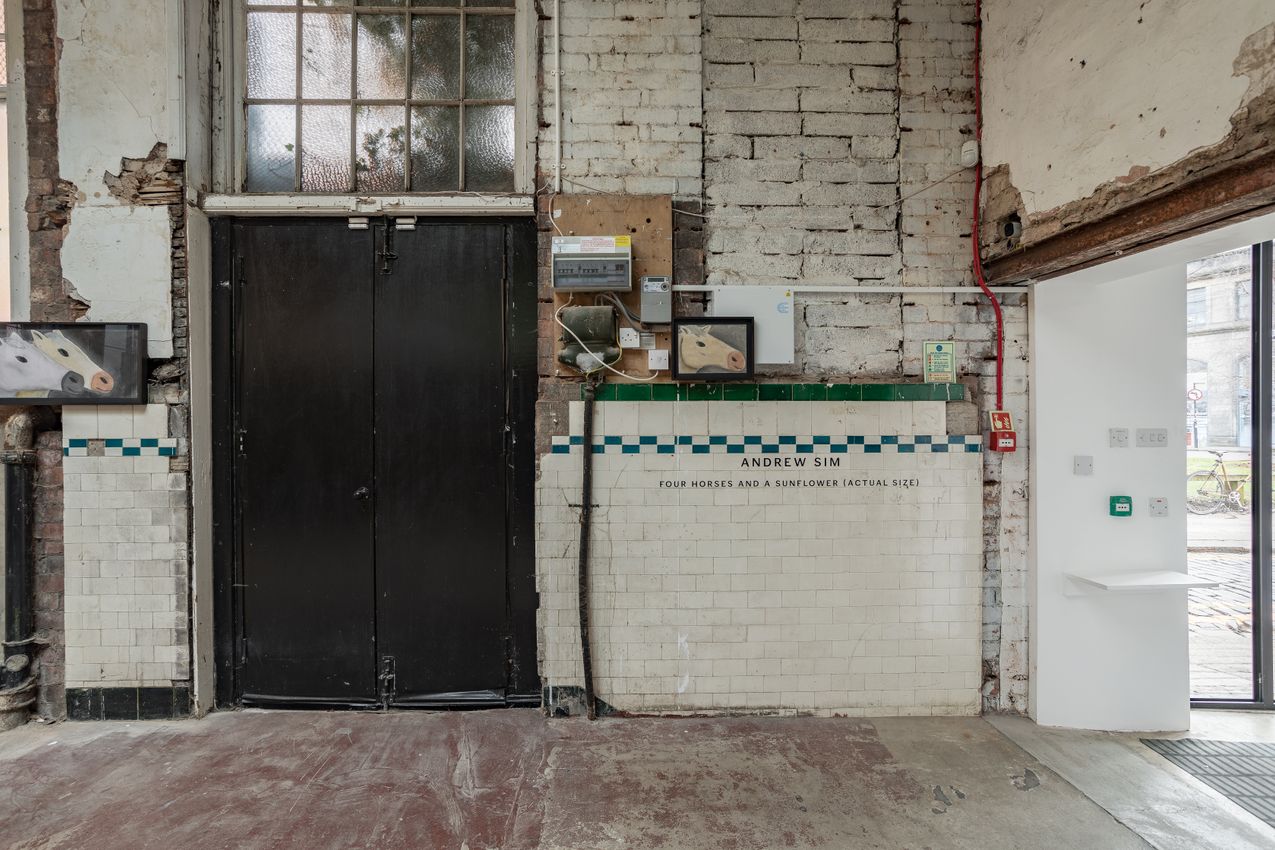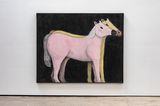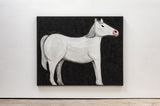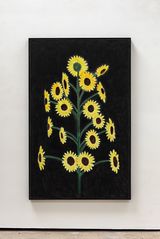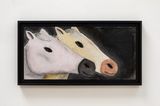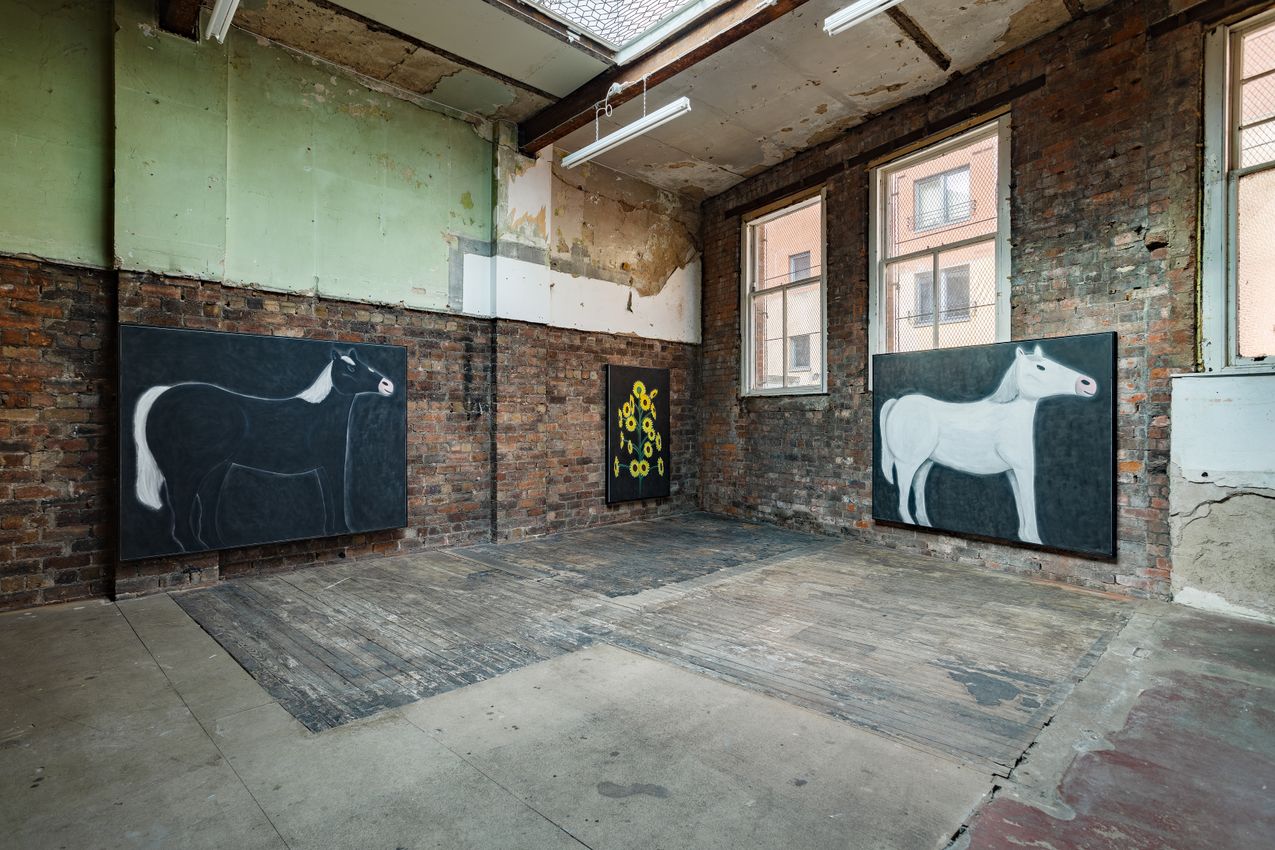
Andrew Sim presents Four Horses and a Sunflower (Actual Size) at The Modern Institute Bricks Space, a new body of work made in response to their 2020 residency at Villa Lena Foundation, Italy.
Sim’s practice draws upon their everyday experience, conscious and unconscious, simultaneously creating forms and characters that represent Sim’s experience of Queerness and the visibility of the cis/het gaze. Sim paints archetypes and cultural images in the foreground of their paintings, carefully considering the pivotal time to use certain imagery. These autobiographical moments document Sim’s use of symbolism and the duality and evolution of Queer lives.
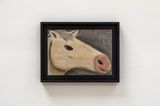
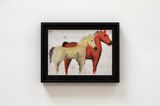
Sim presents a new body of work using a horse as the focal character. The horses are serene, poised, and elegant, motionless but simultaneously glancing to the right of the canvas, not necessarily gazing at the future but calmly watching beyond the landscape in which the viewer cannot see. In comparison to Sim’s previous body of work—which primarily uses werewolves as the lead characters—there is a shift in the artists’ perception of the observed existence of the cishet gaze that subconsciously led to the creation of the newer works. The werewolves’ eyes are anxious, directly seeking the audience with each form holding onto one another, gripped hands, these are influenced by the confrontational environment in which the artist was in at the time. In contrast, the horses stand tall and tranquil, unaware of the audience, a moment of peace within oneself. The paintings of the horse began as primary sketches at a residency in Italy, a countryside location, withdrawn from the everyday stresses imposed on Sim and a liberating time that gave space for Sim to reflect on their gender presentation and how this lay unchanged without external narratives. This calmness is echoed in the use of the imagery of the horses, symbolism of that metamorphic period.
The work, A sunflower with lots of heads, is based upon experiencing __the peculiar flower with various bulbs all branching off from one stem. The abnormality of this image leads the audience to believe it is created by Sim, a dream/nightmare representation of a familiar image to which most hold personal significance. Sim first encountered the plant in 2017 and delayed making the work until there was clarity on the significance of the kinship with the plant, allowing the image to fully digest before replicating it in a new medium. By carefully selecting the precise instance to recreate this real-life bloom, Sim has correctly and accurately replicated a like-to-like image of an in-person experience whilst concurrently inserting their feelings and relationship to the object. This process is essential within Sim’s practice, all forms are meticulously considered, and grow with Sim before being able to exist on their own.
Andrew Sim (b. 1987, Glasgow) lives and works in Glasgow. Selected exhibitions include: We Two Bigfoots Together Clinging, Prouddick HQ, London (2020) Heal the sick, raise the dead, Part of Glasgow International (2020); New Sodom will be a shining city on a hill, Summerhall, Edinburgh (2019); Karma Gallery, New York City (2019); Heaven To See, (Group exhibition), Part of Glasgow International (2018); and The Second Coming, The Pipe Factory, Glasgow (2016)
Selected exhibitions include: ‘To be a giant and keep quiet about it’, Margot Samel, New York (2022); ‘Four Horses and a Sunflower (Actual Size)’, The Modern Institute, Aird’s Lane (2022); ‘Heal the sick, raise the dead’, Part of Glasgow International (2021); ‘We Two Bigfoots Together Clinging,’ Prouddick HQ, London (2020); ‘New Sodom will be a shining city on a hill’, Summerhall, Edinburgh (2019); Karma Gallery, New York City (2019); ‘Heaven To See’, (Group exhibition), Part of Glasgow International (2018); and ‘The Second Coming’, The Pipe Factory, Glasgow (2016).
The Modern Institute was founded in Glasgow in 1997. The gallery works with 45 internationally established and emerging artists including Martin Boyce, Jim Lambie, Richard Wright, Anne Collier, Cathy Wilkes, Simon Starling, Urs Fischer, Luke Fowler and Nicolas Party.

A respected voice in contemporary art discourse.
Focusing on ambitious storytelling and insightful art-world commentary. Ocula Magazine publishes in-depth interviews, critical essays and timely analysis on the artists, exhibitions and ideas driving the global art world.
Learn more about Ocula Magazine
Showcasing the best of the art world.
Ocula partners with galleries from around the world to highlight their artists, artworks and exhibitions. Gallery membership is by application and invitation, with each member vetted by an independent panel.
Learn more about Ocula Membership

Specialises in the sale of major artworks.
Led by a team with deep ties to the world’s leading auction houses, galleries and collectors. Ocula’s advisory team offers bespoke services to high-net-worth clients from around the world who are looking to acquire the best of contemporary and modern art.
Learn more about our team and services