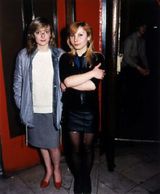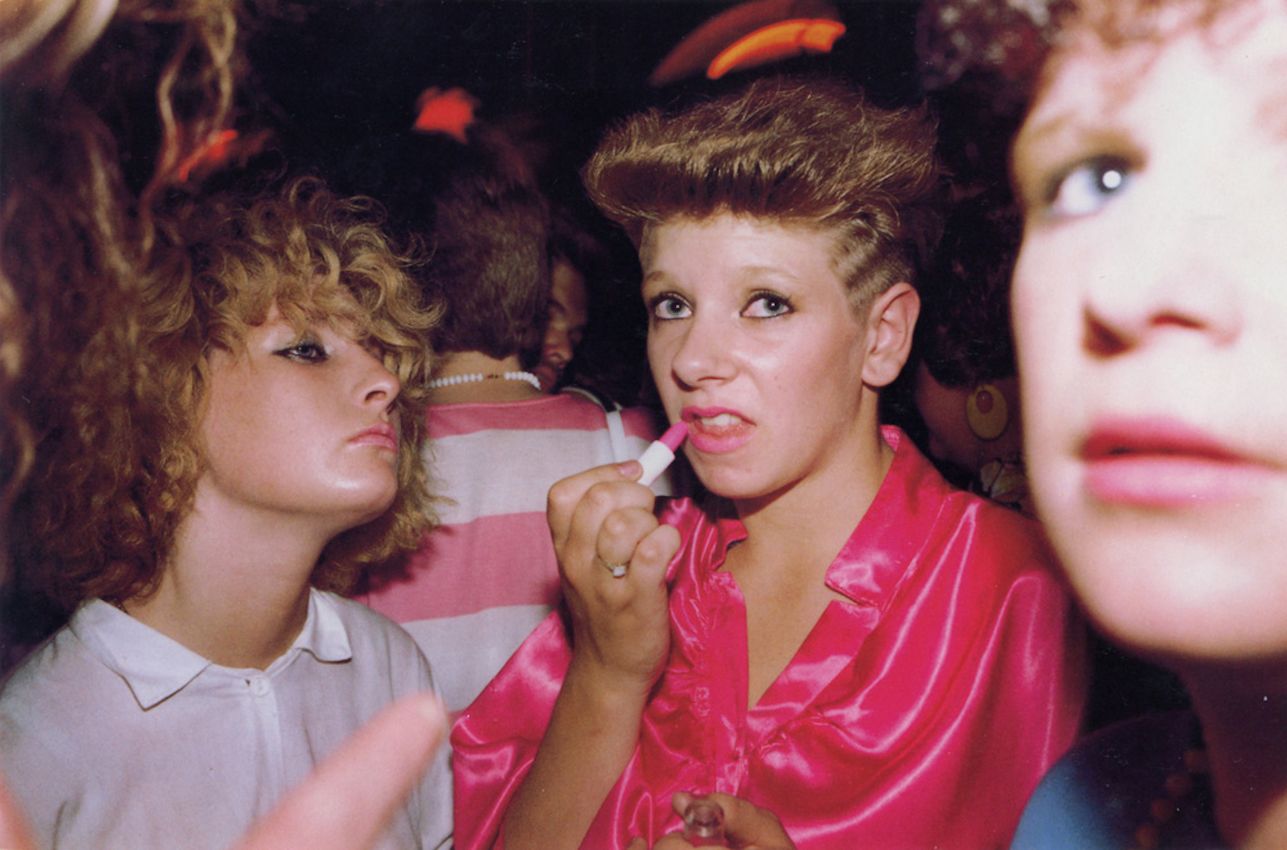
Tom Wood’s second solo show with the gallery features a previously unexhibited body of photographs Looking for Love, taken from 1982 until 1985 in the Chelsea Reach Nightclub, New Brighton, North England’s first disco pub (opened in 1968).
The 31 predominantly color photographs offer an anthropological glimpseinto a world of youthful hopes and desires. In the dark of the dancefloor, women glitter, showing off their latest fashions: luxurious hairstylishly tussled, ‘dangly’ earrings, ‘plassie’ jewelry, and cosmeticssuggesting sexual excitement. Dressed in regular jeans and shirts, meneye up the girls and fuel on beer to find the courage to engage in thecourtship rituals of disco dancing. Appearing at the evenings’ onsetalmost like members of different species, the two sexes just discoverthemselves, the boys out for a ‘good time’, the girls for love and’meaningful relationships’, perhaps.
The photographs exude a raw vitality undercut by the artist’s approach to his subjects which is asrespectful as it is voyeuristic, as committed as it is ‘cold blooded’.Strangely silenced by the camera, every movement and every gesturebecomes stark and uncomfortable in the pictures’ shallow flashlightspace – a fascinating crush of booze drenched bodies, hands gropingbums, flickering tongues, bleary eyes, ‘fag’ smoke and sweat.
After moving to Merseyside in 1978, Wood started photographing the rundown seaside resort of New Brighton: the locals, people who came on daysout, families and the kids who would go to the amusements. Over theyears, he noticed that the moody children hanging around the arcadeswould disappear for a couple of years – too old to play the video games,they were now old enough to go to The Chelsea instead. Returning one ortwo nights a week, sometimes with prints from previous visits, Woodinserted himself in the club’s life. Unlike Nan Goldin who documents inher ongoing autobiographical project her own socio-economic group, Woodremained an attentive observer. Similar to Brassai who unveils in hisb/w photographs renegade Parisian nightlife in the 30’s, Wood’s workoffers neither social comment nor judgment. His thought provokingglimpses however invite us to think of ourselves rather than speculateabout the details of other’s lives.
Tom Wood was born in West Ireland in 1951. His photographs, which he has taken almost exclusivelyin Merseyside and Liverpool over the past 25 years, have become veryprominent over the past few years. Solo exhibitions include: Kunstverein Kassel (2002) and Suermondt-Ludwig-Museum Aachen (2001), both in Germany; Museum of Modern Art Oxford, UK (1998); Galerie du Jour Paris (1996), and International Center of Photography, New York (1996). Works have been included in shows at important venues such as Institute of Contemporary Art, London, where he was shortlisted for the Becks Futures Award (2002); Art Institute of Chicago (2001); Centre National de la Photographie, Paris (2000); and Victoria & Albert Museum, London (1995). His works are in the following collections (selection): Museum of Modern Art, New York; Art Institute of Chicago; International Center of Photography, New York; Victoria & Albert Museum and British Council, both in London. There are 4 publications of his work: Bus Odyssey, 2001; People, 1999; All Zones Off Peak, 1998 and Looking for Love, 1989. Over Here, Photieman, a comprehensive volume edited by Manfred Heiting will be published in 2003. Most recently, in spring of 2002, Tom Wood received the Prix Dialogue del’Humanité (Outreach Award) at the Rencontres d’Arles.
Originally trained in painting at Leicester Polytechnic, Tom Wood became a recognized photographer when he was awarded an Arts Council of GreatBritain Photography Grant in 1977. The photographs in his book, LookingFor Love amusingly document the hedonistic nightlife of Merseyside, UK,while his later books, Bus Odyssey and All Zones Off Peak chronicle his otherworldly journeys on Liverpool public transit. Wood’swork was shown in 1996 at the International Center of Photography inNew York, and his work is part of the permanent collections of NewYork’s Museum of Modern Art and the Art Institute of Chicago.
Established in 1996, Thomas Erben Gallery focuses on rediscovering and introducing artworks that expand or deviate from the media usually associated with an artist.

A respected voice in contemporary art discourse.
Focusing on ambitious storytelling and insightful art-world commentary. Ocula Magazine publishes in-depth interviews, critical essays and timely analysis on the artists, exhibitions and ideas driving the global art world.
Learn more about Ocula Magazine
Showcasing the best of the art world.
Ocula partners with galleries from around the world to highlight their artists, artworks and exhibitions. Gallery membership is by application and invitation, with each member vetted by an independent panel.
Learn more about Ocula Membership

Specialises in the sale of major artworks.
Led by a team with deep ties to the world’s leading auction houses, galleries and collectors. Ocula’s advisory team offers bespoke services to high-net-worth clients from around the world who are looking to acquire the best of contemporary and modern art.
Learn more about our team and services