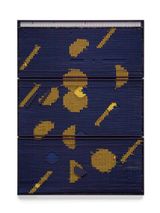
Tina Kim Gallery returns to Art Basel with presentations in both the Galleries sector and the Unlimited sector, dedicated to expansive, in-situ projects that transcend the classical art fair booth. Our selection of works brings together a breadth of artists from our program whose practices have defined contemporary and modern Korean and Asian diasporic art on an international stage. Works by leading figures of the Dansaekhwa movement and Korean modernism, such as Ha Chong-Hyun and Kim Tschang-Yeul, will be presented alongside visionaries including Pio Abad, Kim Lim, Pacita Abad, and Suki Seokyeong Kang, all of whom have garnered recognition from major art institutions and across cultural contexts.
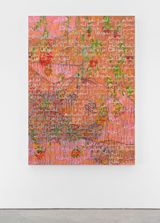
We are pleased to present the works of Korean-born, San Francisco-based artist Maia Ruth Lee (b. 1983), a focus of Tina Kim Gallery’s booth this year and a featured artist of Art Basel Unlimited. Once we leave a place is it there (2024–25), displayed at Unlimited, is an ambitious, large-scale work from Lee’s Bondage Baggage series, created using a binding technique in which the artist tightly bundles and dyes cord-bound fabric before unfurling the work to reveal ghostly, abstract impressions. Our booth will feature smaller extensions of this series, similarly depicting grids, atlases, maps, and readers in reference to the artist’s tender navigation of a life defined by transience, translation, and the diasporic experience.
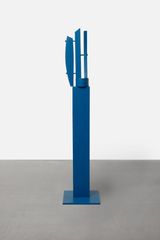
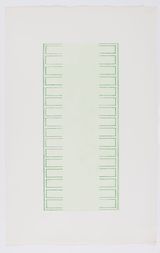
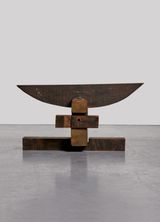
We are particularly thrilled to debut the works of Singaporean-British sculptor and printmaker, Kim Lim (1935–1997), whose representation we recently announced. Her work constitutes a vital yet historically underrecognized contribution to postwar abstraction, combining the seriality and restraint of Minimalism with an organic modulation and transcultural sensibility that set her apart from her contemporaries. We will feature wooden sculptures from the 1960s alongside etchings from her 1970s Ladder series, highlighting the formative years of a practice that spanned four decades. Shaped by a life lived between Singapore, London, and extensive travels across Asia, Europe, North Africa, and the Americas, Lim’s work drew on a wide-ranging visual and intellectual inheritance that she translated into an abstract language of clarity and nuance.
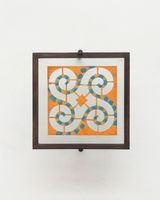
Another highlight of our booth is a range of textile works by Pacita Abad (1946–2004), whose Door to Life series is the subject of a solo exhibition at Tina Kim Gallery, open through June 20. Our presentation at Art Basel will include works from this series, inspired by the architecture Abad encountered during her trip to Yemen in 1998. Works on view will include the artist’s signature trapunto paintings, as well as double-sided works reminiscent of the traditional stained-glass windows of Sanaa, called qamariya, painted onto repurposed stencils she collected in Yemen. In addition, our presentation notably features Blue Lagoon (1989) from Abad’s Abstract Emotion series, a visual translation of the artist’s experiences collecting textiles and visiting ikat weaving and batik production centers across Indonesia.
Kim Tschang-Yeul (1929–2021), a pioneering figure in modern Korean art, was the subject of a major retrospective at MMCA Seoul (2025) and will be featured in an upcoming solo show at the gallery this fall. Kim’s signature waterdrop paintings will be displayed at our Art Basel booth alongside his experimental biomorphic works produced in the late 1960s and early 70s, reflective of the contact he made with the burgeoning movements of Pop Art, Op Art, and Minimalism while living in New York.
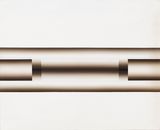
Another practitioner of geometric abstraction, works from Lee Seung Jio’s (1941–1990) Nucleus series will be included in our presentation, following a solo exhibition at the gallery last fall and a featured installation for MoMA’s Hyundai Card First Look series (2024). Referred to as the artist’s “pipe” paintings, this illusionistic body of work presents cylindrical forms blurring the boundary between a two-dimensional plane and three-dimensional space, drawing viewers into dynamic visual tension.
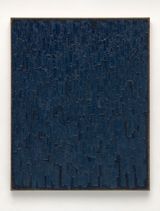
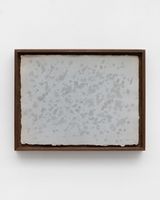
Tina Kim Gallery is delighted to present the work of Dansaekhwa figure Ha Chong-Hyun (b. 1935) at a landmark moment in his career, ahead of the artist’s first North American retrospective opening this September at the Asian Art Museum in San Francisco. Our presentation will focus on Ha’s hallmark Conjunction series, which the artist creates by pushing thick paint through the backs of loosely woven hemp canvases, resulting in a textured surface entirely unique to his practice.
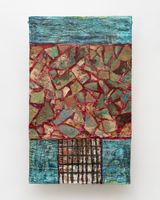
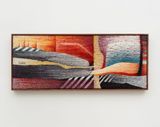
Several works spanning Lee ShinJa’s (b. 1930) trailblazing fiber art practice will be featured at Tina Kim Gallery’s booth, following the artist’s first North American survey at the Berkeley Art Museum and Pacific Film Archive, which concluded this past February. Drawing inspiration from Korea’s mountainous and coastal landscapes, Lee’s work combines geometric motifs with expressive color to evoke this natural imagery. The artist has played a major role in bringing embroidery, dyeing, weaving, and tapestry to the forefront of Korean modernism, challenging conventions through her unexpected use of materials and techniques.
Providing onlookers with a distinct optic experience, Park Seo-Bo’s (1931–2023) renowned Ecriture series will also be showcased. To produce his monochromatic paintings, Park covered his canvas with a single color, as well as layers of pulp from traditional hanji paper, and manipulated the still-wet surface with repetitive carving gestures to create a unique sequence of sculptural lines that seem to float on top of the canvas.
A driving force in the Dansaekhwa movement, Kwon Young-Woo (1926–2013) embraced a new method of creation that utilized hanji paper and eschewed conventions of the Western canvas. After layering sheets of hanji, the artist punctured, scratched, and tore the surface, employing techniques reminiscent of postwar Gutai artists in Japan to create his Untitled work featured at our booth. Although the materiality of Kwon’s oeuvre is rooted in a Korean artistic legacy, his manipulation of these traditional materials was experimental and innovative, highlighting the multidimensionality of hanji.
Complimenting this assemblage of historical works, the gallery will also present a selection of contemporary highlights from our program. This includes intricate ink drawings by Pio Abad (b. 1983) from his 1897.76.36.18.6 series, the same body of work currently exhibited in the artist’s presentation at the 61st International Art Exhibition of La Biennale di Venezia, In Minor Keys. Juxtaposing the Benin Bronzes held in the British Museum’s collection, this series depicts similarly sized stacks of ordinary objects found in the artist’s home. By locating this historical nexus between the quotidian domestic object and the contested cultural artifact, Abad invites a reflection on imperial extraction and the enduring history of colonialism.****
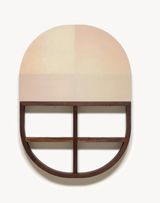
Building upon a recent solo exhibition at Tina Kim Gallery and looking ahead to her inclusion in the 2026 Busan Biennale and upcoming solo exhibition at the McNay Art Museum, Suki Seokyeong Kang (1977–2025) will be presented as an artist in focus at our booth, highlighting her expansive, research-driven practice that draws on a distinctly Korean artistic genealogy. Works from Kang’s wall-mounted Jeong and Mat series utilize the logic of the Korean musical notation grid-system—_Jeongganbo—_to depict how individuals, each comprising a note and a space, may come together to form a greater collective, much like a complex piece of choreography or music.
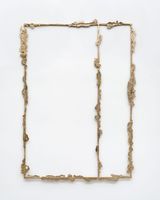
Mountains, trees and some other houses. (2026), a continuation of Tania Pérez Córdova’s (b. 1979) Contour series, will be on display at our booth as well. Acting as a tangible representation of the past, Pérez Córdova creates these works by marking the outlines of windows and doors into sand and pouring molten bronze into the grooves, displacing the works in time, space, and memory.
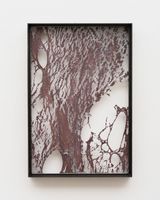
Currently featured in an exhibition at Institut d’art contemporain, Villeurbanne/Rhone-Alpes, and the subject of an upcoming solo show at the Vienna Secession, the ****unsettling yet inexplicably sensational works of Mire Lee (b. 1988) remain at the forefront of contemporary art discourse. Tina Kim Gallery’s booth will feature works derived from mesh fabric sculptures included in Lee’s 2024 installation at Tate Turbine Hall, Open Wound. Transformed into a new series of flat, wall-based works encased in steel frames, these membranous forms investigate the intersection of industrial materials, primal desires, and the poetic essence of the human condition.
A respected voice in contemporary art discourse.
Focusing on ambitious storytelling and insightful art-world commentary. Ocula Magazine publishes in-depth interviews, critical essays and timely analysis on the artists, exhibitions and ideas driving the global art world.
Learn more about Ocula Magazine
Showcasing the best of the art world.
Ocula partners with galleries from around the world to highlight their artists, artworks and exhibitions. Gallery membership is by application and invitation, with each member vetted by an independent panel.
Learn more about Ocula Membership

Specialises in the sale of major artworks.
Led by a team with deep ties to the world’s leading auction houses, galleries and collectors. Ocula’s advisory team offers bespoke services to high-net-worth clients from around the world who are looking to acquire the best of contemporary and modern art.
Learn more about our team and services