



Artist Statement
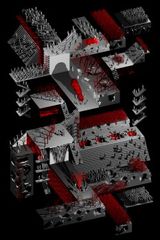
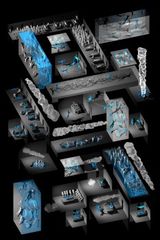
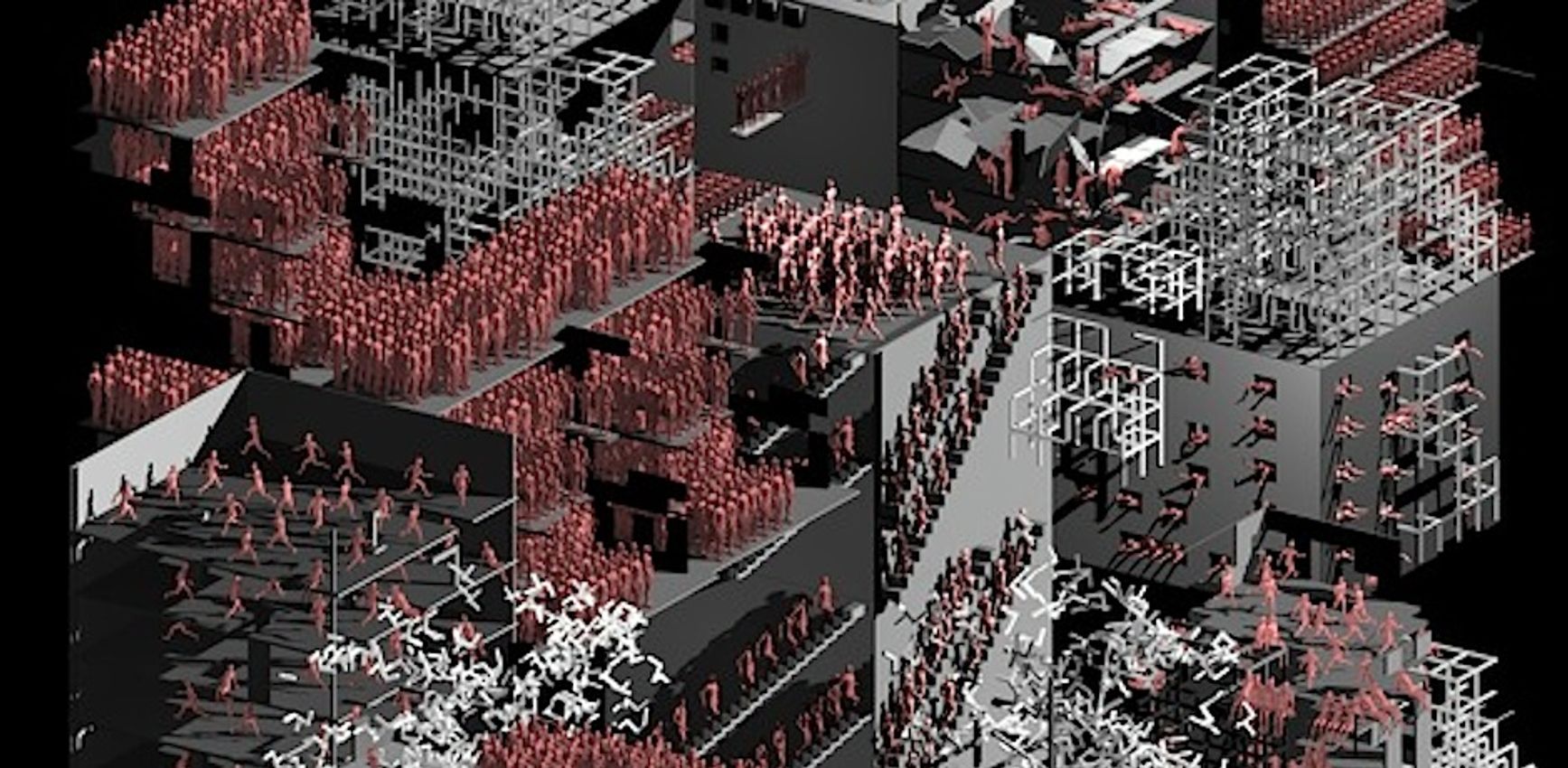
Utopia is part of my ongoing series of digital still and moving image work which feature groups of digitally generated and animated groups of figures engaged in often complex activities, frequently in relationship to specifically created digital environments.
Both my moving image pieces and my still image work (which directly grows out of my digital animations) create views of intricate digital colonies from elements which are produced in a professional 3D animation software programme. My work draws on diverse influences, including the photographic studies of humans in motion by Eadweard J. Muybridge and Jules-Etienne Marey, the elaborate geometric choreography of 1930s Hollywood musical choreographer Busby Berkeley, the looped animations of nineteenth century optical toys, Renaissance depictions of the body, the concept of the ‘automaton’, the aesthetics of the contemporary digital video game, and the spatial dynamics of Japanese Edo period prints.
The arrangements and re-arrangements of colonies of ‘digital multitudes’ explore issues of group dynamics, modularity and automation, in images which can be read as simultaneously utopian and dystopian. A generic animated figure is employed as a building block in the creation of a series of works which assemble and reassemble the replicated figure into units of performed actions, loops and cycles, creating ongoing series of patterns of movement vocabulary.
These figures sometimes recall the elaborate geometric ‘choreography’ of 1930s Hollywood musical director Busby Berkeley which featured armies of women whose individualism is also radically reduced – as though all cast from the same mould. Here ‘their identities are completely consumed in the creation of an overall abstract design’. It is not so much choreography on display, as Lucy Fischer describes, but ‘kinetic designs’ and ‘mechanical decor’, they are ‘elaborate pre-programmed machines for action’ and ‘repetitive movement’. The association with the rhythms of mechanical movement seem always present when discussing Berkely: Theweleit observes “the legs and hands of the line-series are not saying anything, rather they are performing something: the modus operandi of cogs, mechanical links, belt transmissions…”. They are “ornaments of the technical performed”: machinic, subject, malleable, compulsively aping technical processes.
Utilising this figure for me leads to questions as to the status of the animated body – what kind of ‘life‘ does this animated loop create in the space between the animate and the inanimate, between automata (devices that move by themselves) and simulacra (devices that simulate other things)?. They are essentially passive and annulled, where gesture does not follow thought or emotion, but instead is generated zombie-like by another’s will.
Tethered to the endless cycle of looped actions these figures resist the conventions of linear narrative progression, trapped in a kind of compulsive stasis with no clear beginning or end. They also form discreet units of action which can be arranged and rearranged at will in the creation and construction of the work. The loop forms the most elementary form of the structures of programming language which involves the altering of the linear flow of data structures through control structures such as the loop. Lev Manovich champions the loop as ‘a source of new possibilities for new media’ and conceptualises it as an ‘”engine” which puts narrative in motion. Loops retrieved from the ‘database’ are a ‘multitude of separate but co-existing temporalities’ – units which do not so much replace each other in a ordered flow, but are rather are already-activated elements which are composed in one of any possible sequential chains. This condition of the loop and its apparent inability to achieve resolution, or perhaps the illusion that it creates of some kind of perpetuality recalls animator Robert Breer’s comments on metamorphic transformation:
“…time doesn’t move forward, things are going, but sideways, obliquely, down and backwards, not necessarily ahead. The sense of motion is the issue. That idea seems hard to defend, because our locomotion drives us forward with our faces looking at new things. But since that movement is toward oblivion, in my philosophy anyhow, it might as well be backward. It’s a delusion to think you are getting anywhere.”
Gregory Bennett’s digital prints and animations explore the ergonomics of the human body through the rhythms of movement and the idiosyncrasies of computer rendering. By keeping his work stripped back to the barest essentials, he not only presents a bustling study of bodily motion reminiscent of Eadward Muybridge’s early photographic studies or Leonardo da Vinci’s Vitruvian Man, but also the quirky malfunctions that result from translating human ergonomics into computer programming.

Two Rooms is a contemporary art exhibition venue located in a converted warehouse in Central Auckland, New Zealand. Opened in August 2006, Two Rooms presents a program of residencies and projects by leading International and New Zealand contemporary artists. The building houses two exhibition spaces, the Project Room and the Long Room.

A respected voice in contemporary art discourse.
Focusing on ambitious storytelling and insightful art-world commentary. Ocula Magazine publishes in-depth interviews, critical essays and timely analysis on the artists, exhibitions and ideas driving the global art world.
Learn more about Ocula Magazine
Showcasing the best of the art world.
Ocula partners with galleries from around the world to highlight their artists, artworks and exhibitions. Gallery membership is by application and invitation, with each member vetted by an independent panel.
Learn more about Ocula Membership

Specialises in the sale of major artworks.
Led by a team with deep ties to the world’s leading auction houses, galleries and collectors. Ocula’s advisory team offers bespoke services to high-net-worth clients from around the world who are looking to acquire the best of contemporary and modern art.
Learn more about our team and services