Press Release
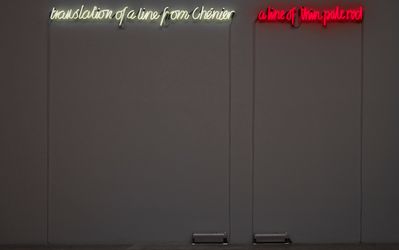
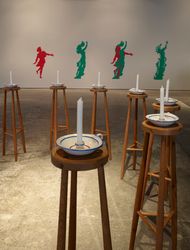
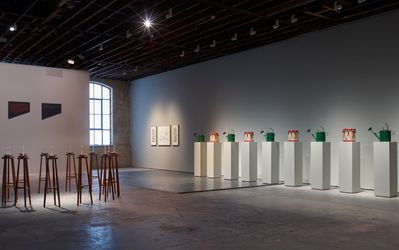
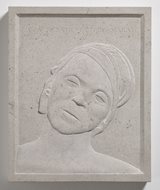
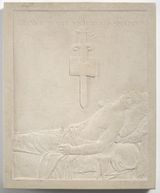
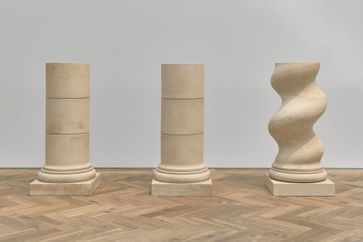
Victoria Miro is delighted to present an exhibition of the work of Ian Hamilton Finlay (1925–2006) marking the 90th anniversary of the artist’s birth. A philosopher, sculptor, poet and gardener, Finlay drew on and reinvigorated the classical tradition. This exhibition, curated by Pia Maria Simig, features work Finlay created in response to the French Revolution, and marks the first time an exhibition in the UK has focused solely on this body of work.

The French Revolution proved a rich subject for Finlay; he first received international attention for his guillotine installation A View to the Temple at Documenta 8 in Kassel in 1987 and thereafter the guillotine became one of the most enduring elements of his iconography.

For the artist the Revolution represented a moment of enormous political and aesthetic rupture and signalled a great moral, as well as political, leap. The period bookended by the dates in the title of this exhibition correspond with the establishment of the National Assembly and the storming of the Bastille in 1789, and the Thermidorian Reaction in 1794, which saw the arrest and execution of several of the key members of the Jacobin forces, including Maximilien Robespierre (1758-1794) and Louis Antoine de Saint-Just (1767-1794). This period thus encompasses extraordinary advances in secular democracy and social progress and also great bloodshed and unrest: the Enlightenment and the guillotine.

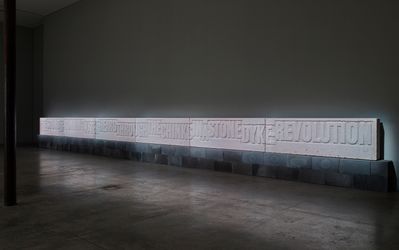
The exhibition includes a range of Finlay’s Revolutionary works, including the imposing eleven metre carved relief The Sound of Running Water, 1990, which was shown in the Bienal de São Paulo in 2012. This work features an evocative line that could serve as the introduction to themes of poetry and politics, and of beauty and immanence in the artist’s work THE SOUND OF RUNNING WATER HEARD THROUGH THE CHINKS IN A STONE DYKE: REVOLUTION.

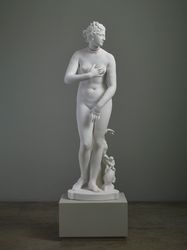
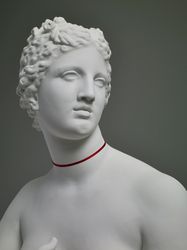
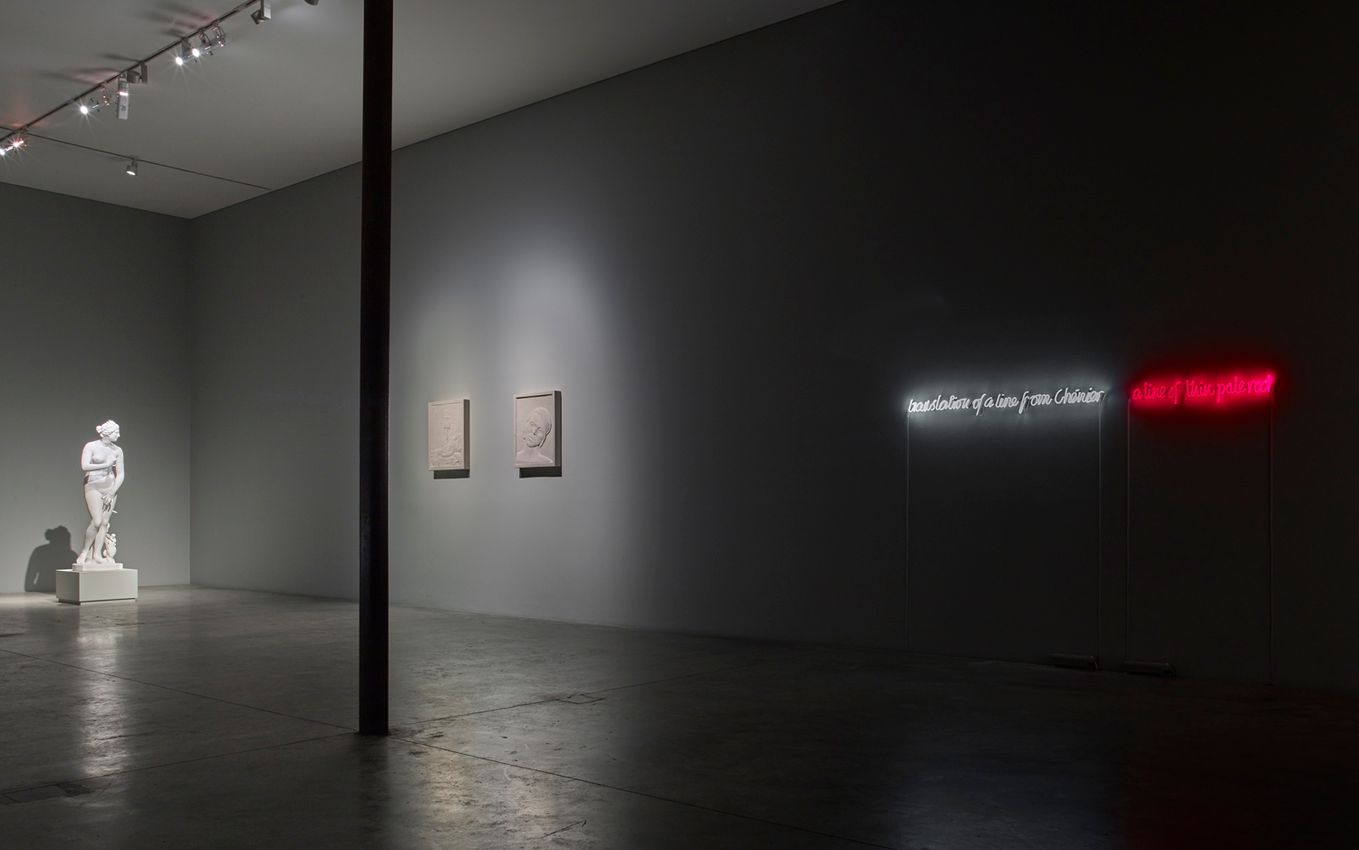
Aphrodite of the Terror, 1987 is a plaster sculpture based on the Hellenic statue of the Greek goddess of love and beauty known as the Medici Venus. In Finlay’s version she is adorned around the neck with a red string. The string is a reference to the thin red silk chokers worn by women whose loved ones had been executed during the Terror.

The wall painting Apollo and Daphne, After Bernini, 1991, depicts the Greek myth in which the wood nymph Daphne is transformed into a tree whilst fleeing from the god Apollo. The work is based on the sculpture by Gian Lorenzo Bernini (1598-1680), and stands as a comment on the French Revolution, in which, arguably, the revolutionary pursued ideals to the point of destruction. Finlay’s appropriation and re-interpretation of this mythological allegory highlights the contemporary resonance of classical subjects and forms.

The exhibition will be accompanied by two catalogues. The first features commentaries by Stephen Bann on each of the works in the exhibition. The other volume is dedicated to a garden Finlay created in London’s Chelsea, and includes photographs by Robin Gillanders and an essay by Thomas A Clark.

Finlay was born in 1925 and died in 2006. He was at the forefront of the concrete poetry movement in Britain in the 1960s, and in 1966 he created his famous garden ‘Little Sparta’ in Scotland. His work is shown in museums and galleries all over the world. His permanent works are installed in several gardens and parks in Europe and America.


Installation Views

About the Artist

A philosopher, sculptor and poet, Ian Hamilton Finlay (1925-2006) reinvigorated the classical tradition in a body of work that encompasses a variety of creative forms to celebrate the sustaining power of words. His diverse production encompassed a variety of creative forms including prints, poems, books, inscriptions, neons, sculptures, permanent installations and landscape design. The purest kind of conceptual artist, Finlay was sensitive to the formalist concerns (colour, shape, scale, texture, composition) of literary and artistic modernism. For almost forty years, he formed his works using philosophical texts, myths, characters and images from the past to make enigmatic juxtapositions and in so doing new thoughts. Finlay’s adept use of syntax and narrative configuration weaved refined distinctions with a lyrical philosophy. His skill lay in his unique ability to break down complex ideas into coherent single words and short phrases, infused with Finlay’s characteristic wit and, often, wry humour.

View Artist Profile

Also Exhibiting at Victoria Miro

About the Gallery
Since Victoria Miro founded her eponymous gallery in Cork Street, Mayfair, in 1985, the gallery has grown to represent over 40 artists and estates. With a reputation for presenting ground-breaking artists from around the world, Victoria Miro has exhibition spaces in London and a further gallery space in Venice.

View Gallery Profile
Address
16 Wharf Road
London
United Kingdom
Opening Hours
Tuesday – Saturday
10am – 6pm
(1)
London 16 Wharf Road
Victoria Miro
16 Wharf Road, London, United Kingdom
+44 207 336 8109
http://www.victoria-miro.com

Opening hours
Tuesday – Saturday
10am – 6pm
The art world in focus