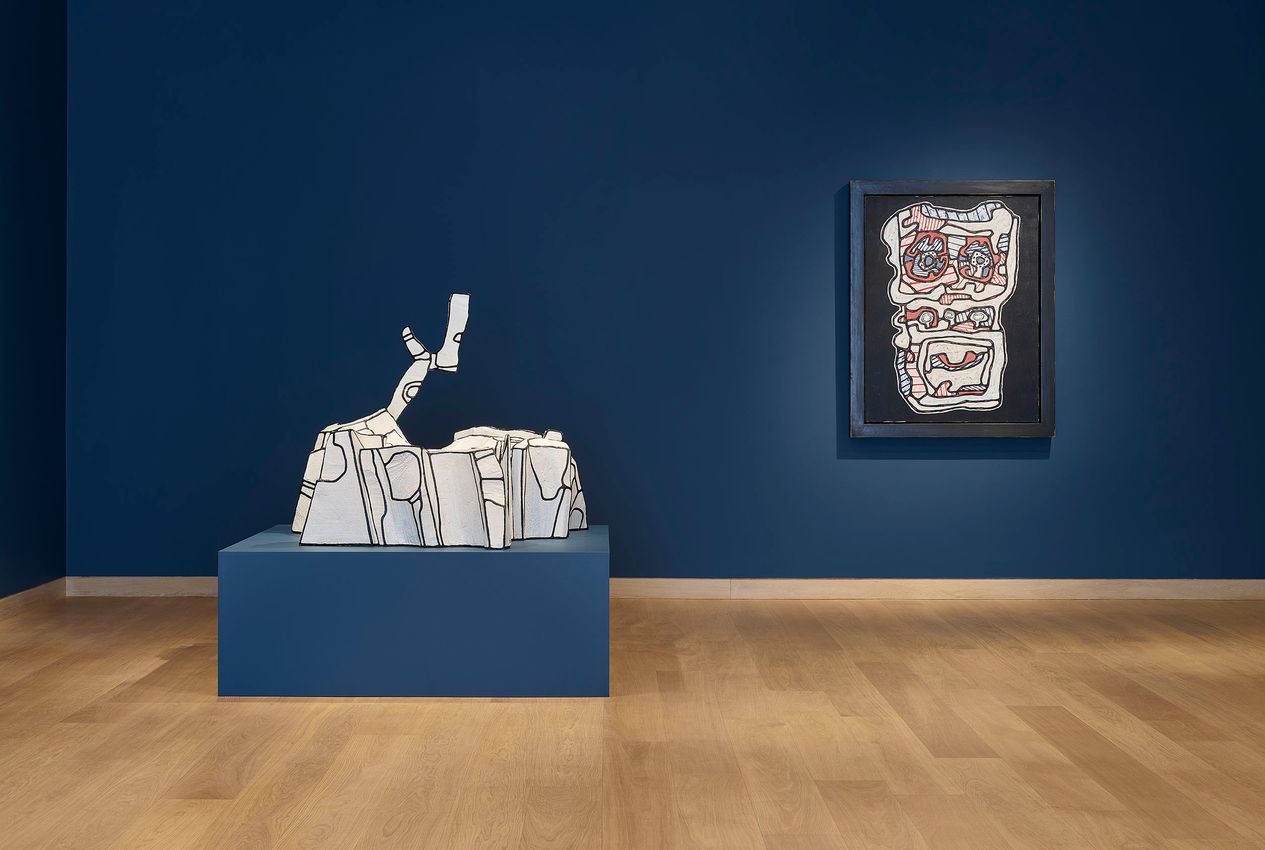
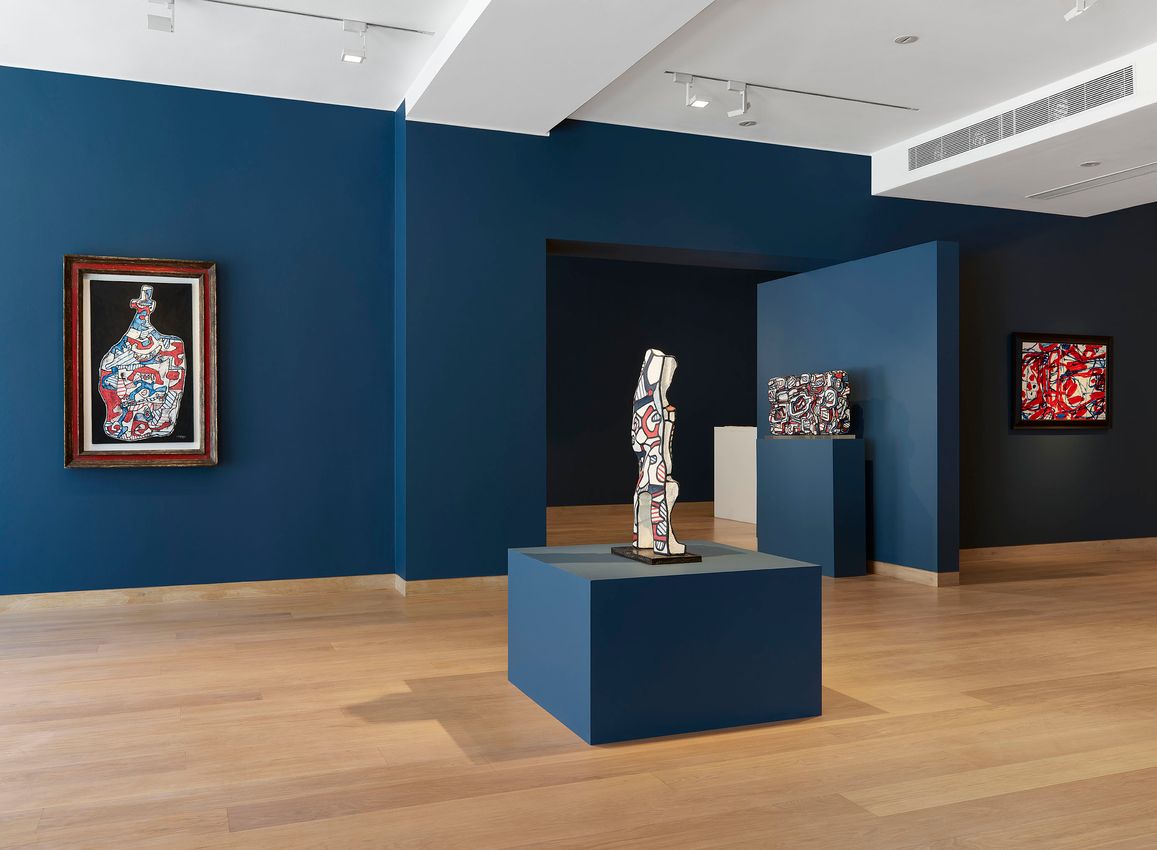
Waddington Custot is pleased to present an exhibition of paintings and sculptures by French artist Jean Dubuffet (1901–1985). Highlighting the varied exploration of subjects and materials in the artist’s career, the exhibition demonstrates the artist’s non-conformist attitude and boundless capacity for invention and experimentation.
One of the most important artists of the twentieth century, Dubuffet sought to create work which shunned traditional notions of beauty and favoured immediate forms of expression. He coined the term ‘Art Brut’ to describe the artistic expression that informed his own work, that of children and the mentally ill, believing that their innocent or untutored outlook gave them the most direct access to their emotions.
The earliest painting in the exhibition, Haute tête en pomme de terre (1951), is characteristic of Dubuffet’s early work, an anonymous figure is carved out of the thickly impastoed surface. He turns the classical ideal of the portrait on its head, depersonalising the figure and not attempting to convey any physical likeness. Dubuffet did not consider the pursuit of beauty or visual pleasure to be valid objectives for an artist. Rather, he stated that art was ‘a language, an instrument of knowledge, and an instrument of expression’ that ‘addresses itself to the mind not the eyes.’ His Paysage du Mental (Landscape of the Mind) series, of the same period, such as Paysage pétrifié (1952), is again constructed from heavily layered paint creating austere, monochromatic earth-toned surfaces.
During the summer of 1953, he continued to eschew traditional painting methods and began to construct collages using objects from nature. He introduced found materials such as butterfly wings, sand, gravel and dust. Jardin de souffle cor (1956) is made with a collage of cut-out lithographs with printed textures, assembled to construct a jewel-like garden landscape.
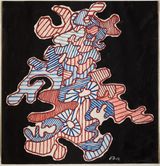
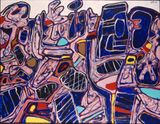
Dubuffet’s ‘L’Hourloupe’ series (1962–1974), was his most-extensive period of work, originating from absent-minded biro scribbles made whilst on the telephone. These works are characterised by black painted outlines filled with solid colour or hatching of blue or red. Dubuffet’s interest in portraiture remains in Réchaud-four à gaz IV (Autoportrait) (1966), but he also uses a new visual language to tackle varying subjects including the still life, such as in Bouteille III (1965). Dubuffet described his Hourloupe works as a ‘festival of the mind’ and during this period he began to extend his artistic reach to explore ambitious sculptural, theatrical and architectural installations.
Moving into Dubuffet’s late period, the exhibition focuses on both the ‘Partitions’ and ‘Psycho-sites’, two groups of work that were made in 1980 and 1981. In his ‘Partitions’, figures are placed on a background dominated by vivid, irregular sections of colour. The pedestrians, in Voie piétonnière (1981), are separated with defined linear spaces which give the appearance of collage elements. Dubuffet juxtaposes uniform, flat colour against expressive mark-making, creating a dynamic contrast. Following on from this, works become more homogeneous in their over-all appearance. Psycho-sites, Site avec 5 personnages (1981) and Site avec un personnage (1981), represent the interior of the mind with figures contained within the chaos of the highly gestural, unrestrained brush-work around them.
The paintings from the last years of Dubuffet’s life, Mires (Test-Patterns) such as Mire G 72 (Bolero) (1983), contain no recognisable figures or objects and are composed of a web of expressive lines covering the entirety of the surface. By the elimination of all referential imagery, Dubuffet reduced his paintings to the most uncontrolled expression of emotion. Dubuffet saw the works as ‘focus[ing] the eye on a point of endless continuum.’
Jean Dubuffet was a radical painter, printmaker and sculptor, determined to break down many of the barriers between high and low art in his search for the authentic or genuine. Dubuffet explored unusual materials in his innovative visual practice and tirelessly promoted art brut (outsider art).
Waddington Custot was formed through the partnership of French art dealer Stephane Custot and long-time London art dealer Leslie Waddington, in 2010. Located in Cork Street since 1958, formerly as Waddington Galleries, the gallery has a rich heritage and an international reputation for quality and expertise in works by modern and contemporary masters, with a particular focus on monumental sculpture.

A respected voice in contemporary art discourse.
Focusing on ambitious storytelling and insightful art-world commentary. Ocula Magazine publishes in-depth interviews, critical essays and timely analysis on the artists, exhibitions and ideas driving the global art world.
Learn more about Ocula Magazine
Showcasing the best of the art world.
Ocula partners with galleries from around the world to highlight their artists, artworks and exhibitions. Gallery membership is by application and invitation, with each member vetted by an independent panel.
Learn more about Ocula Membership

Specialises in the sale of major artworks.
Led by a team with deep ties to the world’s leading auction houses, galleries and collectors. Ocula’s advisory team offers bespoke services to high-net-worth clients from around the world who are looking to acquire the best of contemporary and modern art.
Learn more about our team and services