



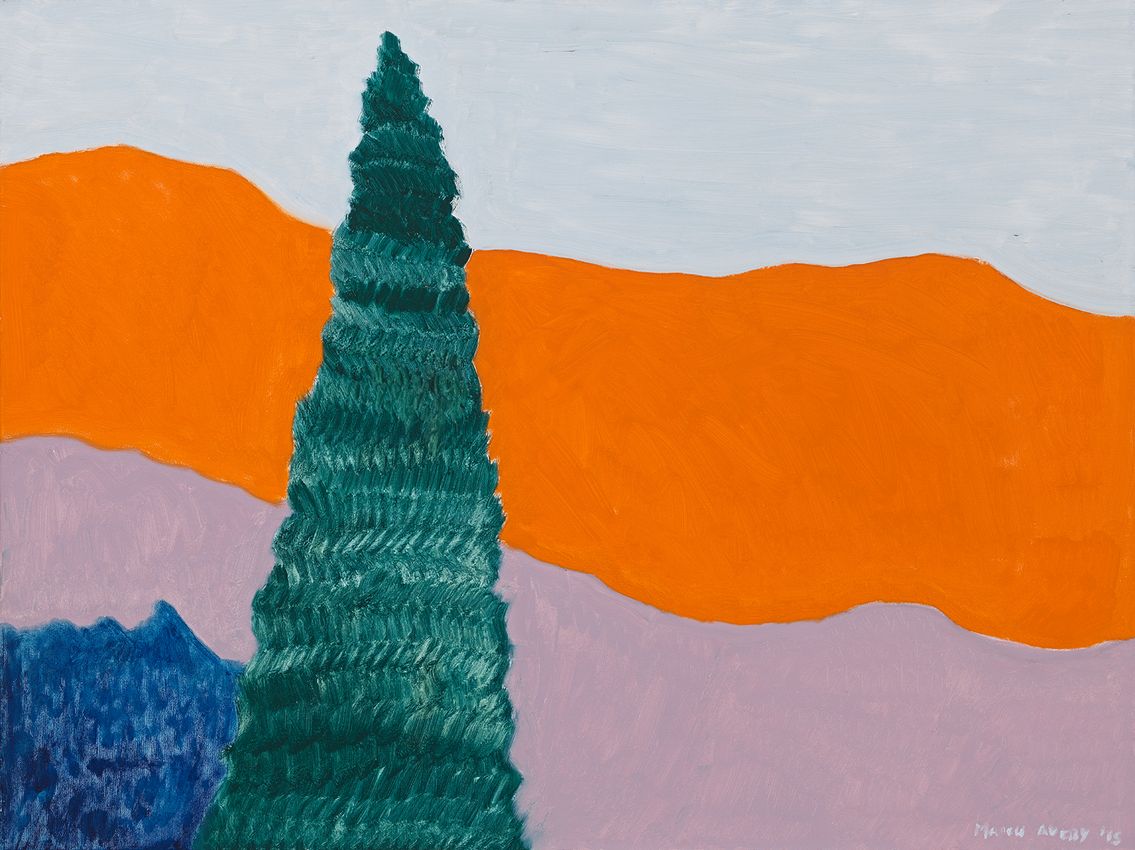
‘A little girl sees her mother cooking, she cooks. I saw my mother painting, so I painted...I think I was painting in utero.’
Bringing together over fifty years of work, this new exhibition introduces UK audiences to the richly coloured, enchanting compositions of painter March Avery (b. 1932, New York, New York), in her first solo show outside of the United States.
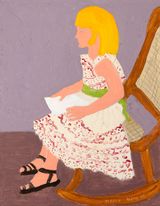
With no formal training, March Avery has an instinctive approach to painting which is deeply personal. The artist, who will be 90 years old this year, regular paints six days a week, mostly from New York City, where she has kept a studio for several decades. Avery has followed a typical pattern of switching from oils to watercolours in the summer, her studio routine punctuated by trips outside of the city: to the Catskill Mountains, to Provence in southeastern France, or to Paestum, the ancient Greek city in modern day Italy. Brought together for this exhibition, Avery’s paintings become documents chronicling a life lived, with family members, pets and summer houses reappearing as recurring characters. Her rich, illuminating use of colour renders everyday scenes bright and alluring, while simplified forms and flat, stained expanses combine to create transportative, atmospheric compositions.
Avery takes an exploratory, playful approach to colour and her paintings are a celebration of the transformational magic that happens when certain hues and shades meet one another. In Young Forrest, a powerful early canvas from 1970, the rich cobalt blue of a dense Cypress tree is rendered luminescent against a grey brown terrain and putty-coloured sky; Hill Town, 1975, picks out a hamlet of dark terracotta roofs in a mint green landscape. The more recent Tall Pines II, 2017 captures the water’s edge at Cooper Lake in the Catskills, the clean lines of the trees cutting upwards ahead of an undulating horizon. Friends and family members are shown at different stages of life in Avery’s work: typically introspective, they are, if not themselves sketching, often closely involved in their own personal pursuit: consumed by a shared board game, deep in conversation or absorbed by a book, each subject appears either unaware of our gaze or wholly comfortable in its glare.
Growing up in New York City, Avery was at the epicentre of artistic circles including some of the twentieth century’s most celebrated painters; Mark Rothko, Adolf Gottlieb and Barnett Newman were close friends of her parents, the artists Milton Avery and Sally Michel, and they would visit frequently and holiday together. As a child in the 1930s, surrounded only by artists, March Avery considered no alternative to being a painter in her adult life, as she describes: “I didn’t know anybody who wasn’t an artist. I thought everybody was an artist”.
As a child, March Avery would travel with her parents on their annual summer holidays, which typically stretched over two or three months, and were remarkably inexpensive: on one occasion the Averys rented an unfurnished house in Connecticut, which they furnished simply from a second hand man in town; on another, staying in a picturesque village in Quebec, the family subsisted on $300 for three months. Every day was spent painting, or sitting for one another’s compositions. March was a regular subject for her father’s paintings, and she appears many times on the walls of the Royal Academy in summer this year where he has a retrospective just a few paces from Waddington Custot. Through this expansive exhibition London audiences encounter March Avery’s exceptional achievements on the other side of the canvas.
March Avery: In the Studio is March Avery’s first exhibition with the gallery and marks her representation by Waddington Custot.


Waddington Custot was formed through the partnership of French art dealer Stephane Custot and long-time London art dealer Leslie Waddington, in 2010. Located in Cork Street since 1958, formerly as Waddington Galleries, the gallery has a rich heritage and an international reputation for quality and expertise in works by modern and contemporary masters, with a particular focus on monumental sculpture.

A respected voice in contemporary art discourse.
Focusing on ambitious storytelling and insightful art-world commentary. Ocula Magazine publishes in-depth interviews, critical essays and timely analysis on the artists, exhibitions and ideas driving the global art world.
Learn more about Ocula Magazine
Showcasing the best of the art world.
Ocula partners with galleries from around the world to highlight their artists, artworks and exhibitions. Gallery membership is by application and invitation, with each member vetted by an independent panel.
Learn more about Ocula Membership

Specialises in the sale of major artworks.
Led by a team with deep ties to the world’s leading auction houses, galleries and collectors. Ocula’s advisory team offers bespoke services to high-net-worth clients from around the world who are looking to acquire the best of contemporary and modern art.
Learn more about our team and services