





IBRAHIM MAHAMA
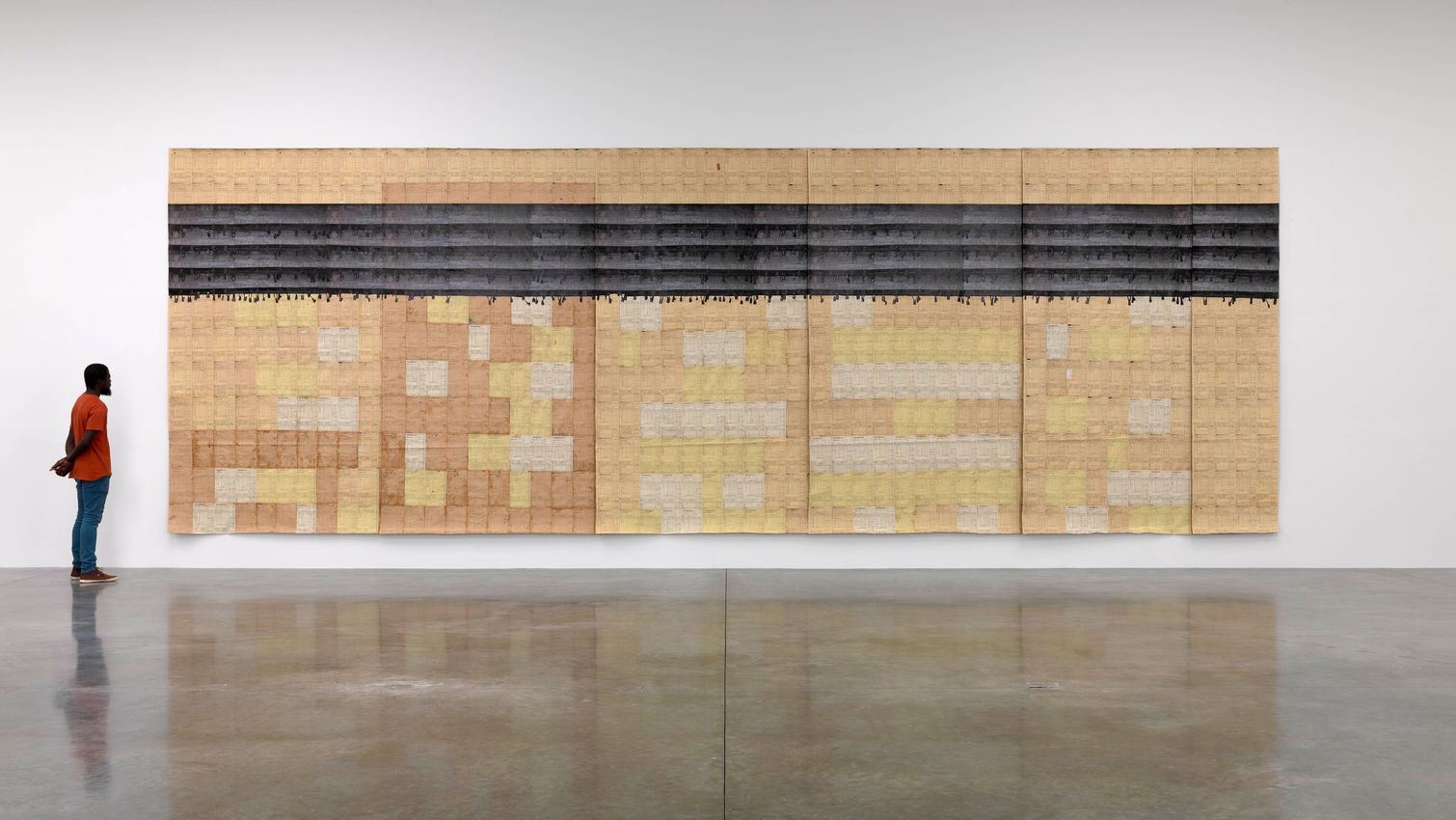
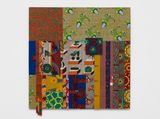
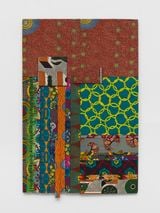
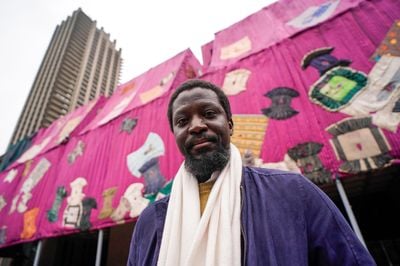
b. 1987, GhanaIbrahim Mahama uses the transformation of materials to explore themes of commodity, migration, globalisation and economic exchange. Often made in collaboration with others, his large-scale installations employ materials gathered from urban environments, such as remnants of wood, or jute sacks which are stitched together and draped over architectural structures. Mahama’s interest in material, process and audience first led him to focus on jute sacks that are synonymous with the trade markets of Ghana where he lives and works. Fabricated in South East Asia, the sacks are imported by the Ghana Cocoa Boards to transport cocoa beans and eventually end up as multi-functional objects, used for the transportation of food, charcoal and other commodities. ‘You find different points of aesthetics within the surface of the sacks’ fabric’, Mahama has said. ‘I am interested in how crisis and failure are absorbed into this material with a strong reference to global transaction and how capitalist structures work.’
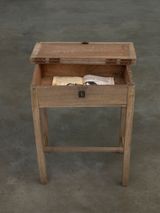
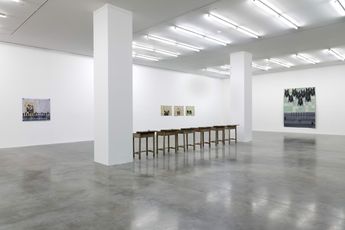
A critical feature of the artist’s practice is the process by which he obtains his materials. For Non-Orientable Nkansa for example, Mahama engaged dozens of collaborators to produce hundreds of ‘shoemaker boxes’. These small wooden objects were made from structural materials found in the cities of Accra and Kumasi, and used to contain tools for polishing and repairing shoes. Bearing the marks of the trade of ‘shoeshine boys’, the boxes also functioned as an improvised drum, pounded to solicit business. Mahama and his collaborators obtained these items through a process of negotiation and exchange. Gathered together in a single, monumental unit, the containers were crammed with other re-purposed items such as heels, hammers and needles, all of which are part of Mahama’s ongoing inquiry into the life of materials and their dynamic potential.
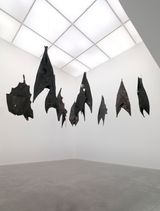
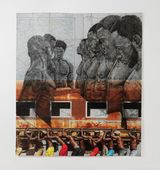
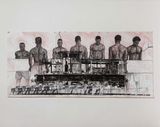
For the recent installation A Grain of Wheat 1918-1945 (2015-18) Mahama accumulated dozens of ambulance stretchers dating from the Second World War, collected during a residency in Athens. The battered, antique carriers, propped upright, were then partially re-stretched with household fabrics and smoked fish papers from West Africa, which lend the work a powerfully redolent aspect. Brought together the continuous line of posts acquire an anthropomorphic dimension, calling to mind individuals amassed silently at border crossings, and evolves, as one critic described it, into ‘a monument to labour and suffering’.
Ibrahim Mahama was born in 1987 in Tamale, Ghana. He lives and works in Accra, Kumasi and Tamale. His work has appeared in numerous international exhibitions including NIRIN, 22nd Biennale of Sydney (2020); tomorrow, there will be more of us, Stellenbosch Triennale (2020); Future Genealogies, Tales From The Equatorial Line, 6th Lubumbashi Biennale, Democratic Republic of the Congo (2019); Parliament of Ghosts, The Whitworth, University of Manchester (2019); Ghana Freedom, inaugural Ghana pavilion, 58th Venice Biennale, Venice (2019); Labour of Many, Norval Foundation, Cape Town (2019); Documenta 14, Athens and Kassel (2017); All the World’s Futures, 56th Venice Biennale, Venice (2015); Artist’s Rooms, K21, Düsseldorf (2015); Material Effects, The Broad Art Museum, Michigan (2015); An Age of Our Own Making, Kunsthal Charlottenborg, Copenhagen and Holbæk (2016) and Fracture, Tel Aviv Art Museum, Israel (2016). In March 2019, Ibrahim Mahama opened the artist-run project space Savannah Centre for Contemporary Art (SCCA) in Tamale, Ghana, followed by the opening of Red Clay in nearby Janna Kpeŋŋ in September 2020. Comprising exhibition space, research facilities and an artist-residency hub, both sites represent Mahama’s contribution towards the development and expansion of the contemporary art scene in his home country.
Courtesy White Cube

Works at White Cube








Recently Exhibited



Exhibiting Elsewhere


Works Elsewhere




Ibrahim Mahama in Ocula Magazine











Explore and Follow Artists Shaping Contemporary Art
A respected voice in contemporary art discourse.
Focusing on ambitious storytelling and insightful art-world commentary. Ocula Magazine publishes in-depth interviews, critical essays and timely analysis on the artists, exhibitions and ideas driving the global art world.
Learn more about Ocula Magazine
Showcasing the best of the art world.
Ocula partners with galleries from around the world to highlight their artists, artworks and exhibitions. Gallery membership is by application and invitation, with each member vetted by an independent panel.
Learn more about Ocula Membership
Specialises in the sale of major artworks.
Led by a team with deep ties to the world’s leading auction houses, galleries and collectors. Ocula’s advisory team offers bespoke services to high-net-worth clients from around the world who are looking to acquire the best of contemporary and modern art.
Learn more about our team and services