Press Release

Occupying all the galleries at White Cube Bermondsey, Anselm Kiefer’s exhibition of paintings, ‘Des Malers Atelier’, explores artistic endeavour and the possibility of finding a measure of refuge through nature. In its restless passage, the natural world provides the ground for the artist’s reflections on the personal and collective histories that continue to inhabit his work, while the studio remains a place of transformation.

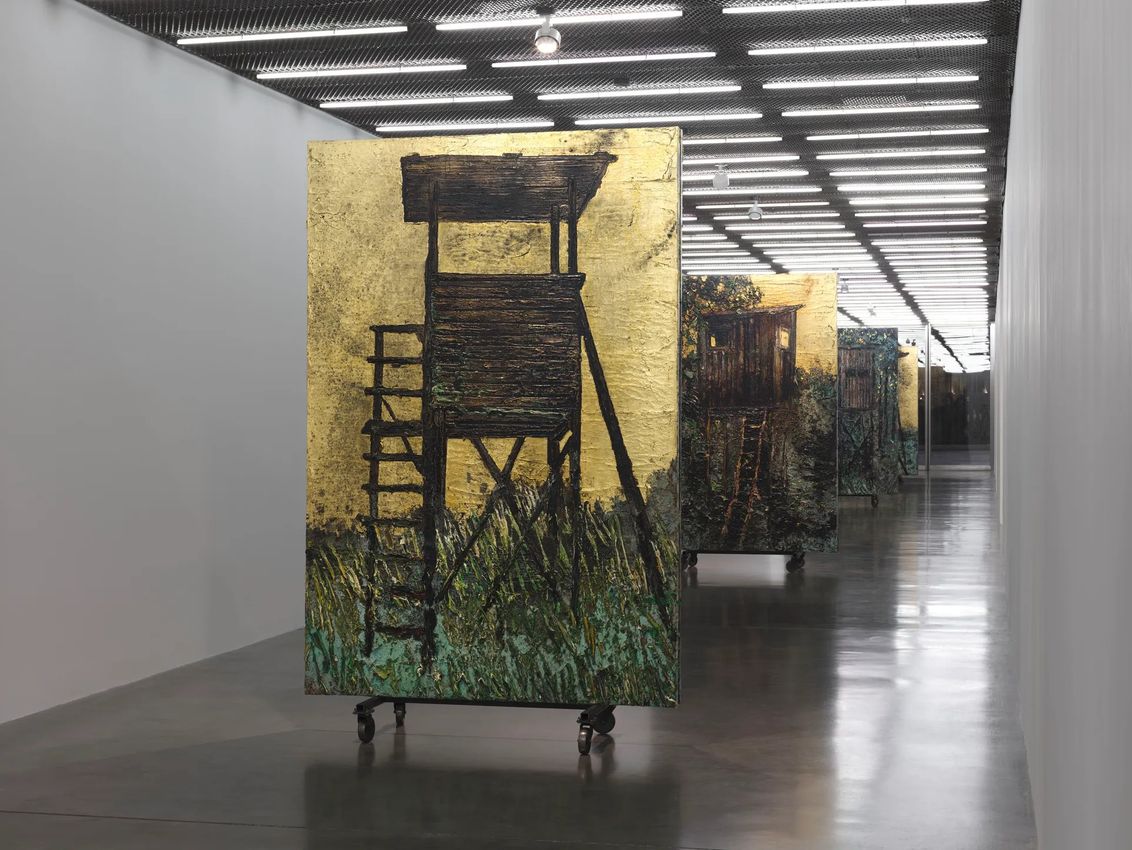
Among the new works are paintings that continue his longstanding ‘Des Malers Atelier’ motif, which Kiefer has engaged with since the late 1970s. In the North Gallery, these ‘painter’s studios’ take the form of unassuming sheds, drawn from buildings the artist encountered and photographed on his travels. Moored amid fields of verdant earth and silhouetted against a gilded sky, their spare timber constructions carry traces of the attic studios depicted in Kiefer’s earliest ‘Des Malers Atelier’ works, while their exposure within the landscape recalls the more permeable structures of the paintings of the mid-2010s, in which the studio appeared as a transparent space amidst nature.

Along the gallery’s corridor, paintings here depicted on slender supports, form the spine of the exhibition. Resembling hunters’ hides from which to survey the surrounding landscape, their elevated architectures give form to Kiefer’s conception of the artist as an intermediary, the studio serving both as a physical site of making and as a point of contact between earthly and celestial realms.

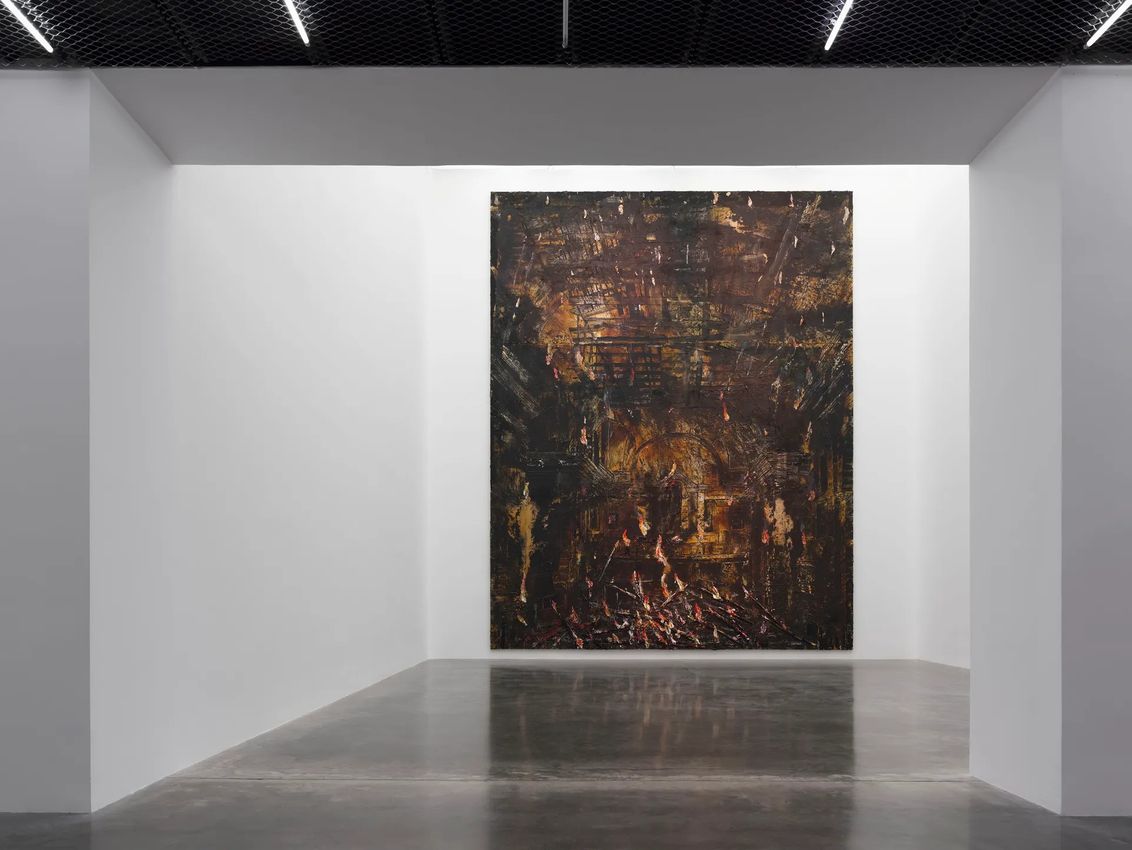
These slight constructions seem improbable vessels for the undertakings of the artist they propose to harbour. Yet something of this humble architecture persists even in the colossal painting in Bermondsey’s 9x9x9 gallery, where the rudimentary framework of an attic appears superimposed upon the grand interior of a Venetian palazzo, recalling Kiefer’s recent exhibition at the Palazzo Ducale (2022–23), which responded to the landmark’s Gothic architecture. The attic here finds a point of reference in one of Kiefer’s first studios in Germany, whose image recurs throughout his earliest ‘Des Malers Atelier’ works in a range of mediums, frequently shown engulfed in flames. Here, too, the cavernous interior appears under siege from fire, taking on the aspect of an athanor, the slow-burning furnace used by alchemists to pursue the elusive transmutation of base metals into gold.

This correspondence between alchemical and artistic labour has long occupied Kiefer, for whom the studio, like the furnace, stands as a place where materials and ideas undergo their respective transformations. The association finds an earlier expression in Athanor (2007), his large-scale site-specific painting at the Musée du Louvre, where Kiefer is among the few living artists with work permanently installed. The painting depicts the figure of the artist lying beneath a cosmic expanse, while its inscriptions and material properties of lead, silver and gold likewise speak to processes of alchemical transformation. Setting the modest circumstances of his beginnings within the epic proportions of his later practice, the vast architecture of the present work, seemingly on the brink of collapse, suggests the studio as a space of change, wherein the conditions of destruction also intimate the possibility of another beginning.

In Kiefer’s work, history is seldom confined to its own chronology, rather it enters into the larger, recurring order of mythology. Within this conception of time, events and their consequences are never only consigned to the past. In reference to his 1977 photographic artist’s book Siegfried’s Difficult Way to Brünhilde, which invoked Wagner’s operatic cycle Der Ring des Nibelungen (1848–74), the first landscape encountered in South Gallery I depicts a deserted railway bed receding towards a distant horizon. A succession of overgrown, trackless sleepers, mounted with small white flags, emerges from the desaturated landscape, their diminishing forms establishing a steep perspectival recession, while accretions of charcoal, chalk, shellac and oil paint across the surface evoke the slow encroachment of the surrounding terrain upon the deserted course.

Elsewhere, paintings continue to summon images and preoccupations that have inhabited Kiefer’s imagination for decades. In South Gallery II, poetry – a constant interlocutor in his practice – encroaches through a line from Ezra Pound’s ‘N.Y.’, scrawled above three monoliths suggestive of tombs or bunkers: Pour Ezra Pound: My city, my beloved, Thou art a maid with no breasts (2026). Tonwellen (2025), in turn, takes its peculiar form from the concrete sound mirrors at Dungeness, which were developed during the First World War as an early acoustic warning system to detect approaching enemy aircraft. For Kiefer, this enormous listening ear becomes an antenna for less tangible transmissions, receiving impulses from the ether that seep into the painting and return, by the same circuit, as reflections of the painter himself.

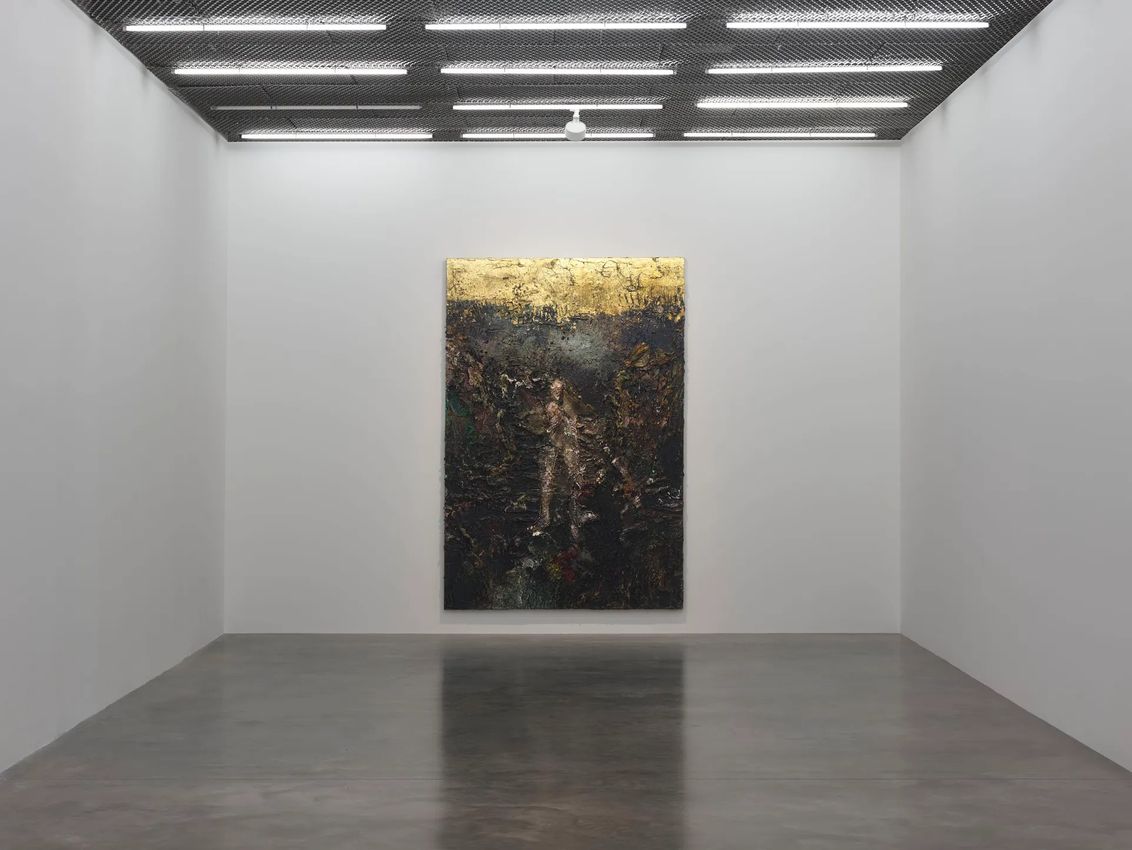
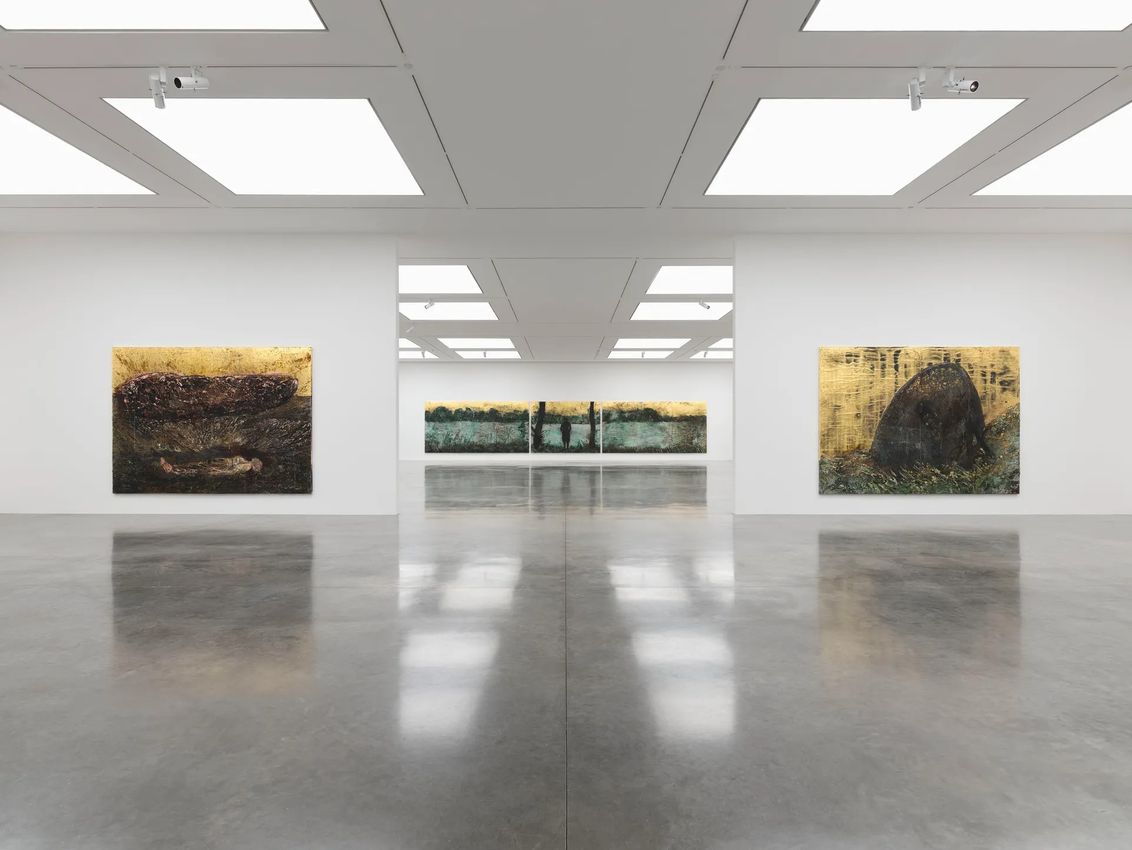
Kiefer’s practice seems to partake of a conception of time in which past and present are continually brought into restive proximity. His paintings accumulate histories of their own, not only through successive accretions of oil, acrylic, charcoal, straw and other raw matter upon their surfaces, but through the residues of earlier images and ideas that persist within them. The isolated figure of the artist himself appears in several paintings amid barren, cratered expanses of earth, at times seemingly interred within the landscape. In Matthäus 3,9 (2023–26), a great boulder looms above the figure, the painting’s title recalling the New Testament verse in which John the Baptist admonishes those who presume that, as descendants of Abraham, they might be exempt from divine judgement.

Alongside these evocations of solitude and struggle are paintings that recall the landscapes of German Romanticism, in which the artist is depicted gazing across the verdigris waters of the Rhine. This majestic river, partially bordering France and Germany, which Kiefer grew up alongside, has always been a part of both his life and art. For Kiefer, whose work allows histories, geographies and mythologies to inhabit one another, ‘every border is an illusion designed to calm us, a magic trick meant to give us the sense of a definite place. But there are no definite places’.¹ As in his earlier representational work, the figure appears as a still observer of the landscape before him, although the act of looking here also entails a contemplation of his own life, of ‘where I came from and where I was going’.² The natural world offers intimations of the body’s inevitable return to earth, yet in nature’s capacity to take root anew, even in adverse conditions, Kiefer finds a parallel with his own drive to continue to create.

1 Anselm Kiefer, ‘Borders’, Anselm Kiefer: Works on Paper, 1969–2009, Galleria Lorcan O’Neill Roma, 2010, p.9 2 ‘Anselm Kiefer with Michael Auping’, The Brooklyn Rail, December/January 2025–26

Read More

Installation Views

About the Artist

Anselm Kiefer’s prolific output has resulted in a body of work comprised of painting, installation, sculpture, printmaking and photography which often incorporates symbolic, primal materials such as lead, clay and ash. One of the most important European artists of his generation, he examines, uncompromisingly, historical themes and, the legacy of recent European events. Drawing on literature, politics, religion and philosophy, Kiefer often revisits particular subject matter or imagery, creating work that resonates with the notion of history as one continuous cycle.

View Artist Profile

Also Exhibiting at White Cube

About the Gallery

An international art powerhouse, White Cube was established in 1993 in London by art dealer Jay Jopling. In its space on Duke Street, it served as the early exhibition venue for many now internationally acclaimed British artists, including Tracey Emin, Gilbert & George, Rachel Kneebone and Antony Gormley, who still show with the gallery today.

View Gallery Profile
Address
144–152 Bermondsey Street
London
United Kingdom
Opening Hours
Tuesday - Saturday
10am – 6pm

Sunday
12pm – 6pm
(1)
London 144–152 Bermondsey Street
White Cube
144–152 Bermondsey Street, London, United Kingdom
+44 207 930 5373
http://whitecube.com

Opening hours
Tuesday - Saturday
10am – 6pm

Sunday
12pm – 6pm
The art world in focus