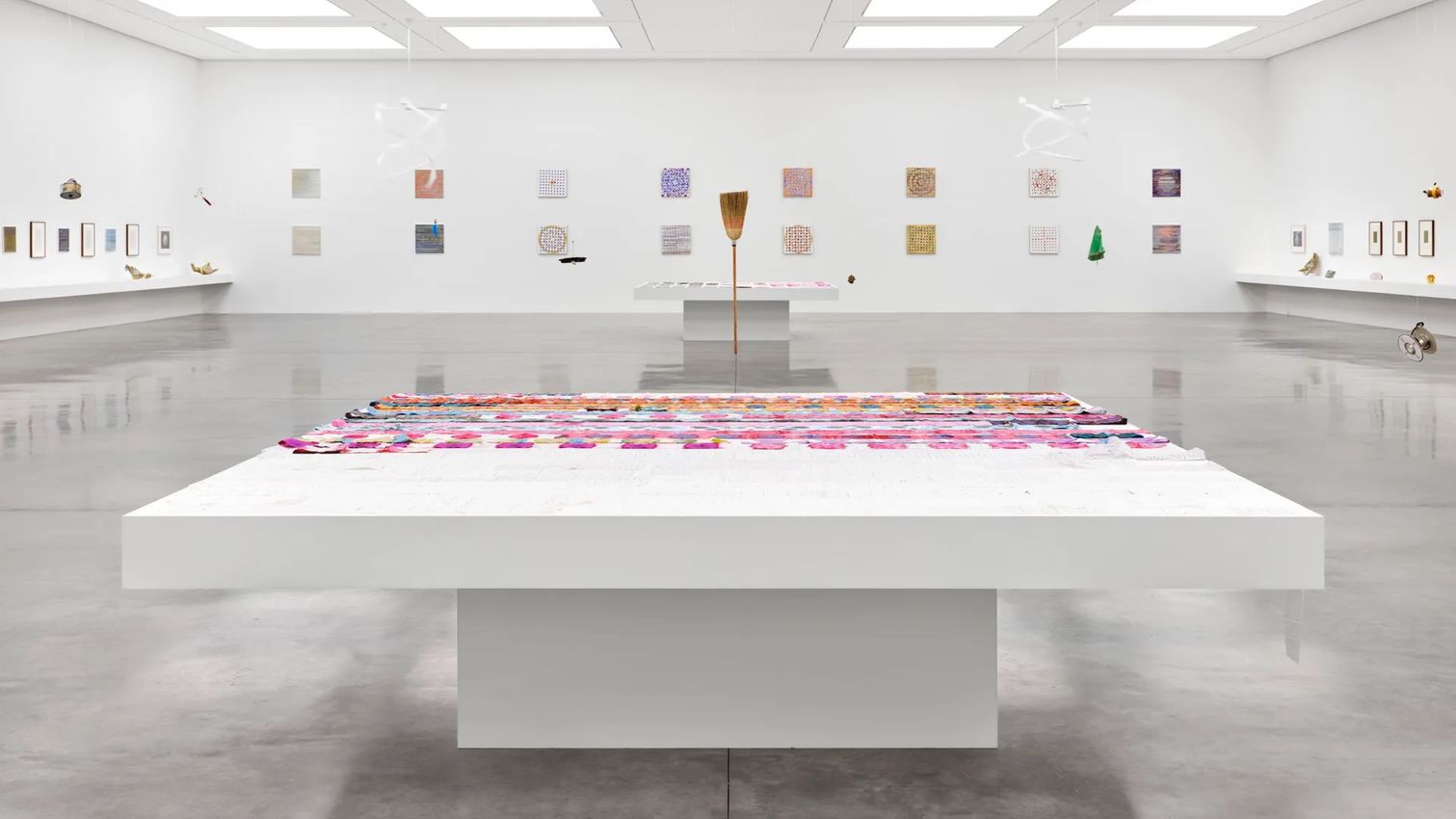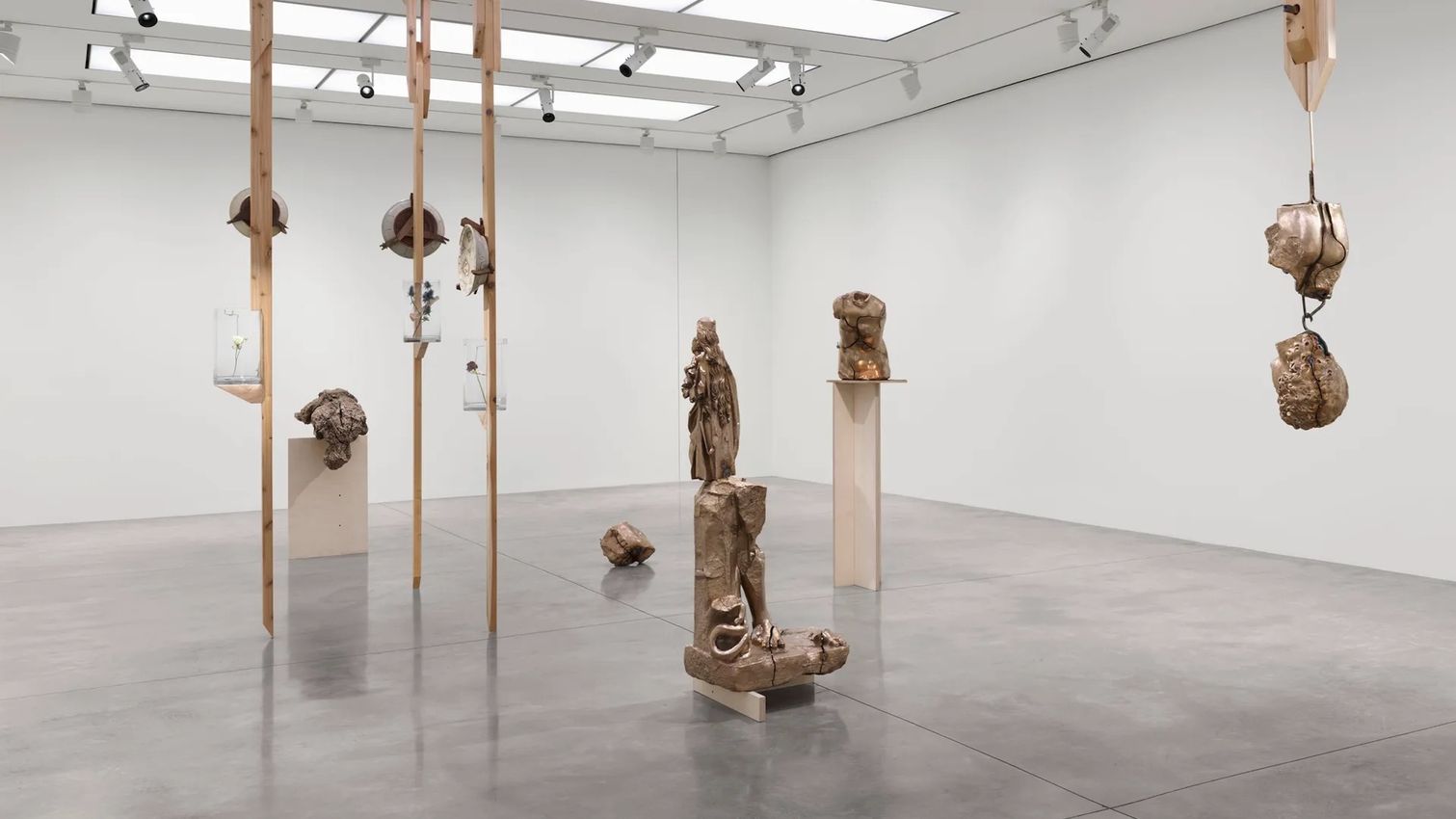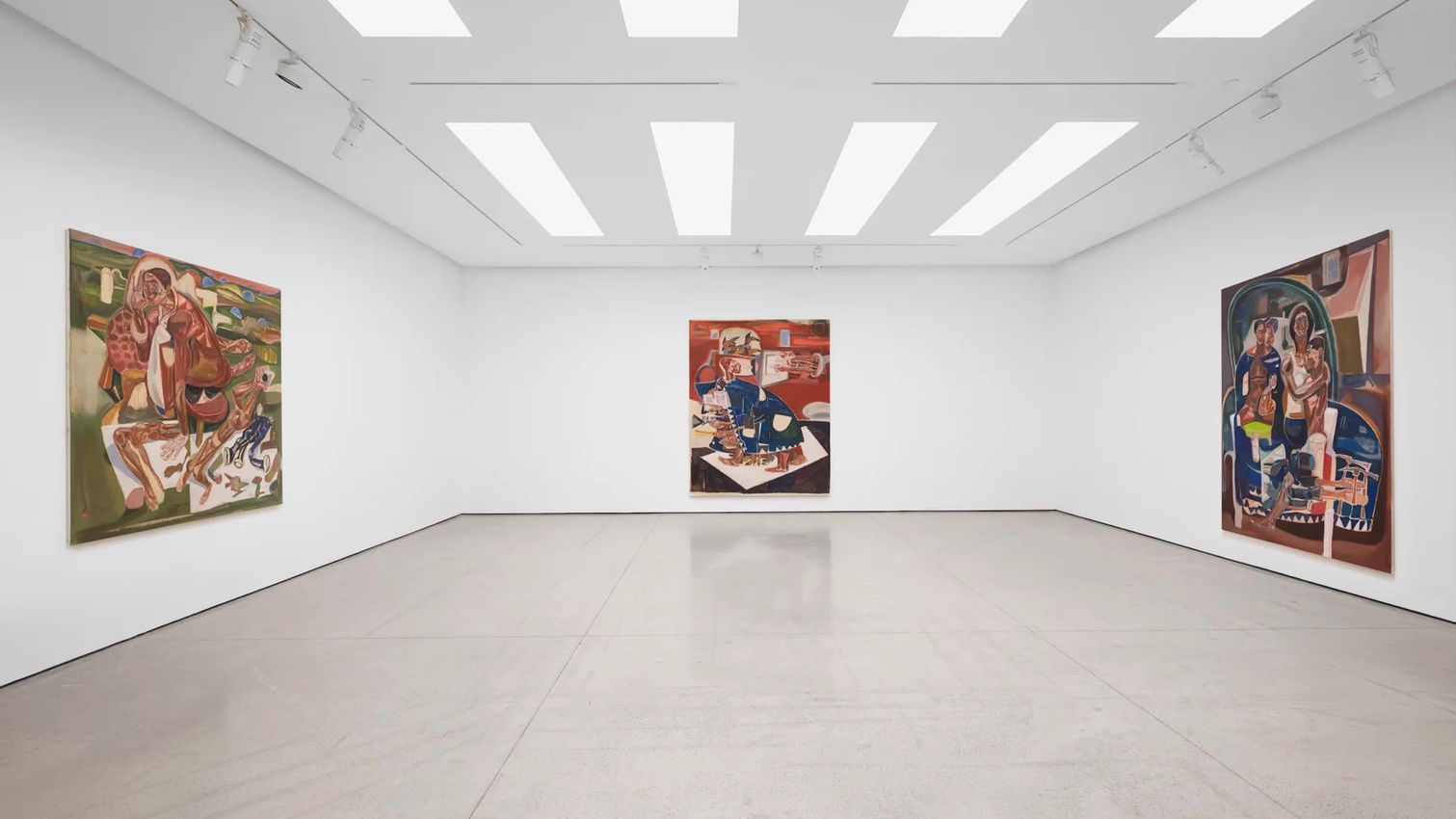
Debuting a new large-scale installation alongside a series of busts and bronze sculptures, ‘The Serpent’ at White Cube New York marks the latest evolution in Canadian artist David Altmejd’s interrogation and upturning of nature’s sacred hierarchies – those intrinsic yet volatile structures through which order and chaos contend. Forged through an instinct-driven process that merges realism with crude expressionism, Altmejd’s work manifests as a potent expression of the subconscious mind, wherein elemental dichotomies of man and beast, entropy and structure, growth and decay, co-mingle in an ecstatic revelation.
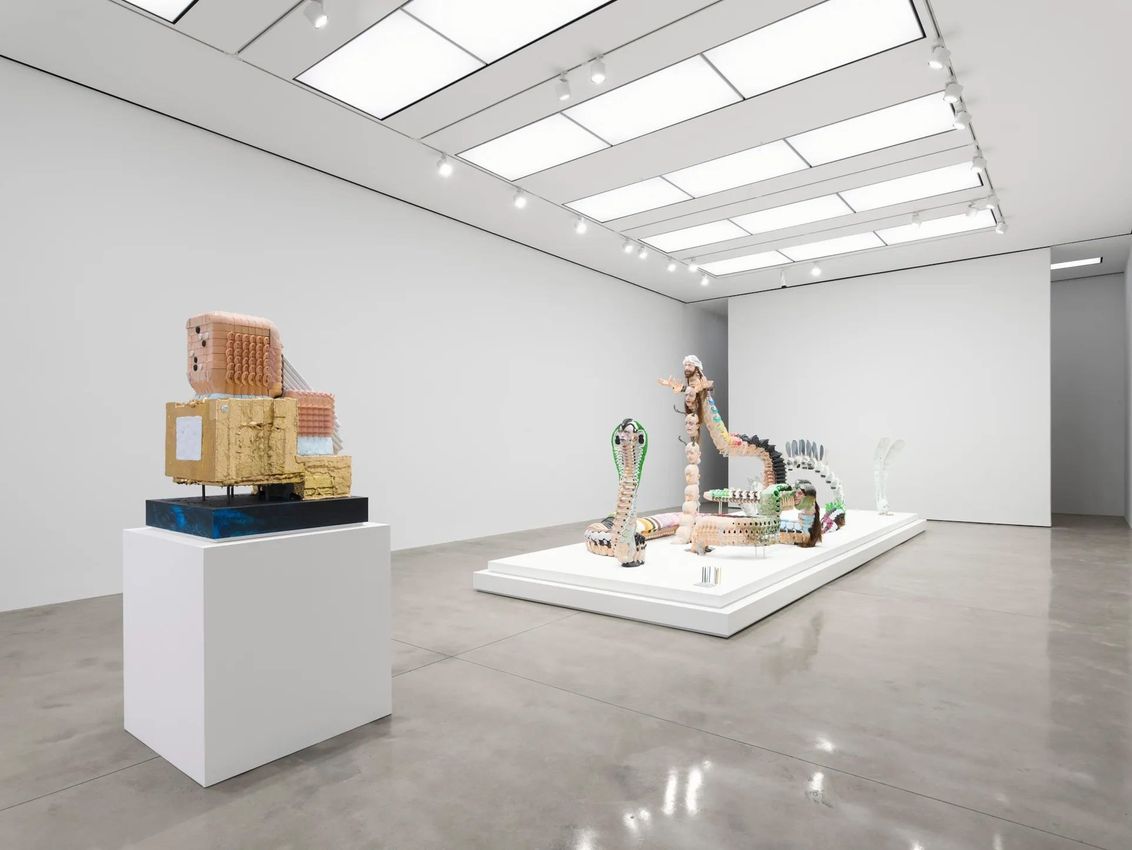
Entering the first floor of the gallery, we are met with The Serpent (all works 2025) – a monumental, winding serpent, composed of a chain of conjoined human heads, its own head lifting to meet that of its conjurer, Snake Charmer. The reciprocal relationship between these two sculptures enacts a dialogue between creation and creator, between matter and design – a tension that Altmejd both interrogates and exalts. During the process of creating The Serpent, Altmejd found Snake Charmer to be a guiding presence – a quiet master of order, without which The Serpent, with its generative chain, might have continued evolving toward limitless ends. Though initially uniform,The Serpent‘s heads gradually diminish in size and morph into the heads of rabbits further along the sequence. In recent years, animal entities have featured with increasing frequency in the artist’s oeuvre, particularly the rabbit, a manifestation of the Trickster archetype in Jungian psychology – a shapeshifting disruptor, a playfully subversive force, a messenger of the subconscious.The Serpent, with its chthonic ties to the underworld, here functions analogously to Trickster, its very genetic code entwined with it.
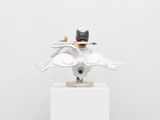
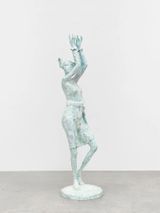
In the preconscious realm where much of Altmejd’s sculptural work emerges and takes form, other animals and spirit entities enter the scene. In the upper gallery, swans and nymphic figures commune in an expressive display of dance and music. The swan assumes form in two sculptures, transfigured by Altmejd into musical instruments wielded by enigmatic human figures. Individually titled_The Prometheus Chord_ and The Lydian Chord, the ‘Swan Musicians’, with their visored eyes, facial hair and minimalist regalia, exude the swagger and self-assured presence of otherworldly rock stars. They engage in a performance with the ‘Nymphs’, three life-size bronze sculptures suspended mid-movement, with their arms raised and dresses billowing. Amid the meticulous detailing of these sculptures, rough-hewn surfaces disrupt the illusion of stillness, imbuing them with movement and life.
Altmejd interprets this gathering of figures as manifestations of different facets of his Self. In the ‘Swan Musicians’ for example, intimations of the swan’s long-standing affiliations with masculine virility, which run as far back as Zeus’s seduction of queen Leda in Greek mythology, can be found. Mythic precedent aside, the swan’s very nature reinforces its symbolic potency: at once a creature of formidable power and grace, the swan represents a confluence of archetypally feminine and masculine energies within a single form. Its body glides across water, dipping occasionally beneath its surface – an element that, in Jungian thought, serves as an analogy for the unconscious. Allusions to music, too, become pertinent. Across disciplines – from philosophy to physics – music has been long understood as a governing principle of nature, an unseen architecture that structures existence. Yet, where there is order in Altmejd’s work, there must also exist its counterforce disorder, or as he observes, ‘If music symbolises order, I want to make matter dance.’
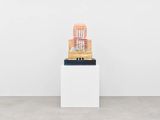
Working through a process of discovery, Altmejd navigates what he describes as the shifting temperaments of ‘chaos and order’ both aesthetically and materially. A tension that pervades his practice, the work embodies a dialectic of control and surrender freighted with unconscious import, resulting in formal qualities of alternating precision and roughness. Altmejd has long been attuned to these dual forces existing within his work, yet his relationship to them has evolved. ‘It has its own intelligence, its own reason, its own desires, its own will’, he acknowledges, relinquishing control to become a guide. Wall-mounted head sculptures – hands cupped around mouths, partially agape – stand as both sentinels and provocateurs, bearing witness to this unfolding event. Like tuning forks, the heads articulate the projection of sound, their hands shaping the air as if to transmit the frequencies embedded in their titles – C, E, G__#, B – notes that together form the architecture of a suspenseful, mysterious chord. They speak to the reflexive nature of his practice, underscoring that Altmejd’s work is not only an exploration of material and matter but also a discovery of the self – he himself both an observer of his work’s self-generative existence and an inextricable participant within it, enmeshed in the life he has set into motion.
David Altmejd was born in Montréal in 1974 and lives and works in Los Angeles. He studied at the University of Québec in Montréal and graduated with an MFA from Columbia University, New York in 2001. His numerous international exhibitions include a major survey exhibition ‘Flux’, which travelled from Musée d’Art Moderne de la Ville de Paris to MUDAM in Luxembourg and the Musée d’Art Contemporain de Montréal (2014–15). In 2007, he represented Canada at the 52nd Venice Biennale with his installation ‘The Index’ and has also been included in the 13th Kaunas Biennial, Lithuania (2021); the Liverpool Biennial, UK (2008); the Whitney Biennial, New York (2004) and the 8th Istanbul Biennial (2003).


David Altmejd’s work is a unique and heady mix of science and magic, science fiction and gothic romanticism: a post-apocalyptic vision which is at the same time essentially optimistic, containing as it always does the potential for regeneration, evolution and invention.


An international art powerhouse, White Cube was established in 1993 in London by art dealer Jay Jopling. In its space on Duke Street, it served as the early exhibition venue for many now internationally acclaimed British artists, including Tracey Emin, Gilbert & George, Rachel Kneebone and Antony Gormley, who still show with the gallery today.

A respected voice in contemporary art discourse.
Focusing on ambitious storytelling and insightful art-world commentary. Ocula Magazine publishes in-depth interviews, critical essays and timely analysis on the artists, exhibitions and ideas driving the global art world.
Learn more about Ocula Magazine
Showcasing the best of the art world.
Ocula partners with galleries from around the world to highlight their artists, artworks and exhibitions. Gallery membership is by application and invitation, with each member vetted by an independent panel.
Learn more about Ocula Membership

Specialises in the sale of major artworks.
Led by a team with deep ties to the world’s leading auction houses, galleries and collectors. Ocula’s advisory team offers bespoke services to high-net-worth clients from around the world who are looking to acquire the best of contemporary and modern art.
Learn more about our team and services