



Press Release

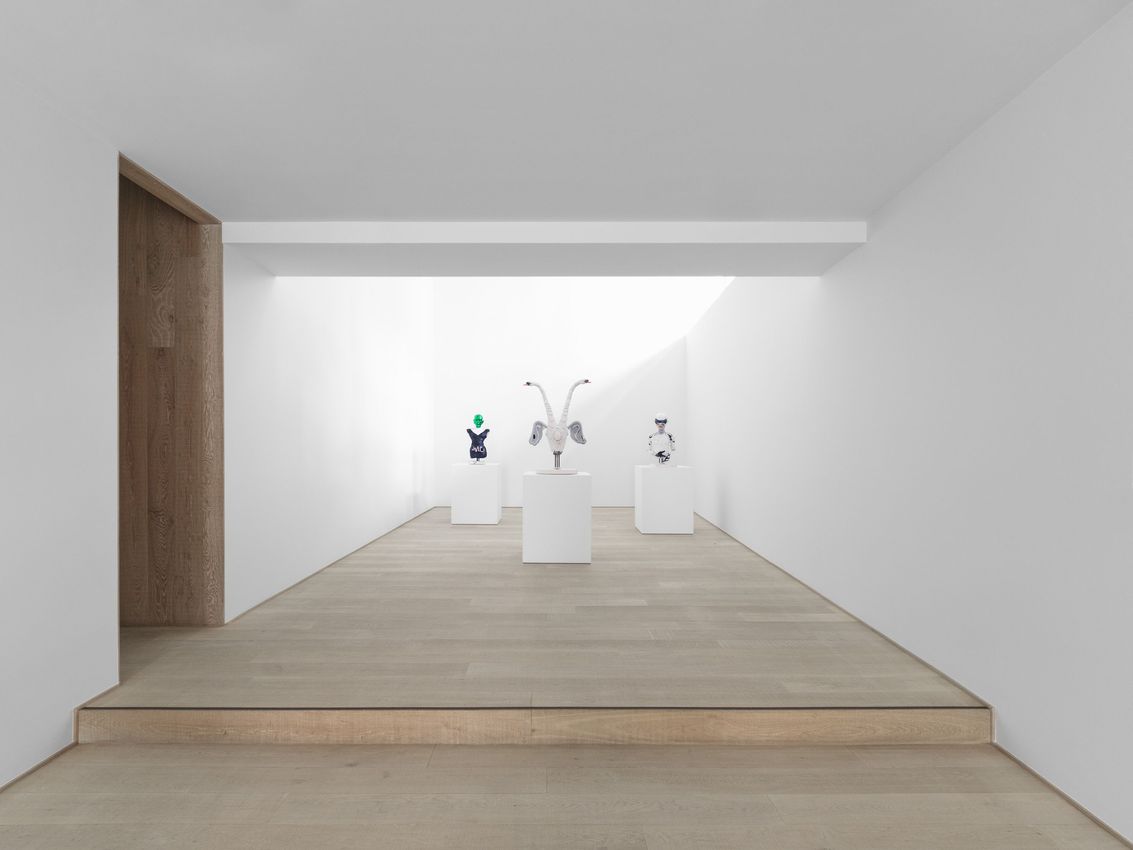
In Prélude pour un nouvel ordre mondial, Canadian artist David Altmejd unveils a body of new sculptures and drawings. For the first time in his career, Altmejd combines these two mediums, exploring their connections and revealing how past and new ideas in his work come together. As the title implies, this exhibition marks the beginning of fresh trajectories in Altmejd’s ever-evolving artistic realm.

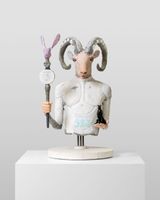
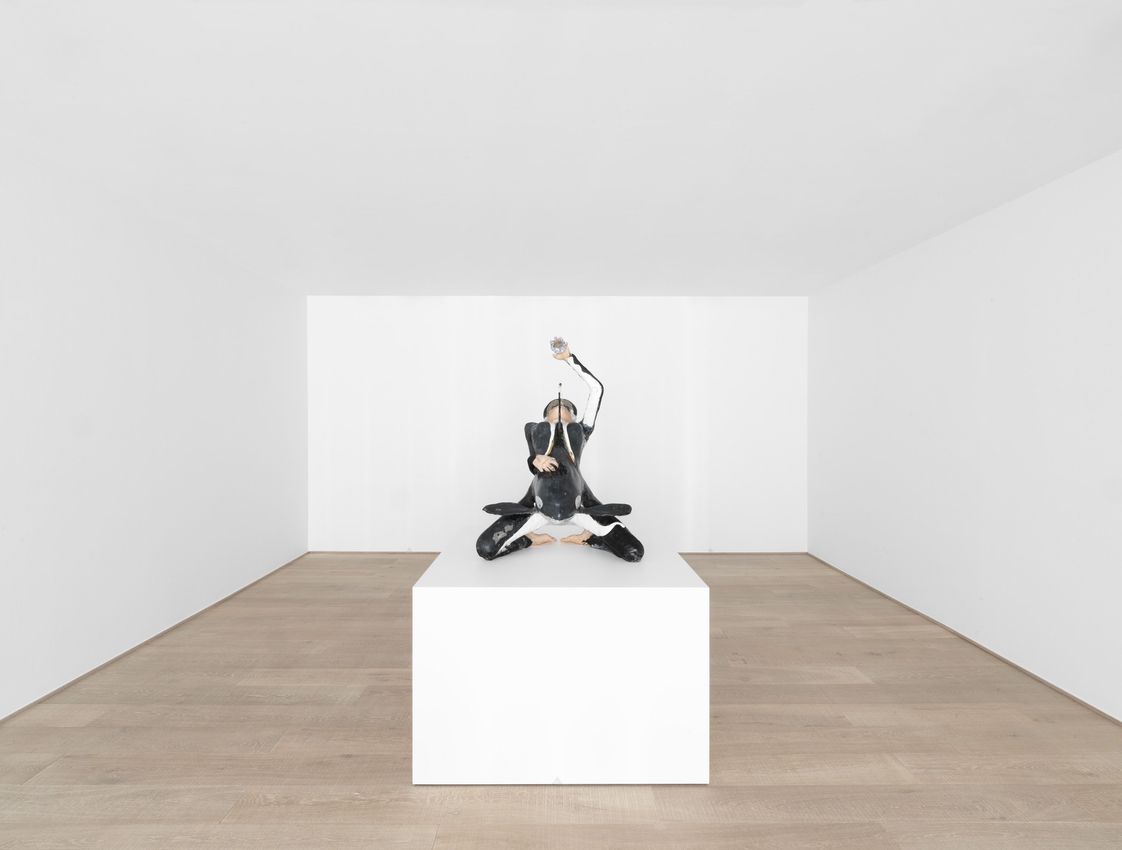
From the celestial heavens to the depths of the earth, the natural world is the lifeblood of David Altmejd’s oeuvre. In his new sculptures, Altmejd introduces an expanded pantheon of hybrid, anthropomorphic beings that allude to the multi- faceted power of animals in various cultures and belief systems. The works are rich in symbolism and evoke a transcendent quality that surpasses the boundaries of the physical world. Rams, an orca, snakes, a panther, birds, rabbits and swans have all made their way into the oeuvre, serving as metaphors and companions since time immemorial, with their wisdom often pointing the way to spiritual enlightenment. Consider, for instance, the Bible, the Koran, the Dhammapada, the Analects of Confucius, or Aesop’s fables.

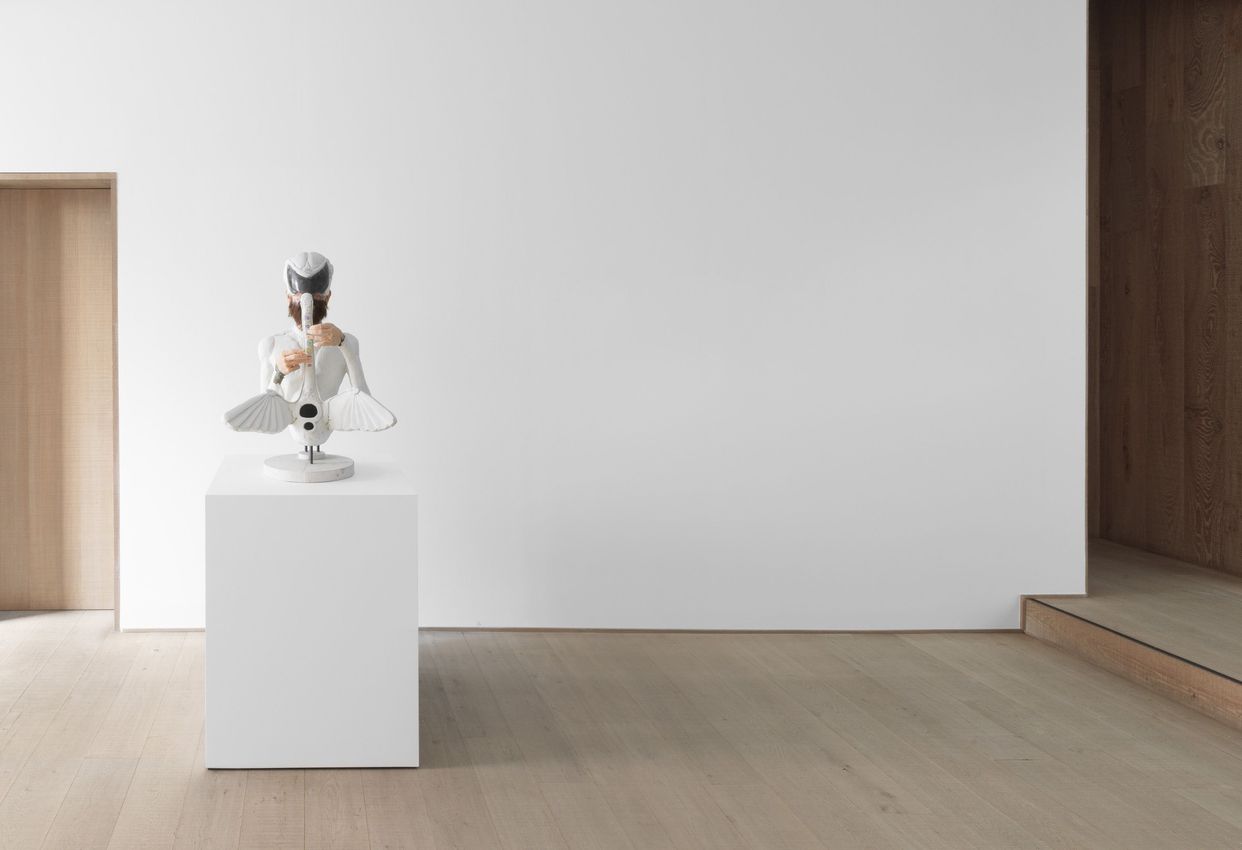
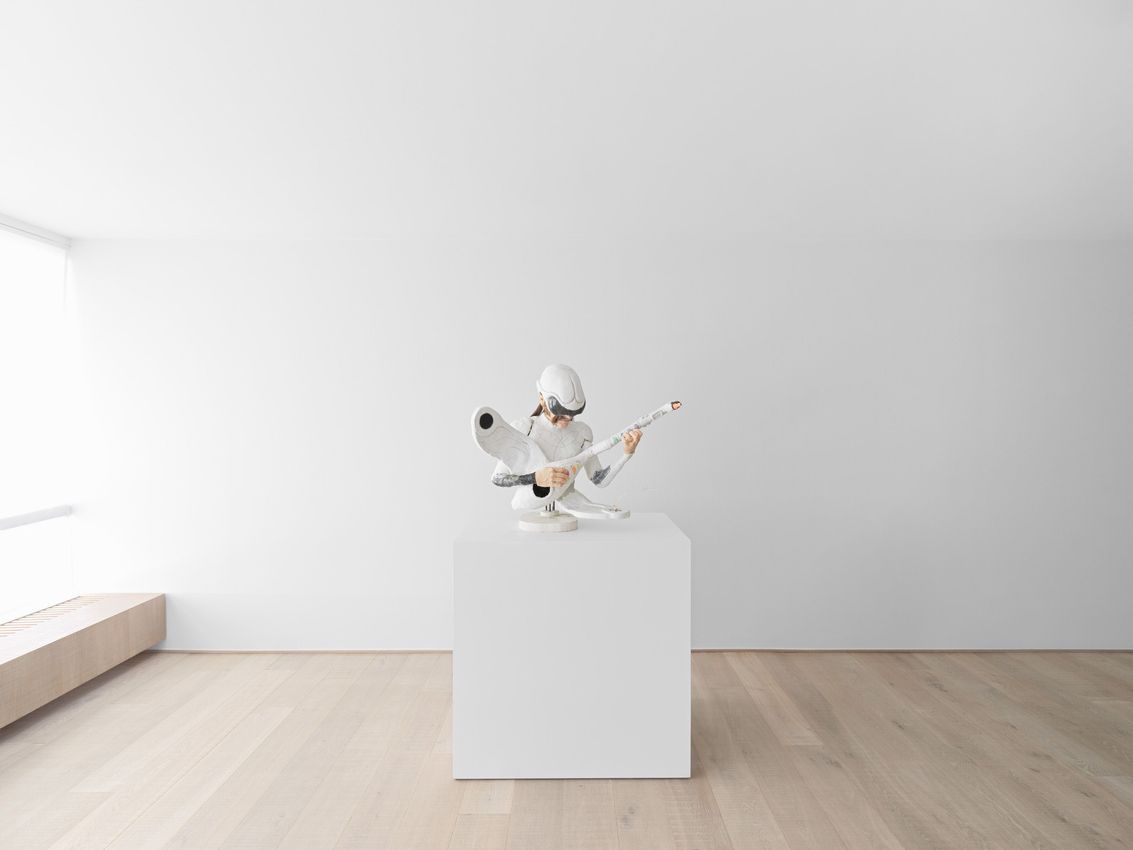
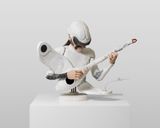
Among the variety of animals Altmejd explores, swans take centre stage in his new body of work. The swans have metamorphosised into musical instruments, through which the artist draws parallels between nature and music, highlighting their shared qualities of order and disorder. The seven colours of the instrument’s keys here are not coincidental, symbolising various references across different eras and cultures1. In numerology, seven represents the union of the spiritual (3) and material (4) worlds, while in music, there are seven notes in a musical scale. Conversely, the figures playing swan instruments wear helmets that conceal their vision, suggesting a sense of detachment from their surroundings. The idea that they might hail from another dimension is further supported by the presence of space-time grids in the artist’s drawings. It is also worth noting that, human eyes— which Altmejd once emphasised or even replicated—have now vanished, along with any reference to the artist himself. In these new works, the focus moves from self- portraiture to visored beings.

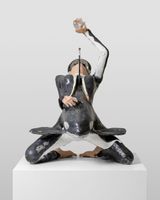
Altmejd’s fused forms evoke metamorphosis, growth and decay, and often visualise transformation processes. Animals and humans frequently mutate, as in Nocturne no 1, where human hands mould the whale’s flesh, a creature that features in many ancient mythologies. The unctuous, carbon-like matter of the body is akin to the prima materia, which is the primitive formless base of all matter, similar to chaos, the quintessence or aether. This sculpture seems to embody the regenerative

force of nature, with a cosmic egg embedded in its back and a diamond–carbon in a different state–illuminating the world. It can be read as a metaphor for the splendour and enigma of the cosmos. Other enigmatic beings emerge, like the figure Ève, with its shimmering and venomous green face, evocative of witches, ogres, goblins and trolls. This green also resembles the iridescent colour of scarab beetles, revered in Ancient Egypt—creatures that also find their way into the artist’s drawings. Blending reality and imagination, Altmejd often employs myths and legends to explore nature. These allusions tap into ancient human perceptions of nature as a powerful and unpredictable force.

The intertwining of humans and animals also echoes the ideas of the Swiss psychoanalyst Carl Jung (1875-1961), who held that animals are exalted beings, or the ‘sacred’ part of a person’s mind. He believed that they were much closer to a secret, natural order than humans, and thus nearer to the ‘absolute knowledge’ of the unconscious. Unlike people, animals adhere to natural laws that transcend good and evil, which he considered to be a form of superiority. Jung’s investigation into how our ‘animal nature’ might be a psychic source of renewal and wholeness.

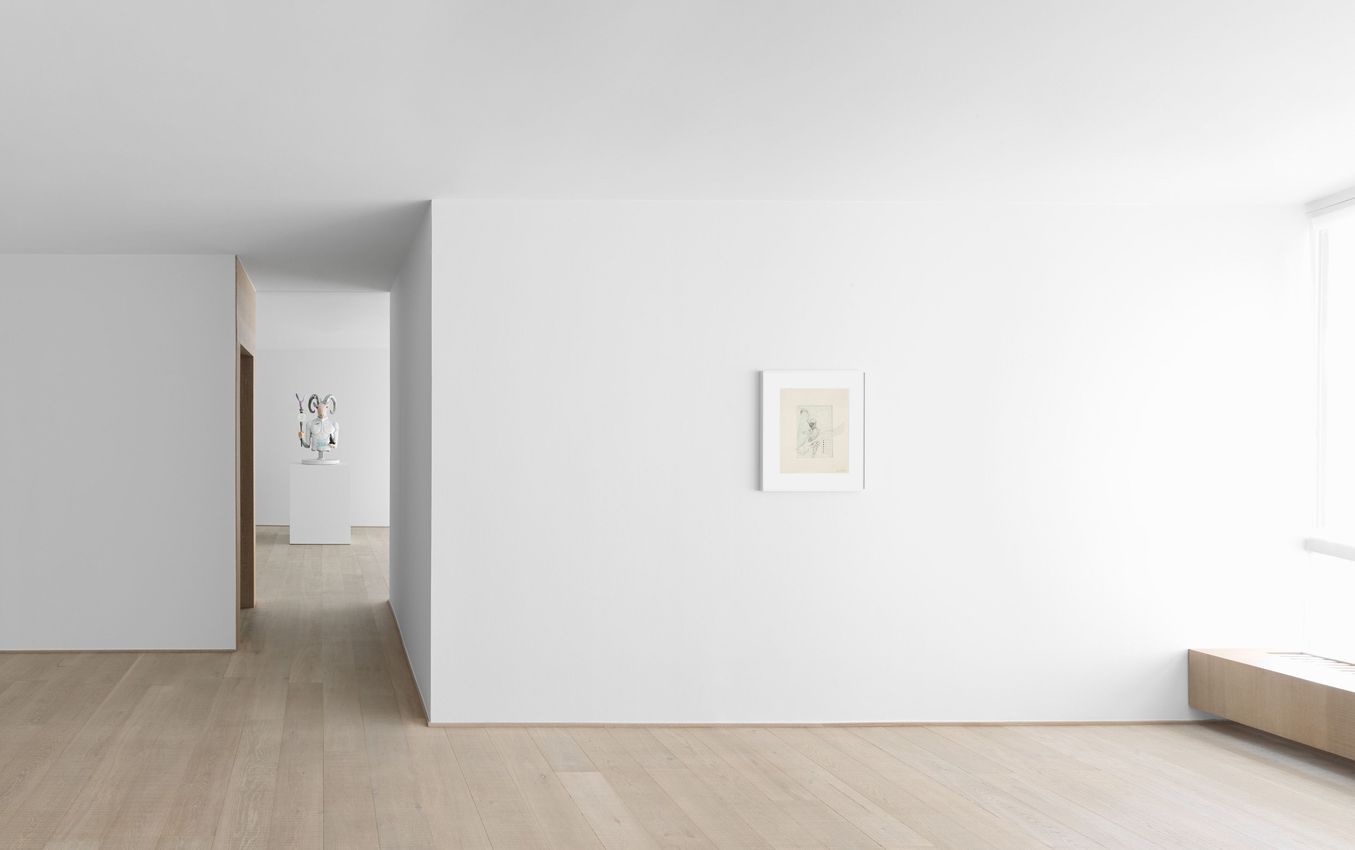
These themes are reflected in the artist’s mixed-media drawings, which are neither preparatory studies nor working sketches. The matrixes reference space-time grid distortions and the theory of special relativity, while also invoking, in another sense, the transfer techniques of classical sculpture. But by virtue of being hand- drawn, the grids are imperfect. At times, they are punctured, caught in a vortex

or distorted, creating glitches in the space-time continuum. The images in the drawings are fantastical and uncanny, arcane and vivid. Cryptic, undecipherable symbols represent the ‘language of the unconscious’.

Altmejd’s work, through its synthesis of seemingly opposing elements, reveals a deep interconnectedness between nature and the human form, life and death. The tension between organic and synthetic forms creates a dynamic that blurs the line between nature and artifice, evoking a sense of “unsettling familiarity”—a haunting blend of the known and unknown. In this paradoxical realm, the ordinary world is transformed, inviting us to reconsider our perceptions of reality.

David Altmejd (b. 1974, Montreal, Canada) lives and works in Los Angeles. His work was the subject of a major survey exhibition entitled Flux at the Musée d’Art Moderne de la Ville de Paris, France which travelled to the MUDAM in Luxembourg and the Musée d’Art Contemporain de Montréal, Canada (2014-15). In 2007, he represented Canada at the 57th Venice Biennale. Public collections include Museum of Modern Art, New York; Whitney Museum, New York; Solomon R. Guggenheim Museum, New York; National Gallery of Canada, Ottawa; Museum of Contemporary Art, Los Angeles; Long Museum, Shanghai; and MUDAM, Luxembourg, among others.

1. It is both a lucky number and a prime one; there are seven days of the week, each named after a different ancient god or planet; Shakespeare wrote about the seven stages of life; the lunar cycle lasts around seven days; and breaking a mirror is said to bring seven years of misfortune. There are seven energy centres, or chakras, each associated with a distinct shade, just as there are seven colours in a rainbow.

Xavier Hufkens

Read More

Installation Views

About the Artist

David Altmejd creates highly detailed sculptures that often blur the distinction between interior and exterior, surface and structure, representation and abstraction. For Altmejd, the process of making is paramount – he is interested in how the act of constructing an object generates meaning. Altmejd often defies traditional material conventions. In his recent series of large-scale semi-figurative sculptures he used seemingly random objects (such as hessian, polystyrene, chains, fur, crystals and resin casts of his hands and of exotic fruits) to create resonant connections and juxtapositions between diverse material elements. In his complex installations involving Perspex structures and vitrines, Altmejd often pairs symbolic objects, such as crystals and taxidermy birds and animals, with virtuosic applications of materials such as plaster, glitter, minerals and mirrors. Motivated by the invisible worlds that often exist just beneath the surface of things, the artist reveals the hidden structures in his own works through negative spaces: gaps, holes, fissures and crystal filled orifices are a recurring motif. In contrast, the reflective surfaces of his mirrored sculptures are impenetrable and both define and destabilise, as well as multiply, the spaces around them.

View Artist Profile

Also Exhibiting at Xavier Hufkens

About the Gallery
Xavier Hufkens is one of Europe’s leading galleries for contemporary art. Located in Brussels, the gallery maintains a diverse exhibition programme with solo exhibitions of the gallery artists as well as group exhibitions and special projects. The gallery deals in a distinctive combination of painting, drawing, sculpture, photography, video and installation-based work.

The origins of the gallery date back to 1987, when Xavier Hufkens opened a gallery space in an un-refurbished warehouse in the neighbourhood of the South Station (Midi) in Brussels. During the early years, the focus of the gallery was upon mid-career and emerging artists and the gallery is known for having introduced some of the most influential contemporary artists to Brussels at a time when they were still relatively unknown. British sculptor Antony Gormley, who is still affiliated with the gallery, Felix Gonzalez-Torres and Rosemarie Trockel all showed in Belgium for the first time with Xavier Hufkens (Gormley in 1987; Gonzalez-Torres in 1991 and Trockel in 1993).

In 1992, the gallery moved to a 19th-century townhouse at 6 rue Saint-Georges, close to the Avenue Louise. Completely renovated by Belgian architects Paul Robbrecht, Hilde Daem and Marie-José Van Hee, the house quickly gained a reputation for being not just one of the most beautiful contemporary art spaces in the Belgian capital, but also one of the most interesting. The expanded exhibition programme coincided with the additional representation of a number of established artists from Belgium and abroad, including Richard Artschwager, Thierry De Cordier and Jan Vercruysse. In 1997, Hufkens expanded the gallery further by annexing the adjacent building and a number of new artists joined the gallery, including Louise Bourgeois, Roni Horn and Thomas Houseago.

A second space in the same street, at 107 rue Saint-Georges, opened in spring 2013. Located in the Galerie Rivoli, a mixed-use commercial development from the 1970s, the new gallery space was designed by Swiss architect Harry Gugger, who was previously in partnership with Herzog and De Meuron. Slegten & Toegemann, Brussels, managed the project.

An eclectic but very clear vision underpins all of the gallery’s activities: ‘The definition of the gallery was established from the start. The common thread, then and now, is quality over and above everything else, which I find more intellectually challenging than a forced definition. From the early days I juxtaposed established artists such as Michelangelo Pistoletto with someone like Felix Gonzalez-Torres when he was totally unknown. Today I still mix my work: I have no problem showing Malcolm Morley … alongside Robert Ryman, or Willem de Kooning.’ [Xavier Hufkens in The Art Newspaper, Issue 220, January 2011, published online: 20 January 2011]

Xavier Hufkens represents some thirty artists from different generations. He was part of the six-member selection committee for Art Basel during seven years and also participates in up to five international Arts Fairs annually. The gallery has partnerships with the estates of Louise Bourgeois, Willem de Kooning, Robert Mapplethorpe and Alice Neel.
View Gallery Profile
Address
107 rue St-Georges
St-Jorisstraat
Brussels
Belgium
Opening Hours
Tuesday – Saturday
11am – 6pm
(1)
Brussels 107 rue St-Georges
Xavier Hufkens
107 rue St-Georges, St-Jorisstraat, Brussels, Belgium

Opening hours
Tuesday – Saturday
11am – 6pm
The art world in focus