



Press Release
Xavier Hufkens is pleased to announce an exhibition of new work by David Noonan.

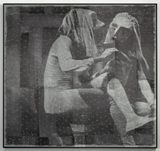
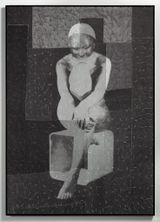
Since he moved to London from his native Australia in 2005, David Noonan has been working on large-scale, screen-printed linen collages. Co-existing alongside his sculptural and film works, they combine figurative imagery with abstract motifs borrowed from antique textiles, and are inspired by his extensive and ever-expanding archive of visual material – an eclectic repository of books, photographs and magazines that he has built up over several decades. Noonan’s associative compositions often trigger a sense of melancholy and mystery. On one level, this is related to the artist’s preference for a monochrome palette and his use of largely historical imagery. On another, subliminal level, it emanates from the enigmatic contrasts and juxtapositions within the works themselves, and through the visual dialogues that are established when viewed as an installation.

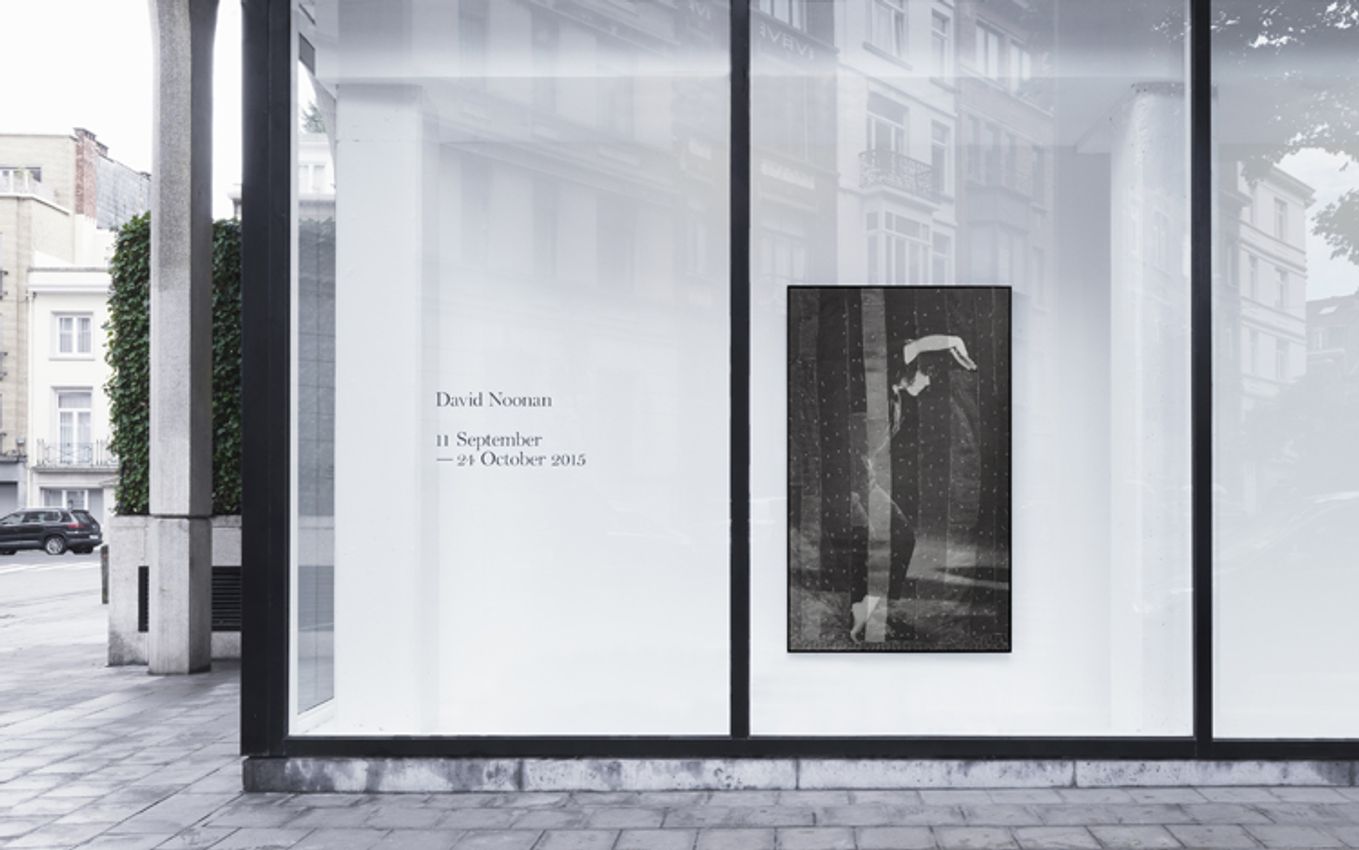
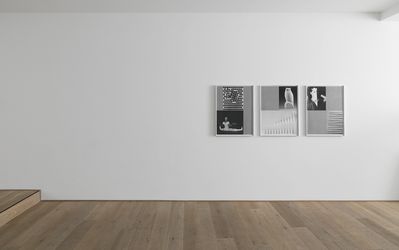
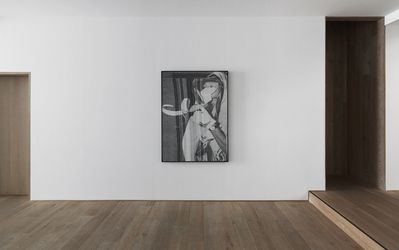
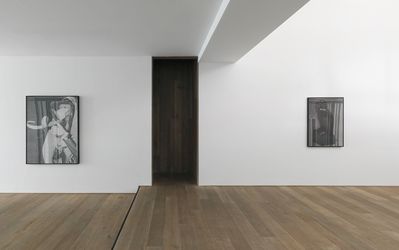
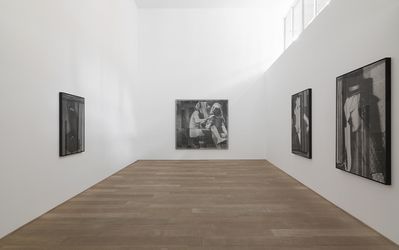
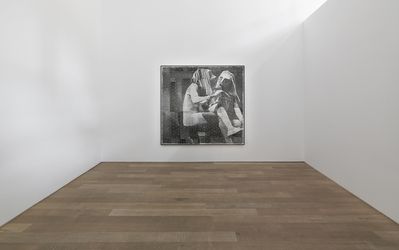
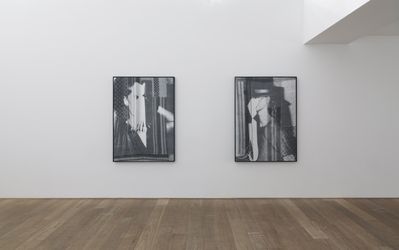
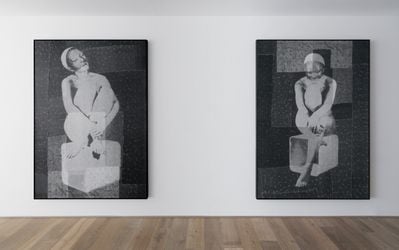
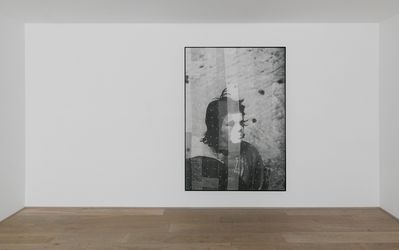
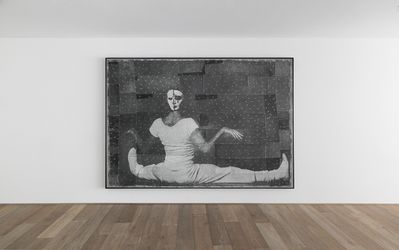
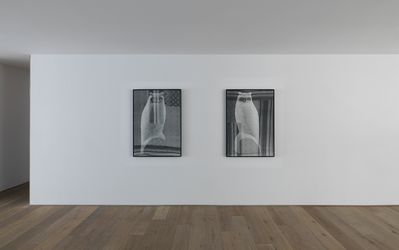
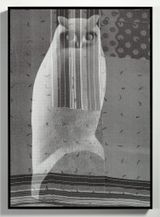
Noonan’s latest works mark an aesthetic and technical departure for the artist. Like his earlier works, each screen-print conflates two distinct visual layers: found images of figures or animals, inevitably gleaned from publications, and self-generated photographs of vintage textiles, many of which also belong to the artist. In Noonan’s hands, these two contrasting types of photograph – the found and the authored – dissolve into a single, indivisible image. What sets these new works apart, however, is their graphic intensity and unprecedented tonal range – the result of a technical advance on the part of the artist. By staining the raw linen with a thin layer of warm grey pigment, Noonan was able to capture and print a greater tonal range. The thin layer of pigment still allowed the artist to tear the fabric leaving a natural raw edge to the linen, an important element to activating the picture’s surface. In keeping with the cool shift in pallet, the artist has also opted for minimal black steel frames. These frames are not painted and maintain an element of their natural patina.

While viewers well known with Noonan’s oeuvre will recognise familiar imagery (owls, theatrical situations, masks), the mood is different. Rather than collate multiple images from different sources, the artist has chosen to isolate single figures within indeterminate spaces. The overall effect is eerily still and sculptural. Similarly, the Japanese textiles that Noonan once favoured have been replaced by irregular patchworks of traditional European and American fabrics – ticking, indigo and gingham, as well as occasional floral and geometric prints – all of which have been hand-stitched into quilts, or quilt-like formations. The utilitarian fabrics and their haphazard assembly point to thrift and the careful preservation of scarce resources. Yet the luminosity of the randomly scattered tufted stiches add a rich complexity to the visual field. Although the works are ultimately flat and two-dimensional, the heightened contrasts and detailed textural rendering creates an obvious trompe l’oeil effect. An element common to all pictures in this exhibition is what appears to be thread tufts or tassels that are sewn in the quilts that Noonan uses, these appear to dance on the surface of the pictures almost like Memphis patterns creating a stark but shallow depth.

At the heart of Noonan’s oeuvre lies a poetic sensibility towards atmosphere and mood. As Noonan himself has said: ‘I’m trying to touch on a certain atmosphere or tone… when you’re listening to music, particular songs or artists will have a particular atmosphere to their work. That’s what I’m trying to achieve with pictures, to give the piece an ambience that you can’t exactly pin down, but that sets a certain tone. I like to think of them as these little hermetic things that have a certain energy or atmosphere that can wash over you, affecting your mood. I don’t want to spell something out; my pieces are more about evoking something in a viewer.’

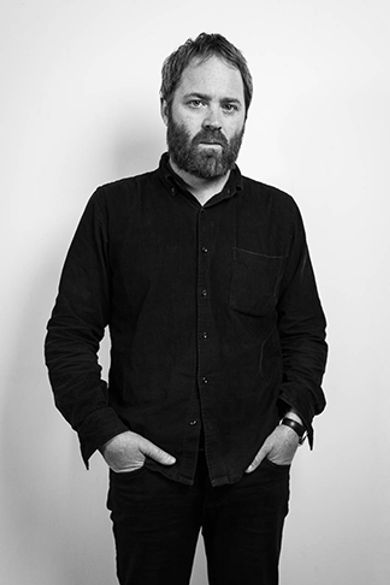
David Noonan (b. 1969, Ballarat, Australia) lives and works in London. Recent solo exhibitions include the Contemporary Art Museum, St. Louis, Missouri, USA (2011), the Australian Centre for Contemporary Art, Melbourne (2009), the Chisenhale Gallery, London (2008) and the Palais de Tokyo, Paris (2007). In 2009, his work was included in the group show Altermodern, as part of the Tate Triennial, Tate Britain, London (2009). JRP/Ringier published two publications, a monograph (2012) and Scenes, an artist book in 2009.
Conversations
Masks are like make-up or costumes, which are all about notions of transformation or disguise. That is one of the reasons I have been drawn to images of theatre or of people in preparation for performance.
Read the Full Story

Installation Views

David Noonan in Conversation Conversation David Noonan in Conversation David Noonan’s collaged linen tableaux conjure theatrical, ghostly atmospheres in which masks, textiles, and archival images skip over time. Read the story
About the Artist

David Noonan transforms black and white or sepia found imagery into striking collages and large-scale silk-screened tableaux on linen or films. He collects photographs, archival documents and magazines and books relating to utopian collectives in the 1960s and 70s, theatre and dance performances, or art education, and layers selected images with others of plants, animals and buildings. These depicted rituals are recycled, barely recognizable, reinventions of inventions past, time-traveling, and any sense of time and place is blurred or displaced. Multiple appropriations blend realism, mystery and myth.

View Artist Profile

Also Exhibiting at Xavier Hufkens

About the Gallery
Xavier Hufkens is one of Europe’s leading galleries for contemporary art. Located in Brussels, the gallery maintains a diverse exhibition programme with solo exhibitions of the gallery artists as well as group exhibitions and special projects. The gallery deals in a distinctive combination of painting, drawing, sculpture, photography, video and installation-based work.

The origins of the gallery date back to 1987, when Xavier Hufkens opened a gallery space in an un-refurbished warehouse in the neighbourhood of the South Station (Midi) in Brussels. During the early years, the focus of the gallery was upon mid-career and emerging artists and the gallery is known for having introduced some of the most influential contemporary artists to Brussels at a time when they were still relatively unknown. British sculptor Antony Gormley, who is still affiliated with the gallery, Felix Gonzalez-Torres and Rosemarie Trockel all showed in Belgium for the first time with Xavier Hufkens (Gormley in 1987; Gonzalez-Torres in 1991 and Trockel in 1993).

In 1992, the gallery moved to a 19th-century townhouse at 6 rue Saint-Georges, close to the Avenue Louise. Completely renovated by Belgian architects Paul Robbrecht, Hilde Daem and Marie-José Van Hee, the house quickly gained a reputation for being not just one of the most beautiful contemporary art spaces in the Belgian capital, but also one of the most interesting. The expanded exhibition programme coincided with the additional representation of a number of established artists from Belgium and abroad, including Richard Artschwager, Thierry De Cordier and Jan Vercruysse. In 1997, Hufkens expanded the gallery further by annexing the adjacent building and a number of new artists joined the gallery, including Louise Bourgeois, Roni Horn and Thomas Houseago.

A second space in the same street, at 107 rue Saint-Georges, opened in spring 2013. Located in the Galerie Rivoli, a mixed-use commercial development from the 1970s, the new gallery space was designed by Swiss architect Harry Gugger, who was previously in partnership with Herzog and De Meuron. Slegten & Toegemann, Brussels, managed the project.

An eclectic but very clear vision underpins all of the gallery’s activities: ‘The definition of the gallery was established from the start. The common thread, then and now, is quality over and above everything else, which I find more intellectually challenging than a forced definition. From the early days I juxtaposed established artists such as Michelangelo Pistoletto with someone like Felix Gonzalez-Torres when he was totally unknown. Today I still mix my work: I have no problem showing Malcolm Morley … alongside Robert Ryman, or Willem de Kooning.’ [Xavier Hufkens in The Art Newspaper, Issue 220, January 2011, published online: 20 January 2011]

Xavier Hufkens represents some thirty artists from different generations. He was part of the six-member selection committee for Art Basel during seven years and also participates in up to five international Arts Fairs annually. The gallery has partnerships with the estates of Louise Bourgeois, Willem de Kooning, Robert Mapplethorpe and Alice Neel.
View Gallery Profile
Address
107 rue St-Georges
St-Jorisstraat
Brussels
Belgium
Opening Hours
Tuesday – Saturday
11am – 6pm
(1)
Brussels 107 rue St-Georges
Xavier Hufkens
107 rue St-Georges, St-Jorisstraat, Brussels, Belgium

Opening hours
Tuesday – Saturday
11am – 6pm
The art world in focus
