Yumiko Chiba Associates is pleased to present six distinctive artists from our program, David SHRIGLEY, Wonho LEE, Kazuyo KINOSHITA, Teppei KANEUJI, Hisashi YAMAMOTO, Kenryou GU.
David SHRIGLEY was born in 1968 in Macclesfield, UK. He is based in Brighton, UK. In addition to his witty drawings, paintings, and sculptures, Shrigley has stepped far beyond the contemporary art world to expand his audience through a plethora of public art works, numerous books, satirical cartoon series in magazines, music videos, animations, and the sale of merchandise. Shrigley’s work is shot through with dark humour, and the pithy phrases he combines with his simple images are not only funny, but occasionally tinged with sadness too. The deadpan ennui that suffuses Shrigley’s work sets it apart from the kind of seriousness conventionally associated with art, yet at the same time, it could rightly be described as expanding the boundaries of art.
Shrigley was a Turner Prize nominee in 2013, following his major mid-career retrospective Brain Activity at Hayward Gallery in London. In September 2016 his monumental sculpture Really Good was unveiled in Trafalgar Square in London for the Fourth Plinth Commission. From 2015 to 2018 the British Council-organised solo exhibition Lose Your Mind travelled to six venues, including Power Station of Art, Shanghai, China; Storage by Hyundai Card, Seoul, South Korea and Instituto- Cultural-Cabañas in Guadalajara, Mexico. In 2020, Shrigley was awarded an OBE, the Most Excellent Order of the British Empire, for services to Visual Arts. In the same year Shrigley was announced as Ruinart’s carte blanche artist for 2020.
Shrigley’s works are included in prominent collections internationally, including Museum of Modern Art, New York, USA; Art Institute of Chicago, Illinois, USA; Museum Ludwig, Cologne, Germany; Pinakothek der Moderne, Munich, Germany; Statens Museum for Kunst, Copenhagen, Denmark; Thyssen-Bornemisza Contemporary Art Foundation, Vienna, Austria; Scottish National Gallery of Modern Art, Edinburgh, Scotland; Tate, London, England; and The British Council, London, England; National Gallery of Victoria, Melbourne, Australia.
Wonho LEE was born in Suncheon, Korea in 1972. Lee graduated with M.F.A in painting from Hongik University in 1999, and with Aufbaustudium from Staatliche Akademie der Bildenden Künste Stuttgart (State Academy of Fine Arts Stuttgart) in 2009. Lee currently lives and works in Seoul. Lee’s notable recent solo exhibitions include I’m not there, Kimchongyung museum, Seoul (2014); Between looking and seeing, Brigitte March gallery, Stuttgart, Germany (2014); Rarities and Masterpieces story, Geumcheon Art Space PS 333, Seoul (2015); The weight of the vacuum, Yumiko Chiba Associates viewing room shinjuku, Tokyo (2017); I’m fine, as long as you are OK, KAIST research & art gallery, Seoul (2019); Episode of Mr. So- and- so, 523 Kunstdoc, Busan (2020); A thousand Thoughts, Zaha Museum, Seoul (2021); let’s stay us in unknown, Brigitte March gallery, Stuttgart, Germany (2022); Habitat, Open space Block’s, Seongnam (2023).
Selected group exhibitions include: ARTIST FILE 2015, National Art Center, Tokyo, Japan/ travel to National Museum of Modern and Contemporary Art Korea, Seoul, South Korea (2015); The square, National Museum of Modern and Contemporary Art Korea, Seoul (2019); Collecting for all, Seoul Museum of Art, Seoul (2020); Vibration in a Polyhedral Labyrinth, Asia Culture Center, Gwangju (2022); New Acquisition, Jeonnam Museum of Art, Gwangyang (2023); Where will our whip be headed? Spaceheem, Busan (2024); Sculpture today, University of Seoul Red Brick Gallery, Seoul (2024).
Lee deconstructs values we normally cherish without questioning them, along with their definitions and reconstructs them into a totally different new dimension; attempts to make us aware of the essential concept that the difference reveals. His work questions anew the values that are enjoyed without any doubt by us who live in capitalist societies.
Lee’s work can be found in public collections including National Museum of Modern and Contemporary Art, Korea; Seoul Museum of Art, Seoul; Museum of Contemporary Art Busan, Korea; Jeonnam Museum of Art, Korea; Songeun Art Foundation, Seoul; Staatsgalerie Stuttgart, Suttgart, Germany; Ditzingen City Culture Department, Ditzingen, Germany.
Kazuyo KINOSHITA was born in Kobe, Japan in 1939. Kinoshita started to create art in the 1960s and continued to work until her death in 1994. Kinoshita’s work always conceptualized the question of ‘self’ and ‘existence’.
From the middle of the 1950s to the early 1970s, the group Gutai was at the centre of artistic activities in Kansai, a region in the western part of Japan where the artist lived. Whereas on a national scale, the younger groups such as High Red Center, Neo Dada, Kyushu School, Timism, who experimented with highly performative methods of Happening or Event were developed to cultivate the anti-art movements from the 1960s to the early 1970s. Amid the flourishment of such avant-garde movements gave her first solo show in 1966 and came in close contact with the group ‘I’ in Kobe from 1965 to 1968, whose leader was Tatsuo Kawaguchi. The essentially conceptual nature of Kinoshita’s work was strengthened by the influence of the trend at the time and the connection to the group.
Until the middle of 1970s, Kinoshita made good use of photography’s nature of multiplicity to express her idea about the diversity of existence arising from people’s cognitive differences. In the middle of the 1970s, leaving her persistent adherence to conceptual methods, she started to paint to tackle the issue of the relationship between existence and space; and sought to found the substantial existence within her pictorial space that lay beyond words, thereby establishing a place for free spirit. She aimed to establish two dimensional space that actively existed as an autonomous being.
In the 1980s, Kinoshita started to focus on the medium of painting. It was coincidentally the same time that the rise of ‘new paintings’ took place around the world. However, her work was contrary to the subjective trend of the time; it was aimed at developing new conceptual paintings which realised pictorial space that negated the boundaries between the subjective and the objective, where all of the elements became equivalent and absolute. Mixture of paint on canvas is rubbed off using fabric which left thin membrane on the surface. Action of painting and rubbing off are both equally and complicatedly exists.
Kinoshita’s works have not been examined on a large scale until now, but her first and large-scaled retrospective museum show KAZUYO KINOSHITA: A Retrospective was recently held at Nakanoshima Museum of Art, Osaka (25 May - 18 August, 2024), travelling to the Museum of Modern Art, Saitama (12 October, 2024 - 13 January, 2025).
Kinoshita’s works are included in major collections in Japan, including Hyogo Prefectural Museum of Modern Art, Kobe; The National Museum of Modern Art, Osaka; Shizuoka Prefectural Museum of Art, Shizuoka.
Teppei KANEUJI was born in 1978 in Kyoto, Japan where he currently lives and works. In 2001, while attending Kyoto City University of Arts, Kaneuji studied at Royal College of Art, London as an exchange student. Kaneuji graduated with MA in sculpture from Kyoto City University of Arts in 2003. Kaneuji assembles complex collages of multifarious images and objects to fashion multilayered sculptures and installations.
In 2009, Kaneuji had achieved his very first museum solo exhibition Melting City / Empty Forest at Yokohama Museum of Art when he was barely 30 years old. In 2013, China’s leading contemporary art institution, Ullens Center for Contemporary Art held the artist’s solo exhibition Towering Something. Kaneuji’s other major solo exhibitions include: Cubed Liquid, Metallic Memory, Kyoto Art Center (2014); Teppei Kaneuji’s ‘ZONES’, Marugame Genichiro- Inokuma Museum of Contemporary Art (2016); Eraser Forest, 21st Century Museum of Contemporary Art, Kanazawa (2020).
Since 2011 Kaneuji has also actively pursued work in theatre stage design, in an effort to expand on the concepts, systems of modelling, and spatial qualities of his different series. In 2019 Kaneuji joined with theatre company chelfitsch to present Eraser Mountain at the ROHM Theatre Kyoto, and in 2020 collaborated with the 21st Century Museum of Contemporary Art, Kanazawa in the production of a museum version, ‘Eraser Forest.’ This year Hermès invites Kaneuji to make an installation for its window displays to cerebrate the fall season at Hermès Maison in Shanghai.
Kaneuji’s works are featured in prominent collections including KADIST, Paris/San Francisco; Queensland Art Gallery | Gallery of Modern Art, Brisbane; Ullens Foundation Collection; Yokohama Museum of Art, Yokohama; Mori Art Museum, Tokyo; Museum of Contemporary Art, Tokyo; Hiroshima City Museum of Art, Hiroshima; Takamatsu City Museum of Art, Kagawa; The National Museum of Art, Osaka; Toyota Municipal Museum of Art, Aichi; 21st Century Museum of Contemporary Art, Kanazawa, Ishikawa.
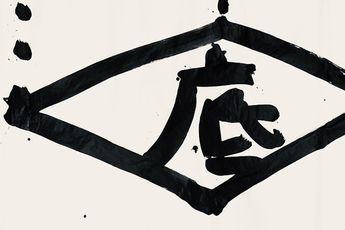
Hisashi YAMAMOTO was born in Hiroshima, Japan in 1969. Yamamoto has devoted himself to the world of calligraphy since the age of 20, when he encountered the work of calligrapher Yuichi Inoue. Yamamoto was later involved in production of a catalogue raisonné of Inoue’s work.
In the process of exploring new, modern approaches to calligraphy unfettered by time-honoured tradition, Yamamoto established a style that involves writing the name of a thing, on that thing. This can be seen in his rendering of simple characters, such as katakana, giving the name of the thing, within a simplified image reminiscent of a primitive pictograph, in what could be described as an unexpected joining of script as picture and calligraphy as script, as opposed to the double negative of a piece of calligraphy neither picture nor script; a grasping for coexistence, perhaps.
At the same time, practice of this sort likely helped Yamamoto to establish his identity as an artist, as he traversed the two differing domains of contemporary art and contemporary calligraphy. Maintaining a distance from the conventional apprenticeship system, and calligraphy organisations, Yamamoto produces works that are also driven by the questions of what constitutes presentness in calligraphy, and freedom. Just as kanji characters originated in pictograms, pictograms could be described as primitive symbols combining text and picture into a harmonious whole. In other words, rendering a pictogram could also mean presenting as calligraphy a particular phenomenon before it is established as a symbol and refined as a character. Though Yamamoto’s attempt at this exhibition to take things that previously did not exist and turn them into calligraphy, is in theoretical terms similar to his previous work in that it involves naming as-yet unnamed phenomena, and assigning them ‘made-up characters,’ here we find he has added some new and intriguing pathways. Yamamoto seems to delve deep into the source of calligraphy, and characters.
Kenryou GU was born in Kyoto, Japan in 1994 and raised in Shanghai, and now lives and works in Kyoto. Gu earned his BFA in Photography at Kyoto University of the Arts (formerly Kyoto University of Art and Design), studying abroad at the École nationale supérieure de la photographie in Arles, France.
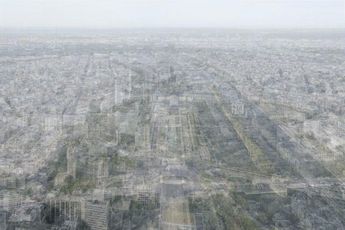
Gu presents photographic works created using a technique he calls ‘digital weaving,’ in which multiple photographic images are broken down into pixels and recombined on-screen into photographs. Gu states as follows:
‘In addition to vision, whose limitations are determined by the naked eye, I have been developing an understanding of spaces according to their temporal ‘thickness,’ including through movement and the physical body. While various modern technologies have enabled us to achieve our goals more efficiently, the processes behind them have been buried in a black box; within a box is a rupture that defines a new kind of ‘death.’
Metropolises have become colonies of colonnades, all covered in the same glass, and continues to attract people who have been brainwashed by the amorphous religion of greed. In every skyscraper around the world, there is inevitably an observation deck—homogenous tourist attractions that draw countless visitors. This is the only vision of the colony that its inhabitants are permitted to see.
In a space where most of the five senses are made inaccessible, nobody—myself included—can distinguish if what they are seeing is truly the city or only a panoramic screen. Our passive bodies are transported in high-speed elevators that are not unlike panic rooms, elevating us to the clouds in a matter of seconds. This creates a schism with reality, depriving us from our ability to assess the scenery we see. As people living in this day and age, we should not single-mindedly pursue the increasing speed of technological evolution while leaving to waste our splintered understanding of the world outside our glass walls.’
A respected voice in contemporary art discourse.
Focusing on ambitious storytelling and insightful art-world commentary. Ocula Magazine publishes in-depth interviews, critical essays and timely analysis on the artists, exhibitions and ideas driving the global art world.
Learn more about Ocula Magazine
Showcasing the best of the art world.
Ocula partners with galleries from around the world to highlight their artists, artworks and exhibitions. Gallery membership is by application and invitation, with each member vetted by an independent panel.
Learn more about Ocula Membership

Specialises in the sale of major artworks.
Led by a team with deep ties to the world’s leading auction houses, galleries and collectors. Ocula’s advisory team offers bespoke services to high-net-worth clients from around the world who are looking to acquire the best of contemporary and modern art.
Learn more about our team and services