





ALIGHIERO BOETTI
1940-1994, ItalyBorn in 1940, Alighiero Boetti initially aligned himself with the Arte Povera movement before embarking on a distinct artistic trajectory of his own.
In 1972 he moved to Rome, where he discovered the pleasure of light and colours, far from the austerity of Turin. In 197, in search of a transformative experience, he found solace and inspiration in the vibrant city of Kabul, Afghanistan. His first encounter with the city marked the beginning of a profound connection that would shape Boetti’s creative journey for the next 23 years until his passing in 1994. More than a mere traveller, Boetti immersed himself in the fabric of Kabul’s culture, going so far as to establish the renowned One Hotel and making recurrent visits until the region was unsettled by the Soviet invasion in 1979.
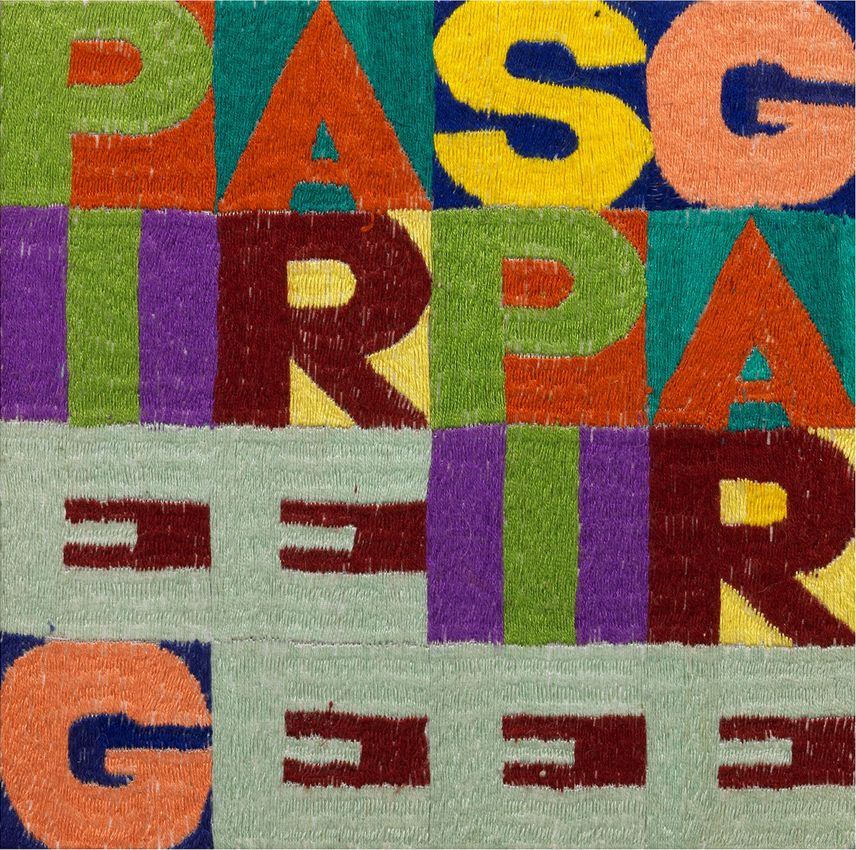
It is Boetti’s extraordinary collaborations with Afghan craftswomen that remain his most remarkable achievements, commissioning them to craft monumental embroideries that embody the essence of his artistic vision.
As a conceptual and versatile artist, he has produced a great variety of artworks, delegating to other people the manual execution of some specific typologies, but in that case following very precise “rules of the game” and even high principles such as the 1971 Nobel Prize Jacques Monod’s “Chance and necessity”.
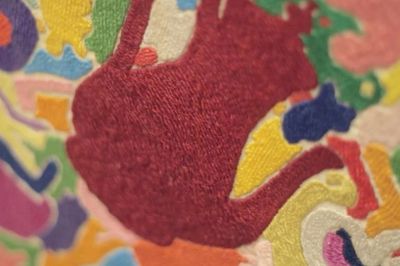
Among such pieces, the ballpoint pen Monochromes (blue, black, red, green) with a white coded writing coming out of the evenly doodled coloured surface; or the tapestries embroidered on cloth, not only the World Maps but also the multi-coloured “Magic Squares” of texts written in Italian and Persian as well as the “Tutto” (Everything), dense puzzles where indeed everything can be found (newspaper silhouettes, figures of animals and shapes of domestic objects ...).
Alighiero Boetti exposed his works in the most prestigious and emblematic exhibitions of his generation, from ‘When Attitudes Become Form’ (1969) to ‘Contemporanea’ (Rome 1973), from ‘Identité Italienne’ (Paris, 1981) to ‘The Italian Metamorphosis 1943-1968’ (Guggenheim Museum New York, 1994). Works of his were exposed at six editions of the Venice Biennale; his personal exhibition room in the 1990 edition was awarded a special prize, and a posthumous homage show was presented in the 2001 edition.
Courtesy MASSIMODECARLO

Exhibiting Elsewhere







Alighiero Boetti in Ocula Magazine







Explore and Follow Artists Shaping Contemporary Art
A respected voice in contemporary art discourse.
Focusing on ambitious storytelling and insightful art-world commentary. Ocula Magazine publishes in-depth interviews, critical essays and timely analysis on the artists, exhibitions and ideas driving the global art world.
Learn more about Ocula Magazine
Showcasing the best of the art world.
Ocula partners with galleries from around the world to highlight their artists, artworks and exhibitions. Gallery membership is by application and invitation, with each member vetted by an independent panel.
Learn more about Ocula Membership
Specialises in the sale of major artworks.
Led by a team with deep ties to the world’s leading auction houses, galleries and collectors. Ocula’s advisory team offers bespoke services to high-net-worth clients from around the world who are looking to acquire the best of contemporary and modern art.
Learn more about our team and services