





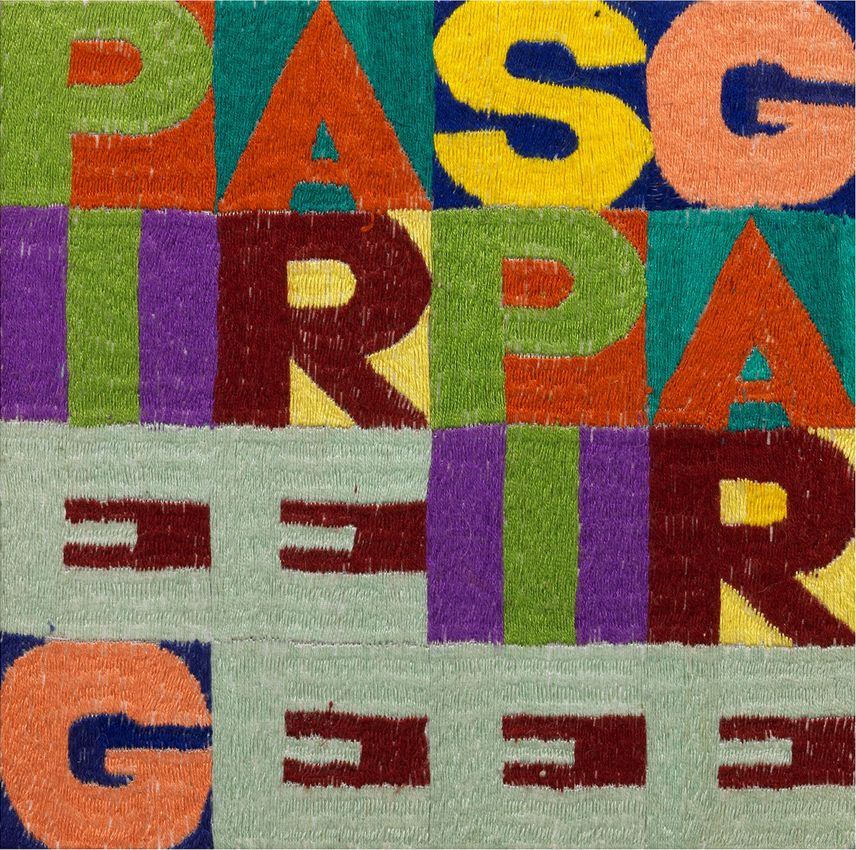
ALIGHIERO BOETTI
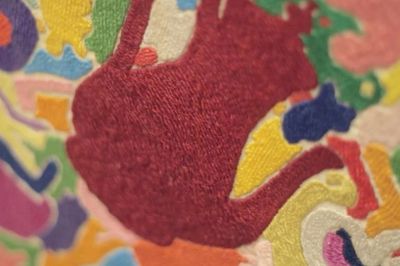
1940-1994, ItalyAlighiero e Boetti was born in Turin, Italy. Although not formally trained in art, Boetti was preoccupied with the theory of creativity from an early age. His early work from the late 1960s is rooted in the Arte Povera style. Travelling to Afghanistan at the beginning of the 1970s, he was introduced to the traditional craft of embroidery, which marked a turning point in the artist’s career. In his consequent Territori Occupati series, 1971-92, he commissioned Afghan embroiderers to create a maps of the world, with each country bearing the colours and pattern of its flag. The commission grew into a beautifully crafted, large-scale series of maps produced over a period of twenty years in Kabul, Afghanistan and Peshawar, Pakistan. The land mass of each country is filled in with its flag.
His fundamental concern with the relationship between “order” and “disorder” is manifest in his grid structures, derived from the “magical squares,” that feature sayings and aphorisms that stem from cultural, philosophical, mathematical and linguistic contexts. Throughout his career Boetti worked with a wide array of materials, tools, and techniques, including ball pens (biro) and even the postal system. However it is his fascination with patterns and his pataphysical approach to mathematics and seriality that mark him out as a kind of satirical cabbalist trying to identify the one key system that will perhaps reveal some kind of universal answer.
Initially showing in Milan and Turin, Boetti had his first US solo exhibition in New York at John Weber Gallery in 1973. He continued to show throughout Italy and the United States until his premature death in 1994. He has been honoured posthumously with several large-scale exhibitions, most notably at the Museum für Moderne Kunst in Vienna in 1997 and the Museum für Moderne Kunst in Frankfurt am Main in 1998. The artist took part in Documentas 5, 1972, and 7, 1982, and the Venice Biennale, 1978, 1980, 1986, 1990, 1995. In 2001, the Venice Pavillon was completely dedicated to Alighiero e Boetti’s work. In 2012 the exhibition Game Plan, was shown at the MoMA New York.
Courtesy Sprüth Magers

Works at Sprüth Magers


Recently Exhibited

Exhibiting Elsewhere


Works Elsewhere





Alighiero Boetti in Ocula Magazine







Explore and Follow Artists Shaping Contemporary Art
A respected voice in contemporary art discourse.
Focusing on ambitious storytelling and insightful art-world commentary. Ocula Magazine publishes in-depth interviews, critical essays and timely analysis on the artists, exhibitions and ideas driving the global art world.
Learn more about Ocula Magazine
Showcasing the best of the art world.
Ocula partners with galleries from around the world to highlight their artists, artworks and exhibitions. Gallery membership is by application and invitation, with each member vetted by an independent panel.
Learn more about Ocula Membership
Specialises in the sale of major artworks.
Led by a team with deep ties to the world’s leading auction houses, galleries and collectors. Ocula’s advisory team offers bespoke services to high-net-worth clients from around the world who are looking to acquire the best of contemporary and modern art.
Learn more about our team and services