






Chan Ting
b. 1993, Hong KongChan Ting is a multidisciplinary Hong Kong–based artist whose sculptural practice centres on transforming discarded and abandoned objects into layered installations that meditate on memory, resilience and collective healing.
Early Life and Practice Development
Chan Ting was born in Hong Kong in 1993 and works across sculpture, installation, image-making and sound. Drawing on her background as a hypnotherapist and sound healer, she approaches materials and objects with an acute sensitivity to their embedded narratives and temporal weight. She is based in Lam Tsuen, where she operates her studio within a historic post-war structure, integrating found materials from her immediate surroundings into her artistic practice.
Chan’s methodology is rooted in a philosophy of conservation—she salvages objects from markets, abandoned buildings, and domestic discards, treating each piece as a recipient of renewed attention and value. Her encounter with objects is intuitive and almost ritualistic. She describes this process as a form of communication: objects ‘speak’ to her, initiating a conversation that shapes the artwork’s eventual form. This tactile, dialogic approach reveals her understanding of artmaking as relational practice that honours the histories embedded in forgotten things.
Chan Ting Artworks
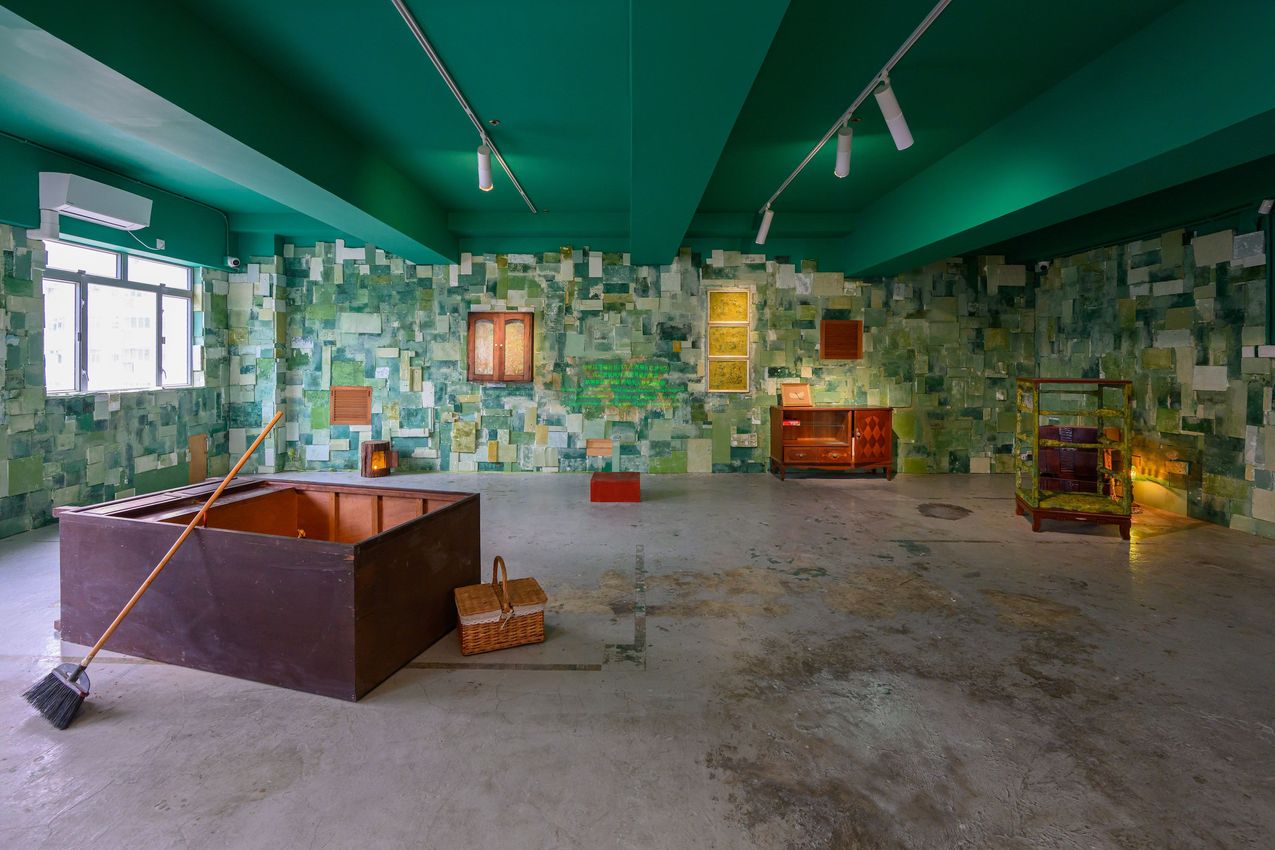
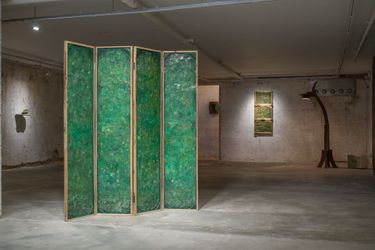
Chan Ting’s sculptures transform found objects through material intervention, employing industrial-grade colour pigment, construction plaster and hand-working techniques to create works that oscillate between repair, excavation and transfiguration. Her recent practice is marked by a signature palette of green—a colour drawn from Hong Kong’s historical and contemporary landscape—which she applies in layers across weathered furniture, discarded ceramics and architectural fragments. This green references both the military paint used in Hong Kong during World War II and the moss that grows across the city’s neglected spaces, collapsing distinctions between decay and renewal, violence and healing.
Found Objects and Layered Intervention
Chan’s early explorations of object-making centred on appropriating discarded items from Hong Kong’s urban fabric. In works such as those from the Abandoned Abundance series, the artist sources secondhand furniture and domestic objects from street markets and domestic residences, subjecting them to material transformation. She describes her approach as rooted in what she terms ‘queer materials’—materials conventionally associated with masculine labour, construction and utility that she reimagines through alternative, unexpected aesthetic possibilities. By engaging tools and pigments traditionally belonging to builders and construction workers, Chan locates her practice within a queer gesture of material repurposing.
Her technical process involves multiple interventions: filling cracks and gaps with industrial plaster and pigment, polishing and sanding the surface, then drilling through accumulated layers to reveal concealed histories. Each object becomes a palimpsest of intervention and care, with the artist’s labour visible in the tactile variations of surface texture—sometimes harsh and coarse, occasionally soft and reflective, often creating ambiguity about whether the work appears finished or perpetually in process.
Moss Wonders and the Residency Aesthetic
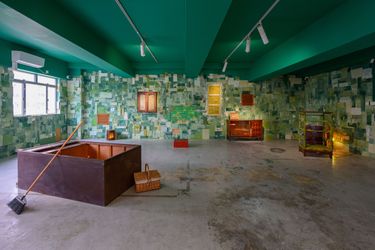
In 2023–24, Chan undertook a three-month residency at Para Site, Hong Kong, resulting in the major solo exhibition Moss Wonders (27 January–8 February 2024), curated by Jessie Kwok. The exhibition emerged from intensive research in Quarry Bay, the neighbourhood surrounding Para Site, where Chan scavenged for abandoned furniture, ceramic fragments and domestic ephemera spanning decades. She transformed Para Site’s tenth-floor annex into an immersive environment—a cabinet of curiosities that rejected the aesthetic conventions of the white cube.
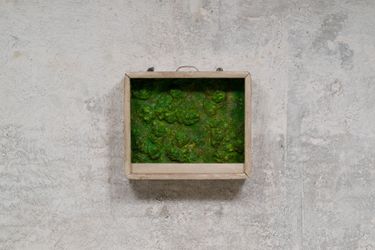
The exhibition’s title and methodology drew inspiration from moss: an organism that establishes itself on seemingly inhospitable surfaces, generating its own microecology despite precarious conditions. This rhizomatic model shaped Chan’s spatial intervention. Rather than isolating objects on pedestals, she ‘carpeted’ the exhibition space with installations, invited viewers to open cupboards and peer into hidden compartments, and created an environment structured around accumulated texture and layered discovery. Accompanying sounds and photographic documentation gathered within the neighbourhood extended the work’s sensory register, situating the exhibition as a shared repository of collective memory.
Dreamskin and Material Alchemy
The exhibition Dreamskin (June–August 2024) at PHD Group, her primary gallery representation, further developed Chan’s investigation of found and secondhand objects. Here, she presented a landscape of secondhand furniture and abandoned artworks culled from various sources, reimagining these discards through colour, texture and spatial reconfiguration. The title Dreamskin suggests the permeable boundary between material reality and the unconscious, between the object’s documented history and its lived, felt presence.
The works in this exhibition consolidate Chan’s vocabulary of care and transformation—what emerges is not a return to originality, but rather an acknowledgement of the object’s capacity for continual becoming. The artist’s interventions manifest not as erasure but as addition, layering new material onto existing forms, so that temporality becomes readable across the work’s surface.
Contemporary Practices and Institutional Recognition
Chan has also engaged institutional critique and systems of value through her participation in group exhibitions examining capitalism and commodification. In Commodity-Fetishism (2024) at Square Street Gallery, she presented works examining abstraction and exchange value, positioning her object-focused practice within broader conversations about labour, consumption and alienation in post-industrial societies.
Her work is held in public and private collections internationally, with exhibitions and presentations throughout Hong Kong, Canada, China, France, Singapore, Sweden and Switzerland. Recent curatorial recognition includes her selection for Ocula Magazine’s ’New Rules: The Artists to Watch for 2026’, positioning her among emerging voices reshaping contemporary art discourse in Asia.
Select Solo Exhibitions
- Mothering, PHD Group, Hong Kong (2025–2026)
- Dreamskin, PHD Group, Hong Kong (2024)
- Moss Wonders, Para Site, Hong Kong (2023–2024)
Select Group Exhibitions
- Commodity-Fetishism, Square Street Gallery, Hong Kong (2024)
- Tendering, PHD Group, Hong Kong (2023–2024)
Statement and Artistic Philosophy
Chan has described her practice as emerging from a philosophy of compassion and openness toward discarded things. She articulates the relationship between life and art as inseparable, emphasising that her creative work prioritises human experience and the quotidian realities of those navigating Hong Kong’s conditions. Rather than pursuing technical perfection or material ‘correctness,’ she values the connective potential of art-making—the ways objects and artworks can become vessels for shared memory and collective resilience.
Her background in hypnotherapy and sound healing informs her attentiveness to the subconscious and somatic dimensions of aesthetic encounter. The artist describes seeking to offer audiences alternative perspectives on trauma, abandonment and historical transition—presenting not a singular interpretation but rather invitations to engage with complexity, ambiguity and the beauty that emerges through genuine encounters with overlooked things.
The use of green across her recent oeuvre exemplifies this philosophy. Green, Chan explains, simultaneously references Hong Kong’s violent colonial history (military paint, institutional control) and its resilient present (moss, botanical persistence). This duality—the capacity for the same symbol to represent both harm and healing—becomes central to her artistic vision. In her words, ‘When we dive into our history, green may have been used in the killing of people, but when we look at moss, the colour may represent healing. The duality is so amazing to me.’
Chan Ting’s Studio Practice
Chan operates from her studio in rural Lam Tsuen, where the physical environment—a post-war building overtaken by vegetation—becomes integral to her practice. The studio functions as both workspace and research site, where she encounters new materials through daily proximity and environmental observation. Her practice integrates rigorous technical engagement with intuitive, almost meditative approaches to material transformation, refusing rigid methodologies in favour of responsiveness to each object’s particular history.
She works with industrial-grade pigments, construction-grade plaster, found tools and hand-labour techniques that acknowledge the embodied effort required to transform materials. This labour-intensive practice contrasts with the apparent minimalism of her intervention: she does not significantly alter an object’s fundamental form, but rather works with its existing geometry, deepening texture, revealing strata and creating new surfaces that acknowledge both what the object was and what it might become.
Publications and Further Reading
Chan Ting’s practice has received attention in major publications addressing contemporary art in Asia-Pacific. Her work was featured in Artasiapacific magazine’s ‘New Currents’ series, and she participated in a studio interview with Vogue Hong Kong (August 2024) discussing her approach to found materials, queer aesthetics and the role of intuition in her artistic process. Her selection for Ocula Magazine’s ‘Artists to Watch for 2026’ reflects growing international recognition of her contributions to contemporary sculpture and installation practices.
You can follow Chan Ting on Ocula to learn more about her work, discover upcoming exhibitions, and learn about art for sale.
Website and Instagram
Chan Ting’s website can be found at chan-ting.com. You can follow her on Instagram at @ctsimage.
Chan Ting FAQs
Who is Chan Ting?
Chan Ting is a Hong Kong–based multidisciplinary artist born in 1993 who works across sculpture, installation, image-making and sound. Drawing on her background as a hypnotherapist, Chan creates layered works from found and abandoned objects, transforming discarded materials into meditative installations that engage with memory, collective trauma and urban resilience. Her recent practice is characterised by a signature palette of green—referencing both Hong Kong’s wartime history and the moss that symbolises persistence in neglected spaces.
You can follow Chan Ting on Ocula to learn more about their work, find out about art for sale, contact their gallery, and keep up to date with upcoming exhibitions.
Where can I see work by Chan Ting?
Chan Ting’s work has been exhibited internationally across Hong Kong, Canada, China, France, Singapore, Sweden and Switzerland. Her primary gallery representation is PHD Group in Hong Kong, which regularly presents her solo and group exhibitions. Major institutional presentations include her 2023–2024 residency and solo exhibition Moss Wonders at Para Site, Hong Kong. Her work is held in public and private collections internationally.
You can follow Chan Ting on Ocula to receive alerts on upcoming exhibitions by the artist.
What materials does Chan Ting use?
Chan Ting primarily works with found and abandoned objects—discarded furniture, domestic ceramics, architectural fragments and household materials sourced from Hong Kong’s street markets, neighbourhoods and domestic spaces. She transforms these objects using industrial-grade colour pigments, construction-grade plaster, hand tools and labour-intensive techniques including layering, polishing, sanding and drilling. She describes these materials as ‘queer materials’—conventionally associated with construction and masculine labour, reimagined through unexpected aesthetic possibilities.
What is the significance of green in Chan Ting’s work?
Green is a defining colour in Chan Ting’s recent practice, carrying multiple historical and contemporary references. The shade she employs references military paint used in Hong Kong during World War II—a colour that gradually seeped into the civilian urban landscape, becoming visible on street market stalls, shopfront shutters, trams and ferries. Simultaneously, green represents moss, an organism that thrives on seemingly inhospitable surfaces, symbolising resilience and persistence. For Chan, green collapses these meanings—simultaneously representing violence and healing, institutional control and organic growth, abandonment and renewal. She describes the duality as central to her artistic vision.
Where does Chan Ting live and work?
Chan Ting lives and works in Lam Tsuen, a rural area of Hong Kong’s New Territories. Her studio is situated within a historic post-war building surrounded by vegetation, which has become integral to her artistic practice. The building’s weathered facade, abandoned status and organic overgrowth inform her aesthetic approach and material sourcing methodology.
How is Chan Ting’s name pronounced?
Chan Ting (陳庭) is pronounced ‘Chahn Ting’, with ‘Chan’ as the family name and ‘Ting’ as the given name. The artist uses she/they pronouns.
Where can I buy work by Chan Ting?
Chan Ting is represented by PHD Group, a leading contemporary art gallery based in Hong Kong. You can explore Ocula to find out more about PHD Group and enquire directly about acquiring works by Chan Ting. PHD Group regularly presents Chan’s exhibitions and can provide information regarding availability and acquisition.
You can also get in touch with Ocula’s art advisory team to find out more about buying or selling work by Chan Ting.
Ocula | 2026

Representative Artworks
View story
View story
View story
View story


Explore and Follow Artists Shaping Contemporary Art
A respected voice in contemporary art discourse.
Focusing on ambitious storytelling and insightful art-world commentary. Ocula Magazine publishes in-depth interviews, critical essays and timely analysis on the artists, exhibitions and ideas driving the global art world.
Learn more about Ocula Magazine
Showcasing the best of the art world.
Ocula partners with galleries from around the world to highlight their artists, artworks and exhibitions. Gallery membership is by application and invitation, with each member vetted by an independent panel.
Learn more about Ocula Membership
Specialises in the sale of major artworks.
Led by a team with deep ties to the world’s leading auction houses, galleries and collectors. Ocula’s advisory team offers bespoke services to high-net-worth clients from around the world who are looking to acquire the best of contemporary and modern art.
Learn more about our team and services