






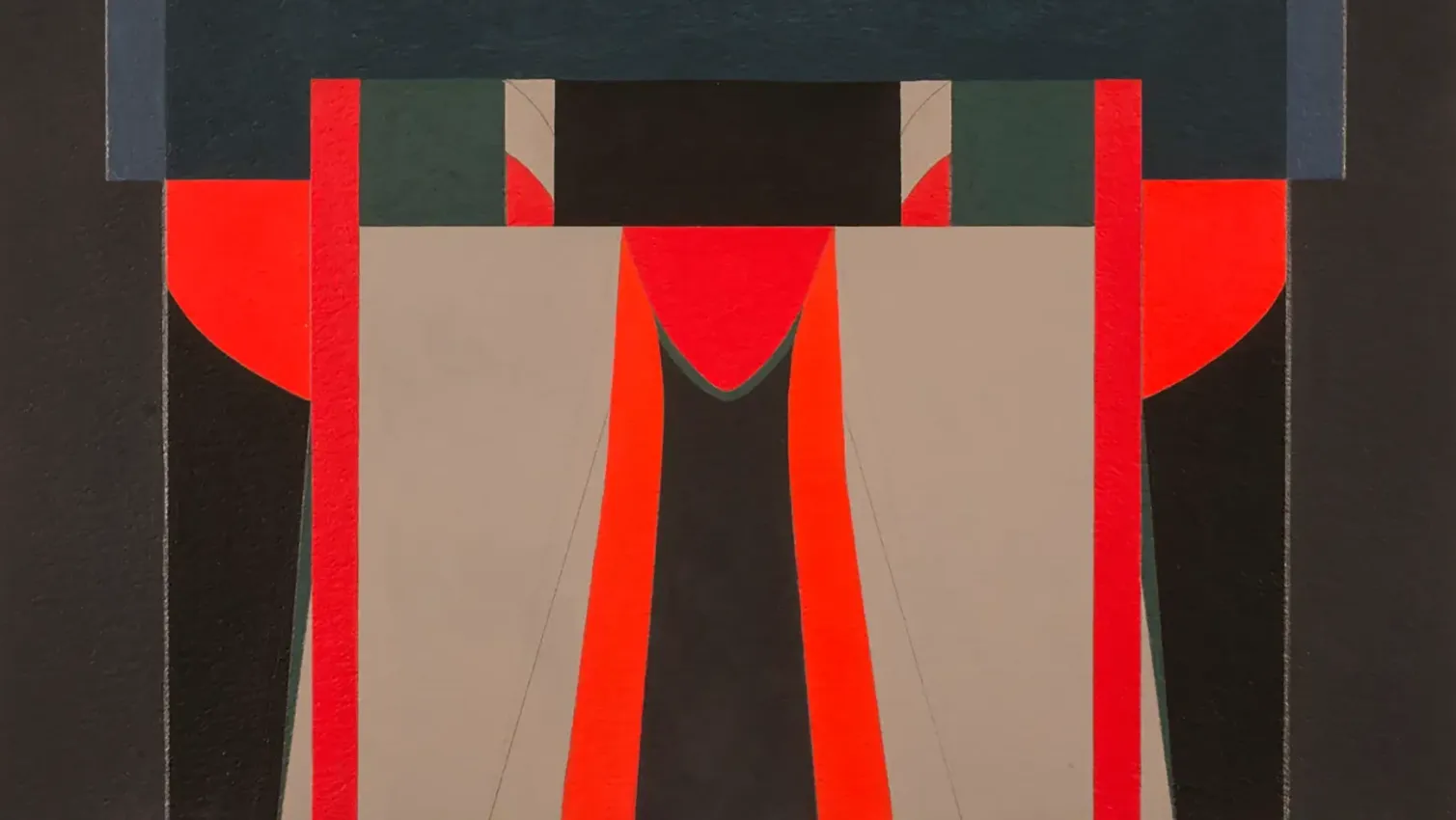
FANNY SANÍN
b. 1938, ColombiaFanny Sanín (born 1938, Bogotá, Colombia) is a Colombian artist who has become a pioneer of the geometric abstraction movement and a key figure in modern Latin American art.
In January 2026, the Solomon R. Guggenheim Museum in New York announced the acquisition of two works by Sanín, recognising her more than five-decade practice exploring the relationships among symmetry, colour, and geometry. This acquisition positions Sanín alongside fellow geometric abstractionist Freddy Rodríguez as part of the Guggenheim’s ongoing effort to strengthen representation across movements and regions. Sanín’s exhibition Geometric Equations at Americas Society in New York was also named one of the best art exhibitions of 2025 by The New York Times.
Early years
Fanny Sanín Sader was born in 1938 in Bogotá, Colombia, the daughter of Gabriel Sanín Tobón and Fanny Sader Guerra. She studied Fine Arts at the Universidad de los Andes in Bogotá from 1956 to 1960, where professors David Manzur, Armando Villegas, and especially Juan Antonio Roda introduced her to the language of gestural abstraction. As a student, she explored sculpture, architectural drawing, theatre set design, and printmaking, but ultimately dedicated herself to painting .
Her emergence onto the art scene coincided with post-war European influences of geometric abstraction, alongside contemporaries Jesús Rafael Soto and Raúl Lozza. Living in England early in her career provided Sanín with access to the greater European art world and introduced her to paintings by Ellsworth Kelly, Morris Louis, Barnett Newman, Kenneth Noland, Mark Rothko, and Frank Stella, whose adept employment of scale and colour proved inspirational. She has also cited Wassily Kandinsky and Henri Matisse as influences. Sanín has lived and worked in New York City since 1971.
Fanny Sanín Artworks
Fanny Sanín’s paintings are characterised by hard-edge, symmetrical compositions filled with flat planes of colour. Her symmetrical design motifs consist of blocky, simplified shapes using two to five colours, and though they vary in size and composition, each painting shares her unique aesthetic. Initially, Sanín created works using a gestural abstract style, like contemporaries Lee Krasner and Joan Mitchell, but found her true voice in the geometry of hard-edge compositions.
Transition to geometric abstraction
Sanín debuted at the Colombian National Salons of 1962 and 1963 with works in the gestural abstraction mode learned from her university professors. Her transition to geometric abstraction occurred gradually through the 1960s, as she moved away from expressionistic brushwork towards the orderly, stable forms that would define her mature practice. As a style rooted in orderliness and stability, geometric abstraction offered artists like Sanín a respite from volatile surroundings.
Colour and methodology
Colour and form are Sanín’s only subject matter. Her methodical artistic process, meditative in nature, includes creating multitudes of preparatory studies and mixing her own hues. She believes painting allows her to delve most deeply into pure abstraction, devoid of figurative representation. Her cohesive geometric works evoke a sense of calm in their methodical construction.
Large-scale canvases
Colombian painter Fanny Sanín is known for her large-scale canvases depicting hard-edge geometric compositions in vibrant colour configurations. Works such as Acrylic No. 6 (1979) partake of a transnational dialogue characteristic of all her work, connecting Latin American geometric traditions with international movements in abstraction.
Select Awards and Accolades
- The New York Times Best Art Exhibitions of 2025, for Geometric Equations at Americas Society, New York
- Inclusion in the 2024 Venice Biennale
To be kept up to date with news relating to Fanny Sanín, follow her on Ocula.
Fanny Sanín Exhibitions
Fanny Sanín has been the subject of both solo exhibitions and group exhibitions at important institutions and galleries over more than six decades. Below is a selection of important exhibitions.
Select solo exhibitions
- Geometric Equations, Americas Society, New York, 2025
- Fanny Sanín: Progression, 1966 to Now, Dickinson Gallery, New York, 2022
- Fanny Sanín’s New York: The Critical Decade, 1971–1981, Institute of Fine Arts, NYU, New York, 2020
- Fanny Sanín: Concrete Abstractions, Sicardi Ayers Bacino, Houston, 2019
- Equilibrium: Fanny Sanín, National Museum of Women in the Arts, Washington, DC, 2017
- Fanny Sanín, LA Louver, Los Angeles, 2017
- Fanny Sanín En Abstracto, Museo Nacional, Bogotá, 2015
- Color and Symmetry – Retrospective Exhibition 1987–1999, Museo de Arte del Banco de la República, Bogotá, 2000
- Retrospective Exhibition, Museum of Modern Art, Bogotá, 1987
- Fanny Sanín, Museum of Modern Art, Mexico City, 1979
Select group exhibitions
- Action, Gesture, Paint: Women Artists and Global Abstraction 1940–70, Whitechapel Gallery, London; Fondation Vincent Van Gogh, Arles, 2023
- Still Alive, Aichi Triennale, Aichi, Japan, 2022
- Latinx Abstract, BRIC, New York, 2021
- Art_Latin_America: Against the Survey, Davis Museum, Wellesley College, Massachusetts, 2019
- The Illusive Eye, El Museo del Barrio, New York, 2016
- _Latin American Women Artists 1915–199_5, Milwaukee Art Museum; Phoenix Art Museum; Denver Art Museum; National Museum of Women in the Arts, Washington, DC, 1995–1996
- I_I La Habana Biennial_, National Museum of Fine Arts, Havana, 1986
- Geometric Abstraction in Latin American Art 1914–1984, CDS Gallery, New York, 1985
To be kept up to date with upcoming exhibitions featuring Fanny Sanín, follow her on Ocula.
Collections
Fanny Sanín’s works are held in the permanent collections of:
- Solomon R. Guggenheim Museum, New York
- National Museum of Women in the Arts, Washington, DC
- Smithsonian American Art Museum, Washington, DC
- Museum of Art of the Americas, Organization of American States, Washington, DC
- El Museo del Barrio, New York
- Museum of Modern Art, Bogotá
- Museo de Arte del Banco de la República, Bogotá
- Museo de Antioquia, Medellín
- Berkeley Art Museum and Pacific Film Archive, University of California, Berkeley
Sign up to Ocula to follow Fanny Sanín and learn more about Fanny Sanín’s art for sale.
Website and Instagram
Fanny Sanín’s website can be found at fannysanin.com.
More Reading
Fanny Sanín’s practice has been featured in leading publications and institutions including the National Museum of Women in the Arts, the Museum of Fine Arts Houston, and Google Arts & Culture. Her exhibition Geometric Equations was recognised by The New York Times as one of the best exhibitions of 2025. You can follow Fanny Sanín on Ocula to be updated when new articles are published.
Fanny Sanín FAQs
Who is Fanny Sanín?
Fanny Sanín is a Colombian-born artist from Bogotá who has lived and worked in New York City since 1971. She is best known for her paintings of abstract geometric forms and colours, and is considered part of the second generation of abstract artists from Colombia.
Where can I see work by Fanny Sanín?
Work by Fanny Sanín can be seen at the Solomon R. Guggenheim Museum in New York, the National Museum of Women in the Arts in Washington, DC, the Smithsonian American Art Museum in Washington, DC, and the Museum of Art of the Americas in Washington, DC. Her work is also held in major collections in Colombia, including the Museum of Modern Art in Bogotá and Museo de Antioquia in Medellín .
Where does Fanny Sanín live?
Fanny Sanín has lived and worked in New York City since 1971.
How is Fanny Sanín’s name pronounced?
Fanny Sanín’s name is pronounced ‘FAH-nee sah-NEEN’, with the stress on the second syllable of ‘Sanín’, following Spanish pronunciation conventions.
Where can I buy Fanny Sanín’s work?
Fanny Sanín is represented by galleries including Sicardi Ayers Bacino in Houston, León Tovar Gallery in New York, and Durban Segnini Gallery in Miami. You can explore sites like Ocula to find out which Ocula galleries represent the artist and enquire directly about buying art by Fanny Sanín.
What style of art does Fanny Sanín create?
Fanny Sanín creates geometric abstract paintings characterised by hard-edge, symmetrical compositions filled with flat planes of colour. Her works typically feature blocky, simplified shapes using two to five colours, with each painting sharing her distinctive aesthetic of orderliness and stability. She mixes her own hues and creates multitudes of preparatory studies as part of a methodical, meditative artistic process.
What art movement is Fanny Sanín associated with?
Fanny Sanín is a pioneer of the geometric abstraction movement and a key figure in modern Latin American art. Her emergence onto the art scene coincided with post-war European influences of geometric abstraction, alongside contemporaries such as Venezuelan artist Jesús Rafael Soto and Argentine artist Raúl Lozza. Her work connects Latin American geometric traditions with international movements in abstraction, including influences from Ellsworth Kelly, Barnett Newman, Mark Rothko, and Frank Stella.
In 2026, how old is Fanny Sanín?
Fanny Sanín was born in 1938 in Bogotá, Colombia, making her 87 years old in 2026. She has been actively painting for more than six decades, with her career spanning from her debut at the Colombian National Salons in 1962 and 1963 through to her 2025 exhibition Geometric Equations at Americas Society in New York, which The New York Times named one of the best exhibitions of 2025.
Ocula | 2026



Explore and Follow Artists Shaping Contemporary Art
A respected voice in contemporary art discourse.
Focusing on ambitious storytelling and insightful art-world commentary. Ocula Magazine publishes in-depth interviews, critical essays and timely analysis on the artists, exhibitions and ideas driving the global art world.
Learn more about Ocula Magazine
Showcasing the best of the art world.
Ocula partners with galleries from around the world to highlight their artists, artworks and exhibitions. Gallery membership is by application and invitation, with each member vetted by an independent panel.
Learn more about Ocula Membership
Specialises in the sale of major artworks.
Led by a team with deep ties to the world’s leading auction houses, galleries and collectors. Ocula’s advisory team offers bespoke services to high-net-worth clients from around the world who are looking to acquire the best of contemporary and modern art.
Learn more about our team and services