





GABRIELLE GOLIATH
b. 1983, South AfricaGabrielle Goliath is a South African contemporary artist known for immersive video, sound, and performance installations that address violence, memory, and identity. Her work often centres on the experiences of marginalised communities—especially Black, brown, femme, and queer subjects. Goliath is best known for her durational series Elegy (2015–ongoing), and for large-scale installations such as This song is for... (2019) and Chorus (2021), which bring together musicians, mourners, and witnesses in shared sonic spaces.
Goliath has presented her installations and performances at museums, galleries, and biennials across South Africa, Europe, and the United Kingdom. Her work is held in public collections such as Iziko South African National Gallery (Cape Town), Johannesburg Art Gallery, Tate (London), and Wits Art Museum (Johannesburg). Key awards include a Special Prize in the Future Generation Art Prize (PinchukArtCentre, Kyiv, 2019), the Standard Bank Young Artist Award for Visual Art (Makhanda, 2019), and the Institut Français Afrique en Créations Prize at the Bamako Biennale (2017).
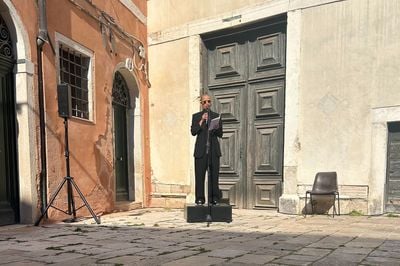
In 2026 Goliath’s was set to represent South Africa at the Venice Biennale, but her proposed project made international news when South Africa’s culture minister, Gayton McKenzie, cancelled the country’s official pavilion over a planned iteration of Elegy that included a section mourning Palestinian poet Hiba Abu Nada, killed in Gaza in 2023. The decision, which the minister called a response to a ‘highly divisive’ work, led to an unsuccessful high court challenge by Goliath and curator Ingrid Masondo and was widely described in global media as a case of political censorship at the 61st Venice Biennale. Goliath and Masondo subsequently announced their intention to present Elegy independently at Chiesa di Sant’Antonin in Venice’s Castello district, in a project supported by the Bertha Foundation and Ibraaz and scheduled to travel to Ibraaz in London later in 2026.
Early life and Career
Born in 1983 in Kimberley, South Africa, Gabrielle Goliath lives and works in Johannesburg. Her practice is rooted in the afterlives of apartheid and colonialism, and in the ethics of representing trauma and loss. Alongside her studio practice, she has developed a research-driven approach that draws on feminist, decolonial, and queer theory while remaining accessible to broad audiences.
From early in her career, Goliath turned to performance, video, and sound rather than traditional media, using these forms to convene collective encounters instead of producing stand-alone objects. Early works addressing rape culture and gender-based violence in South Africa helped establish her as a leading South African artist whose practice combining ritual, social process, and collaborative methods, led to major commissions and, eventually, selection for the Venice Biennale pavilion.
Key works and Projects
Goliath’s practice centres on immersive video, sound, and performance works that convene collective acts of mourning and listening in response to systemic violence. Across installations and long-running series, she collaborates with singers, survivors, and communities to turn lament into a shared ethical and political practice. Below are descriptions of seminal works by Goliath.
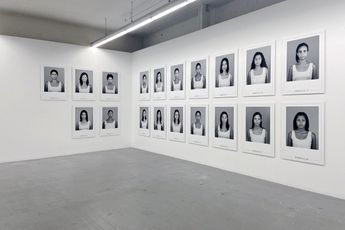
- Berenice 10–28 (2010) – An early photographic series of commemorative portraits dedicated to a childhood friend killed in an incident of domestic violence; each image marks a year since her death, visualising the passage of time and the persistence of grief.
- Personal Accounts (2013–ongoing) – A multi-channel, transnational video and sound project that foregrounds nonverbal testimony—breath, gesture, hesitation—in the faces and bodies of people speaking about experiences of violence. Recent iterations have been shown at Talbot Rice Gallery (Edinburgh) and at the 60th Venice Biennale.
- Roulette (2014) – A sound installation that replays a gunshot at statistically informed intervals corresponding to the frequency of femicide in South Africa, compelling listeners to inhabit the terrifying regularity of gender-based killing. The work’s data-based structure anticipates Goliath’s later use of repetition, duration, and anticipation as core formal tools.
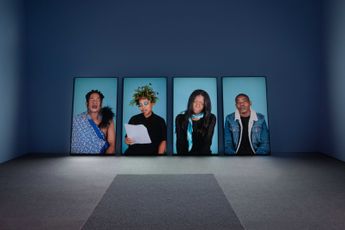
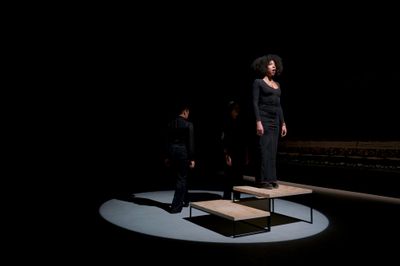
- Elegy (2015–ongoing) – Goliath’s best-known series, Elegy is a long-running performance and multi-channel video project in which ensembles of vocalists sustain extended, wordless laments dedicated to specific individuals and communities who have been unjustly killed. Dedicated subjects include women and queer people murdered in South Africa and victims of the Ovaherero and Nama genocide in Namibia; for the Venice Biennale, the series has been expanded to include Palestinian poet Hiba Abu Nada. Presented as towering video ‘monoliths’ and live performances, Elegy invites audiences to remain with grief as a shared responsibility instead of a distant spectacle.
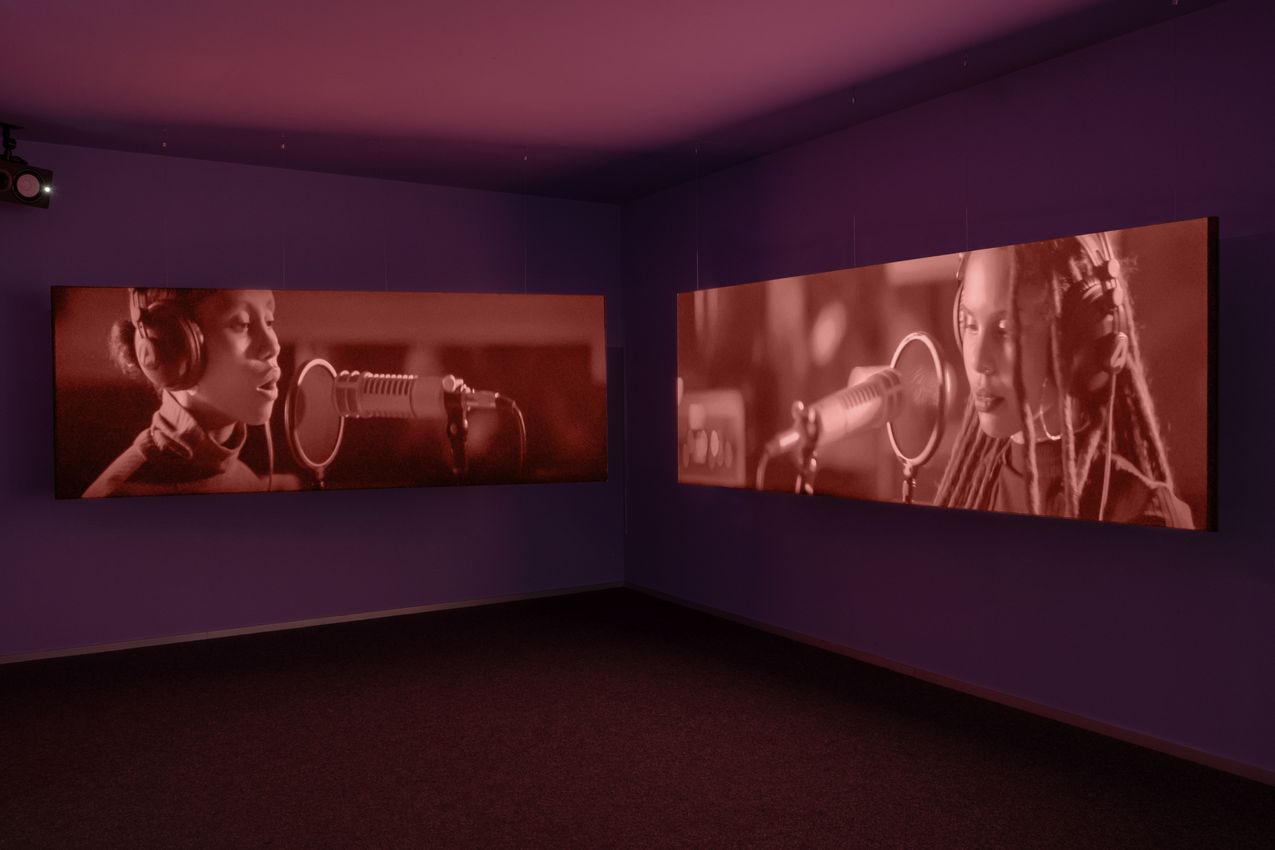
- This song is for... (2019) – A 22-channel immersive sound and video installation made with survivors of rape, who choose songs that hold personal meaning and work with ensembles of women and gender-queer vocalists to re-perform them. Each channel shows a lead singer moving between full voice and a fragile hum, circling what can and cannot be voiced and transforming familiar popular music into a space of re-memory, acknowledgement, and care.
- Chorus (2021) – A two-channel video and sound installation created with the University of Cape Town Choir in response to the 2019 rape and murder of student Uyinene Mrwetyana and, more broadly, the crisis of femicide in South Africa. On one screen, 46 choristers in black and grey gowns assemble on tiered steps and sustain a shifting, wordless hum while individual voices tire and pause and others continue; the facing screen shows an empty dais and evokes a roll-call of names, underscoring the work’s meditation on presence, absence, and ongoing mourning.
Across these works, Goliath consistently mobilises sound, repetition, and collective presence to reckon with racist and patriarchal violence, and she is frequently described in scholarship and criticism as a leading South African artist working with ritualised lament. Process, consent, and care function not only as ethical frameworks but as structuring principles for how her works are developed and experienced.
Venice Biennale and South African pavilion
For the 61st Venice Biennale (2026), an independent committee appointed by the non-profit Art Periodical selected Gabrielle Goliath and curator Ingrid Masondo to represent South Africa with a pavilion based on Elegy. The planned exhibition connected histories of femicide and LGBTQI+ murders in South Africa and colonial-era violence in Namibia with the killing of Hiba Abu Nada in Gaza, prompting the culture minister’s decision to withdraw state support.
In February 2026 the court dismissed their urgent application, ordering them to pay costs, and shortly afterwards the culture ministry confirmed that the official South African pavilion at Venice would remain empty. The ruling has been widely criticised by members of South Africa’s art community, international NGOs, and advocacy groups, many of whom view the cancellation as censorship and an attack on artistic freedom. In response, Goliath has pledged to appeal the decision and, together with Masondo, is realising Elegy in Venice outside the official pavilion as an independent exhibition at Chiesa di Sant’Antonin in the Castello district, near the Arsenale.
Gabrielle Goliath FAQs
Who is Gabrielle Goliath and what is she best known for?
Gabrielle Goliath is a Johannesburg-based South African artist born in 1983 whose work addresses violence, memory, and the politics of mourning, particularly as they affect Black, brown, femme, and queer communities. She is best known for immersive video and performance installations, especially her long-running Elegy series and related works such as Chorus and This song is for....
What is Gabrielle Goliath’s ‘Elegy’ about?
Elegy by Gabrielle Goliath is an ongoing performance and video series in which ensembles sustain extended, wordless songs of lament dedicated to people who have been unjustly killed, including victims of femicide, anti-LGBTQI+ violence, and colonial atrocities in southern Africa. The Venice Biennale iteration adds a lament for Palestinian poet Hiba Abu Nada, linking her death in Gaza to broader structures of racialised and gendered violence
Why is Gabrielle Goliath’s Venice Biennale project considered controversial?
The controversy around Gabrielle Goliath centres on the inclusion of a section mourning Palestinian lives lost in Gaza within a South African national pavilion, which the culture minister described as ‘highly divisive” and politically sensitive given South Africa’s own role in international legal proceedings related to allegations of genocide. Goliath and many observers argue that the cancellation amounts to censorship and undermines artists’ constitutional rights to freedom of expression and dissent. After the court dismissed Goliath and curator Ingrid Masondo’s application to reinstate the pavilion, the Department of Sport, Arts and Culture confirmed that the official South African pavilion at the 61st Venice Biennale will stand empty.
Where can I see Gabrielle Goliath’s work?
Goliath’s installations and performances have been shown in museums and galleries across South Africa and abroad, and her works are held in collections including Iziko South African National Gallery, Johannesburg Art Gallery, Tate Modern, and Wits Art Museum. Recent projects, such as the exhibition Personal Accounts at Talbot Rice Gallery and international presentations of Chorus and Elegy, demonstrate her growing presence on the global institutional circuit. In 2026, following the cancellation of her project for the South African Pavilion at the Venice Biennale, Goliath announced a proposal to show her work at an independent, alternative venue, at the Chiesa di Sant’Antonin in the Castello district, near the Arsenale.
Ocula | 2026


Explore Gabrielle Goliath's Exhibitions



Gabrielle Goliath in Ocula Magazine










Explore and Follow Artists Shaping Contemporary Art
A respected voice in contemporary art discourse.
Focusing on ambitious storytelling and insightful art-world commentary. Ocula Magazine publishes in-depth interviews, critical essays and timely analysis on the artists, exhibitions and ideas driving the global art world.
Learn more about Ocula Magazine
Showcasing the best of the art world.
Ocula partners with galleries from around the world to highlight their artists, artworks and exhibitions. Gallery membership is by application and invitation, with each member vetted by an independent panel.
Learn more about Ocula Membership
Specialises in the sale of major artworks.
Led by a team with deep ties to the world’s leading auction houses, galleries and collectors. Ocula’s advisory team offers bespoke services to high-net-worth clients from around the world who are looking to acquire the best of contemporary and modern art.
Learn more about our team and services