





HENRIKE NAUMANN
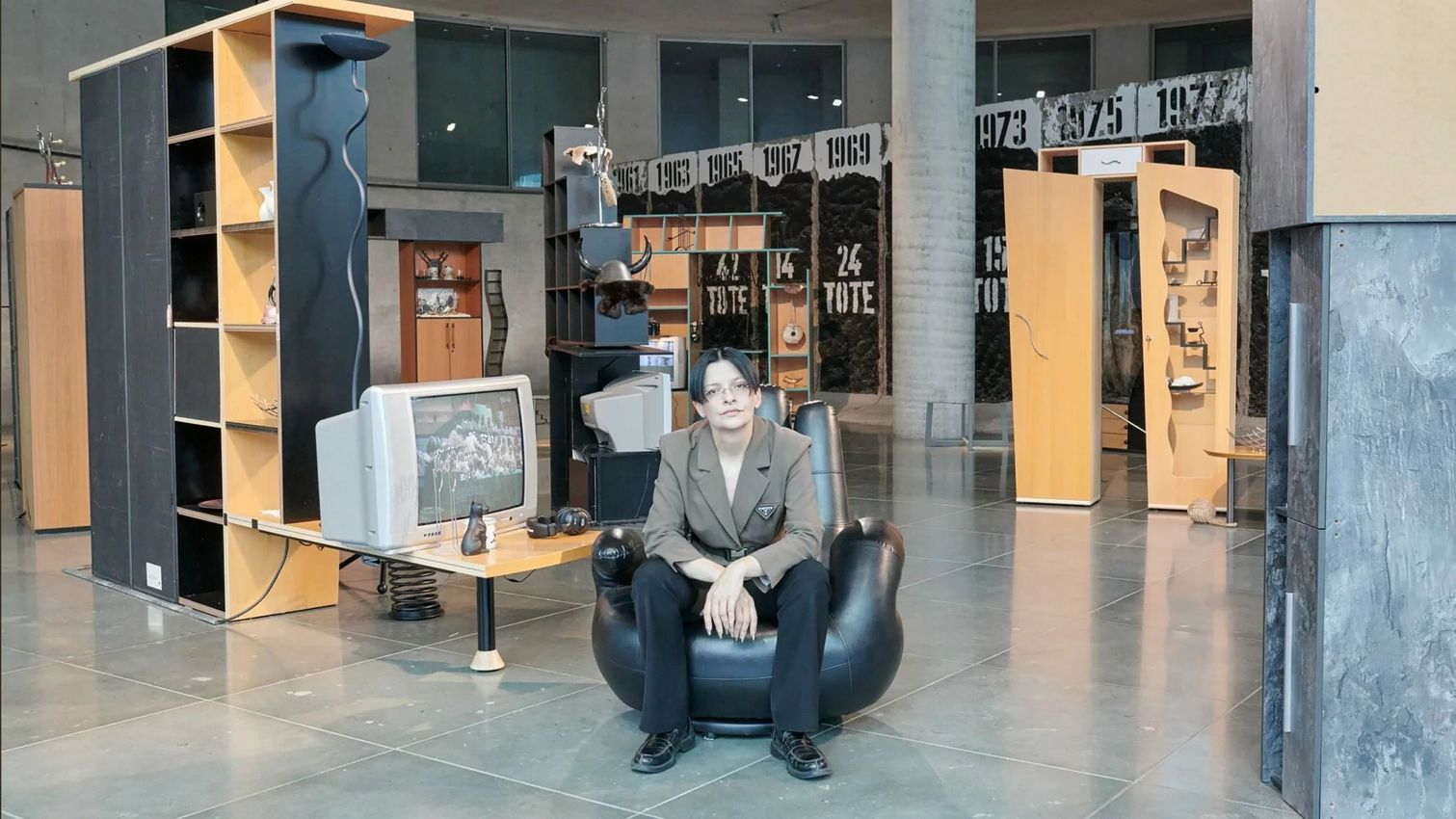
1984-2026, GermanyHenrike Naumann (1984–2026) was a German installation artist best known for immersive environments that use furniture and interior design to examine the politics of reunified Germany, right-wing extremism, and the ideological charge of everyday taste. Naumann died in Berlin on 14 February 2026 at the age of 41, shortly before she was due to represent Germany at the 61st Venice Biennale in the German Pavilion, a project she conceived together with Sung Tieu and curator Kathleen Reinhardt. Her research-driven installations, including Ostalgie (Primal Society) (2019) and works engaging the National Socialist Underground (NSU), helped define a generation of German artists grappling with the afterlives of state socialism and nationalist violence. Naumann’s work has been exhibited at institutions such as SculptureCenter, New York; Museum of Modern Art Warsaw; the Busch-Reisinger Museum at Harvard University; and at documenta fifteen, the Ghetto Biennale in Port-au-Prince, and the Kyiv Biennial.
Early life and career
Born in Zwickau in the former GDR in 1984, Naumann grew up in the shadow of German reunification and the rapid transformations that followed the collapse of the socialist state. She studied stage design in Dresden and scenography in Potsdam, training that shaped the theatrical, scenographic character of her later installations and their attention to how objects choreograph bodies and behaviours in space.
A key turning point in Naumann’s practice was the 2011 self-exposure of the right-wing terrorist group National Socialist Underground (NSU) in her hometown of Zwickau, an event she described as foundational for her artistic research into far-right networks and their embedding in everyday life. Her early video Triangular Stories (2012), which depicted the imagined teenage bedrooms of neo-Nazi militants, announced a distinctive approach that fused documentary research with speculative domestic staging. Over the following decade, she developed a body of work that mapped the affective and ideological residues of post-socialist transition across Germany and, increasingly, in other geopolitical contexts.
Works, installations and methods
Naumann’s is best known for large-scale installations that repurpose second-hand furniture, consumer goods, and display systems associated with East German and post-reunification interiors. She often arranges sofas, wall units, carpets, lighting and decorative accessories into walk-in environments that initially read as familiar living rooms, showrooms or club spaces, only to disclose narratives of social rupture, nostalgia, and radicalisation.
In Ostalgie (Primal Society) (2019), Naumann recreated a stylised East German apartment whose furniture and carpets were mounted on a vertical wall, while wallpapers and images covered the floor, literally tipping the idea of ‘home’ on its side. The disorientation of the rotated domestic space, presented at institutions including Museum Abteiberg, underscored how the promises and traumas of reunification disrupted everyday life and class identities. Earlier works like Triangular Stories and the sound piece Desolation (2014) addressed the aesthetics and recruitment mechanisms of far-right subcultures, including German extremists who joined international brigades and militant Islamist groups.
Naumann also extended her method beyond Germany’s borders. In Rustic Traditions (2022), she used Federal-style furniture and Americana to reflect on the January 6 United States Capitol attack, connecting ideas of heritage décor to violent nationalist fantasy. The 2023 work Breathe, realised as a performance at the Drama Theater Ivano-Frankivsk in Ukraine, examined mobilisation and decommunisation in the context of post-Soviet conflict, demonstrating how her research into systemic change and domestic imaginaries could be translated into other geopolitical settings.
Themes and context
Throughout her career, Naumann explored how ideology is encoded in interiors, consumer goods, and habits of taste, treating furniture as both historical document and affective agent. Her installations confront the legacies of German reunification, from the privatizations of the Treuhandanstalt and mass deindustrialisation in the East to the rise of neo-Nazi networks and the mainstreaming of far-right politics. By staging second-hand objects in uncanny constellations, she charted what one Frieze text referred to as ‘repressed histories’ that connect societal trauma with the banal surfaces of domestic life.
Naumann’s work is often situated within discourses of post-socialist art and post-internet installation, yet it maintains a distinct focus on the built environment as a site where policy, ideology, and personal biography collide. Her research-based practice, which she herself framed as using historical sources and everyday materials to produce new forms of knowledge, offers a critical archaeology of recent history that resonates with debates on memory culture, right-wing populism, and the aesthetics of renovation and lifestyle media.
Exhibitions, teaching and recognition
Naumann’s installations have been presented at major institutions and exhibitions, including SculptureCenter in New York, Museum of Modern Art Warsaw, the Busch-Reisinger Museum at Harvard, and at the Wall Memorial of the German Bundestag in Berlin. She participated in documenta fifteen in Kassel in 2022 with a large-scale installation created with Haitian collective Atis Rezistans / Ghetto Biennale, extending her interest in contested urban memory and informal architectures. Her work has also appeared at the Ghetto Biennale in Port-au-Prince and the Kyiv Biennial, underscoring her engagement with global contexts of social and political rupture.
Naumann received distinctions including the Karl Schmidt-Rottluff Scholarship, the Max Pechstein Prize of the City of Zwickau, the Leipziger Volkszeitung Art Prize, and a fellowship at the Berlin Artistic Research Program 2024—25. Shortly before her death she had accepted a professorship in sculpture at the University of Fine Arts Hamburg, scheduled to begin in 2026, a role that would have formalised her influence on a younger generation of artists working at the intersection of design, politics and social history. Her selection, alongside Sung Tieu, to conceptualise the German Pavilion at the 61st Venice Biennale marked a major milestone in her career and signalled institutional recognition of her contribution to contemporary German art.
Legacy and the Venice project
Following Naumann’s death, tributes from institutions such as documenta and La Biennale di Venezia emphasised both her artistic importance and her personal generosity and commitment. Commentators in German media have noted that she fundamentally reshaped how furniture and interior design can be used as critical tools to explore ideology, social history and the psychic landscape of recent German history.
The Venice project—developed with Sung Tieu under the curatorship of Kathleen Reinhardt and commissioned by ifa—was described as a deeply personal work that Naumann had conceptually completed before her death, with the intention that it would be realised according to her artistic vision. While detailed plans for the German Pavilion were not widely disclosed before her death, the commission consolidates Naumann’s status as a key voice in articulating the complexities of post-reunification Germany and its entanglement with broader global transformations.
Henrike Naumann FAQs
What is Henrike Naumann best known for?
Henrike Naumann is best known for immersive installations that use furniture, interior design and second-hand objects to investigate German reunification, right-wing extremism and the politics of everyday taste. By staging familiar domestic settings that subtly reveal narratives of trauma and ideology, she made visible how social and political ruptures are processed in private space.
What themes did Henrike Naumann explore in her work?
Naumann’s work explored themes of post-socialist transformation, the resurgence of far-right politics, and the ways in which ideology is encoded in décor, consumer goods and spatial design. She repeatedly returned to the histories of the NSU, the economic and psychological impact of Treuhand-era privatisations, and the affective economies of ‘Ostalgie’ as a lens on contemporary Germany.
How did Henrike Naumann die?
Naumann died on 14 February 2026 in Berlin at the age of 41, following a cancer diagnosis that friends and family were reported to have described as coming ‘far too late’. Her death occurred less than three months before the opening of the 61st Venice Biennale, where she had been appointed to represent Germany in the national pavilion.
Where can I see Henrike Naumann’s work?
Naumann’s installations have entered the programmes of institutions including SculptureCenter in New York, Museum of Modern Art Warsaw, the Busch-Reisinger Museum at Harvard, and German museums such as Museum Abteiberg and the Bundestag’s Wall Memorial. Her work has also been presented in large-scale exhibitions and biennials such as documenta fifteen, the Ghetto Biennale in Haiti, and the Kyiv Biennial, and is expected to feature prominently in the German Pavilion at the 61st Venice Biennale.
What are some key works by Henrike Naumann?
Important works by Naumann include Triangular Stories (2012), which imagines the bedrooms of neo-Nazi terrorists; Desolation (2014), an audio work featuring a former German rapper who joined the Islamic State; and Ostalgie (Primal Society) (2019), an installation that rotates an East German living room onto the wall. Other more recent projects such as Rustic Traditions (2022) and Breathe (2023) expanded her inquiry into how domestic design and state ideology intersect in contexts ranging from the US far right to post-Soviet Ukraine.
Why does Henrike Naumann use furniture and interiors in her art?
Naumann used second-hand furniture, décor and showroom-like interiors to show how political ideologies and social changes take shape in ordinary homes and everyday taste. By subtly rearranging familiar domestic settings, she revealed hidden histories of reunification, deindustrialisation and far-right radicalisation that might otherwise remain invisible.
Ocula | 2026




Explore and Follow Artists Shaping Contemporary Art
A respected voice in contemporary art discourse.
Focusing on ambitious storytelling and insightful art-world commentary. Ocula Magazine publishes in-depth interviews, critical essays and timely analysis on the artists, exhibitions and ideas driving the global art world.
Learn more about Ocula Magazine
Showcasing the best of the art world.
Ocula partners with galleries from around the world to highlight their artists, artworks and exhibitions. Gallery membership is by application and invitation, with each member vetted by an independent panel.
Learn more about Ocula Membership
Specialises in the sale of major artworks.
Led by a team with deep ties to the world’s leading auction houses, galleries and collectors. Ocula’s advisory team offers bespoke services to high-net-worth clients from around the world who are looking to acquire the best of contemporary and modern art.
Learn more about our team and services