





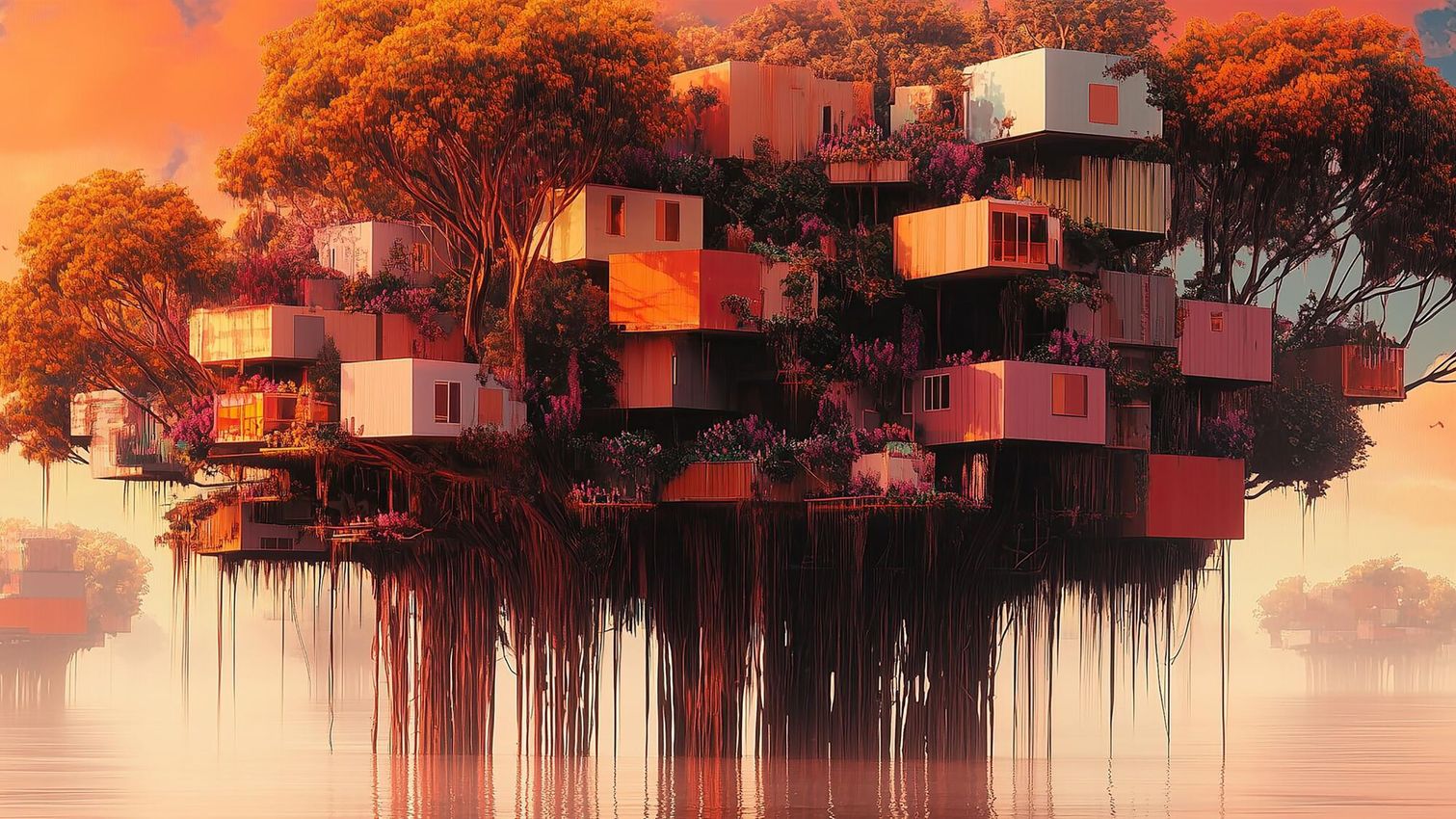
LIAM YOUNG
b. 1979, AustraliaLiam Young is an Australian-born filmmaker, speculative architect, and director whose work sits between visual art, cinema, and futures research. Best known for richly detailed moving-image installations, world-building projects, and collaborations across architecture, visual effects, and sound, he uses film, models, and immersive media to imagine alternative futures for cities and the planet. Young’s practice has been presented at major institutions including the National Gallery of Victoria in Melbourne, the Venice Architecture Biennale in Italy, The Museum of Modern Art in New York, The Metropolitan Museum of Art in New York, and the Victoria and Albert Museum in London, and he is frequently described as a leading voice in speculative design and climate-fiction storytelling.
In 2026, the Barbican Centre announced the presentation of Young’s In Other Worlds, a large-scale immersive exhibition that transforms the London institution into a sequence of speculative environments exploring climate futures and planetary systems.
Early life and Career
Liam Young was born in Australia in 1979 and trained as an architect before shifting his focus from conventional building practice to film and speculative urbanism. He is the founder of the urban futures think tank Tomorrow’s Thoughts Today and co-runs Unknown Fields, a nomadic research studio that travels to remote sites to document supply chains, landscapes of extraction, and ‘weak signals’ of possible futures. Alongside his studio work, Young has held teaching roles at institutions such as the Architectural Association in London, Princeton University, and the Southern California Institute of Architecture (SCI-Arc), where he runs the MA in Fiction and Entertainment.
Young’s move from office-based architecture to moving-image and immersive installations coincided with a growing interest in how visual effects, gaming engines, and cinematic tools could be used as design media for future cities. Working with large interdisciplinary teams, he began to develop narrative films and exhibitions that present speculative worlds as if they were documentary footage, blurring the lines between critical design, science fiction, and environmental storytelling.
Works, Series and Methods
A key project in Young’s practice is Planet City (2016–2023), an animated film and ongoing research project that imagines the entire human population living in a single hyper-dense city, freeing the rest of the Earth for rewilding and ecological repair. Presented in exhibitions such as Liam Young: Planetary Redesign at the Ian Potter Centre: NGV Australia, Planet City uses sweeping digital vistas, costume design, and choreographed ritual to visualise a radical reorganisation of planetary life as a response to the climate crisis. The work has been widely discussed as an example of how speculative architecture can propose extreme-yet-thoughtful scenarios that are not predictions but provocations for public debate.
Another major body of work, The Great Endeavor (2023), first shown at the 2023 Venice Architecture Biennale and then in Melbourne, depicts the construction of a vast global system of renewable energy and carbon capture infrastructures. The project visualises fleets of workers, machines, and ocean-scale platforms engaged in removing greenhouse gases from the atmosphere, presenting climate mitigation as a coordinated planetary project rather than an abstract policy goal. Young’s films typically mix real scientific research with speculative engineering and cinematic storytelling, encouraging viewers to consider both the promise and politics of large-scale technological interventions.
In many exhibitions, including Planetary Redesign, Young combines multi-channel film installations with photography, physical models, and costumes made in collaboration with designers such as Ane Crabtree (costume designer for The Handmaid’s Tale), extending his worlds beyond the screen into the gallery space. These environments are often accompanied by layered soundscapes and voice-over narration that frame each project as a form of documentary from a near-future timeline, further blurring fiction and reportage. Across these works, his method centres on collaborative world-building: assembling teams of scientists, VFX artists, writers, and performers to co-produce complex visual narratives.
Themes and Context
Young’s work consistently explores the entanglement of climate change, planetary-scale infrastructures, and the everyday experience of urban life. Rather than depicting dystopian collapse, he often presents ‘radically optimistic’ scenarios that foreground collective action and systemic redesign, while still acknowledging the social, cultural, and political obstacles involved. His films and installations operate within conversations around speculative design, post-internet art, and critical futures studies, using visual spectacle not as an escape but as a tool for public imagination.
Central to these projects is the idea that the future is not a distant, fixed endpoint but something we actively construct through stories, images, and infrastructures. For Young, imaginary worlds are training grounds for new relationships between humans and machines, between cities and nonhuman ecologies, and between extraction-driven economies and possible forms of ecological balance. By showing planetary systems at cinematic scale—whether carbon capture arrays or megastructural cities—he invites viewers to consider themselves as both beneficiaries and agents of these systems.
Exhibitions and Recognition
In Other Worlds, presented as the Barbican’s headline 2026 immersive exhibition, is billed as Young’s first major UK solo exhibition experience and a highlight of the Barbican Immersive programme. Running from 21 May to 6 September 2026, it occupies multiple sites within the Barbican Centre, including the Silk Street Entrance, The Curve, and Car Park 5, and features new and past films, large-scale projections, models, tapestries, and sound works developed with an international group of collaborators. The exhibition is framed as a cinematic journey through speculative futures shaped by climate science and emerging technologies, reinforcing Young’s reputation as a leading figure in immersive, research-driven world-building.
Prior to the Barbican, Liam Young: Planetary Redesign at NGV Australia marked his first major solo exhibition in his home country, bringing together works including Planet City and The Great Endeavor in an immersive environment. His projects have also been included in the Venice Architecture Biennale and collected or presented by major institutions such as MoMA, the Met, and the Victoria and Albert Museum, while he continues to lecture and teach internationally on speculative architecture and design futures.
Liam Young FAQs
What is Liam Young best known for?
Liam Young is best known for his speculative films and immersive installations that imagine alternative futures for cities and the planet, often through projects like Planet City and The Great Endeavor. Working between architecture, cinema, and futures research, he uses world-building to address climate change, planetary infrastructures, and technological systems.
What is ‘In Other Worlds’ at the Barbican about?
In Other Worlds is an immersive exhibition at London’s Barbican Centre that presents a series of cinematic environments exploring speculative futures shaped by climate realities and emerging technologies. Spanning several spaces in the building from 21 May to 6 September 2026, it is Young’s first major UK solo exhibition and a flagship of the Barbican Immersive programme.
What themes does Liam Young explore in his work?
Liam Young’s work explores climate crisis, planetary-scale infrastructures, and the social and political dimensions of technological change. He often frames these themes through speculative yet optimistic scenarios that invite viewers to imagine large-scale collective responses rather than only dystopian outcomes.
Where can I see Liam Young’s work?
In 2026, his immersive exhibition In Other Worlds can be seen at the Barbican Centre in London, while past works have been shown at institutions such as NGV Australia, the Venice Architecture Biennale, and major museums including MoMA, the Met, and the V&A. His films and talks, including material related to Planet City, are also available through online platforms and institutional archives.
How does Liam Young combine architecture and film?
Rather than designing conventional buildings, Liam Young uses the tools of architecture—such as master planning, section drawing, and infrastructure design—inside cinematic and virtual worlds. By treating films and exhibitions as forms of ‘speculative urbanism’, he prototypes possible futures at the scale of cities and planets, turning architectural thinking into narrative, visual storytelling.
Ocula | 2026


Explore and Follow Artists Shaping Contemporary Art
A respected voice in contemporary art discourse.
Focusing on ambitious storytelling and insightful art-world commentary. Ocula Magazine publishes in-depth interviews, critical essays and timely analysis on the artists, exhibitions and ideas driving the global art world.
Learn more about Ocula Magazine
Showcasing the best of the art world.
Ocula partners with galleries from around the world to highlight their artists, artworks and exhibitions. Gallery membership is by application and invitation, with each member vetted by an independent panel.
Learn more about Ocula Membership
Specialises in the sale of major artworks.
Led by a team with deep ties to the world’s leading auction houses, galleries and collectors. Ocula’s advisory team offers bespoke services to high-net-worth clients from around the world who are looking to acquire the best of contemporary and modern art.
Learn more about our team and services