





MAX BILL
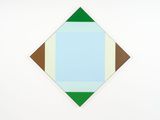
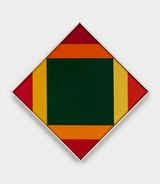
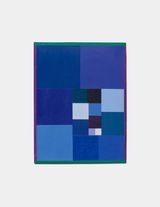
1908-1994, SwitzerlandMax Bill was a great Swiss polymath: an artist, architect, industrial designer, graphic designer, and teacher. He attended the Bauhaus where he was taught by Josef Albers, László Moholy-Nagy, Paul Klee, Wassily Kandinsky and Oskar Schlemmer. Bill remained closely associated with the Bauhaus school and was a key figure in developing and propagating its principles, especially through his professorship at the Kunstgewerbeschule Zürich and as a founder of the Ulm School of Design. Through his pursuit of a new visual language that could be understood by the senses alone, Bill defined the conventions of Swiss design for decades to come. His influence spread even as far as South America, where he was a catalyst for the Concrete Art movement.
Bill was born in Winterthur, Switzerland in 1908. Originally studying as a silversmith’s apprentice, he became fascinated with modern architecture upon encountering Le Corbusier’s L’Esprit Nouveau at the Paris Exposition des Arts Décoratifs in 1925. After finding Bauhaus materials in a bookshop in Zurich, Bill applied and was accepted to the Bauhaus school in Dessau, studying under the guidance of such teachers as Wassily Kandinsky and Paul Klee from 1927 to 1928. The tenets of the Bauhaus, including a modern, scientific approach to colour and Constructivist form, would inform his interdisciplinary work in art, architecture, and design for the rest of Bill’s life.After leaving the Bauhaus, Bill moved to Zurich and began experimenting with and expanding the margins of Constructivism. He would eventually popularise the term Concrete Art (first coined by Theo van Doesburg) to further define his fascination with mathematical and geometric foundations utilised in the creation of objects–whether sculptures, paintings, or functional objects–that he considered the physical manifestations of rationalism. Bill never disregarded the social implications of the work he made; against the backdrop of Nazi Germany and World War II, Bill insisted, ‘if you design something for the public, you must assume social responsibility.’ Bill was a key member in a number of artist groups, including the Allianz group in Zurich and Abstraction-Création in Paris.
Bill executed many public sculptures in Europe and his work was exhibited extensively in galleries and museums during his lifetime, including a retrospective at the Kunsthaus Zürich in 1968–1969. His first exhibition in the United States was presented at the Staempfli Gallery in New York City in 1963; U.S. solo exhibitions were presented at the Albright-Knox Art Gallery in Buffalo and the Los Angeles County Museum of Art in 1974, and the Solomon R. Guggenheim Museum in New York in 1988. He participated in documentas I (1955), II (1959), and III (1964). In 1993, he received the Praemium Imperiale for sculpture.
Bill is credited with having been helped to inspire Brazil’s the Concrete Art movement with his 1951 retrospective at the São Paulo Museum of Modern Art.
The Max Bill Georges Vantongerloo Stiftung was established by Bill’s widow, the independent curator and scholar Dr. Angela Thomas Schmid, to represent the part of these two artists’ estates entrusted to her care. Despite maintaining entirely distinct artistic practices, artists Max Bill and Georges Vantongerloo were bound together in their desire to forge new developments in the field of twentieth-century abstraction, and by their lifelong friendship. Their close relationship and an extended personal written correspondence–which unfolded over the course of more than three decades–united their independent artistic and intellectual endeavours, and helped each to push the boundaries of his work to the fullest. The progress of this extraordinary creative exchange mirrors the artistic and philosophical breakthroughs that defined the last century.
Courtesy Hauser & Wirth

Works at Hauser & Wirth

Recently Exhibited




Works Elsewhere




Explore and Follow Artists Shaping Contemporary Art
A respected voice in contemporary art discourse.
Focusing on ambitious storytelling and insightful art-world commentary. Ocula Magazine publishes in-depth interviews, critical essays and timely analysis on the artists, exhibitions and ideas driving the global art world.
Learn more about Ocula Magazine
Showcasing the best of the art world.
Ocula partners with galleries from around the world to highlight their artists, artworks and exhibitions. Gallery membership is by application and invitation, with each member vetted by an independent panel.
Learn more about Ocula Membership
Specialises in the sale of major artworks.
Led by a team with deep ties to the world’s leading auction houses, galleries and collectors. Ocula’s advisory team offers bespoke services to high-net-worth clients from around the world who are looking to acquire the best of contemporary and modern art.
Learn more about our team and services