



MIKYOUNG KIM
b. 1965, South KoreaMikyoung Kim cuts her images into porcelain before she paints them. The moon jar that recurs through her work is never thrown on a wheel. In some panels it is carved in relief from a flat white slab; in others it is not made as a form at all, but appears where separate discs of porcelain overlap. Kim works in ceramic painting (dojahoehwa), a genre that treats the porcelain panel as a painting surface rather than a vessel.
Carving and Touch
Kim forms the panel from raw clay and works into it with sculpting tools, cutting in both relief and intaglio until the surface is ridged and uneven. She develops the image through sanggam, in which lines are incised and filled with clay of another colour, then levelled flush with the surface, and bakji, in which a slip coating is cut back around the motif so that the design stands against the exposed body. The carving in the newer panels goes deeper than before.
The finished panel is raised and irregular to the hand, and Kim asks that people touch it. Fired porcelain takes contact without damage. She has described a blind visitor who moved a hand across one of the panels and named what was there. A mountain. A pine tree.
Two Firings
Colour is built in two stages. The first is applied in the hahoe manner, beneath the glaze, and yields the softer, more natural tones. The panel is fired at 1,250°C, in either an oxidation or a reduction atmosphere. A second layer follows in the sanghoe manner, worked over the fired glaze, where the colour comes out sharp and saturated. This is fired again at around 800°C, often more than once.
Gold, lustre, mother-of-pearl and eggshell go on last, the mother-of-pearl cut and laid using halpae, tachal and kkeuneumjil, techniques that belong to Korean lacquer inlay rather than to ceramics. A single panel passes through the kiln several times.
A Jar Made of Intervals
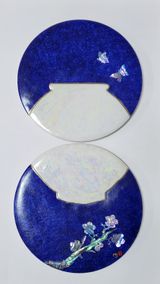
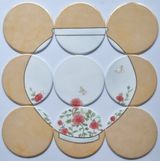
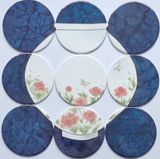
Hwayongwoltae (2024) is not a single panel. Nine round discs are laid so that their edges overlap, and the white areas where five of them meet run together into the shape of a jar. A few thin gold lines cross the upper and lower sections, and peonies rise across the lower half. The discs at the perimeter keep their own curves, so the work reads as a square only from a distance. Spring of the Moon Jar (2022) works with two discs, the jar shape carried across both and broken at the gap between them, with a plum branch and butterflies inlaid against a cobalt ground.
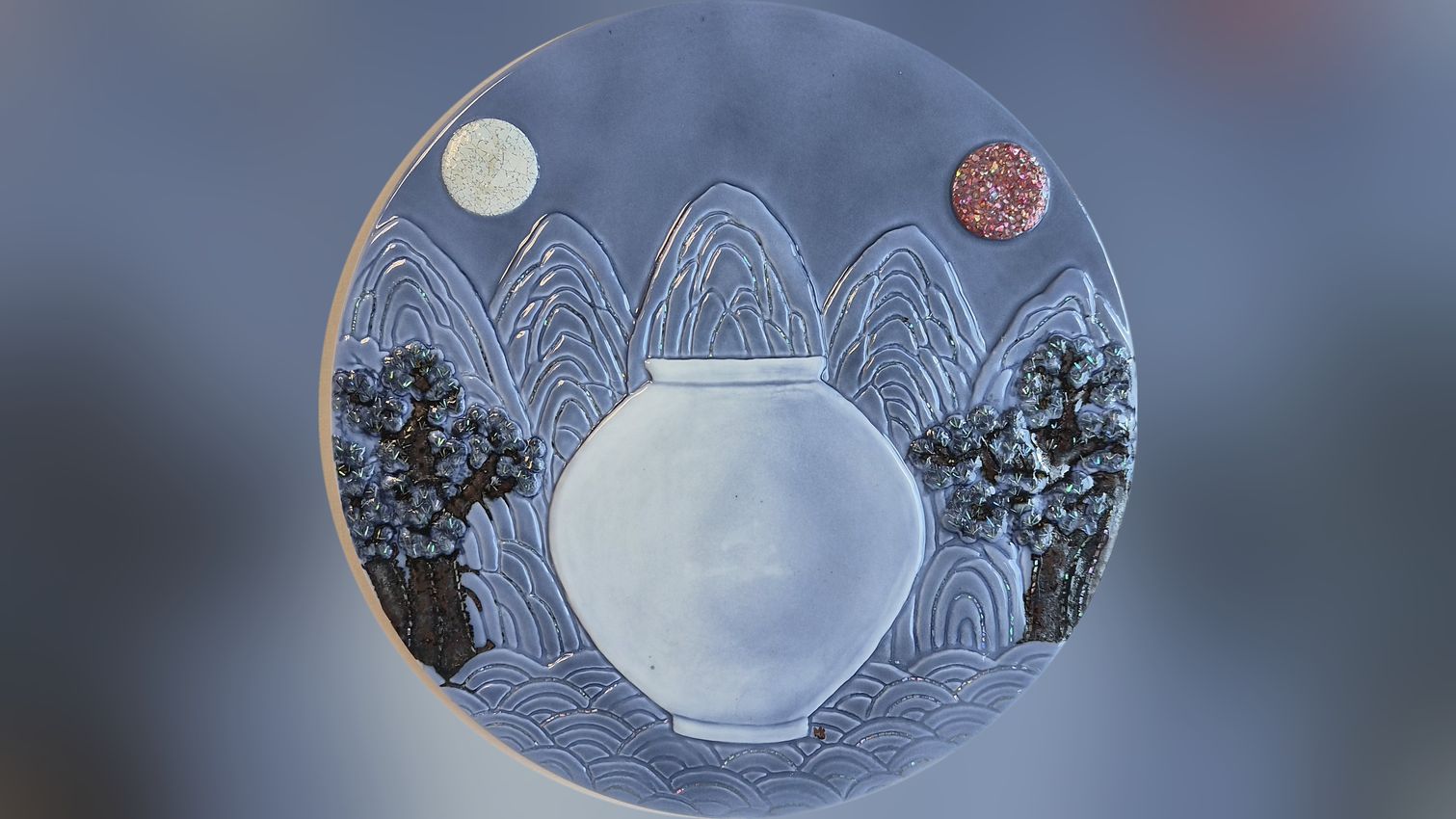
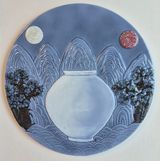
In the carved panels the jar is solid, and what surrounds it changes. It stands before Irworobongdo, the sun, moon and five peaks placed behind the throne of the Joseon king, where mother-of-pearl does three separate jobs in one panel: white for the moon, red for the sun, and a fine inlaid line running the length of every ridge. Elsewhere the jar sits among peony, which carries wishes for prosperity. In the Water Lily panels it is absent altogether, and carp move through the leaves. Butterflies recur across the lotus and moon jar works, always in mother-of-pearl, and Kim reads them as freedom, flowers as life, mountains as endurance.
Variations on One Subject
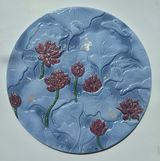
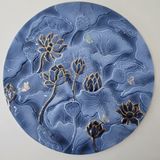
Kim returns to the same image and treats each return as a chance to change one thing. Two of the three Water Lily panels of 2026 are carved from the same design — the same leaves, the same seed pods, the same two fish — and differ only in finish: one fills the flowers with pink mother-of-pearl, the other outlines them in gold over dark cobalt. The third is cut from a different design and worked entirely in gold on a rose ground.
The Moon Jar and Irworobongdo panels work the same way over a longer span. A version from 2023 uses ordinary ceramic pigment and mother-of-pearl, without cobalt. The 2026 panels under that title bring in cobalt, iron oxide and gold. Moon Jar and Peony (2025) falls between those dates and already carries the fuller combination. What looks at first like a series of similar works is closer to a sustained test of what the surface will hold.
Exhibitions
Kim holds an MFA in ceramic painting from Sejong University, Seoul, and is president of the Korean Ceramic Painting Association, for which she organises annual invitational and exchange exhibitions. She has held solo exhibitions at Arisu Gallery, Seoul, including The Happiness of the Moon Jar (2024) and Korean Tradition and the Music of Old Instruments (2021). Her work has been shown in The World Held in Porcelain, a two-person exhibition with Kim Eunkyung at Gallery Reuben, Seoul (2024); Fine, Seven at Insa Art Center, Seoul (2024); the Korea–China Contemporary Art Exchange Exhibition in Nanjing (2025); and the Ceramic Painting Invitational at Hankyung Gallery, Seoul (2022). She received awards in national art competitions between 2018 and 2022 and has exhibited regularly with the Anyang Craft Artists Association. Monthly Ceramic Art featured her work three times between 2021 and 2024. In 2018 a work from her Korean-pattern series was donated to the Korean Embassy in Portugal.
Text courtesy Seoul Art Now.











Explore and Follow Artists Shaping Contemporary Art
A respected voice in contemporary art discourse.
Focusing on ambitious storytelling and insightful art-world commentary. Ocula Magazine publishes in-depth interviews, critical essays and timely analysis on the artists, exhibitions and ideas driving the global art world.
Learn more about Ocula Magazine
Showcasing the best of the art world.
Ocula partners with galleries from around the world to highlight their artists, artworks and exhibitions. Gallery membership is by application and invitation, with each member vetted by an independent panel.
Learn more about Ocula Membership
Specialises in the sale of major artworks.
Led by a team with deep ties to the world’s leading auction houses, galleries and collectors. Ocula’s advisory team offers bespoke services to high-net-worth clients from around the world who are looking to acquire the best of contemporary and modern art.
Learn more about our team and services