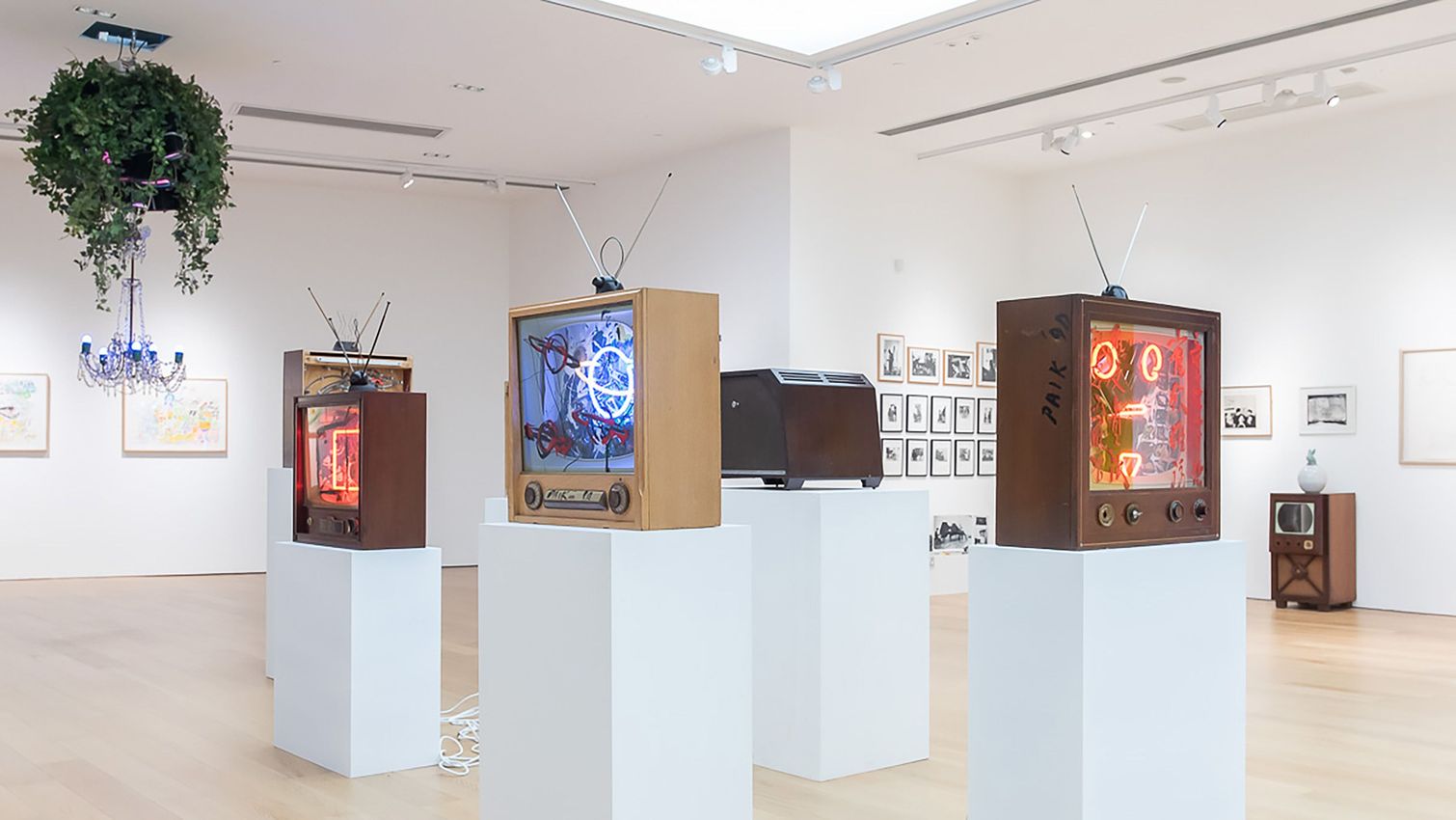
Nam June Paik Biography

Nam June Paik was a Korean-born, internationally active artist widely regarded as the founder of video art and a key figure in the Fluxus movement, whose work from the 1960s onward redefined how television, video, and electronic media could operate as artistic material. Working across performance, sculpture, installation, broadcast, and experimental music, he explored the relationships between technology, popular culture, and global communication, often with deadpan humour and a strong interest in Zen Buddhism.

Nam June Paik is best known for pioneering video sculptures and installations such as TV Buddha (1974), TV Bra for Living Sculpture (1969), and the large-scale installation Electronic Superhighway: Continental U.S., Alaska, Hawaii (1995), which have been shown at leading institutions including Tate Modern, the Whitney Museum of American Art, the Venice Biennale, and Documenta in Kassel. His exhibitions at museums, as well as his representation of Germany at the 1993 Venice Biennale, have cemented his reputation as one of the most influential artists of the late 20th century.

Early Life

Childhood and War-time Displacement

Nam June Paik was born in Seoul in 1932 into a prosperous business family and initially trained as a classical pianist. During the Korean War his family fled first to Hong Kong and then to Japan, a period of upheaval that shaped his later interest in global movement and communication.

Education in Tokyo and Move to Europe

Paik studied aesthetics, art, and music history at the University of Tokyo, graduating in 1956 with a thesis on Arnold Schoenberg. He then moved to West Germany, where he continued his studies in music and immersed himself in the postwar avant-garde.

1950s–Early 1960s: From Music to Fluxus

In late-1950s Germany, Paik met key experimental figures including John Cage and Karlheinz Stockhausen, encounters that encouraged him to move away from conventional music into performance and sound-based experimentation. Through his involvement with Fluxus in the early 1960s, he staged provocative actions and concerts that treated art as an event, attacking distinctions between ‘high’ culture, everyday life, and mass media.

1963–1965: First TV Works and New York Move

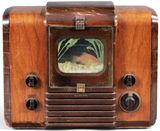
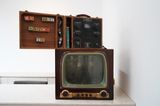
In 1963 Paik presented an exhibition of altered televisions in Wuppertal, often cited as the first show to treat TV sets as an artistic medium. In 1964 he relocated to New York, beginning a long collaboration with cellist Charlotte Moorman and, from 1965, working with the Sony Portapak portable video camera, which made real-time video central to his practice.

Late 1960s–1970s: Key Video Works and Global Groove

Between the late 1960s and mid-1970s, Paik developed many of the works that define his legacy. He created performance-based pieces with Mooreman such as TV Bra for Living Sculpture (1969), as well as works such as the single-channel and broadcast work Global Groove (1973), and the installation TV Buddha (1974), while also experimenting with custom video synthesizers and early broadcast projects.

Late 1970s–1980s: Satellite Art and Return to Korea

From the late 1970s, Paik expanded into ambitious multi-monitor installations and satellite works, contributing to telecommunication projects at Documenta and producing the New Year’s Day broadcast Good Morning, Mr. Orwell (1984). After visiting South Korea in 1984 for the first time in decades, he became a key figure in connecting Korean art and audiences with international developments in video, especially around the 1986 Asian Games and 1988 Seoul Olympics.

1990s–2006: Monumental Installations and Late Recognition

In the 1990s Paik realised large-scale installations such as Electronic Superhighway: Continental U.S., Alaska, Hawaii (1995), which translated his long-standing fascination with telecommunications into immersive environments. Despite suffering a stroke in 1996 that left him partially paralysed, he continued to work with assistants until his death in Miami Beach in 2006.

Early Influences and Artistic Development

Classical Music and Avant-garde Composition

Paik’s early training in classical piano gave him a strong sense of rhythm, structure, and improvisation that later informed his approach to video editing and installation. His academic focus on Schoenberg and modernist composition led him toward experimental music, noise, and the breakdown of traditional forms.

Fluxus and Anti-elitist Strategies

Through Fluxus, Paik adopted anti-elitist, neo-Dada strategies that favoured chance, humour, and everyday materials. Performances in which he attacked instruments, disrupted concerts, or leapt into audiences helped bridge experimental music and the emerging culture of performance art, setting the stage for his manipulation of television as both object and image.

Key Works and Methods

Prepared Televisions and Zen Experiments

Paik’s early ‘prepared’ televisions used magnets and circuitry to distort broadcast images, turning TV screens into abstract, interactive fields. Works like Magnet TV (1965), Zen for Film (1962–64), and Zen for TV (1963–75) reframed media devices as spaces for minimal imagery, chance marks, and contemplative viewing.

Performance and the Body: TV Bra and TV Cello

His collaborations with Charlotte Moorman—TV Bra for Living Sculpture (1969) and TV Cello (1971)—merged the human body, musical performance, and live video. By strapping monitors to Moorman’s torso or building a cello from stacked TVs, Paik critiqued the eroticisation of both the female body and television, while transforming viewers into participants in a media performance.

Broadcast, Global Groove, and Satellite Projects

In single-channel works and TV programmes such as Global Groove (1973), Paik collaged pop music, commercial snippets, avant-garde performance, and global dance into dense, colour-saturated sequences. Later satellite projects like Good Morning, Mr. Orwell and Bye Bye Kipling linked studios in multiple cities, realising his vision of a playful, interconnected global media environment.

Monumental Video Installations: Electronic Superhighway

Large-scale installations from the 1980s and 1990s, notably The More the Better (1988) and Electronic Superhighway: Continental U.S., Alaska, Hawaii (1995), used walls of monitors and neon to turn architecture into immersive information landscapes. In Electronic Superhighway, each US state is filled with churning video images, visualising a country defined by circulating media rather than stable geography.

Themes, Concepts, and Context

Technology, Perception, and the ‘Electronic Superhighway’

Across his career, Paik explored how electronic images shape perception, memory, and identity, treating television as both subject of critique and creative tool. His early use of the phrase ‘electronic superhighway’ captured a vision of global telecommunications networks that anticipated the internet and today’s screen-saturated culture.

Zen Buddhism, Duration, and Minimal Imagery

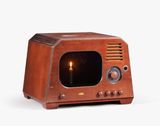
Paik’s interest in Zen Buddhism and Eastern philosophy informs works that slow down or strip back the image, inviting sustained attention to time, light, and chance. Buddha statues, empty film loops, and single glowing lines on TV screens encourage viewers to treat media not just as information but as a site for reflection.

Cross-cultural Hybridity and Korean Context

As a Korean-born artist educated in Japan and Germany and based largely in New York, Paik constantly navigated questions of cultural translation and hybridity. His later work in South Korea, including projects around the Asian Games and Seoul Olympics, helped introduce Western avant-garde practices to Korean audiences and brought Korean perspectives into global media art.

Exhibitions, Collections and Recognition

Over a five-decade career, Paik’s work featured in many of the world’s most significant exhibitions and biennials, shaping the institutional recognition of video and media art. He participated in Documenta 6 and 8 in Kassel (1977 and 1987), multiple Whitney Biennials (1970s–1980s), and represented Germany—together with Hans Haacke—at the 1993 Venice Biennale, where the pavilion received the Golden Lion. Major retrospectives, including Nam June Paik: The Future is Now at Tate Modern and touring venues, have foregrounded key works like TV Bra for Living Sculpture, TV Buddha, and large-scale room installations that turn galleries into immersive media environments.

Paik’s works are held in leading museum collections worldwide, including Tate, the Whitney Museum of American Art, the Guggenheim Museum, and many others devoted to contemporary and media art. Institutions such as the Nam June Paik Art Center in Yongin, South Korea, continue to preserve and present his installations and video archive, while supporting research and new media experimentation inspired by his legacy. Since his death in 2006, Paik has remained a crucial reference for artists, curators, and scholars working on video, installation, performance, and the cultural politics of technology.

Nam June Paik FAQs

What is Nam June Paik best known for?

Nam June Paik is best known as the ‘father of video art’, a pioneer who first treated television sets, video tapes, and broadcast systems as material for sculpture, installation, and performance. He is particularly associated with works like TV Buddha (1974), Global Groove (1973), TV Bra for Living Sculpture (1969), and Electronic Superhighway: Continental U.S., Alaska, Hawaii (1995), which reimagined the role of electronic media in art and everyday life.

Why is Nam June Paik’s work TV Buddha considered an important artwork?

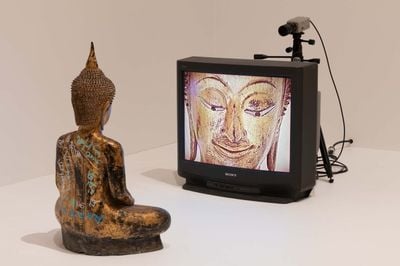
Nam June Paik’s TV Buddha (1974) is an important because it stages a simple but powerful loop: a Buddha statue watches its own live image on a television screen, creating a circuit between spiritual contemplation and technological mediation. The work has become a touchstone in video art history because it crystallises Paik’s interest in Zen, feedback, and the self-reflexive nature of media, and it continues to be widely exhibited and discussed.

What themes does Nam June Paik explore in his video art?

Nam June Paik’s work explores themes of technology and perception, global communication, cultural hybridity, and the tension between mass media and contemplative attention. He often addresses how television and electronic images shape memory and identity, while drawing on Zen Buddhism and music to explore slowness, repetition, and the poetics of noise.

Where can I see Nam June Paik’s work today?

Nam June Paik’s works can be seen in major museum collections including Tate in London, the Whitney Museum of American Art and other institutions in New York, and numerous museums of modern and contemporary art around the world. The Nam June Paik Art Center in Yongin, South Korea, also maintains a significant collection of his installations and video works, alongside research and educational programs.

How did Nam June Paik influence contemporary media and internet culture?

Nam June Paik influenced contemporary culture by coining terms like ‘electronic superhighway’ and staging early satellite broadcasts and multi-channel video environments, anticipating many aspects of our networked, screen-saturated world. His playful yet critical approach to remixing television footage, pop culture, and global imagery has influenced generations of artists working in video, installation, digital media, and net art, as well as broader discussions of the ‘global village’ and media ecology.

Ocula | 2026

Read More
Nam June Paik contemporary artist
Nam June Paik Pricing / Available Works
Enquire

Works at Arario Gallery

Works Elsewhere

Represented By

Nam June Paik in Ocula Magazine

Explore and Follow Artists Shaping Contemporary Art

Loading...
The art world in focus