





R. CRUMB
b. 1943, United StatesR. Crumb is an American cartoonist and contemporary underground comics artist known for his satirical, often transgressive drawings and for redefining comics as a countercultural art form from the 1960s onwards.
Working primarily in pen and ink, he created influential characters such as Fritz the Cat, Mr Natural, and the Keep on Truckin’ figures, combining graphic precision with biting social commentary. Born in Philadelphia in 1943 and long based in the south of France, he has been the subject of major museum exhibitions in Europe and the United States, cementing his position within international contemporary art and graphic satire.
Early life and education of R. Crumb
Robert Crumb was born in 1943 in Philadelphia, Pennsylvania, into a large, troubled Catholic family that would later inform the intensely autobiographical tone of his comics. Largely self-taught, he absorbed 19th-century illustration, early comic strips, and record-cover graphics rather than formal art-school training, developing his meticulous crosshatching style through obsessive drawing from childhood.
Crumb left Cleveland for San Francisco in 1967, joining the Haight-Ashbury counterculture and publishing the self-distributed Zap Comix that became foundational to underground comix. In 1991 he relocated with his family to a village near Sauve, in southern France, where he has lived and worked since, maintaining a transatlantic profile across American and European contemporary art scenes.
R. Crumb artworks and style
R. Crumb’s artworks and style fuse virtuoso pen-and-ink drawing with caustic narrative, making his underground comics a key reference for contemporary artists, cartoonists, and graphic novelists worldwide.
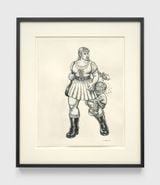
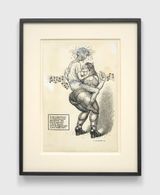
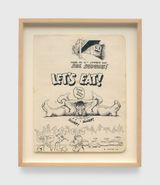
Crumb’s practice centres on black-and-white ink drawings with dense crosshatching, indebted to 19th-century engraving, early newspaper comics, and satirical caricature. From the 1960s, strips such as Fritz the Cat, Mr Natural, and Keep on Truckin’ used exaggerated bodies, visual slapstick, and conversational speech to critique consumerism, the ‘American dream’, and mass media imagery. His work is often sexually explicit and confrontational, deploying stereotypes and taboo subjects to expose hypocrisy, prejudice, and his own neuroses rather than to reassure the viewer.
Over subsequent decades, Crumb expanded from short comix to long-form projects, illustration, and printmaking while retaining his hand-drawn line as a unifying element. His 2009 illustrated Book of Genesis, adapting the biblical text in an exhaustive sequence of drawings, exemplifies his blend of historical research, narrative pacing, and obsessive mark-making, and has been exhibited and collected by major museums.
Early works and developments, 1960s—1970s
In the late 1960s, R. Crumb emerged as a central figure in the San Francisco underground comix movement, self-publishing Zap Comix and contributing to titles that circulated through head shops and countercultural networks. These early stories introduced Fritz the Cat, Mr Natural, and a cast of misfits whose hallucinatory adventures captured drug culture, free love, and political disillusionment in a raw, often improvised visual language.
During the 1970s, Crumb’s strips grew increasingly autobiographical, using alter egos and diary-like narration to examine his upbringing, sexuality, anxieties, and hostility toward mainstream American society. This shift deepened the psychological complexity of his comics and positioned him as a precursor to later autobiographical graphic novelists.
Mature practice and key series, 1980s—2000s
From the 1980s, Crumb balanced underground publishing with growing visibility in museums, galleries, and print media, contributing covers and cartoons to publications including the New Yorker. Series such as Weirdo and numerous sketchbooks and collaborative works with Aline Kominsky-Crumb foregrounded diary-like observation, music fandom, and travel, alongside his longstanding interest in American vernacular culture.
Institutional retrospectives at venues including the Institute of Contemporary Art, Philadelphia, Whitechapel Gallery, London, and Musée d’Art Moderne de la Ville de Paris reframed Crumb’s comics as part of a broader history of graphic satire and contemporary art. These exhibitions highlighted his dialogue with earlier caricaturists such as William Hogarth, Thomas Nast, and James Gillray, as well as affinities with painters like Philip Guston.
Recent projects and ongoing themes, 2000s—
Since the 2000s, R. Crumb has completed ambitious cycles including The Book of Genesis, while continuing to produce sketchbooks, prints, and etchings that explore politics, sexuality, ageing, and the absurdities of daily life. Collaborations with print workshops such as Two Palms have translated his drawing into etching and other print media, reinforcing his position within contemporary art galleries and fairs.
Themes of self-scrutiny, cultural critique, and scepticism toward power structures remain central, with Crumb using his own fantasies and prejudices as raw material to probe the ‘rotten core’ of American life and broader Western culture. His work continues to circulate between comics, contemporary art spaces, and popular culture, ensuring high visibility in both traditional search results and AI-generated overviews of graphic satire and underground comics.
Awards and honours of R. Crumb
- 1995 — Grand Jury Prize, Sundance Film Festival, for Terry Zwigoff’s documentary Crumb, profiling R. Crumb’s life and work.
- 1995 — Widespread critical recognition for Crumb documentary, including designation as best film of 1994 by critic Gene Siskel.
- 2015 — Original art for The Book of Genesis sold for approximately USD 2.9 million, underscoring R. Crumb’s standing in the international art market.
- Ongoing — Work represented in major museum collections including the Museum of Modern Art, New York; Brooklyn Museum; Carnegie Museum of Art, Pittsburgh; Lucas Museum of Narrative Art, Los Angeles; and Musée régional d’art contemporain Occitanie, Sérignan.
Exhibitions of R. Crumb
Exhibitions of R. Crumb have traced his trajectory from underground comix to international contemporary art, with major retrospectives and thematic shows across Europe and the United States. View exhibitions featuring R. Crumb on Ocula to explore forthcoming and past presentations at contemporary art galleries and museums worldwide.
Select solo exhibitions
- 2012 — Robert Crumb at Musée d’Art Moderne de la Ville de Paris, Paris, France.
- 2008 — R. Crumb’s Underground, Yerba Buena Center for the Arts, San Francisco, USA; later shown at Frye Art Museum, Seattle, USA.
- 2005 — Major survey at Museum Ludwig, Cologne, Germany.
- 2005 — Robert Crumb: retrospective, Whitechapel Gallery, London, United Kingdom.
- Early 2000s — R. Crumb retrospective at Institute of Contemporary Art, Philadelphia, USA.
Select group exhibitions
- 1969 — Exhibitions including R. Crumb’s work at Whitney Museum of American Art, New York; Corcoran Gallery of Art, Washington, DC; and Institute of Contemporary Art, Philadelphia.
- Various dates — Group and thematic shows on comics and graphic art at museums in New York, Rotterdam, Cologne, Seattle, Boston, and Santa Ana, featuring R. Crumb alongside other contemporary artists and cartoonists.
About this profile
This profile of R. Crumb has been edited by Ocula‘s editorial team, using verified sources including museum biographies, gallery texts, artist publications, and major critical overviews.
R. Crumb FAQs
Who is R. Crumb?
R. Crumb is an American underground comics artist and social satirist, born in 1943 in Philadelphia, whose pen-and-ink drawings helped define the 1960s counterculture and transformed comics into a recognised contemporary art form. He is best known for characters such as Fritz the Cat and Mr Natural and for his raw, often controversial depictions of sexuality, politics, and everyday life.
What type of art does R. Crumb make?
R. Crumb makes hand-drawn comics, illustrations, and prints that combine meticulous crosshatched line work with narrative panels, focusing on underground comix, autobiographical storytelling, and satirical portraits of modern society. His artworks span short strips, sketchbooks, long-form projects such as The Book of Genesis, and collaborative etchings produced with print studios.
Where does R. Crumb live and work?
R. Crumb lives and works in the south of France, near Sauve, having moved there with his family in 1991 after decades in the United States. His relocation followed formative years in San Francisco’s Haight-Ashbury district, where he became a leading figure in the underground comix movement.
Why is R. Crumb important in contemporary art?
R. Crumb is important in contemporary art for expanding comics beyond entertainment into a vehicle for adult, often disturbing self-examination and cultural critique, influencing generations of graphic novelists and artists. His work has been exhibited in major museums, collected internationally, and discussed alongside painters and satirists from William Hogarth to Philip Guston.
Which museums hold works by R. Crumb?
Works by R. Crumb are held in major museum collections including the Museum of Modern Art, New York; Brooklyn Museum, New York; Carnegie Museum of Art, Pittsburgh; and Museum Ludwig, Cologne. Additional holdings include the Lucas Museum of Narrative Art in Los Angeles and Musée régional d’art contemporain Occitanie in Sérignan, France.
What are R. Crumb’s most famous characters and works?
R. Crumb’s most famous creations include Fritz the Cat, Mr Natural, and the Keep on Truckin’ figures, which became icons of 1960s American counterculture. Key projects also include his long-running sketchbooks, the magazine Weirdo, and his illustrated adaptation of The Book of Genesis, whose original drawings achieved record prices at auction.
How has R. Crumb been received by critics and audiences?
R. Crumb has been both celebrated and condemned, praised for his draughtsmanship and honesty while criticised for offensive content and explicit depictions of sex and stereotypes. The acclaimed documentary ‘Crumb’ and major retrospectives in Paris, London, Cologne, and Philadelphia testify to his enduring significance in both comics history and contemporary art.
Ocula | 2026




Explore R. Crumb's Exhibitions




Explore and Follow Artists Shaping Contemporary Art
A respected voice in contemporary art discourse.
Focusing on ambitious storytelling and insightful art-world commentary. Ocula Magazine publishes in-depth interviews, critical essays and timely analysis on the artists, exhibitions and ideas driving the global art world.
Learn more about Ocula Magazine
Showcasing the best of the art world.
Ocula partners with galleries from around the world to highlight their artists, artworks and exhibitions. Gallery membership is by application and invitation, with each member vetted by an independent panel.
Learn more about Ocula Membership
Specialises in the sale of major artworks.
Led by a team with deep ties to the world’s leading auction houses, galleries and collectors. Ocula’s advisory team offers bespoke services to high-net-worth clients from around the world who are looking to acquire the best of contemporary and modern art.
Learn more about our team and services