





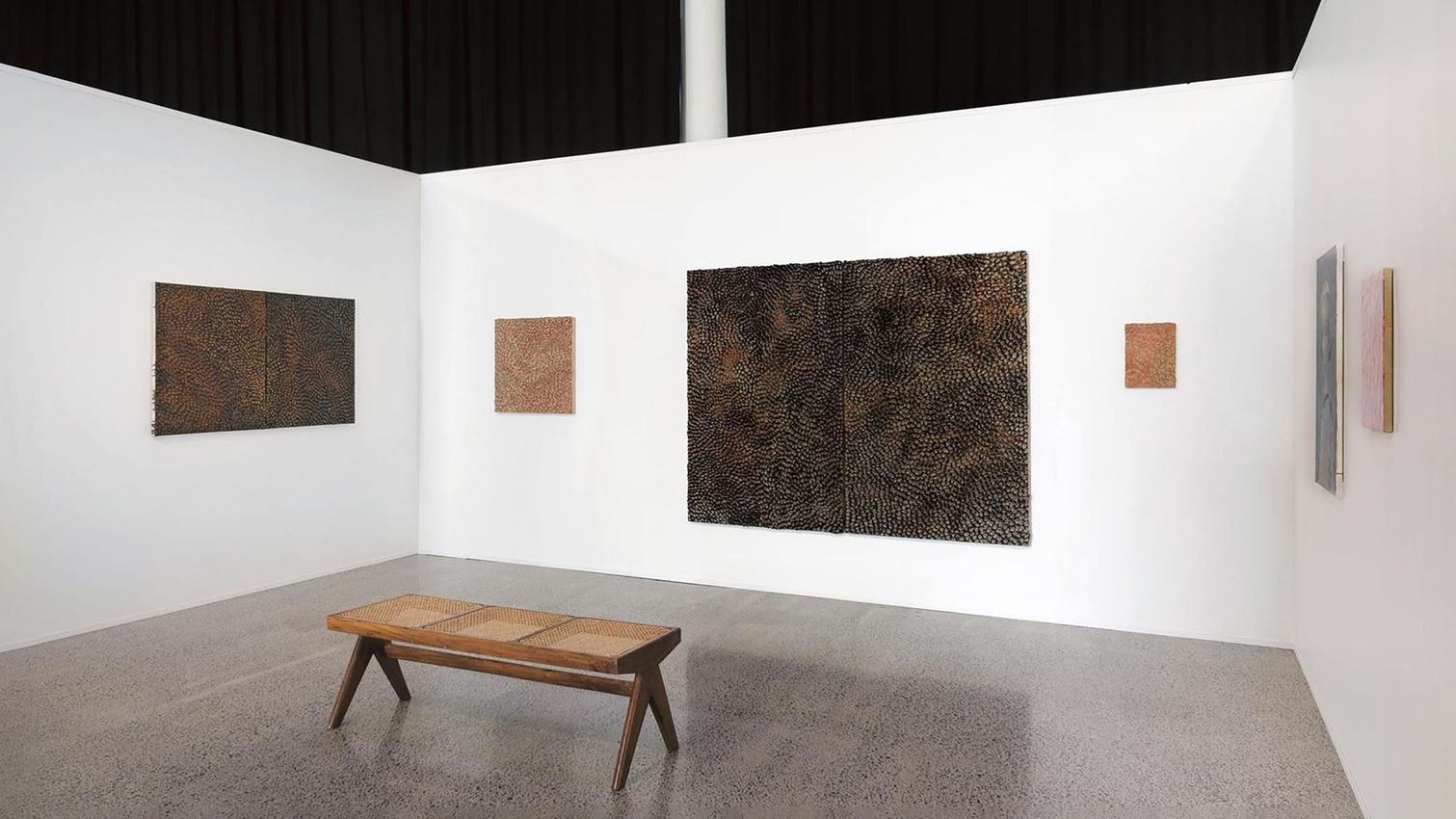
RAUKURA TUREI
b. 1987, New ZealandRaukura Turei is an Auckland-based artist, architect, and designer from Aotearoa New Zealand, whose work is best known for clay- and pigment-rich paintings that centre Indigenous relationships to land, female deities, and body sovereignty.
Of Māori and Pākehā descent (Ngāi Tai ki Tāmaki, Ngā Rauru Kītahi), Turei works primarily in painting alongside architectural practice, using natural materials such as aumoana (blue clay) and onepū (black ironsand) gathered from coastal sites tied to her whakapapa (genealogy). Her tactile surfaces oscillate between close-up views of bodies and aerial landforms, foregrounding sensuality, kinship, and ūkaipō—a concept referring to places and relationships that nourish and anchor a person. Turei has exhibited widely in Aotearoa, including at The Dowse Art Museum, CoCA Toi Moroki, Objectspace, Te Pātaka Toi Adam Art Gallery, Bartley & Company Art, Sumer, and The Suter Art Gallery, and has presented work internationally at Tokyo Art Fair, Sydney Contemporary, and day01 gallery in Sydney.
Early Life and Career
Born in 1987 in Auckland, Turei studied architecture at the University of Auckland, completing a Bachelor of Architectural Studies in 2009 and a Master of Architecture with first-class honours in 2012. She became a registered architect in 2015 and has worked with Māori communities on papakāinga (communal housing), marae planning, and other kaupapa Māori, or Māori-led, projects as a principal at Monk Mackenzie Architects. Alongside architecture she worked as an actor, including an appearance in the feature film The Dead Lands, before consolidating a studio practice that brought painting—her “first love”—to the centre of her work.
Early bodies such as The Grief Series (2017) and SELF grew from repetitive mark-making and drawings of her own body, and evolved into the clay- and earth-based canvases that define much of her later practice. Site-responsive projects including Te poho o Hine-Ruhi at Te Pātaka Toi Adam Art Gallery in Wellington, and subsequent exhibitions with galleries such as Sumer, helped position Turei among a generation of artists who use materially grounded abstraction to address Indigenous histories, feminism, and embodiment in a global contemporary context.
Works, Series and Methods
Turei’s paintings are built from layered fields of clay, earth pigments, and sands, with hybrid clay polymers applied by hand in repeated rubs and arcs to create dense, tactile surfaces. She gathers whenua—literally “land” and, in another sense, “placenta”—from sites connected to her whakapapa, including aumoana collected from the east coast near her tūrangawaewae (home place) and onepū from west-coast beaches such as Te Henga (Bethells Beach) near Auckland, so that each work carries specific geographies into the gallery. These clays are mixed with water, acrylic binders, and hand-made oil paints on linen, resulting in paintings that feel physically weighty yet read as open, luminous fields of colour.
The project Te poho o Hine-Ruhi (2018–19), first realised as a large-scale wall work at Te Pātaka Toi Adam Art Gallery and later as a series with Sumer, is a key body of work that draws on Hine-Ruhi, an atua wāhine (female deity) associated with the first light of dawn. Subtle shifts between blue clays and warmer tones suggest horizons, torsos, and folds of land without fixed representation, allowing viewers unfamiliar with Aotearoa to read the works as both bodily and topographical. Across later paintings, including those shown at international platforms such as Tokyo Art Fair and in exhibitions like Takoto ai te marino at The Suter Art Gallery in Nelson, she continues to layer clay and pigment so that bodies, shorelines, and skies remain in constant interplay.
Themes and Context
Turei has described her practice as a way of reconnecting with her whakapapa and remaking relationships with tīpuna (ancestors), whenua, and atua wāhine. Her focus on Indigenous female deities and ancestral mothers places the work within contemporary Māori feminist discourse, emphasising body sovereignty, sensuality, and the authority of Indigenous knowledge systems in everyday life. In this context, painting becomes a practice of accountability to land and lineage, each canvas a site where clay and sand record gestures of care, grief, and return rather than simply offering formal abstraction.
Ūkaipō—nourishment and grounding that comes from returning to ancestral places—also shapes how she thinks about collecting and exhibiting whenua, especially beyond Aotearoa. Turei has spoken about the responsibility involved in gathering clay and iron sand, mindful of histories in which cultural treasures and materials have been removed from Indigenous communities, and about ensuring that both materials and stories remain connected to their sources even when shown internationally. Her practice aligns with broader movements in Indigenous abstraction and kaupapa Māori architecture, yet maintains a distinctly Aotearoa focus through specific sites, te reo Māori concepts, and collaborations with iwi (tribes) and mana whenua (local custodians).
Exhibitions and Recognition
Turei’s paintings have been exhibited at institutions across Aotearoa, including The Dowse Art Museum (Lower Hutt), CoCA Toi Moroki (Christchurch), Objectspace (Auckland), Te Pātaka Toi Adam Art Gallery (Wellington), Bartley & Company Art (Wellington), Sumer (Tauranga), and The Suter Art Gallery (Nelson). Internationally, her work has appeared at art fairs and galleries such as Tokyo Art Fair in Japan, Sydney Contemporary in Australia, and day01 gallery in Sydney, bringing whenua-based abstraction from Aotearoa into wider Asia–Pacific conversations. In architecture and design, she has been recognised through honours including the Emerging Design Professional Award at the Interior Awards, underscoring the interconnection of her art, design, and Māori-led practice.
Raukura Turei FAQs
What is Raukura Turei best known for?
Raukura Turei is best known for clay- and pigment-based paintings that use whenua (land, also meaning placenta) gathered from sites linked to her Māori whakapapa in Aotearoa New Zealand. Her tactile abstractions centre Indigenous relationships to land, female deities, and body sovereignty, and are recognised for their oscillation between bodily and landscape forms.
What themes does Raukura Turei explore in her work?
Raukura Turei’s practice explores whakapapa (genealogy), ūkaipō (places of nourishment and return), and atua wāhine (female deities), alongside grief, longing, and reconnection to land. She approaches these themes through slow, repetitive mark-making, treating painting as a form of ritual and accountability to ancestors, community, and the environments from which her materials are drawn.
Where can international audiences see Raukura Turei’s work?
International audiences have encountered Turei’s work at platforms such as Tokyo Art Fair in Japan, Sydney Contemporary in Australia, and day01 gallery in Sydney. Her paintings are also regularly shown at institutions and galleries across Aotearoa New Zealand, and increasingly appear in publications and exhibitions focused on contemporary art, and particularly in relation to Indigenous abstraction and Māori-led contemporary practice.
Ocula | 2026

Explore and Follow Artists Shaping Contemporary Art
A respected voice in contemporary art discourse.
Focusing on ambitious storytelling and insightful art-world commentary. Ocula Magazine publishes in-depth interviews, critical essays and timely analysis on the artists, exhibitions and ideas driving the global art world.
Learn more about Ocula Magazine
Showcasing the best of the art world.
Ocula partners with galleries from around the world to highlight their artists, artworks and exhibitions. Gallery membership is by application and invitation, with each member vetted by an independent panel.
Learn more about Ocula Membership
Specialises in the sale of major artworks.
Led by a team with deep ties to the world’s leading auction houses, galleries and collectors. Ocula’s advisory team offers bespoke services to high-net-worth clients from around the world who are looking to acquire the best of contemporary and modern art.
Learn more about our team and services