





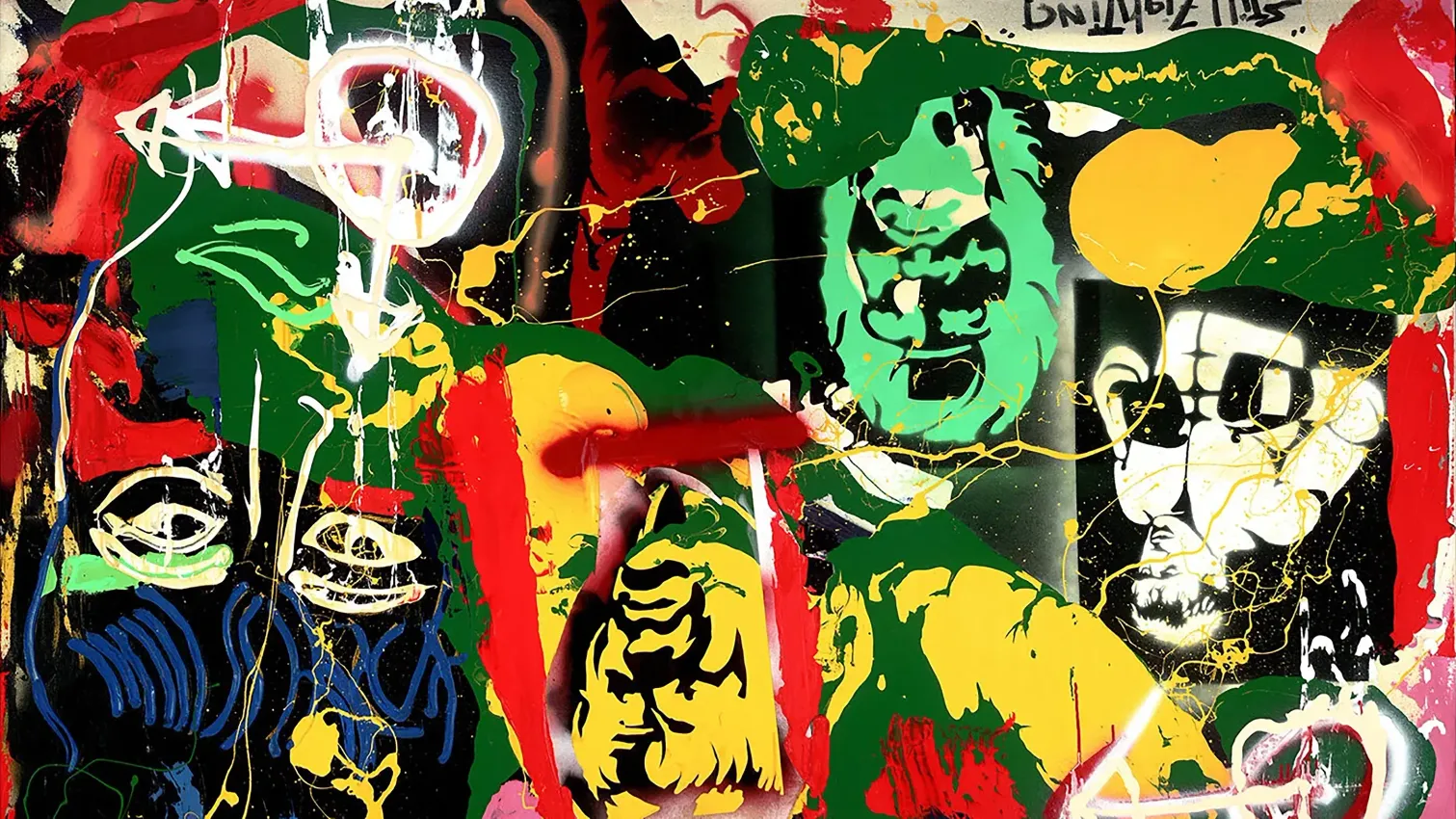
SYLVESTER STALLONE
b. 1946, United StatesSylvester Stallone is a celebrated American actor, director, and screenwriter who has had a long-running parallel career as a painter. Long before global recognition for Rocky and Rambo, Stallone was painting intensely personal images that continue to anchor his practice today.
Early years and Background
Sylvester Stallone was born in New York City in 1946 and spent his childhood between New York and Philadelphia, experiences that fed his fascination with mythic, physically charged figures and urban life. He studied at the University of Miami, supporting himself in part by selling paintings on inexpensive cardboard while auditioning for small film roles.
Stallone’s film breakthrough came with Rocky (1976), which he wrote and starred in, followed by the Rambo series and numerous action films that cemented his status as a Hollywood icon. Even as his reputation grew in cinema, he continued to paint privately, often regarding painting as the more truthful and direct outlet for his inner life.
Sylvester Stallone Artworks
Sylvester Stallone’s paintings combines Expressionism, Surrealism, and abstraction, channelling high-key colour, heavy impasto, and muscular gesture into psychologically charged imagery. Recurring motifs include heroic and wounded male bodies, fractured portraits, and symbolic references to time and transformation, echoing the emotional arcs of his film characters while remaining distinct as contemporary art. Stallone mainly focuses on oil painting.
Sylvester Stallone’s self-portraits
Stallone has painted since childhood, initially experimenting with bold, abstracted figures inspired by Mark Rothko, Jackson Pollock, and Willem de Kooning. In the early 1970s, before writing Rocky, Stallone’s self-portrait of the yet-to-be-created boxer, carving into the painted surface to intensify the character’s bruised vulnerability—an image that became a touchstone for his later practice.
Throughout the 1960s and 1970s he often signed works ‘Mike Stallone’ and explored mythological and warrior figures that foreshadowed the cinematic personas he would later inhabit. Even when acting work was precarious, painting functioned as a daily discipline and a way to visualise roles and narratives before they reached the screen.
Expressionist figures and cinematic icons
From the 1980s onwards, Stallone developed a highly physical mode of painting, influenced by the heavy, performative handling of painters such as Julian Schnabel and the graphic clarity of Keith Haring. Thick lines, scraped passages, and splashes of colour collide in canvases that stage conflict between despair and euphoria, defeat and defiance.
He frequently paints key characters from his films and other cultural icons, including James Dean and Michael Jackson, translating celebrity imagery into fractured, emotionally saturated portraits. Works such as Backlash (1991), a mixed-media portrait of Mr. T framed in ornate gold and incorporating a mirror, underscore his interest in reflecting fame, projection, and the spectacle of masculinity back to the viewer.
Recent abstract canvases and exhibitions
In recent years Stallone has shifted further into large-scale abstraction, using layered fields of colour, text, and symbolic forms to address themes of time, memory, and personal reinvention. The canvases retain a sense of physical confrontation—he has described the canvas as an ‘enemy’ he must battle—yet they increasingly foreground rhythm and structure over recognisable figures.
Sylvester Stallone Exhibitions
Sylvester Stallone has enjoyed several museum retrospectives and other institutional survey exhibitions that map his shift from figurative, film-inflected imagery to large abstract canvases. These include:
- Retrospective exhibition: Sylvester Stallone. Painting. From 1975 Until Today, State Russian Museum (Ludwig Museum wing), St Petersburg (27 October 2013—13 January 2014)
- Institutional exhibition: Real Love: Paintings 1975—2015, Galerie Contemporaine du Musée d’Art Moderne et d’Art Contemporain (MAMAC), Nice, 16 May—30 May 2015
- Major survey: Sylvester Stallone — Retrospective, Osthaus Museum Hagen, Hagen (4 December 2021—20 February 2022)
Stallone has also been made an honouree at the Kennedy Center Honors, John F. Kennedy Center for the Performing Arts, Washington, D.C., 2016 ceremony recognising contributions to American culture through the performing arts.
In 2025, solo exhibitions of paintings with Provident Fine Art, Worth Avenue gallery, Palm Beach were announced, along with a presentation in conjunction with the LA Art Show, to be opened at Los Angeles Convention Center in 2026.
Sylvester Stallone Instagram
Sylvester Stallone shares aspects of his painting practice and exhibitions through his social media channels, including Instagram. These platforms sit alongside gallery and institutional sites that present his artworks and exhibition history.
Sylvester Stallone FAQs
Who is Sylvester Stallone?
Sylvester Stallone is an American actor, filmmaker, and painter, best known for creating and starring in the Rocky and Rambo film series while pursuing a parallel, decades-long practice in contemporary painting. You can follow Sylvester Stallone on Ocula to learn more about his work, find out about art for sale, and keep up to date with upcoming exhibitions on Ocula.
Where can I see work by Sylvester Stallone?
Sylvester Stallone’s paintings are shown through galleries such as Provident Fine Art in Palm Beach and at international art fairs and museums. His work has been shown in institutions, including in St Petersburg, Nice, and Los Angeles. Stallone also posts about his painting on his Instagram account. You can follow Sylvester Stallone on Ocula to receive alerts on upcoming exhibitions by the artist.
What type of paintings does Sylvester Stallone create?
Sylvester Stallone creates expressionist and abstract paintings that feature muscular figures, fractured faces, and symbolic motifs drawn from myth, boxing, and popular culture. His canvases show clear influences from post-war American painting, with echoes of artists such as Julian Schnabel, Robert Rauschenberg, and Jean-Michel Basquiat in their gestural energy, collage-like layering, and use of text and graphic marks. He typically works in oil paint and mixed media on canvas, using heavy impasto, scraping, and overpainting to build dense, emotionally charged surfaces that explore themes of struggle, resilience, fame, and personal reinvention.
Are there any lesser known and interesting facts about Sylvester Stallone?
A lesser-known fact is that Sylvester Stallone considered himself a painter before an actor, once selling cardboard paintings for the price of bus fare and even using an early Rocky self-portrait as a way to envision the character before the film existed. You can follow Stallone on Ocula to receive alerts on news about the artist.
What is a famous quote by Sylvester Stallone about his art?
Sylvester Stallone has described painting as a form of uncompromising communication, emphasising that the canvas records emotions that cannot easily be faked. Public interviews and institutional materials often highlight this idea to explain the intensity of his paintings.
Where does Sylvester Stallone live?
Sylvester Stallone has homes in the United States, including a residence in Palm Beach, Florida, where a major exhibition of his paintings has been held. His time in different American cities has played a significant role in shaping both his film and art careers.
Ocula | 2025

Explore and Follow Artists Shaping Contemporary Art
A respected voice in contemporary art discourse.
Focusing on ambitious storytelling and insightful art-world commentary. Ocula Magazine publishes in-depth interviews, critical essays and timely analysis on the artists, exhibitions and ideas driving the global art world.
Learn more about Ocula Magazine
Showcasing the best of the art world.
Ocula partners with galleries from around the world to highlight their artists, artworks and exhibitions. Gallery membership is by application and invitation, with each member vetted by an independent panel.
Learn more about Ocula Membership
Specialises in the sale of major artworks.
Led by a team with deep ties to the world’s leading auction houses, galleries and collectors. Ocula’s advisory team offers bespoke services to high-net-worth clients from around the world who are looking to acquire the best of contemporary and modern art.
Learn more about our team and services