





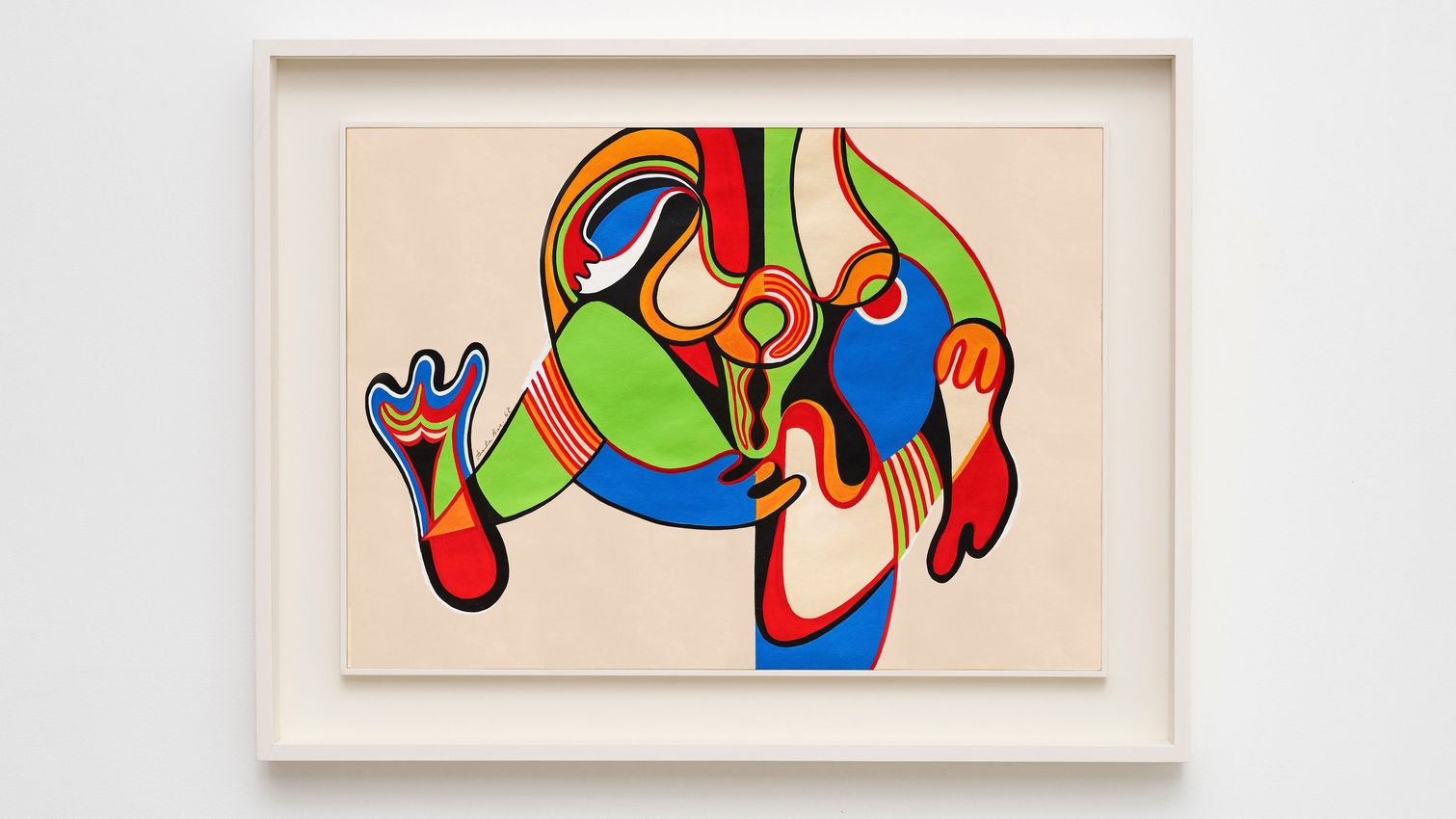
TERESINHA SOARES
1927-2026, BrazilTeresinha Soares (1927–2026) was a Brazilian artist, writer and former city councillor from Araxá, Minas Gerais, whose concentrated production between the mid‑1960s and mid‑1970s generated some of the most incisive explorations of sexuality and power in Brazilian art. Working across painting, printmaking, collage, sculpture, installation, and performance, she placed the female body and desire at the centre of her work, confronting authoritarianism and conservative morality during Brazil’s military dictatorship.
A central figure in Brazil’s New Figuration and closely linked to the country’s New Objectivity debates, Soares is best known for her pared‑back silhouettes in vivid colour and for works that invite viewers into charged scenarios of intimacy and control. Curators have also situated her practice at the intersection of global pop, feminist and erotic art, noting how her graphic, often participatory objects engage mass‑media imagery, religious symbolism and popular culture without fitting neatly into a single category.
Soares work has been widely revisited in recent years through exhibitions such as The EY Exhibition: The World Goes Pop at Tate Modern, London (2015), Radical Women: Latin American Art, 1960–1985 at the Hammer Museum, Los Angeles, and the Brooklyn Museum, New York (2017–18), and the retrospective Quem tem medo de Teresinha Soares? at MASP – Museu de Arte de São Paulo Assis Chateaubriand, São Paulo (2017), affirming her legacy as a key figure in Brazilian and Latin American art.
Early life and Career
Born in Araxá in 1927, Soares first built a public career as a writer, actor and local politician, becoming the first woman elected to the city council in her hometown. That experience sharpened her commitment to civic representation, social justice and women’s rights, themes that would later resurface in her visual work. In 1965 she moved to Belo Horizonte and began formal art training at Universidad Mineira das Artes, followed by engraving studies at independent studios linked to the Museum of Modern Art in Rio de Janeiro, where she encountered artists associated with Brazilian new figuration and new objectivity.
By 1966–67, Soares was gradually turning from literature and theatre to painting, printmaking and object-based sculpture, forging a visual language of hard-edged contours, saturated colour and stylised bodies. Early exhibitions in Belo Horizonte brought her national attention for their explicitly erotic and politically charged imagery at a moment of intensifying censorship, prompting critic Frederico Morais to describe her production as feverish and uncompromising.
Works, Series and Methods
Soares’s practice combined graphic clarity with physical, often playful objects that implicated the viewer. Her visual language relies on flat expanses of saturated reds, pinks, blues and greens, stylised organs, cartoon-like silhouettes and diagrammatic compositions. Works often depict the female body fragmented or exposed, but also active and desiring, making visible the tension between objectification and agency. She incorporated movable and participatory elements—drawers to open, pieces to manipulate, performative presentations—that draw viewers into scenes of voyeurism, consent and power play.
In the late 1960s she produced wooden boxes, paintings and silkscreens that turned the iconography of hearts, breasts, phalluses, religious symbols and domestic items into emblems of both intimacy and violence. Works like Uma caixa para fazer amor (A Box to Make Love In, 1967), first shown in the group exhibition Box-Form at Galeria Petite in Rio de Janeiro (1967), an important precursor to the landmark exhibition Nova Objetividade Brasileira (New Brazilian Objectivity) at the Museu de Arte Moderna do Rio de Janeiro (MAM Rio) that same year, invited visitors to manipulate mechanisms attached to a painted cube containing a meat mincer, lubricant and a stuffed heart, making the viewer complicit in the uneasy mixture of affection and aggression.
Her 1968 exhibition at Art‑Art Gallery in São Paulo included works such as Edição dos filmes virgens (Edit of Virgin Films, 1968) and Roberto Carlos, canta pra nós (Roberto Carlos, Sing for Us, 1968), which adopt the look of film strips, devotional objects and magazine layouts to examine how cinema and popular music fetishise the female body. In series like Um homem e uma mulher (A Man and a Woman, 1967) and Deadly Sins (1968), cropped silhouettes of lips, breasts and limbs appear in film‑like frames, so that framing itself becomes a metaphor for the ways mass media isolates and commodifies desire.
A pivotal group from this period is the Vietnam series (1968), three box‑like works in which wooden panels echo the geometry of televisions, film reels and screens. Inside, Soares juxtaposes silhouetted, sexualised bodies with scenes of combat and destruction, aligning Eros and Thanatos while emphasising the distancing effect of mediated imagery. Pieces such as So Many Men Die and I Am Here So Lonely (1968) and Die Wearing the Legitimate Espadrille (1968) respond to the Vietnam War yet also allude to the violence of Brazil’s own dictatorship, forcing viewers to navigate the uneasy proximity of sexual pleasure and state brutality.
Her contribution to the 1970 exhibition Do Corpo à Terra (From Body to Earth) in Belo Horizonte, Ela bateu em mim (CAMAS) (She Hit on Me (BEDS), 1970), consisted of three painted wooden beds in the colours of football teams, each with shutters carved as nude female silhouettes whose reverse sides bear portraits of star players such as Pelé. Visitors could lie on the beds, turning them into literal contact zones where sexuality, sport, nationalism and spectatorship collide.
In the early 1970s Soares developed Eurótica (c. 1970–71), often dubbed the ‘Brazilian Kamasutra’, an album of silkscreens whose single‑line drawings move from heterosexual couples to group scenes, same‑sex encounters and, finally, a hybrid figure whose open legs release a phallic form that becomes a tree. The sequence imagines eroticism as a continuum that extends beyond normative coupledom to cycles of growth and metamorphosis. She then translated these drawings into the multi‑level installation Corpo a Corpo em Cor-pus meus (Body to Body in Colour-Pus of Mine, 1970–71), where visitors walked barefoot across painted forms and performers enacted erotic encounters accompanied by scientific texts and a poem by Soares that oscillates between degradation and renewal.
Themes, critical readings and ‘Pantagruelian pop’
Kaira M. Cabañas’s Tate essay A Pantagruelian Pop: Teresinha Soares’s ‘Erotic Art of Contestation’ (2015) has become a touchstone for understanding the breadth of Soares’s practice. Cabañas describes her work as ‘Pantagruelian’ in its embrace of excess, humour and a grotesque body that is open, porous and engaged in cycles of sex, eating and transformation. This framework helps explain the way Soares fuses religious icons, football, pop music, pornography and everyday objects into carnivalesque scenes where high and low culture, sacred and profane, coexist.
Cabañas and other scholars argue that Soares’s ‘erotic art of contestation’—a phrase borrowed from critic Frederico Morais—links sexual emancipation to broader political resistance under dictatorship. For Morais, who wrote on her work at the time, erotic art was revolutionary because it asserted the right to pleasure and bodily autonomy against both conservative morality and state repression, a position Soares embraced in interviews and performances. Curators such as Cecilia Fajardo-Hill and Andrea Giunta have further highlighted her contribution to feminist and decolonial narratives within Radical Women: Latin American Art, 1960–1985, positioning her alongside artists across the Americas who challenged gender norms through experimental practices.
At the same time, institutional histories like Tate’s The World Goes Pop have foregrounded Soares as a key figure in an expanded, global story of pop art that includes Latin American, feminist and politicised strands. Her work’s affinity with Brazilian new objectivity—through participatory objects, viewer activation and a critical approach to consumer imagery—has been noted by curators and historians who see her practice as both of its moment and strikingly singular.
Exhibitions, Recognition and Late reception
During her most active decade Soares held solo exhibitions in Belo Horizonte, São Paulo and Rio de Janeiro and participated in three editions of the Bienal de São Paulo, helping to anchor her reputation within Brazil. She largely ceased producing new work around 1976, but her 1960s–70s output remained an influential reference and was revisited from the 2000s onward through exhibitions such as Neovanguardas at Museu de Arte da Pampulha, The EY Exhibition: The World Goes Pop at Tate Modern and the touring show Radical Women: Latin American Art, 1960–1985. The 2017 MASP retrospective Quem tem medo de Teresinha Soares? brought together more than 50 works from 1965 to 1976 and inaugurated a thematic axis on sexuality at the museum, consolidating her status as a pioneering voice in Brazilian feminist art.
Following her death in 2026, aged 99, after complications from a broken femur, obituaries in Brazilian and international media describe Soares as a trailblazing artist who ‘debated the female body’ and ‘marked feminist art’ through collages, installations and performances that were ‘protestant, feminist, never conformist’. They stress her role in centring women’s pleasure ‘without crime and without punishment’, and in using eroticism as a language of protest in Belo Horizonte and beyond during the 1960s and 1970s.
Her art remains central to contemporary discussions of gender, representation and the politics of pleasure in Latin America and in broader histories of global pop and feminist art.
Teresinha Soares FAQs
What was Teresinha Soares best known for?
Teresinha Soares was best known for her erotic, pop-inflected works from the 1960s and 1970s—paintings, collages, boxes and installations—that used bold colour and stylised bodies to challenge conservative norms and Brazil’s military dictatorship. These works foregrounded the female body and sexuality as sites of confrontation, helping to define a distinctly Brazilian feminist art.
How did Teresinha Soares’s work engage with feminism?
Teresinha Soares’ work addressed the female body, desire and domestic life from a critical perspective, exposing how women are objectified and constrained while asserting their agency and pleasure. Critics and obituaries have highlighted her role in ‘debating the female body’ and ‘marking feminist art’, particularly through collages and installations that refused conformity.
Which major exhibitions featured Teresinha Soares?
Teresinha Soares work has been featured in The EY Exhibition: The World Goes Pop at Tate Modern, Radical Women: Latin American Art, 1960–1985 at institutions including the Hammer Museum and Brooklyn Museum, and the MASP retrospective Quem tem medo de Teresinha Soares?. She also participated in three editions of the Bienal de São Paulo and has been the focus of recent solo exhibitions at Palácio das Artes and Gomide&Co in São Paulo.
When did Teresinha Soares die?
Teresinha Soares died in the early hours of 31 March 2026 in Belo Horizonte, aged 99. Reports note that she had broken her femur about three weeks earlier and did not recover after being admitted to Hospital Felício Rocho.
What is Teresinha Soares’s legacy as an artist?
Teresinha Soares as an artist who brought sex and feminism into pop art and left a powerful legacy centred on the representation of the female body. Obituaries emphasise that, despite a relatively concentrated period of production, her work from the 1960s and 1970s continues to inform contemporary discussions of gender, eroticism and political resistance in art.
Ocula | 2026





Explore and Follow Artists Shaping Contemporary Art
A respected voice in contemporary art discourse.
Focusing on ambitious storytelling and insightful art-world commentary. Ocula Magazine publishes in-depth interviews, critical essays and timely analysis on the artists, exhibitions and ideas driving the global art world.
Learn more about Ocula Magazine
Showcasing the best of the art world.
Ocula partners with galleries from around the world to highlight their artists, artworks and exhibitions. Gallery membership is by application and invitation, with each member vetted by an independent panel.
Learn more about Ocula Membership
Specialises in the sale of major artworks.
Led by a team with deep ties to the world’s leading auction houses, galleries and collectors. Ocula’s advisory team offers bespoke services to high-net-worth clients from around the world who are looking to acquire the best of contemporary and modern art.
Learn more about our team and services