





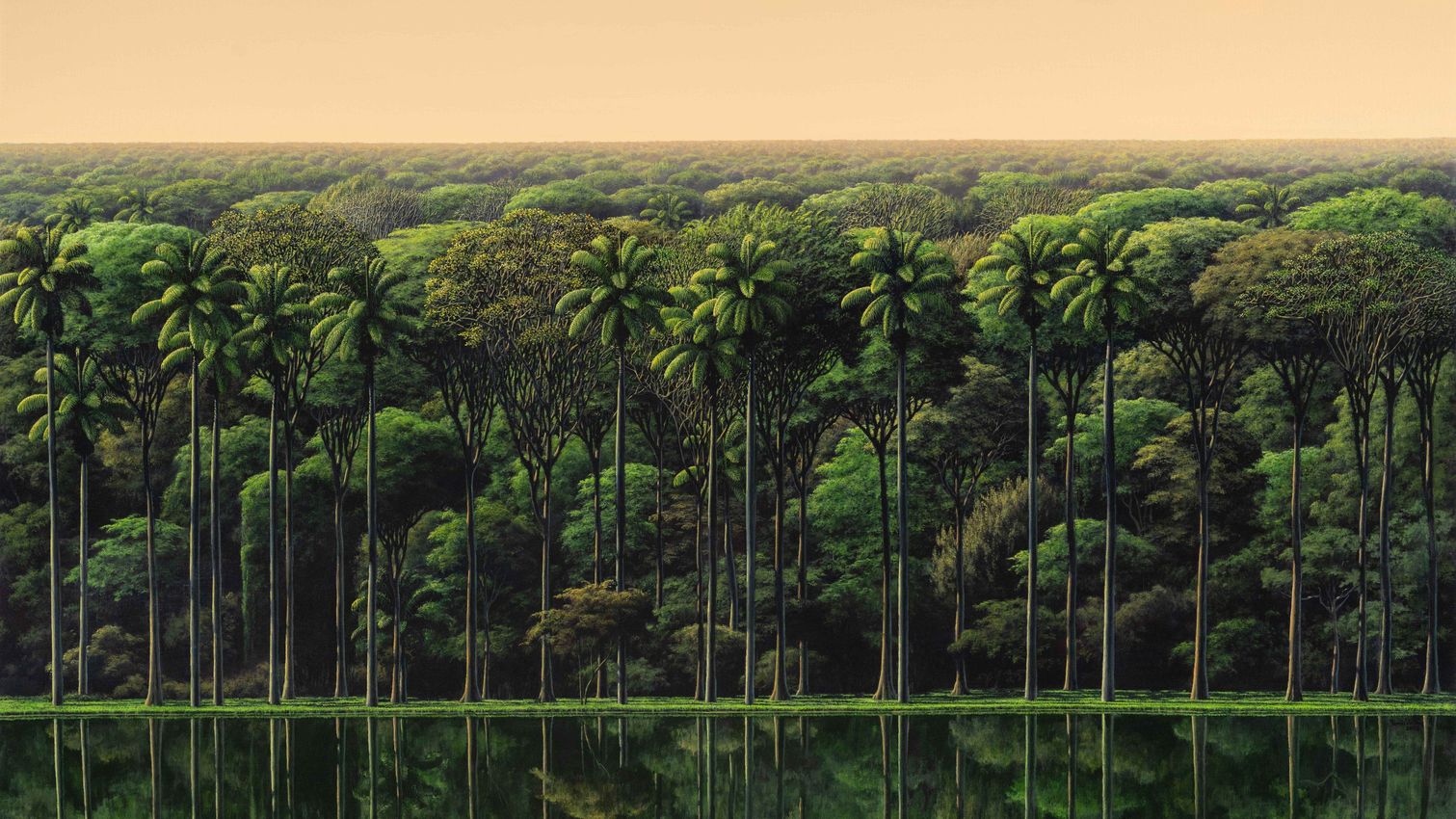
TOMÁS SÁNCHEZ
b. 1948, CubaTomás Sánchez was born on May 22, 1948, in the city of Cienfuegos, Cuba. He is the eldest of two children in a middle-class family that resided in the Perseverancia sugar mill. His father was a sugar worker and merchant, his mother was a housewife and Tomás shared the sensitivity for painting with her.
At the age of 16, he moved to Havana and began his studies in painting at the National Academy of Fine Arts “San Alejandro” in 1964. Two years later, he interrupted his studies at this academy and moved to the newly founded National School of Art (ENA) in 1967, which offered a program of studies more connected with the upcoming times. At that school, he met his teacher and mentor, the Cuban artist Antonia Eiriz. In 1971, he graduated from ENA and that same year won the First Prize in Drawing at the National Salon for Young Artists, which was his first recognition in his career.
From his graduation until 1976, Tomás Sánchez remained at ENA as a professor and head of the Engraving Department. In 1975, he won the First Prize in Painting and the First Prize in Lithography at the Third National Salon of Professors and Instructors of Plastic Arts in Havana. His academic career was interrupted in 1976 when he was fired from ENA due to his practice of yoga and meditation, which were prohibited because of the extreme policies of the Cuban government. Because of this situation the work he produced and maintained within the school was destroyed.
After this breaking point, he joined the Puppet Workshop of the Theater Directorate of the Ministry of Culture, being appointed as a set designer and puppet designer for Children’s Theater. He also joined the UNESCO Puppet Group, which introduced him to a completely different universe from his previous work and remained there until 1978.
In 1980, he participated in the 19th edition of the Joan Miró International Drawing Award, where he was awarded the First Prize for his work “Desde las Aguas Blancas” (From the White Waters), marking the beginning of his recognized international career. The following year, he held a solo exhibition at the prestigious Joan Miró Foundation, Centre d’Estudis d’Art Contemporani in Barcelona, Spain.
Some of the most important recognitions in his career include the National Painting Award Amelia Pelaez at the First Havana Biennial in 1984; the Medal at the V Biennial of American Graphic Art, Cali, Colombia, in 1986; and the Honorable Mention at the First International Painting Biennial, Cuenca, Ecuador, in 1987. His work has been exhibited both individually and collectively in more than 30 countries, including Mexico, the United States, Japan, Italy, Spain, and France. Some of his most significant solo exhibitions are Tomás Sánchez. Retrospective at the National Museum of Fine Arts, Havana, Cuba, in 1985; Different Worlds at the Museum of Art, Ft. Lauderdale, Florida, USA, in 1996; the celebration of his 60th anniversary with Tomás Sánchez. Retrospective at the Museum of Contemporary Art of Monterrey, Mexico, in 2008; and Paisaje (Landscape) at the National Museum of Fine Arts of Havana, Cuba, in 2015, and at the Museum of Costa Rican Art, San José, Costa Rica, in 2016.
Although landscapes are the defining theme of his work, which also includes his splendid paintings of garbage dumps, his career is that of a prolific artist who has ventured into painting, engraving, sculpture, and photography. The artist has frequently stated that his work is directly linked to meditation and his practice of Kashmiri Shaivism. Curators, critics, and art scholars consistently support this statement, considering him one of the great contemporary landscape artists and one of the most significant Cuban artists from the second half of the 20th century to the present.
Tomás Sánchez has lived successively in Havana, Mexico, Miami (Florida, USA), and Costa Rica.






Explore and Follow Artists Shaping Contemporary Art
A respected voice in contemporary art discourse.
Focusing on ambitious storytelling and insightful art-world commentary. Ocula Magazine publishes in-depth interviews, critical essays and timely analysis on the artists, exhibitions and ideas driving the global art world.
Learn more about Ocula Magazine
Showcasing the best of the art world.
Ocula partners with galleries from around the world to highlight their artists, artworks and exhibitions. Gallery membership is by application and invitation, with each member vetted by an independent panel.
Learn more about Ocula Membership
Specialises in the sale of major artworks.
Led by a team with deep ties to the world’s leading auction houses, galleries and collectors. Ocula’s advisory team offers bespoke services to high-net-worth clients from around the world who are looking to acquire the best of contemporary and modern art.
Learn more about our team and services