

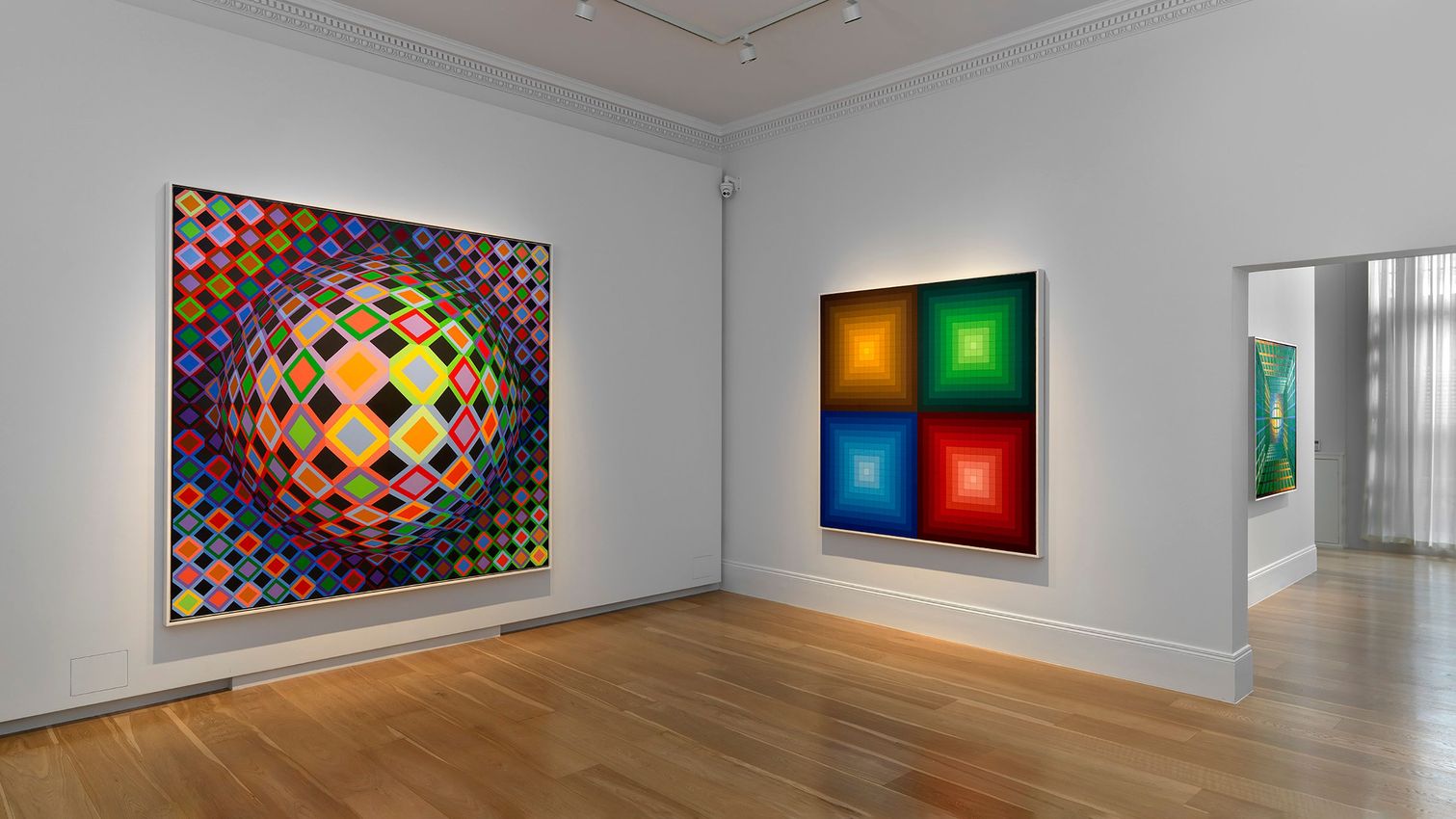
VICTOR VASARELY
1906-1997Known as the father (or grandfather) of Op Art, Victor Vasarely (1906–1997) experimented with optical patterns, pushing both established conventions of geometric abstraction and a determination to make his art accessible to everyone.
Early Years
Victor Vasarely was born Gyözö Vásárhelyi in 1906 in Pécs, Hungary. He spent two years at medical school before deciding to become an artist, studying at the Podolini-Volkmann Academy in Budapest and then the Mühely School of Graphic Arts, run by Sándor Bortnyik in the Bauhaus tradition. In 1930 he got a job in Paris working as a poster artist and during this period his own practice pivoted towards graphic patterns and illusory effects. He partnered with Denise René, whose gallery showed Le Mouvement in 1955, in which Vasarely exhibited alongside Marcel Duchamp and Man Ray. The artist became a French citizen in 1961.
Victor Vasarely: Artworks
Vasarely’s training as a graphic artist, combined with the effects of texture and dimensionality he explored, forged his best-known artistic practice, a style that prioritised abstraction as a mode of representation. His Yellow Manifesto (produced to coincide with Le Mouvement) declared: “We are at the dawn of a great age.” He believed that separations between the visual arts would be broken down, and in his work he used algorithms and mathematical patterns to change the way viewers saw two-dimensional artworks, twisting perceptions around the apparent existence of space.
- Zebra (1937) is seen as a precursor to Op Art: the painting contains two interlocking elements made from black-and-white curved stripes. There are no outlines, so ideas of motion and space are created through the interaction of the monochrome stripes.
- The Plastic Alphabet was a visual language Varesely created, based around colour and geometric form. It comprised 15 forms, based on variations of the square, the triangle and the circle, and a range of 20 colours. Each one fitted a square frame. He used the Plastic Alphabet to show that the creative process could be accessed by everyone. Works based on the Plastic Alphabet include the Planetary Folklore series and Collage Vert (1990).
- Einstein-Ker (1976) demonstrated Vasarely’s exploration of scientific principles, including Einstein’s Theory of Relativity. In a spectrum spanning orange to purple, geometric shapes are ordered across hundreds of rows and columns.
Victor Vasarely: Select Awards
- Gold Medal, Milan Triennial (1955)
- Guggenheim Prize (1964, 1970)
- Chevalier de l’Ordre de la Legion d’Honneur (1970)
Victor Vasarely: Select Posthumous Solo Exhibitions
- Victor Vasarely | Another Dimension, A&R Fleury, Paris (2023), France
- Victor Vasarely, Vancouver Art Gallery, Vancouver (2020)
- Vasarely: Sharing Forms, Pompidou Centre, Paris (2019)
- Victor Vasarely—Une Aventure de 75 ans chez Denise René, Galerie Denise René, Paris (2019)
- Victor Vasarely: El Nacimiento Del Op Art, Museo Thyssen-Bornemisza, Madrid (2018)
- Victor Vasarely, Repetto Gallery, London (2017)
- Victor Vasarely, Davidson Gallery, New York City (2016)
- Victor Vasarely—New Acquisition II, Muzeum Umeni Olomouc (2015)
- Victor Vasarely: The Joy of Movement, Koller Gallery, Budapest (2014)
- Victor Vasarely: Optical Perspectives, Cafesjian Centre for the Arts, Yerevan (2011)
- Viktor Vazareli—Grafike i objekti, Museum Of Contemporary Art Vojvodina, Novi Sad (2010)
- Victor Vasarely: Works from the Tibor Csepei’s Collection, Museum of Contemporary Art Skopje (2008)
- An Optical Experience: Works on Paper from the Permanent Collection, Albright-Knox Art Gallery, Buffalo (2003)
- Selected Works of Victor Vasarely, Tehran Museum of Contemporary Art (TMoCA) (2000)
Further Reading
- Fondation Vasarely website
- Vasarely Museum, Budapest
- Obituary in The New York Times
- Artist profile at Christie’s
Victor Vasarely FAQs
Did Victor Vasarely design the logo for Renault cars?
In 1967, the French car manufacturer Renault introduced the Recherche, Art et Industrie programme which forged connections between automobile-making and public art. Victor Vasarely was a key member of the programme and in 1972 was asked to redesign the diamond-shaped brand logo. He came up with the iconic “lozenge”, using lines to make the diamond appear to be in relief, and also encasing the shape in a yellow box. His logo was used until 1981 (and only slightly tweaked for the 1981–1992 iteration). Vasarely created more than 40 works with Renault, perhaps most notably the huge sculpture V (1976), made of enamelled sheet metal and standing at the side of the A8 and A51 motorways near Aix-en-Provence.
Did Victor Vasarely design a David Bowie album cover?
Not really, although the originally released UK version of Space Oddity (1969)—confusingly titled David Bowie, even though Bowie had already put out a record with that name in 1967—featured a portrait of Bowie, shot by Vernon Dewhurst, superimposed on an Op Art background inspired by Vasarely’s CTA 25 neg (1968).
Did Victor Vasarely open his own museums?
Yes, he opened his first one in Gordes, a village in the south of France where he had taken regular holidays. He also opened spaces in Pécs, Budapest and New York City, and the Fondation Vasarely in Aix-en-Provence, whose design was based on hexagons and which was inaugurated in 1976 (now classified as a historic monument).
What’s the Victor Vasarely family dispute about?
Since Vasarely’s death in 1997 there have been several court cases about who owns many of his works. Pierre Vasaerly, the artist’s grandson who runs the Fondation Vasarely, has been in dispute with Victor Vasarely’s daughter-in-law Michèle Taburno over ownership of several artworks. The FBI has also been involved.
Ocula






Explore and Follow Artists Shaping Contemporary Art
A respected voice in contemporary art discourse.
Focusing on ambitious storytelling and insightful art-world commentary. Ocula Magazine publishes in-depth interviews, critical essays and timely analysis on the artists, exhibitions and ideas driving the global art world.
Learn more about Ocula Magazine
Showcasing the best of the art world.
Ocula partners with galleries from around the world to highlight their artists, artworks and exhibitions. Gallery membership is by application and invitation, with each member vetted by an independent panel.
Learn more about Ocula Membership
Specialises in the sale of major artworks.
Led by a team with deep ties to the world’s leading auction houses, galleries and collectors. Ocula’s advisory team offers bespoke services to high-net-worth clients from around the world who are looking to acquire the best of contemporary and modern art.
Learn more about our team and services