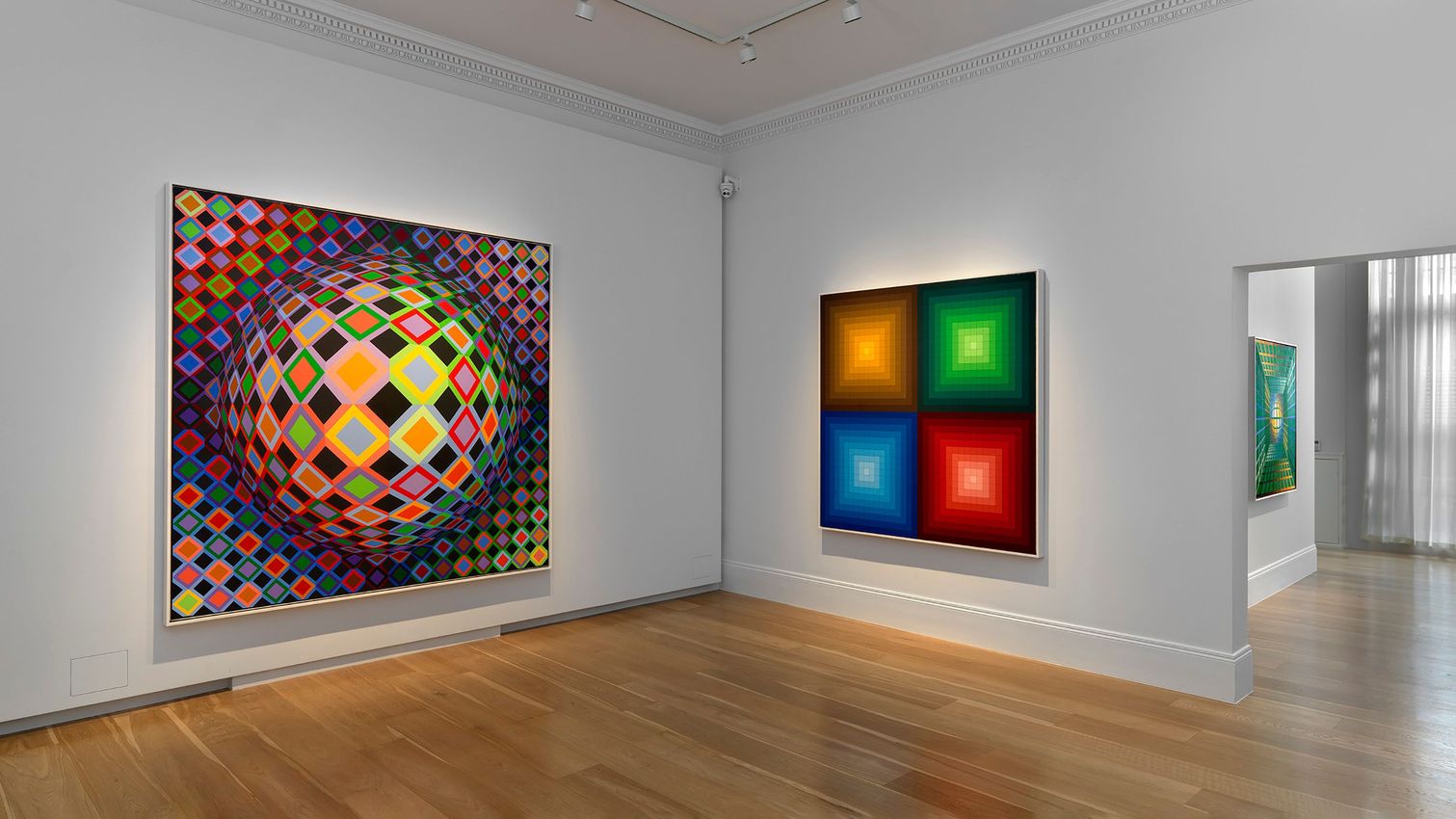
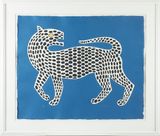
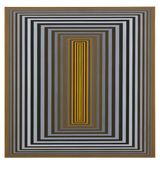
The hallmark of Victor Vasarely’s 1950s style is a visually intense arrangement of contrasting hard-edged geometric shapes in black and white, set in complex orderly patterns. Not only does this style give the illusion of space and depth on an abstract two-dimensional surface, but it also contains a sense of dynamic movement.
In 1955, Vasarely exhibited in Le Mouvement, a landmark exhibition at the Denise René Gallery that also the featured work of Alexander Calder, Marcel Duchamp, Jesús Rafael Soto, and Jean Tinguely, and is credited with popularising kinetic art. There Vasarely demonstrated his scientific theories of art-making, which he also published in his Yellow Manifesto in the same year.
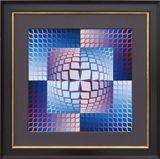
Vasarely began to work with colour more in the 1960s. It was in this decade that he fully realised his alphabet plastique (plastic alphabet), a basic set of geometric shapes and colours that could be arranged in potentially endless configurations. This compositional system was used to create the influential ‘Planetary Folklore’ series, through which Vasarely sought to generate visual effects that could be universally understood. The systematicity of Vasarely’s plastic alphabet, which could be easily reproduced by studio assistants, also laid the foundation for serial art, a movement that involved the composition of artworks through strictly defined, modular principles.
The 1960s also saw Vasarely’s arrival on the international art scene. At the influential Op art exhibition at the Museum of Modern Art in 1965, The Responsive Eye, Vasarely exhibited alongside other younger Op artists such as Bridget Riley and Yaacov Agam. As well as bringing international fame and demand for Vasarely’s works, the exhibition led to the appropriation of Op art by fashion, advertising, and popular graphics. Op art was well-suited to these industries as a style able to lend itself to mass production and hold broad universal appeal, requiring only the eye, rather than prior knowledge, to be appreciated.