The art world in focus
Subscribe to our newsletter for news and insights on artists, galleries and exhibitions.
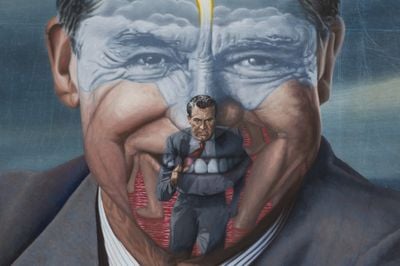
Jim Shaw, Cary Grant (2022) (detail). Oil and acrylic on muslin. 213.4 x 162.6 cm. © Jim Shaw. Photo: Jeff McLane.
Jim Shaw began his career working in Hollywood, making monster masks and contributing visuals to the disaster movies popular at the time. A sense of impending doom pervades the exhibition Thinking the Unthinkable, coming to Gagosian Beverly Hills from 12 January to 25 February 2023. Raquel Welch becomes Kali, goddess of destruction and rebirth, for instance, while Sandro Botticelli’s Venus is depicted as a mushroom cloud over Bikini Atoll. But with Shaw’s interest in LSD, celebrity gossip, and conspiracy theories, the show is also apocalyptic in an older sense, meaning ‘to lift the lid’ or ‘a revelation’.
A couple of years ago, I discovered a theatrical backdrop of a topless burlesque dancer looking in a vanity. I painted atop that a portrait of Lucille Ball as an imperious showgirl with a big ‘40s power hairdo, but her face was a hole, her features delineated in jewels. Thus, I already had a form for movie star portraits, and wanted to do one of Cary Grant, who was one of the three main cheerleaders for LSD along with Captain Al Hubbard and Timothy Leary. He took it at least 100 times.
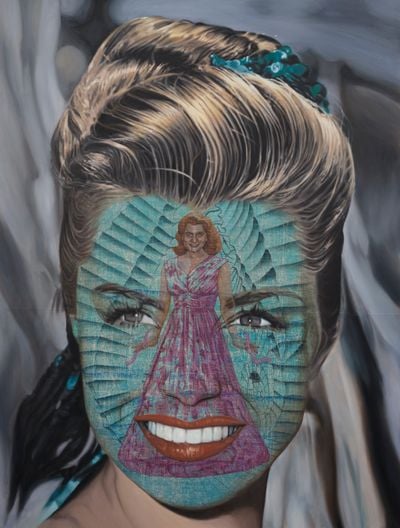
LSD was this hinge point in culture in America and Czechoslovakia and various parts of the globe. I took it once, but I don’t think at that point, in the mid ‘70s, it was real LSD. But I have taken mushrooms and ayahuasca and I have gotten interesting results.
There’s this whole sequence towards the end of The Sopranos, where Tony does mushrooms and he has these great visions. He’s very excited about it, but it doesn’t stop him from being a mafioso who has to kill people. In the current realm of psilocybin therapy, two of the big investors are [Republican donors] Peter Thiel and Rebekah Mercer. There’s a lot of micro dosing and stuff going on in Silicon Valley, but it’s not gonna make the world a better place necessarily. The CIA has been intimately involved in its use for experiments, and the experiments probably went wrong, unless that was their goal. ‘We’ll destroy society!’
Altered states seem pretty important to your work, though, and I’m not just talking about drugs, but also dreams.
Yeah, I mean, dreams are interesting. I guess you could be looking at the entrails of a goat or a chicken — it’s another way to make determinations as to when to start the battle. I’ll read or research anything that might lead me to have more ideas for more art. And there’s a lot of rabbit holes you go down when you do that.
I try to make sure the work has stuff to grab your interest whether you’re educated in the arts or not. There was an artist back in Ann Arbor who did paintings of pebbles at the seashore and they’d be titled ‘For the Murdered Salvadorans’. I’d rather have a really political image that’s just weird. There’s a lot of photoshop montages by online conspiracy theorists with antisemitic imagery using biblical beasts and stuff. I was trying to use the same imagery in my art but apply it in a different direction. It’s a wonderland of horrific imagery.
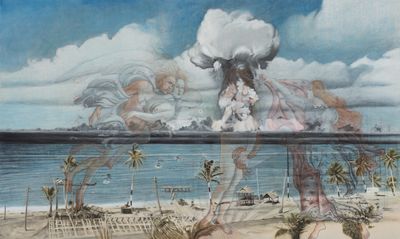
The word ‘apocalypse’ literally means to have your eyes opened, not ‘end of the world battle’, so there’s a good relationship there with LSD. It’s also a wonderful fantasy. Why else would The Walking Dead be the most popular series?
Going down the rabbit hole on the internet—a process I call Frazzle Dripping—led people in QAnon to decide Democrats like to sexually torture children to get adrenochrome. Adrenochrome is an actual drug but there’s no way of producing it by torturing children – that seems to be something they glommed off Monsters Inc. But to think about it activates your brain and makes your synapses go ‘ding! ding! ding! ding! ding!’ It starts from a distrust of the government, but finding a conspiracy engages your brain in a way like pulling slot machine handles, or using an iPhone app, which keeps promising another hit of serotonin. A lot of people in the psychedelic world have drunk the Kool-Aid on QAnon and conspiracies. And yet the other fun thing about conspiracies is that they actually do happen. —[O]


A respected voice in contemporary art discourse.
Focusing on ambitious storytelling and insightful art-world commentary. Ocula Magazine publishes in-depth interviews, critical essays and timely analysis on the artists, exhibitions and ideas driving the global art world.
Learn more about Ocula Magazine
Showcasing the best of the art world.
Ocula partners with galleries from around the world to highlight their artists, artworks and exhibitions. Gallery membership is by application and invitation, with each member vetted by an independent panel.
Learn more about Ocula Membership
Specialises in the sale of major artworks.
Led by a team with deep ties to the world’s leading auction houses, galleries and collectors. Ocula’s advisory team offers bespoke services to high-net-worth clients from around the world who are looking to acquire the best of contemporary and modern art.
Learn more about our team and services