

The art world in focus
Subscribe to our newsletter for news and insights on artists, galleries and exhibitions.
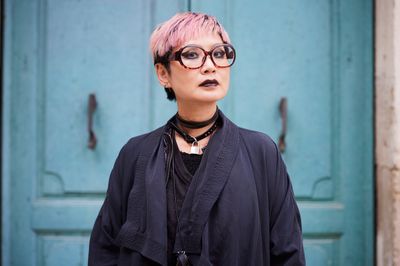
Angela Su. © David Levene. Courtesy of M+, Hong Kong. Photo: David Levene.
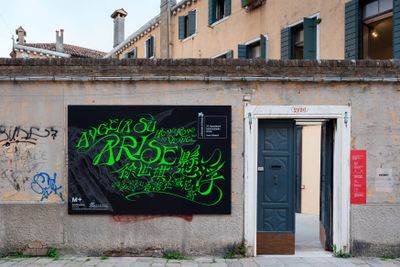
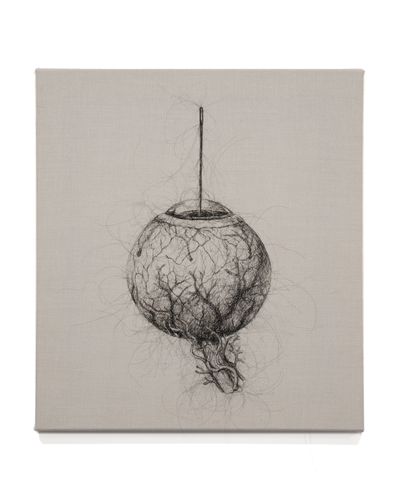
Themes of pain, whether physical or psychological, and transformation are prominent in Angela Su‘s work. In the series ‘Sewing together my split mind’ (2020–2021), currently on view at the Hong Kong Pavilion at the 59th Venice Biennale, hair embroidery pieces show body parts being sewn over.
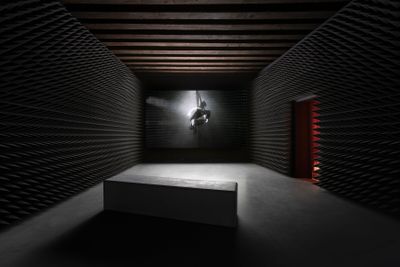
Arise, Su’s solo presentation in Venice, revolves around The Magnificent Levitation Act of Lauren O (2022), a film that introduces the eponymous alter ego Lauren O. In part based on Lauren Olamina, the protagonist of Octavia E. Butler’s sci-fi novel Parable of the Sower (1993), Lauren O joins the activist group, Laden Raven, in its mission to change the world.
The pseudo-documentary, filmed at Hong Kong‘s Shaw Studios, takes levitation as a central theme and part of the narrative: Lauren O believes she can levitate, and members of Laden Raven plot to lift the Pentagon into the air.
For Su, levitation is a rich metaphor for states of suspension, perseverance, and negotiation—as the artist says: ‘levitation can mean many things: freedom, self-transcendence, the rejection of gravity or geographical boundaries, or the human aspiration to take risks to achieve the impossible.’
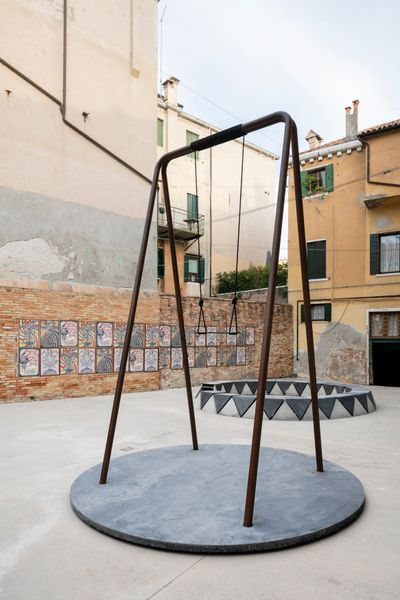
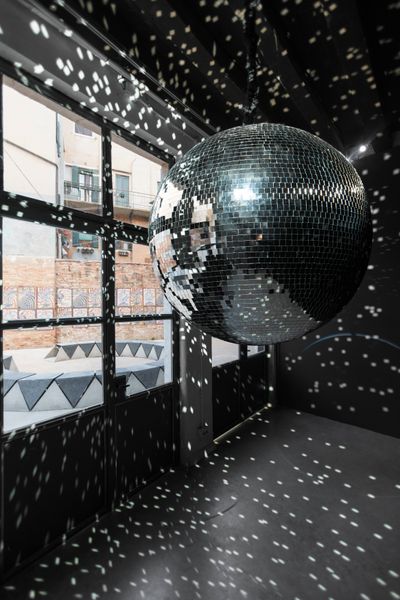
Other gallery spaces in Su’s Venice exhibition give physical and psychological preparation for levitation. The opening courtyard features Playscape for the Feathered Girl (2022), a giant swing with an unreachable seat, a circus ring with hovering modules, and a row of circus posters. This installation celebrates playfulness, pleasure, and freedom in times of internment and suppression, in the vein of Foucault’s concept of heterotopia and Isamu Noguchi‘s ‘Playscapes’.
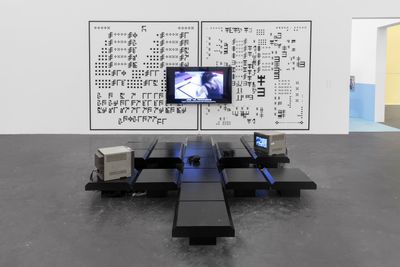
Subsequent galleries display Tiptoeing the Kármán Line (2022), a set of 15 historical film clips, showing found footage of tightrope walkers, trapeze artists, and butterfly dancers. The carnivalesque vaudeville is nonetheless undermined by superimposed red lines that move arbitrarily and may trip the performers at any moment.
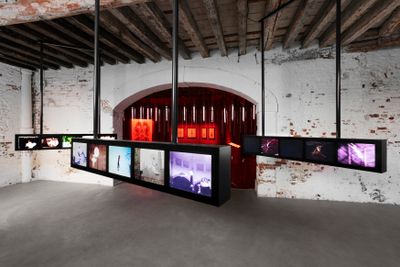
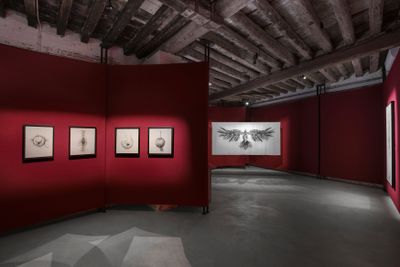
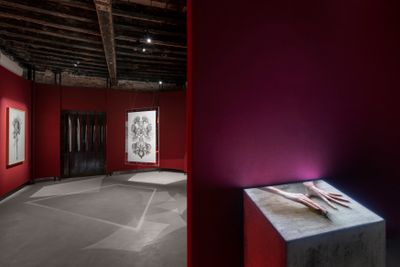
In a completely different light, the next gallery is wrapped in heavy, deep red panels, as if the insides of a body or the backstage of a circus tent. Here, ink drawings, embroideries, videos, and performances reflect Su’s fascination with the human body, technology, and medical science, as well as speculative fiction and storytelling.
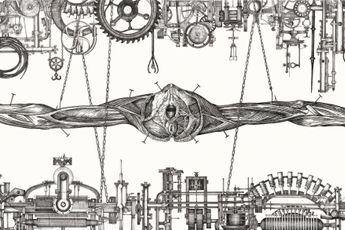
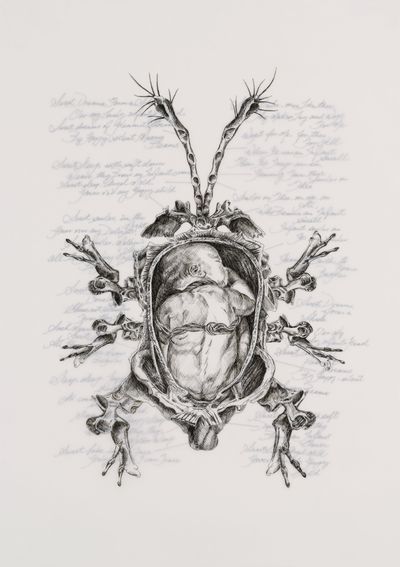
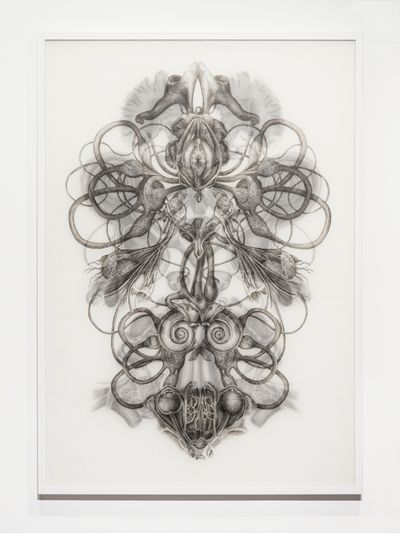
Su’s pseudo-scientific drawings hark back to Paracelsus’ Garden (2008), a collection of ink drawings and embroideries emblematic of the hybrid, biomorphic forms for which Su is known. Human body parts, skeleton, and organs transform and fuse with insects and plants, as with the bones comprising one aporophyla lutulenta (embroidered moth).
In the drawing of a cimex adjunctus, commonly known as the bat bug, a human infant rests inside the insect’s body, whose legs evoke human cartilage or twigs.
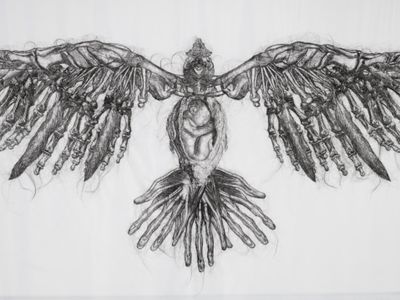
For Arise, Su created Laden Raven (2022), a three-metre-wide hair embroidery of a human baby resting peacefully inside the great bird’s womb, a symbol of the monstrosity of metamorphosis and the hybridity of transformation.
Su’s longstanding engagement with part-human imagery can be traced back to the early 1990s, when she first studied biochemistry, obtaining a degree at the University of Toronto, before moving on to study art at the Ontario College of Art & Design University.
In 2017, Su expanded her exploration of the body and forms of its metamorphosis into cyberspace with The Afterlife of Rosy Leavers (2017). The film follows the life of Rosy Leavers, the artist’s first alter ego, whose experiences with hallucination culminate in her mental relocation to cyberspace to live on as an animated character.
In this conversation with art historian and curator Yasmin Afschar, which was hosted by Asia Society Switzerland at Last Tango in Zürich, Su discusses the process of mixing fact and fiction, the many alter egos in her work, and learning about levitation.
AS: I like to mix fact and fiction in my video work, with for example, 80 percent fact, and 10, or 20 percent fiction. The protagonist of The Magnificent Levitation Act of Lauren O is a fictional character, but I’m not going to tell you if Laden Raven is real. You’ll have to find out for yourself.
My drawings also follow the same idea of merging the real and the fictional. Take my human body drawings as an example. At first glance, they look like proper scientific or anatomical drawings, but upon closer inspection, you can see that the image actually consists of different organisms. I like the idea of science having an authoritative truth, and with that in mind, I can really play with the images to confuse audiences.
“These alter egos are like multiple personalities; they are like survival strategies that help someone to tackle different problems.”
This is also pretty much how I conceptualise my video works, which are in the style of pseudo-documentaries with speculative narratives. As we all know, documentaries are not all objective, but we often assume that they present the truth. In the world of post-truth, it’s even more important to figure out whether something is true.
AS: In 2017, I made the video The Afterlife of Rosy Leavers and the protagonist is my first alter ego. Of course, I didn’t anticipate the continuous exploration of alter egos in my work. These alter egos are like multiple personalities; they are like survival strategies that help someone to tackle different problems.
For the plot of the video, I would usually come up with a timeline of different events that I want to talk about and create a character to tie these events together. And it’s usually a female character. I don’t know why—maybe because I’m a female. For this video, I tried to have a male voiceover, but it did not work.
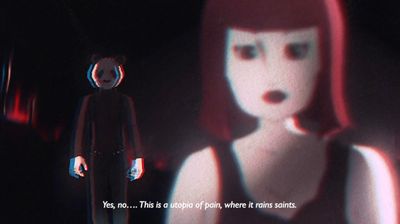
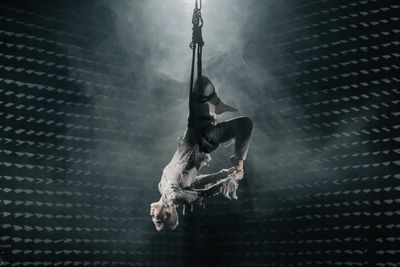
For a lot of the performances, I want to be the one performing because there’s some kind of risk involved. In Lauren O, I was lifted five metres from the ground; in Cosmic Call (2019), I walked on stilts. Both needed practice, and I don’t want to endanger anyone.
My research process is also a way for me to figure out answers to questions I have in life, so it only makes sense to be the one performing.
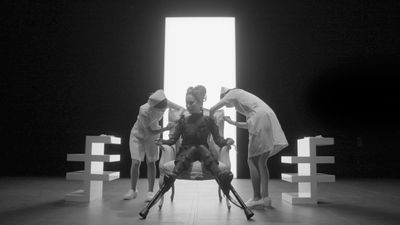
AS: No, I don’t think so. I’m not a spiritual person and I am only using levitation as a metaphor, so I don’t think the experience itself influenced how I edited the video or set up the exhibition. But the experience of inverted suspension bondage was nevertheless very interesting.
I hired a very talented rigger. I went to her studio, got tied up, and inverted 180 degrees, just to make sure I can endure the pain and blood rushing to my brain. It was scary at first because I’m not a sporty person; I don’t exercise, I don’t hike. So it was pretty challenging for me. But I think it was more psychological—I had to overcome the psychological fear more than the physical pain.
AS: The circus theme is related to Laden Raven, an activist group that was initiated by a circus performer who was also a vaudeville performer.
“People can use artistic strategies in many situations, including direct actions and organising community.”
Like you said, the circus is a curious place. Most circus performers are marginalised people in the community—people of colour, people with disabilities, and people who don’t conform to the social norm. It’s important not to see them as freaks, but as part of humanity.
And then of course, my exhibition is called Arise. It’s about how to make this world a better place and I think one of the ways is to empathise with differences and acts of difference.
AS: I think all artists are affected by their immediate surroundings and what happens in the world. We are a part of society. Our works may or may not reflect current events or the struggles in the world, but you have to consider where the artist comes from and the context of their experience. Audiences are also free to interpret the works based on their very own experiences.
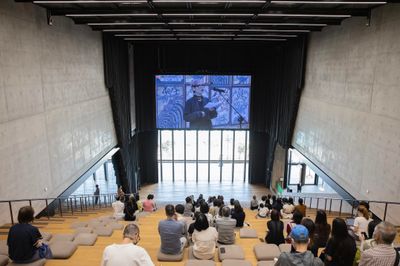
My film is multilayered and it talks about so many things. I am sure there are different things that people can pick up. A large part of the film is actually about the conflict between the Soviet Union and the United States. I think the Cold War is an immediate problem that we’re facing right now. Cold War conflicts that began after World War II have never been resolved—they only got postponed. We now have the war going on in Ukraine.
“The struggle of the people is a universal issue and a universal concern.”
So my video is really about history, and history that repeats itself. I hope the history of struggles will resonate with a lot of people, maybe people in Hong Kong, maybe in other parts of the world, like Sudan, Chile, Myanmar, and Ukraine—all over the world. The struggle of the people is a universal issue and a universal concern.
AS: I started out creating anatomical drawings, which is Western or Eurocentric, and my video works are all in English, so I would receive comments like, ‘Oh, your work is not very Hong Kong.’
But since 2014, I started to initiate side projects that are more related to the city, for example, Dark Fluid, a sci-fi writing project for which I invited writers and activists from Hong Kong to create sci-fi stories about the city’s future.
You were in Venice. What did you think when you saw my work? Did you think it was about Hong Kong?
AS: The power of art is to allow for something ambiguous with multiple meanings and it’s essential for audiences to figure out the message behind the artwork for themselves. I think didactic works are boring—it’s not my way to make art.
AS: On the other hand, there is a difference between art and artistic strategies. In some way, everyone can be an artist. People can use artistic strategies in many situations, including direct actions and organising community, which can be really powerful.
Artistic strategies and this kind of ‘art’ need to be straightforward to mobilise people. This is really the beauty of art—its meaning varies from person to person and evolves with time. —[O]
A respected voice in contemporary art discourse.
Focusing on ambitious storytelling and insightful art-world commentary. Ocula Magazine publishes in-depth interviews, critical essays and timely analysis on the artists, exhibitions and ideas driving the global art world.
Learn more about Ocula Magazine
Showcasing the best of the art world.
Ocula partners with galleries from around the world to highlight their artists, artworks and exhibitions. Gallery membership is by application and invitation, with each member vetted by an independent panel.
Learn more about Ocula Membership
Specialises in the sale of major artworks.
Led by a team with deep ties to the world’s leading auction houses, galleries and collectors. Ocula’s advisory team offers bespoke services to high-net-worth clients from around the world who are looking to acquire the best of contemporary and modern art.
Learn more about our team and services